Cost of Living in Porto Alegre
Where this figure comes from. No cost survey covers Porto Alegre, so the $1,000 a month above is our own estimate rather than a measurement. On 416 of our 999 city guides the figure is built from a published Numbeo basket, a one-bedroom rent in the centre plus one person's monthly costs without rent, converted to USD; this city is not one of them. How we source everything.
Porto Alegre is one of the better value southern Brazilian capitals, and $1,000 a month covers a comfortable single-person life. A furnished one-bedroom on a monthly lease in Moinhos de Vento, Bom Fim, Cidade Baixa or Petrópolis runs $300 to $600, with cheaper options further out in Menino Deus or Santana. Groceries are $180 to $280, helped by the agricultural south, and a per-kilo or executivo lunch costs $5 to $8, with a churrascaria dinner $15 to $25. A prepaid SIM from Vivo, Claro or TIM with generous data is $8 to $15. Coworking hot desks run $70 to $150, cheaper than São Paulo or Florianópolis. Utilities are $45 to $85, with the notable difference that winter here needs heating rather than cooling, and fibre internet is $25 to $45. Transport is $35 to $70. Value verdict: strong, particularly for a city with real infrastructure and a genuine university culture. The flood of 2024 changed the rental map rather than just the skyline: demand shifted uphill afterwards and prices in the higher neighbourhoods moved with it, so a bargain in a low-lying street now carries a question that did not exist before.
Where to Work in Porto Alegre
Moinhos de Vento is the polished base: leafy, safe by local standards, dense with specialty coffee, and walkable to the centre. Bom Fim and Cidade Baixa are the bohemian and student districts, cheaper, louder and better for nightlife, while Petrópolis and Auxiliadora suit quieter, longer stays. Coworking is well established thanks to the city's technology sector; the Tecnopuc innovation park at PUCRS and the Distrito Criativo around the Quarto Distrito anchor a startup ecosystem, with independent spaces spread across Moinhos, Independência and the centre. Specialty coffee culture is strong and laptop friendly in Moinhos de Vento and Bom Fim, though tables fill at lunch. Fibre from Vivo, Claro and regional providers covers the city. The practical caveats are the 2024 flooding, which damaged parts of the low-lying centre and Quarto Distrito, plus street-safety vigilance downtown after dark. The valley north of the city has been the country's shoe manufacturing centre for generations and a petrochemical complex sits beyond it, which together are why the commuter line runs where it does and why this state's economy is industrial at heart rather than agricultural.
Getting Around Porto Alegre
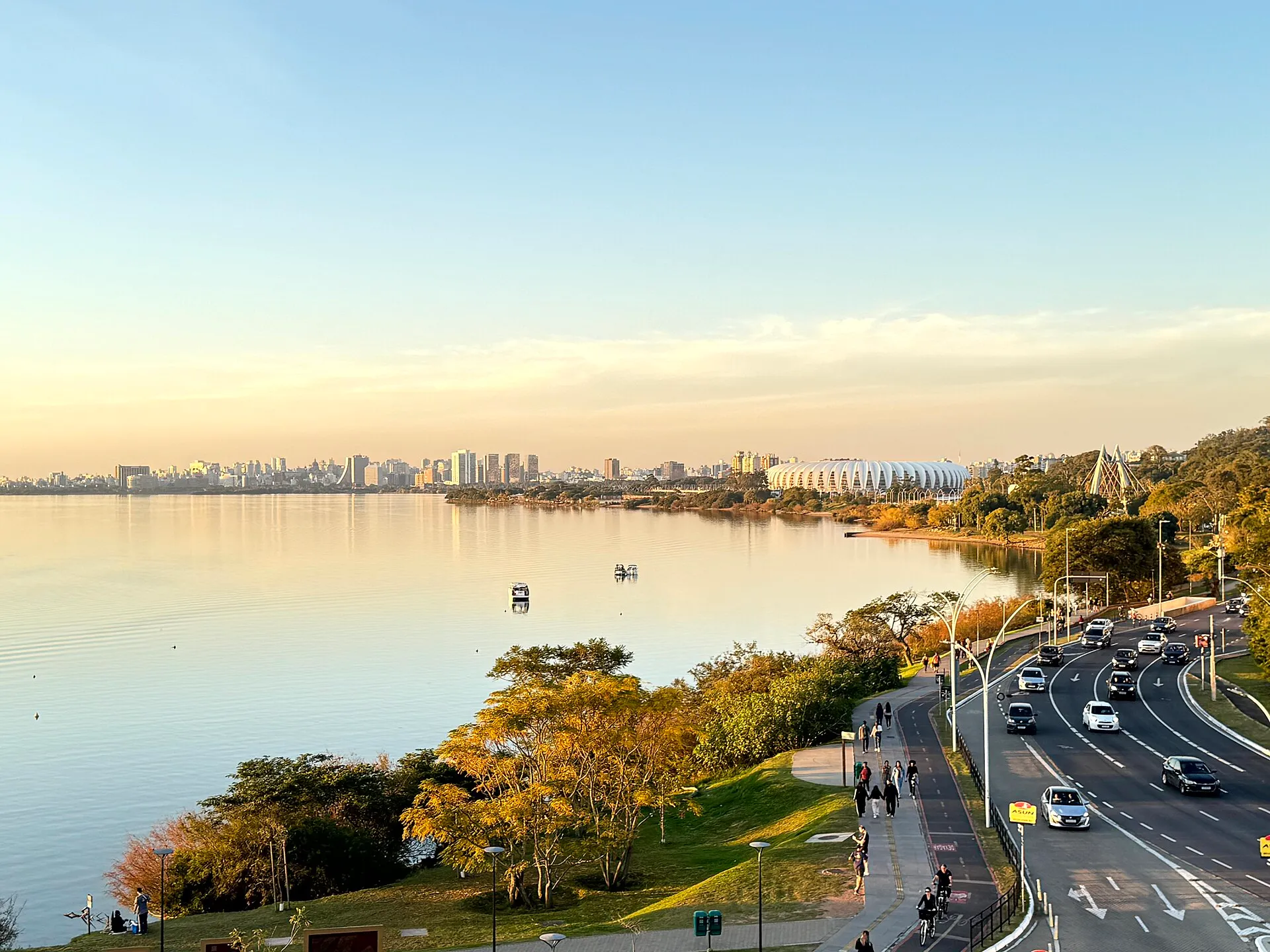
Porto Alegre has a single elevated metro line, Trensurb, running north from the Mercado Público to Canoas, Esteio, Sapucaia and São Leopoldo for roughly $1; it is a commuter link rather than an urban network. City buses are extensive and cost about $1 with a rechargeable TEU card, and a lotação minibus network runs faster semi-express routes for slightly more. Uber and 99 dominate for most trips, with typical fares of $2.50 to $8 across the central neighbourhoods, and they are the standard choice at night. The centre, Moinhos de Vento, Bom Fim and Cidade Baixa are walkable and connected, though hilly in places and unsafe downtown after dark. Salgado Filho airport sits about 7 km north and is directly served by Trensurb's Aeroporto station; an Uber is $5 to $10. A car is unnecessary in the city but useful for the Serra Gaúcha wine country. Whether the water the city sits on is a river or a lake is a genuine local argument with geographers on both sides, and either way the sunset over it is a civic ritual, with a boat that runs out each evening to watch it.
Sorting transport? Book an airport transfer, or compare car rental on Auto Europe and QEEQ.
Visas for Porto Alegre
Brazil reinstated visa requirements for US, Canadian and Australian citizens in April 2025; those nationals now apply online for an eVisa costing around $81, valid for multiple entries over ten years with stays of up to 90 days each. UK, EU, New Zealand and most other Western passport holders still enter visa free for 90 days. In both cases the 90 days can be extended once at a Polícia Federal office, including the one in Porto Alegre, for another 90 days, capping the stay at 180 days in any twelve-month window before departure is required. Brazil's digital nomad visa, introduced in 2022, offers a legitimate longer route: one year, renewable once, requiring proof of remote work for a non-Brazilian employer or clients plus monthly income of at least $1,500 or bank savings of at least $18,000, together with valid health insurance. It can be applied for at a Brazilian consulate before travelling or, once already in Brazil, through the Ministry of Justice.
Best Time to Visit Porto Alegre
Porto Alegre has a humid subtropical climate with four genuine seasons, unusual for Brazil, and no dry season. Summer, December to February, is hot and humid with highs of 30C to 34C and frequent heat spikes, plus afternoon storms. Autumn, March to May, is the best window: warm days around 24C, comfortable nights and manageable rain. Winter, June to August, is cool and grey, with highs of 18C to 20C, lows near 9C, and occasional cold snaps driven by Antarctic air; buildings are poorly insulated and rarely heated, so it feels colder indoors than the numbers suggest. Spring, September to November, is pleasant but windy and wet. Rain falls year round at roughly 100 to 140 mm a month, and the catastrophic floods of May 2024 demonstrated the Guaíba basin's vulnerability. Key dates include Carnival in February, the Semana Farroupilha gaúcho festival in September, and the Feira do Livro in the centre each November.
Pros and Cons of Porto Alegre
Porto Alegre offers a distinctly un-tropical Brazil that suits some people far better than the beach cities. It is affordable, with a strong food culture built on churrasco and Italian and German immigrant traditions, a serious specialty coffee scene, and an easy chimarrão-drinking social life. Fibre is fast, the technology sector around Tecnopuc gives professional depth, universities keep the city young, and the Serra Gaúcha wine country, Gramado and the Santa Catarina beaches sit within a few hours. Four real seasons appeal to anyone who finds constant heat draining. The drawbacks are not trivial. Crime leads them: robbery rates rank among the higher Brazilian capitals, the centre is unsafe after dark, and phone-snatching shapes daily habits. The May 2024 floods inundated large parts of the city and recovery is uneven. Winters are cold in unheated buildings, English is scarce, and the foreign nomad community is tiny.
Who Porto Alegre Is For
This is a working Brazilian city and not a nomad hub, which suits people who speak or will learn Portuguese and who prefer four seasons, wine country and a strong food culture to beaches and heat. It fits developers and technology workers who value the Tecnopuc ecosystem and cheap fast fibre, budget-conscious remote workers who want a capital city at small-city prices, and anyone using it as a base for southern Brazil, Uruguay and Argentina, both a short trip away. Students, academics and people who thrive on university-town energy do well in Bom Fim and Cidade Baixa. It is wrong for anyone who wants tropical weather, a ready-made expat social circle, or English-language convenience. Skip it if street-crime vigilance is exhausting rather than manageable, if cold unheated winters are a dealbreaker, or if flood risk in the low-lying districts is a concern worth avoiding.