Cost of Living in Paramaribo
Where this figure comes from. No cost survey covers Paramaribo, so the $1,100 a month above is our own estimate rather than a measurement. On 416 of our 999 city guides the figure is built from a published Numbeo basket, a one-bedroom rent in the centre plus one person's monthly costs without rent, converted to USD; this city is not one of them. How we source everything.
Budget around $1,100 a month as a solo remote worker in Paramaribo, which is cheap by any measure and reflects a small economy that has been through serious currency instability. A one-bedroom place runs roughly $350 to $700. Food is the standout: Suriname's markets are cheap and its cooking, drawing on Javanese, Hindustani, Chinese, Creole and Dutch traditions, is among the most varied anywhere per head of population. The Surinamese dollar has devalued sharply in recent years, so any figure quoted in it dates quickly and locals often price in United States dollars. This is our own estimate rather than measured data. Fibre from Telesur runs about $40 to $80 a month for modest speeds, which is poor value by regional standards. Anybody signing a lease should establish which currency it is denominated in before anything else in the contract, because that single detail decides what the rent will actually cost a year from now. Groceries in the Chinese supermarkets, which dominate retail here, are noticeably cheaper than the Dutch-style shops. Imported goods carry a heavy markup because almost everything arrives through one port.
Where to Work in Paramaribo
Paramaribo's connectivity is modest: fibre from Telesur reaches parts of the city at workable speeds, mobile data is the fallback, and neither is fast by international standards. Power cuts happen. There is essentially no coworking aimed at foreigners. Dutch is the official language and the language of all administration, with Sranan Tongo as the common tongue between communities; English is spoken by younger people and in business but is not something to rely on. Anyone with Dutch will find Suriname dramatically easier than anyone without, which is the main practical filter here. Suriname sits three hours behind GMT, which gives a comfortable European afternoon overlap and a full working day with the Americas, and is one of the better time zones on the continent for transatlantic work. Starlink became available in 2024 and is the practical answer for anyone who needs a connection the local network cannot supply. Telesur is state-owned and the effective monopoly on fixed lines, which is a fair part of why prices sit where they do and why service complaints have nowhere much to go. Digicel provides the main mobile alternative.
Getting Around Paramaribo
Paramaribo's historic centre is compact, flat and walkable, and the UNESCO-listed core of white wooden Dutch colonial buildings is genuinely the reason to be here. Minibuses and shared taxis cover the city cheaply. Most residents drive, on the left, in cars imported from Japan. Beyond the coastal strip the country is rainforest with almost no roads: the interior is reached by riverboat or light aircraft, and trips to the Upper Suriname River or Brownsberg are organised rather than improvised. Zanderij airport is an hour south with flights to Amsterdam, Miami and the region. Cars drive on the left, a Dutch colonial inheritance shared with almost nowhere else in South America, and the vehicles are almost all right-hand-drive imports from Japan. The ferry across the Suriname river to Meerzorg has been replaced by the Jules Wijdenbosch bridge, which is the landmark most visible from the waterfront. The Afobaka road south towards Brokopondo is the only sealed route of any length into the interior, and it stops well short of the rainforest proper, which is why almost everything beyond it goes by river.
Sorting transport? Book an airport transfer, or compare car rental on Auto Europe and QEEQ.
Visas for Paramaribo
Suriname introduced an e-visa and a tourist card system that most Western nationalities can use, typically granting ninety days, and the process is done online before travel rather than at the border. There is no remote work visa. Dutch nationals have easier access given the historic relationship. Extensions are handled locally through the immigration service. Yellow fever vaccination is required for arrivals from endemic countries and strongly advised regardless. Suriname has changed its entry rules more than once in recent years. Anyone crossing overland to French Guiana or Guyana should check both sides separately, since the river crossings have their own rules and hours. The tourist card is the cheaper and simpler of the two routes for most nationalities and is bought online for around $25, while the e-visa costs more and covers longer or multiple-entry stays. Both must be arranged before travel, and neither is issued at the airport. Anyone crossing to French Guiana should remember it is legally part of France and the European Union, so Schengen rules apply at that border despite the setting.
Best Time to Visit Paramaribo
Suriname has two dry seasons and two wet ones, which is unusual and worth planning around. The long dry season from August to November and the short one from February to April are the practical windows, with less rain and better river conditions for reaching the interior. Temperatures sit around thirty-one all year with humidity that never drops. The long rains from April to August make interior travel harder and the coast greyer. There are no hurricanes here: Suriname sits well south of the belt, which is a real advantage over the Caribbean islands. Leatherback turtles nest on the beaches at Galibi and Braamspunt between roughly February and July, which is the single best reason to time a visit, and the Galibi reserve is reached by boat from Albina on the French Guianese border. The short dry season in February and March coincides with the country's Holi Phagwa celebrations, which the Hindustani community observes on a scale that fills the streets of the capital and is one of the more striking things a visitor can time a trip around.
Pros and Cons of Paramaribo
Paramaribo has a UNESCO World Heritage centre of white wooden Dutch buildings that looks like nowhere else in South America, a cathedral that is among the largest wooden structures in the western hemisphere, and a street where a mosque and a synagogue stand side by side and share a car park. The food and the ethnic mix are extraordinary for a country of 600,000 people, and rainforest covers most of it. Dutch is close to necessary, the internet is slow going, the currency has been unstable for years, and there is no nomad presence whatsoever. Suriname is around ninety-three per cent forest, the highest proportion of any country on earth, and the Central Suriname Nature Reserve is a UNESCO site covering an area larger than several European countries with essentially no permanent population in it. Paramaribo's wooden architecture is built almost entirely without nails in the older buildings, using timber joinery that has survived two and a half centuries of equatorial humidity, and the restoration work along the Waterkant is ongoing rather than finished.
Who Paramaribo Is For
Dutch, or the willingness to work in it, opens up a genuinely unusual South American base at very low cost, and the interior is the reason to bother. Anyone drawn to the mix of cultures will find more of it here per square kilometre than almost anywhere. Dutch does most of the work here and its absence is felt daily, a fast connection is not something the country can guarantee, and anybody expecting Brazilian infrastructure has misread which side of the border they are on. Getting to the rainforest requires organising a trip rather than a day out. Researchers working across the Guianas tend to end up here. Of the three capitals this is the most comfortable to live in and the easiest to reach from Europe, which settles the question for most fieldwork. The Maroon communities of the interior are a serious reason to come. They descend from people who escaped plantation slavery and built autonomous societies along the upper rivers, and several now run their own tourism on their own terms rather than through an operator in the capital. It also suits birdwatchers, since Suriname's forest holds species lists that rival anywhere in the Amazon basin with a fraction of the visitor pressure.
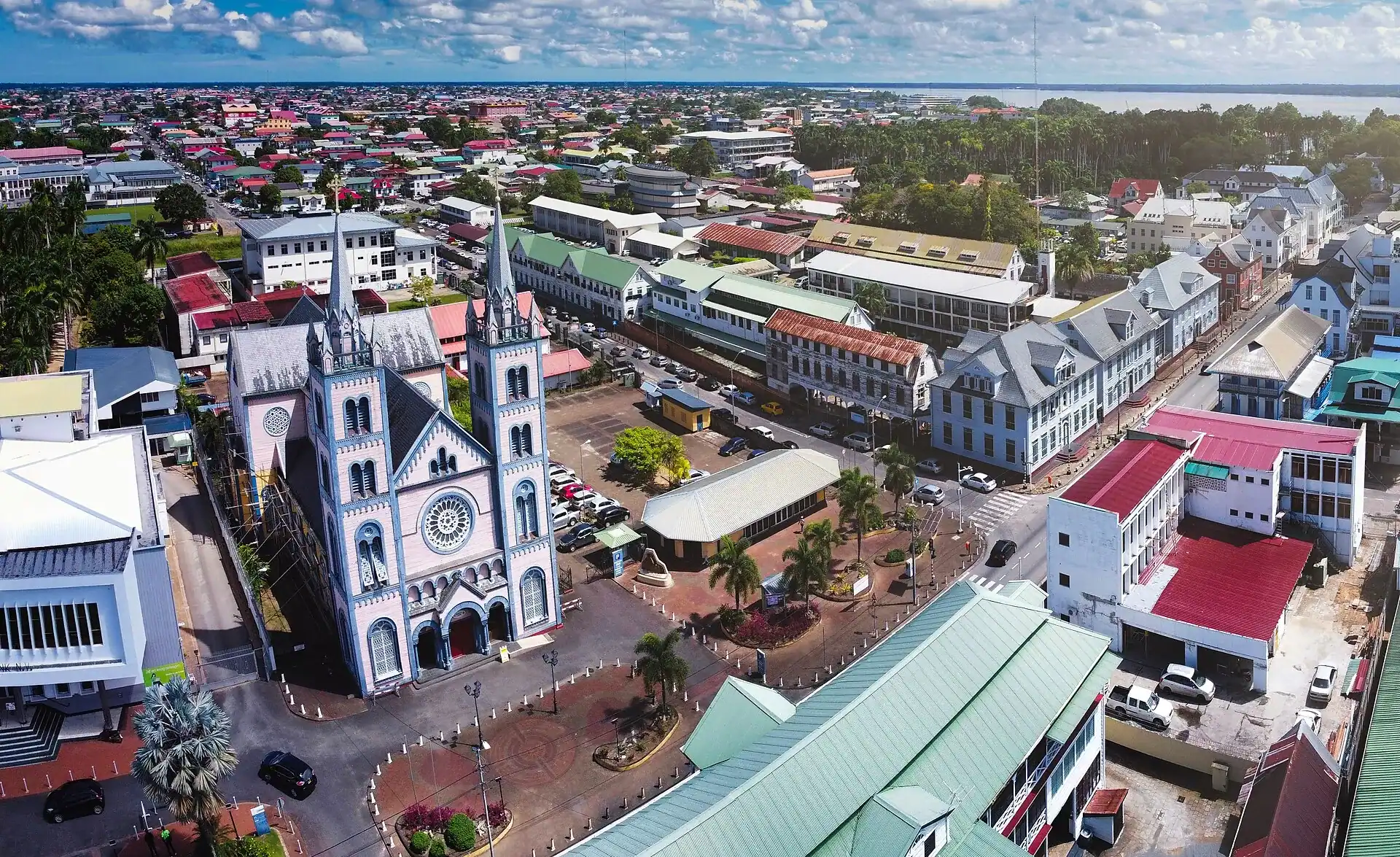 Photo: Jean-Pierre Veira / Wikimedia Commons (CC BY-SA 4.0)