Cost of Living in Georgetown
Where this figure comes from. No cost survey covers Georgetown, so the $1,300 a month above is our own estimate rather than a measurement. On 416 of our 999 city guides the figure is built from a published Numbeo basket, a one-bedroom rent in the centre plus one person's monthly costs without rent, converted to USD; this city is not one of them. How we source everything.
Budget around $1,300 a month as a solo remote worker in Georgetown, and note that this figure has been moving upward fast. Guyana began producing offshore oil in 2019 and has since been among the fastest-growing economies in the world, which has pushed rents in the capital up sharply as international companies arrive. A one-bedroom place runs roughly $500 to $1,000 depending on how close it sits to the areas the oil sector has taken. Food from the markets is cheap and the produce is excellent. Imported goods carry a heavy markup. This is our own estimate rather than measured data, and it dates faster here than elsewhere. The oil boom's effect on rents is the single most important thing to check before committing to anything, since figures more than a year old are likely to understate the market by a wide margin. Fibre runs $60 to $120 a month, which is expensive for the speed. A generator or an inverter is a normal household item rather than a precaution, and should be budgeted as one.
Where to Work in Georgetown
Georgetown's connectivity has improved with the oil money but remains the weak point: fibre reaches parts of the city at workable speeds, mobile data from GTT and Digicel is the fallback, and neither is dependable enough to plan a day around without a backup. Power cuts are frequent enough that generators are standard in any serious building. There is a small coworking presence serving the energy sector and local startups. English is the official language, which is unusual in South America and is Guyana's single biggest practical advantage for an English-speaking visitor. Guyana sits four hours behind GMT with no daylight saving, which gives a workable European afternoon and a full North American day, and is one of the better time zones on the continent for transatlantic work. Starlink became available in 2024 and has changed the practical picture for anyone who can install it. A local content law passed a few years ago requires the oil companies to hire and buy Guyanese first across a long list of services, which has created a scramble for qualified locals and made it harder rather than easier for a foreigner to pick up work here.
Getting Around Georgetown
Georgetown is flat, laid out on a Dutch grid with drainage canals down the middle of several avenues, and much of it sits below sea level behind a seawall. The centre around Stabroek Market and the wooden St George's Cathedral is walkable by day. Minibuses cover the city and the coast road cheaply and drive alarmingly. Taxis are inexpensive and are the standard advice after dark. The interior is another matter entirely: Kaieteur Falls and the Rupununi savannah are reached by light aircraft, and there is no road network to most of the country. The seawall is where Georgetown walks in the evening and is the city's real public space. Kaieteur is a day trip by light aircraft costing a few hundred dollars, and the flights are weather-dependent and cancel often, so anyone determined to see it should allow more than one attempt in their plans. The bridge over the river west of the city floats on pontoons and is retracted on a published schedule to let ships through, stopping the traffic completely for an hour at a time, so a crossing has to be planned around that timetable rather than around the clock.
Sorting transport? Book an airport transfer, or compare car rental on Auto Europe and QEEQ.
Visas for Georgetown
Guyana gives most Western nationalities and all Commonwealth citizens visa-free entry for up to ninety days, granted on arrival, with extensions available from the immigration department. There is no remote work visa and no particular framework for long-stay visitors. Anyone wanting to stay beyond ninety days applies locally, and the process is manageable but slow. Yellow fever vaccination is required if arriving from an endemic country and is sensible regardless given the interior. Guyana is a member of CARICOM, so regional nationals move more freely. Anyone heading into the interior should also note that visits to Amerindian villages require a permit arranged through the tour operator rather than on arrival. Guyana's land borders are a separate matter from the airport: the crossing to Brazil at Lethem is remote and the Suriname ferry at Moleson Creek runs to a limited schedule, so an overland exit needs planning rather than improvisation.
Best Time to Visit Georgetown
Guyana sits close to the equator and is hot and humid year-round, around thirty degrees every month. The calendar is set by rain rather than temperature, and there are two wet seasons: a long one from May to August and a shorter one from November to January. The drier windows, February to April and September to October, are the practical time to visit, and September is also when Kaieteur Falls is at its most dramatic against low water. Georgetown floods in heavy rain because the drainage system is old and the city is below sea level. Mashramani in February, marking the republic anniversary, is the country's largest festival and the best time to see Georgetown at its most alive. The seawall and the drainage kokers are worth understanding as infrastructure: the city depends on them entirely and a spring tide with heavy rain is a genuine flood risk. Cricket is the other thing that fills the calendar, with the regional Twenty20 tournament bringing a fortnight of full stands and a party atmosphere to the ground outside the city in late summer, and it is where the country is at its loudest and most itself.
Pros and Cons of Georgetown
Guyana is South America's only English-speaking country, with a wooden colonial capital unlike anything else on the continent, Kaieteur Falls, the highest single-drop waterfall in the world at nearly five times the height of Niagara, and rainforest covering four-fifths of the country. Costs are low and the culture, mixing Indian, African, Amerindian, Chinese and Portuguese, is genuinely distinctive. Georgetown has a serious crime problem, and it is not one to take lightly, the infrastructure is weak, and the oil boom is changing prices and the city faster than any guide can keep up with. Guyana is also culturally part of the Caribbean rather than Latin America despite sitting on the South American mainland, belonging to CARICOM and playing Test cricket, which surprises visitors who arrive expecting a Spanish-speaking continent.
Who Georgetown Is For
An experienced traveller after somewhere genuinely off the remote work map, interested in the interior rather than the capital, who will organise the day around the security situation rather than hope. Anyone working in energy, conservation or development will find real professional depth here right now. This is the wrong place to begin a first trip to South America, reliable internet is not something the country can promise, and current travel advice needs reading properly rather than skimming before anybody commits to a stay. The interior is the reason to come; Georgetown is the way in. It also suits birders specifically, since the Rupununi and the Iwokrama rainforest hold species lists that draw serious ornithologists from around the world and the country has built its small tourism sector largely around them.
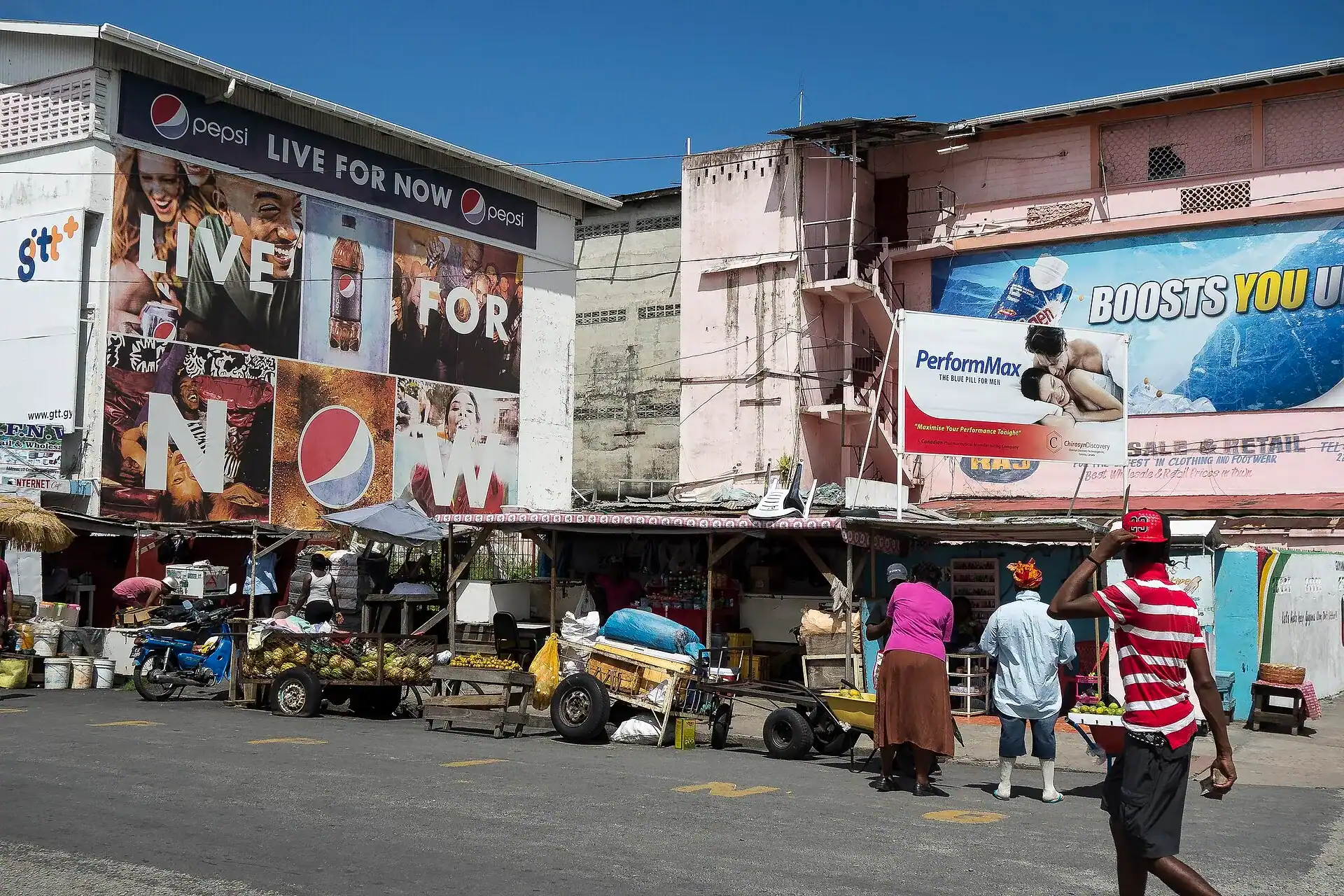 Photo: Dan Sloan / Wikimedia Commons (CC BY-SA 2.0)