Cost of Living in Münster
Where this figure comes from. No cost survey covers Münster, so the $1,900 a month above is our own estimate rather than a measurement. On 416 of our 999 city guides the figure is built from a published Numbeo basket, a one-bedroom rent in the centre plus one person's monthly costs without rent, converted to USD; this city is not one of them. How we source everything.
Budget roughly $1,900 a month as a solo remote worker in Münster, which is expensive for a German city of 320,000 and reflects 60,000 students competing for a limited housing stock. A one-bedroom apartment near the centre or in Kreuzviertel runs about $800 to $1,100, and the outer districts drop that to $650 to $850. Finding anything at all in September and October is the real difficulty rather than the price. Groceries land around $320 to $400. A Mittagstisch lunch is $10 to $14, a restaurant dinner with a beer $22 to $32, and a Pinkus or Altbier about $4. A monthly transit pass is roughly $55, though most people cycle instead. Utilities add $130 to $230. Landlords in a market this tight ask for a credit record, three payslips and sometimes a reference from a previous landlord, and a newcomer has none of the three, which is why so many arrivals begin in a sublet found through a university noticeboard. A subsidised housing certificate exists for low incomes and is worth asking about, though the waiting lists are long. The deposit is capped at three months by law, which is one of the few protections that reliably works in a tenant's favour here.
Where to Work in Münster
Münster has a solid coworking supply at roughly $170 to $280 a month, serving a startup scene that has grown around the university and the applied sciences school. German fixed-line internet is the weak spot nationally, but Münster is better served than average and fibre is available in much of the city, with cable a common alternative; mobile data is expensive by European standards and worth checking before relying on it. Cafes around the Hafen, the redeveloped canal harbour, and in Kreuzviertel are comfortable with laptops. English is widely spoken among students and in the startup sector, and daily administration still runs in German. The distinction between a freelance profession and a trade business decides which taxes apply and which registrations are needed, and it turns on the nature of the work rather than on preference: writers, designers and engineers usually fall on the freelance side, while anything resembling buying and reselling does not. Getting that classification wrong at the start is expensive to unwind later. Invoices carry mandatory content requirements down to the tax number and the numbering sequence, and a client will return one unpaid rather than overlook a missing field.
Getting Around Münster
Münster is the bicycle capital of Germany and the statistic is not a slogan: there are more bikes than people, the Promenade ring road around the old town is closed to cars entirely, and the city is flat. Almost everyone cycles, and a used bike is the first purchase most arrivals make. Buses cover the rest with a monthly pass around $55; there is no tram or metro. The railway station is central and connects to Cologne and Düsseldorf in about an hour and a half, Hamburg in three and Amsterdam in about three and a half. Münster-Osnabrück airport is small; Düsseldorf and Dortmund are the practical gateways at ninety minutes.
Sorting transport? Book an airport transfer, or compare car rental on Auto Europe and QEEQ.
Visas for Münster
Germany is in the European Union and the Schengen area, so EU and EEA citizens may live and work here after registering an address, which is compulsory. Most other Western passports get 90 days in any 180. Germany has no digital nomad visa as such, but the freelance route, the Aufenthaltserlaubnis für selbständige Tätigkeit or Freiberufler visa, is long established and well used, particularly in Berlin though available nationally; it requires a business plan, proof of clients and health insurance. Germany also runs the EU Blue Card for qualified employees above a salary threshold, and since 2024 an Opportunity Card, a points-based route for job seekers. The salary threshold for a skilled permit is lower for shortage occupations than for everything else, and the list is revised, so a role that did not qualify two years ago may qualify now. The 2023 reform loosened the requirement that a qualification be formally recognised before arrival, which used to be the step that stopped people. Appointments at a foreigners' office in a university city are the bottleneck rather than the rules, and waits of two or three months are ordinary rather than exceptional. Dortmund's budget flights to Skopje, Tuzla and Pristina are the cheap way out of Schengen from here, and the Entry/Exit System stops the Schengen clock on the exact day.
Best Time to Visit Münster
May to September is the comfortable half of the year in Münster, with warm days in the low to mid twenties, long evenings and the city's canal-side and lakeside spaces at their best. The Aasee, the artificial lake beside the centre, is where the city goes in summer. September and October bring the students back and the city to full life. Autumn is wet, and winter is grey, damp and dark rather than severely cold, hovering a few degrees above freezing, which is the standard north-west German pattern and the main thing to prepare for. Münster is one of the rainiest cities in Germany. The Christmas markets in December are numerous and good. The Send, the funfair held on the square in front of the castle three times a year, is the local fixture outsiders never hear about and residents arrange weekends around. The lake beside the centre is where the whole city goes on the first warm evening of the year, which arrives without notice in April or May and empties every office by five. Waterproofs are equipment rather than an optional extra in any month.
Pros and Cons of Münster
Münster is one of the most liveable mid-sized cities in Germany: flat, green, exceptionally safe, cycleable to a degree that changes how you use a city, and with a rebuilt gabled centre that carries its history well, including the hall where the Peace of Westphalia was signed. The student population keeps it young and the cultural programme full. It is expensive relative to what it offers, and the housing shortage is severe enough that arriving without a lease already signed is genuinely difficult. It rains a lot and the winters are dark. There is no nomad scene, and while English works in the university and startup worlds, German is needed for everything administrative.
Who Münster Is For
German infrastructure, safety and civic quality in a city you can cross by bicycle, for anyone who can absorb the rent. Cyclists are the point of the place, and everything else follows from that. Academic and startup ties bring in a good share of the rest, and the Ruhr, the Netherlands and the North Sea are all inside a couple of hours of here. Families get schools that are genuinely good and streets that nobody has to think about. The budget has to stretch to German student-city rents, the sunshine is Westphalian and therefore rationed, and the foreign community is academic rather than settled. Berlin, Leipzig and Cologne all offer more of the last two, and Leipzig is considerably cheaper. A semester is the natural trial length, since the housing market, the social calendar and the university year all turn together in September and again in March. Anyone arriving outside those months should expect to sublet first and sign later.
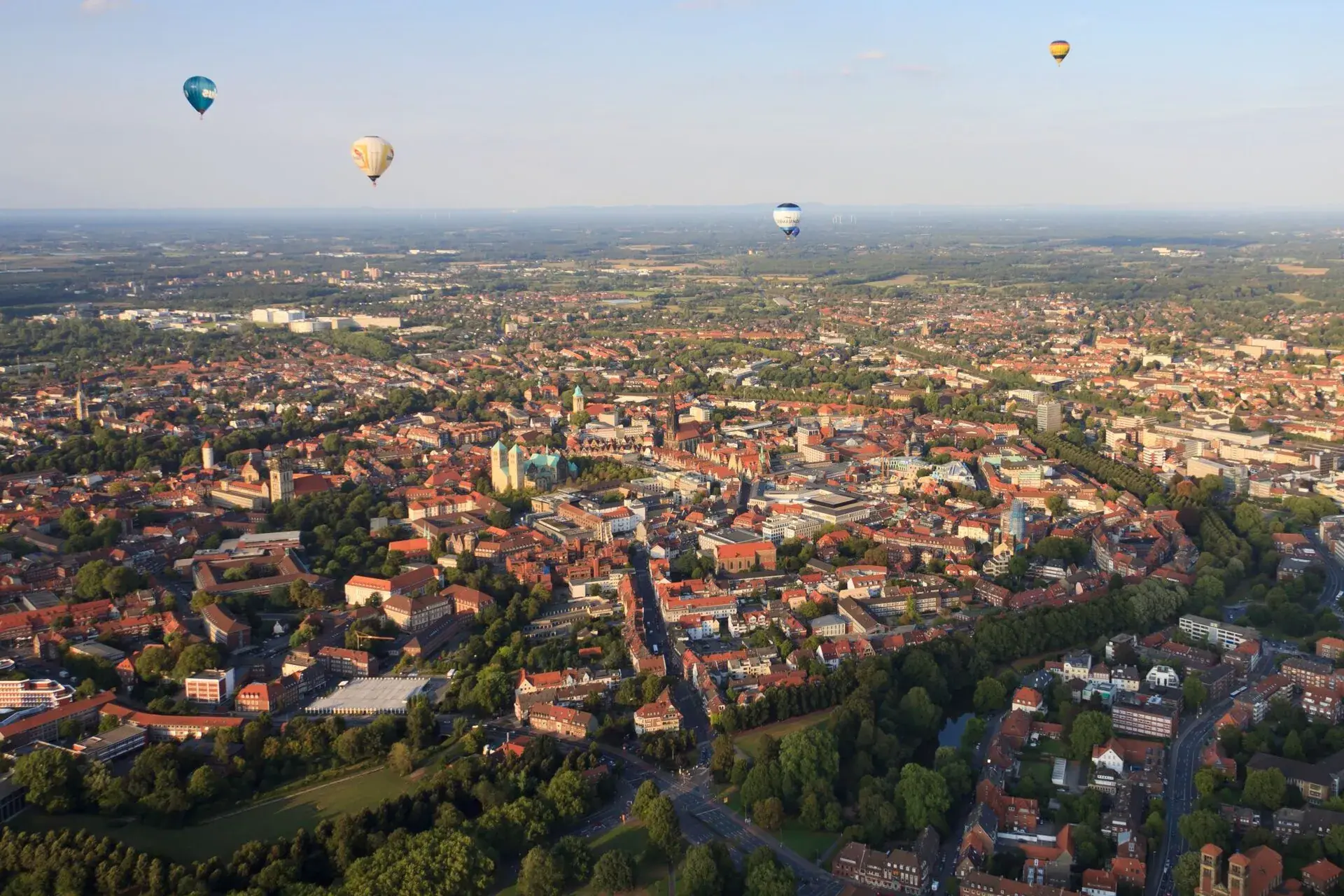 Photo: Bernhard Kils / Wikimedia Commons (CC BY-SA 3.0)