Cost of Living in Giethoorn
Where this figure comes from. No cost survey covers Giethoorn, so the $1,400 a month above is our own estimate rather than a measurement. On 416 of our 999 city guides the figure is built from a published Numbeo basket, a one-bedroom rent in the centre plus one person's monthly costs without rent, converted to USD; this city is not one of them. How we source everything.
Giethoorn is not a budget base. It is a tiny, sought-after village in one of Europe's more expensive countries, and almost everything here is priced for holidaymakers rather than long-stay residents. There is no local rental market to speak of, so most visitors book holiday cottages, B&Bs, or canal-side apartments by the week, which pushes the effective monthly cost well above what you would pay in a Dutch city. Groceries mean a drive to Steenwijk, and dining out in the village skews toward tourist pricing. Budget realistically for a comfortable stay, keeping in mind that longer bookings and shoulder-season dates lower the nightly rate considerably.
- Estimated monthly range: roughly $1,600 to $2,600 for one person, depending heavily on season and length of stay.
- Accommodation is the biggest line item; weekly and monthly holiday-let rates beat nightly ones.
- Groceries are cheaper at Steenwijk supermarkets than at village shops.
- Canal boat hire, bike rental, and restaurant meals add up quickly if done daily.
Where to Work in Giethoorn
Before committing to a stay, accept that Giethoorn is a scenic village and was never meant to be a work hub. Dutch internet infrastructure is genuinely excellent, and most holiday cottages and B&Bs advertise solid, reliable wifi, so a video call or a focused writing day is entirely doable from your rental. What you will not find is any coworking space, a startup crowd, or a laptop cafe culture; services in the village are limited and geared to day-trippers. The upside is real, though. A quiet canal-side rental, booked out of high season, makes a genuinely lovely and calm base for deep, solo work, especially in the early morning and evening when the tour boats have gone.
- Fibre and 4G/5G coverage are strong.
- No coworking spaces exist in the village; your rental is your office.
- Cafes are tourist-focused and busy midday, not reliable work spots.
- Steenwijk, a short hop away, has more everyday services and cafes.
Getting Around Giethoorn
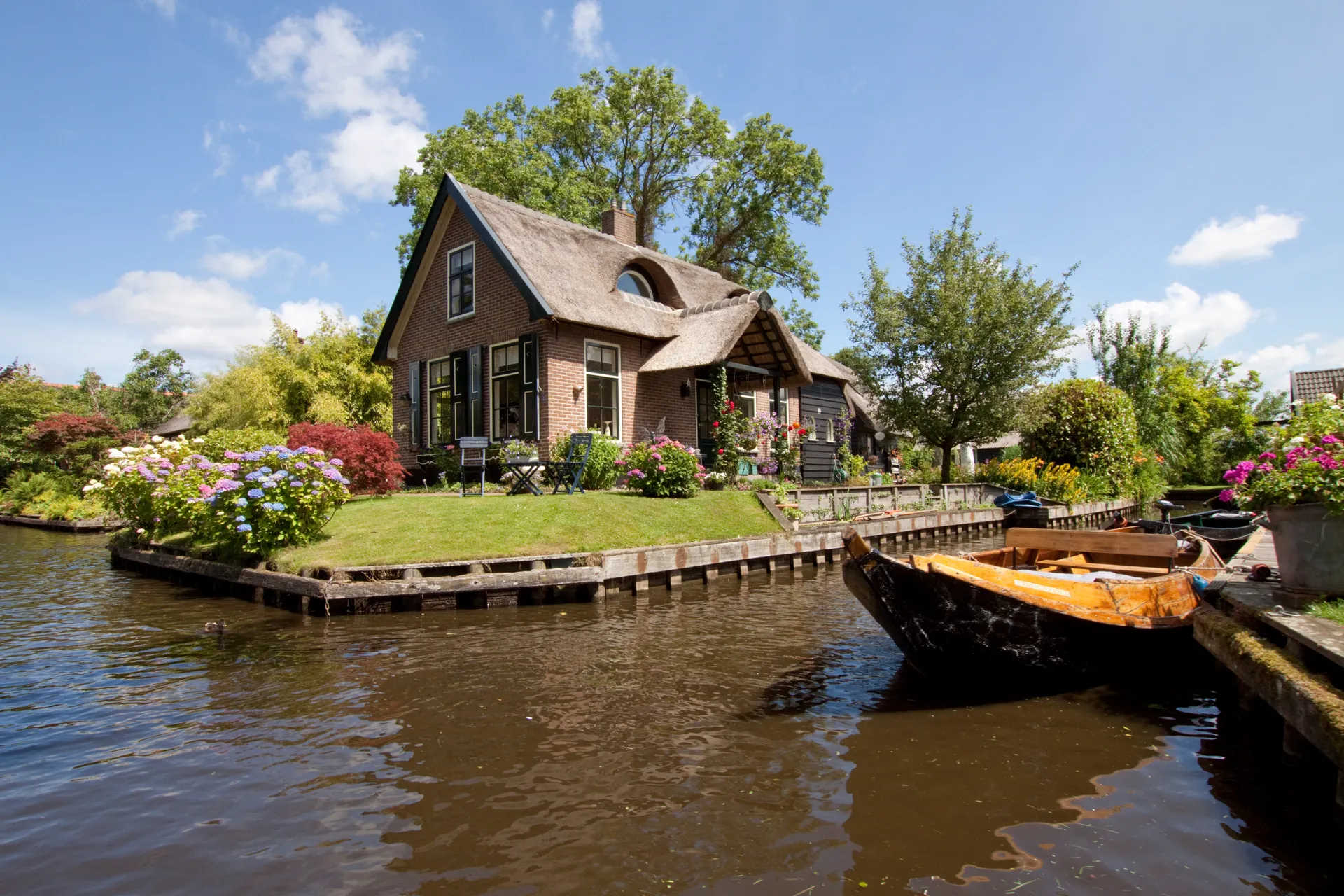
Giethoorn's charm is that it is largely car-free at its core. The historic village is explored on foot along the towpath and over its wooden arched footbridges, or from the water in one of the quiet electric "whisper boats" or a rented canoe or kayak that glide along the canals. Cars are kept to car parks on the edges, so you leave the vehicle behind and slow right down. For connections to the wider world, buses and a short drive or taxi link the village to Steenwijk, the nearest railway town, from which trains reach Zwolle and onward to Amsterdam in roughly one and a half to two hours. A bicycle is invaluable for the surrounding De Wieden reserve. By public transport, bus 70 runs between Steenwijk's railway station and the village all year, and from April to October the faster 270, the Giethoorn Express, doubles the service to a bus every half hour. Whisper boats need no licence, which is why the canals fill with first-time skippers by midday.
- Explore the core on foot and by electric whisper boat, canoe, or kayak.
- Cars stay in edge car parks; the canal lanes are for walking and boats.
- Steenwijk station is the rail gateway to Zwolle and Amsterdam.
- Rent a bike to reach Dwarsgracht, Jonen, and the wider reed beds.
Sorting transport? Book an airport transfer, or compare car rental on Auto Europe and QEEQ.
Visas for Giethoorn
Giethoorn sits in the Netherlands, part of the Schengen Area, so most non-EU visitors enter under the standard Schengen allowance of 90 days within any rolling 180-day period, whether visa-free or with a short-stay Schengen visa depending on nationality. EU and EEA citizens may live and work freely. For a longer, work-based stay, the Netherlands offers self-employment and freelance residence routes, and Americans in particular often look at the Dutch-American Friendship Treaty (DAFT), which provides a relatively accessible path to a self-employment residence permit. These national routes involve real paperwork, minimum investment, and registration steps. For a non-EU visitor the first Schengen crossing usually happens far from here, in the passport hall at Schiphol, where the EU's Entry/Exit System opens the record that then counts every day spent in the Netherlands and across the German border an hour's drive east, even though nothing on that road is checked.
- Schengen short stay: 90 days in any 180-day window for most non-EU visitors.
- EU/EEA citizens have full freedom to live and work.
- DAFT is a notable self-employment route for US citizens.
Best Time to Visit Giethoorn
The village looks its storybook best in late spring and summer, when the canals shimmer, the gardens bloom, and the reed beds turn lush green. That is also, inevitably, the busiest and most crowded stretch, with tour groups and day-trippers filling the towpaths from mid-morning. Autumn is a lovely compromise, calmer and colourful as the trees turn, while winter is very quiet and genuinely peaceful, occasionally cold enough for the canals to freeze into skating conditions. Whatever the season, the real secret is timing your days: the early morning and the evening, before and after the coach parties arrive and leave, are when Giethoorn becomes the serene, whisper-quiet village of the postcards.
- Late spring and summer: greenest and prettiest, but the most crowded.
- Autumn: quieter, colourful, and comfortable for walking and paddling.
- Winter: very quiet, sometimes freezing, occasionally good for skating.
- Any season: early morning and evening beat the day-tripper crush.
Pros and Cons of Giethoorn
Giethoorn rewards a very particular kind of traveller and frustrates everyone else. If you want beauty, calm, clean air, and safety, few places match a car-free canal village set in a nature reserve. If you want convenience, nightlife, community, or a working scene, you will feel the gaps immediately. The honest picture is that this is a slow-travel idyll with tourist-town drawbacks: it is expensive, extremely busy by day in season, and thin on everyday services. Go in with the right expectations and it can be one of the most restful stays in the Netherlands. Go expecting a functioning nomad base and you will be disappointed.
- Pros: gorgeous car-free canals, superb safety and cleanliness, excellent English and internet, immersive nature.
- Pros: deeply peaceful early, late, and off-season.
- Cons: expensive, mobbed by day-trippers in season, no nomad or nightlife scene.
- Cons: very limited services and shops; you rely on nearby Steenwijk.
Who Giethoorn Is For
Giethoorn is for the slow traveller, the writer on a quiet deadline, the couple after a romantic and photogenic retreat, and the nature lover who wants reed beds, lakes, and birdsong at the door. It suits someone happy to trade convenience for calm, who will book a canal-side cottage out of peak season and structure their days around dawn paddles and evening strolls rather than cafes and coworking. It is not for the nomad who needs a scene, spontaneous social life, cheap living, or a busy service town underfoot. Many travellers, sensibly, experience Giethoorn as a memorable day trip from Zwolle or Amsterdam rather than a long stay. The setting is bigger than the village. Giethoorn sits inside Weerribben-Wieden National Park, more than 12,000 hectares forming the largest continuous peat-bog area in north-western Europe, where otters were reintroduced in 2002 and have since spread across the country.
- Great for slow travellers, quiet solo workers, couples, and nature lovers.
- Great for anyone who values calm and scenery over convenience.
- Not for nomads wanting community, nightlife, or a budget base.
- Often best enjoyed as a day trip if a long, quiet stay is not for you.