Cost of Living in Macau
Where this figure comes from. No cost survey covers Macau, so the $2,400 a month above is our own estimate rather than a measurement. On 416 of our 999 city guides the figure is built from a published Numbeo basket, a one-bedroom rent in the centre plus one person's monthly costs without rent, converted to USD; this city is not one of them. How we source everything.
Budget around $2,400 a month as a solo remote worker in Macau, which is expensive and reflects one of the most densely populated places on earth with a gaming economy behind its property prices. A one-bedroom flat runs roughly $1,100 to $1,700. Food is the compensation: Macau eats extraordinarily well at every price point, and a bowl of noodles or a Portuguese-influenced set lunch costs very little. The pataca is pegged to the Hong Kong dollar, which is itself pegged to the United States dollar, and Hong Kong dollars circulate freely. This is our own estimate rather than measured data. The government pays every permanent resident an annual cash handout out of the gaming revenue, a policy with no real parallel anywhere, and it explains a good deal about how the place is governed. Professional tax exists, but the exemption threshold is high enough that most salaries fall below it, and nothing is added at the till. None of that reaches a visitor, who pays resident-level rents without a single one of the resident-level compensations that go with them.
Where to Work in Macau
Macau's connectivity is excellent: fibre throughout, comprehensive 5G and entirely reliable power, all underwritten by an economy that turns over more gaming revenue than anywhere else in the world. There is a small coworking market. Cantonese is the language of daily life, Portuguese remains co-official and appears on every street sign though few people speak it, and Mandarin and English are both widely used in business and tourism. The territory sits eight hours ahead of London, on the same clock as Hong Kong and mainland China. Anyone working with Europe will find the eight-hour offset means a European morning lands at the end of the Macau working day, which is a narrow overlap. The casinos run three shifts and never close, so there is a working population awake at every hour and food available to match, which makes a late working night easier to sustain here than almost anywhere. The university campus sits across the water on Hengqin, on land under this territory's jurisdiction rather than the mainland's, a distinction that matters before you assume a campus address is local. Public wifi across the peninsula is free and genuinely usable.
Getting Around Macau
Macau is small and much of the peninsula is walkable, though it is dense and hilly. Buses are cheap and comprehensive, and the casinos run free shuttle buses between the ferry terminals, the airport and their properties, which locals use as a de facto transport network. A light rail line serves Taipa and Cotai. Ferries run to Hong Kong in an hour, and the Hong Kong-Zhuhai-Macau Bridge, the longest sea crossing in the world, opened in 2018 and carries buses across in about forty minutes. The Cotai strip, built on reclaimed land between the islands of Taipa and Coloane, holds most of the newer casinos and did not exist thirty years ago. Private cars cannot simply drive the bridge, since cross-boundary plates are quota-controlled, so almost everybody crosses on a shuttle and changes to local transport at the far end. The flat fare applies wherever you are going and the same card works in the shops. The peninsula is steep enough in places that older neighbourhoods are linked by public escalators and lifts rather than by roads, which is the quickest way up the hill on foot.
Sorting transport? Book an airport transfer, or compare car rental on Auto Europe and QEEQ.
Visas for Macau
Macau is a Special Administrative Region of China with its own immigration system entirely separate from the mainland's, and it is generous: most Western nationalities receive between thirty and ninety days visa-free on arrival, with British citizens getting six months. A Chinese visa does not admit you here and is not needed. There is no remote work visa. Longer stays require a work permit tied to an employer or an investment residency route. Crossing to mainland China from Macau is a full international border, and US citizens need a Chinese visa for it, while UK, Canadian and most European passports enter the mainland visa-free for up to 30 days. Anyone using Macau as a way to reset a Hong Kong stay should note both territories keep their own records and the practice is well understood by both. Patua, the creole that mixed Portuguese with Cantonese and a scattering of other tongues, survives among a few dozen speakers and is classified as critically endangered, kept going largely by one annual theatre production. It has no official standing and never did. The practical languages for any paperwork are Chinese and Portuguese, with English accepted in most offices that deal with foreigners but guaranteed in none of them.
Best Time to Visit Macau
October to December is the best window, with warm dry days in the low twenties, low humidity and clear air. March to May is humid and often foggy. Summer from June to September is hot, humid and the typhoon season, and Macau is exposed; Typhoon Hato in 2017 flooded the city and killed ten people. Winter is mild at around fifteen degrees. The Macau Grand Prix, run on public streets in November, is the only race in the world where both cars and motorcycles compete on the same circuit. Coloane, the southern island, keeps a village and a stretch of black sand beach that most visitors never reach and is the quietest part of the territory. The typhoon signal system decides everything in summer: at signal eight the ferries stop, the casinos shut their doors and the place closes until it drops, which can take a day and is announced hours ahead. The tail of that season runs into October in some years. Chinese New Year and the Golden Week holidays in early May and October are when mainland visitor numbers peak, and the difference between a quiet Tuesday and a holiday weekend here is enormous.
Pros and Cons of Macau
Macau is four hundred years of Portuguese administration on the edge of China and the result is genuinely unlike anywhere else: baroque churches and Chinese temples on the same street, a UNESCO World Heritage historic centre, and a food culture that invented its own cuisine from the collision. It has the world's largest gaming industry, excellent infrastructure and a generous visa policy. It is expensive, it is extremely dense, wholly dominated by the casino economy, and the air quality reflects its position in the Pearl River Delta. Macanese cuisine is also recognised as the world's first fusion food, developed over four centuries from Portuguese, Chinese, Malay and Indian ingredients.
Who Macau Is For
A compact, extremely safe, well-connected Asian base with remarkable food and a visa policy that asks almost nothing, if the casinos do not bother you. It is a genuinely underrated place to spend a month. Thirty square kilometres of mostly built land offers neither space nor nature in any quantity. Using it as a base for mainland China does not work either, since crossing means a full border formality every time, plus a separate visa for US citizens, rather than a short hop. Colonial architecture survives more completely in this small territory than anywhere else in East Asia, which is a strange thing to be able to say about a place better known for casinos.
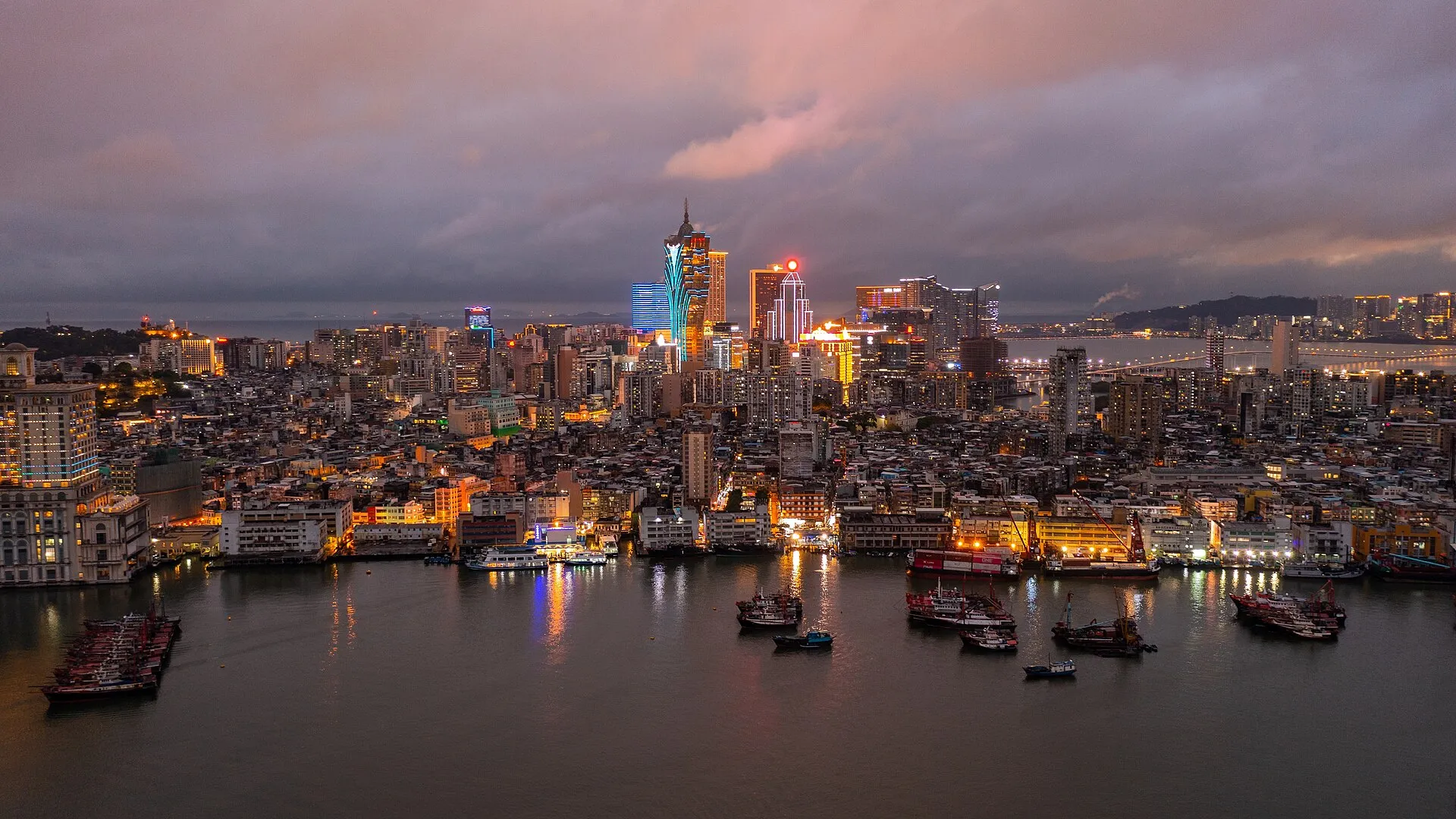 Photo: Charlie fong / Wikimedia Commons (CC BY-SA 4.0)