Cost of Living in Erfurt
Where this figure comes from. No cost survey covers Erfurt, so the $1,500 a month above is our own estimate rather than a measurement. On 416 of our 999 city guides the figure is built from a published Numbeo basket, a one-bedroom rent in the centre plus one person's monthly costs without rent, converted to USD; this city is not one of them. How we source everything.
Budget roughly $1,500 a month as a solo remote worker in Erfurt, which is markedly cheaper than western German cities of comparable size. A one-bedroom apartment near the centre or in the Andreasviertel runs about $580 to $800, and the outer districts drop that to $450 to $600. Thuringia remains one of the more affordable German states and Erfurt has not yet seen the rent escalation of Leipzig or Dresden. Groceries land around $300 to $380. A Mittagstisch is $9 to $13, a restaurant dinner with a beer $20 to $28, and a Thüringer Rostbratwurst from a street grill about $3. A monthly transit pass is roughly $50. Utilities add $130 to $220. Rent is quoted cold, and the warm figure adds heating, water and building costs worth a couple of hundred dollars on a flat this size. The deposit is capped by law at three months of the cold rent and sits in an account that earns interest for the tenant. A credit report is asked for at almost every viewing, and somebody who has only just arrived has none to show, which costs more viewings than any level of income makes up for. The broadcasting fee, about twenty dollars a month per household, is compulsory whether or not anything is watched, and it follows the address registration automatically.
Where to Work in Erfurt
Erfurt has a modest coworking supply at roughly $130 to $220 a month, serving a small startup scene and the state administration, since Erfurt is Thuringia's capital. The university and the applied sciences school keep a student population of around 10,000. German internet is patchier than the country's reputation suggests, but Erfurt's centre is reasonably well served with cable and increasingly fibre; check the specific building rather than assuming. Mobile data is expensive by European standards. Cafes around the Krämerbrücke and the Domplatz are comfortable for a few hours. English is common among students and in the technology sector and limited in administration, which runs in German. The city is a more serious technical employer than its size implies. A semiconductor foundry with customers worldwide has its headquarters here, and the public broadcaster's children's channel is produced in the city, which between them support a professional population invisible in the tourist picture. A large industrial park has grown up around the motorway junction south of the centre and has taken most of the region's recent manufacturing investment. For a freelancer the practical consequence is that the client base is local and industrial rather than agency work, and it is reached by turning up rather than by pitching.
Getting Around Erfurt
Erfurt has one of the densest tram networks in Germany for its size, six lines covering the city from a compact, largely pedestrian medieval centre, with a monthly pass around $50. The old town is small enough to walk across in twenty minutes and the Krämerbrücke, a bridge entirely lined with inhabited houses, sits in the middle of it. Cycling works well on the flat. The railway station is a major node on the fast north-south and east-west lines, putting Berlin at under two hours, Frankfurt at two and a half and Munich at two and a half, which is exceptional connectivity for a city of 215,000. Erfurt-Weimar airport is small; Berlin and Frankfurt are the gateways. The station became a high-speed junction when the line through the Thuringian Forest opened, and that single fact shapes what living here is like, since two capitals and a financial centre all become day trips. The nationwide monthly transport ticket covers every tram, bus and regional train in the country for one flat fee, which beats a local pass outright for anyone who leaves the city even occasionally. Inside the old town a car is a liability rather than an asset, because the medieval street plan was not built for one.
Sorting transport? Book an airport transfer, or compare car rental on Auto Europe and QEEQ.
Visas for Erfurt
Germany is in the European Union and the Schengen area. EU and EEA citizens may live and work here after the compulsory address registration; most other Western passports get 90 days in any 180. There is no German digital nomad visa. The established route for the self-employed is the Freiberufler residence permit, which requires a business plan, evidence of clients and German health insurance, and is granted by the local foreigners' office; standards vary by city and Erfurt is less used to such applications than Berlin. The EU Blue Card covers qualified employees above a salary threshold, and the 2024 Opportunity Card offers a points-based route for job seekers. Erfurt-Weimar's own departures are mostly holiday flights to Antalya and Hurghada, and for non-EU residents they are the nearest external Schengen border: the EU Entry/Exit System logs the exit and the return at the airport, so a week in Turkey or Egypt comes off the Schengen allowance to the day.
Best Time to Visit Erfurt
May to September is the comfortable window, with warm days in the low to mid twenties and the Domplatz and the Petersberg citadel at their best. Erfurt sits in the Thuringian basin and is drier and slightly warmer than much of central Germany. The DomStufen-Festspiele, an open-air opera festival staged on the cathedral steps, runs in July and August and is the city's landmark event. Autumn is pleasant into October. Winter is cold and grey, generally a few degrees either side of freezing from December to February, with occasional snow. The Christmas market on the Domplatz, staged below the cathedral and the Severikirche, is one of the most photographed in Germany. The Krämerbrückenfest in June hands the bridge and the surrounding streets over to music and stalls for a weekend, and it is the town's own event rather than a visitor attraction. The national garden show was held here in 2021 and the egapark grounds on the hill west of the centre were rebuilt for it, leaving the city with one of the largest public gardens in the country. Winters here are grey rather than severe, and the fact worth planning around is that the light has gone by four in the afternoon at midwinter.
Pros and Cons of Erfurt
Erfurt is one of the best-preserved medieval city centres in Germany, survived the war largely intact, and offers it at eastern German prices with a tram network, a fast-rail hub and the Thuringian Forest an hour away. It is safe, walkable, green and considerably cheaper than Leipzig or Dresden, let alone the west. Luther studied here and the city wears that history well. Thuringia is quiet and the city itself is small, with limited nightlife and a very thin international presence. There is no nomad community. English is less useful than in the bigger eastern cities. The state's politics have drawn attention in recent years, which some arrivals weigh, and winters are grey.
Who Erfurt Is For
German standards of living for a bill that still leaves something over each month, in a small, calm, historic city. Fast rail reaches Berlin, Frankfurt and Munich without the rent any of the three would charge for the privilege. Hikers have the Rennsteig and the Thuringian Forest close by, and the medieval street plan is a thing some people specifically want to live inside rather than visit for a weekend. It works for couples and for focused solo work. German is required rather than useful, no established foreign community exists, the nightlife suits a student town of this size, and flying anywhere begins with a train to Leipzig or Berlin. Leipzig is ninety minutes away, larger and livelier, and Berlin is under two hours.
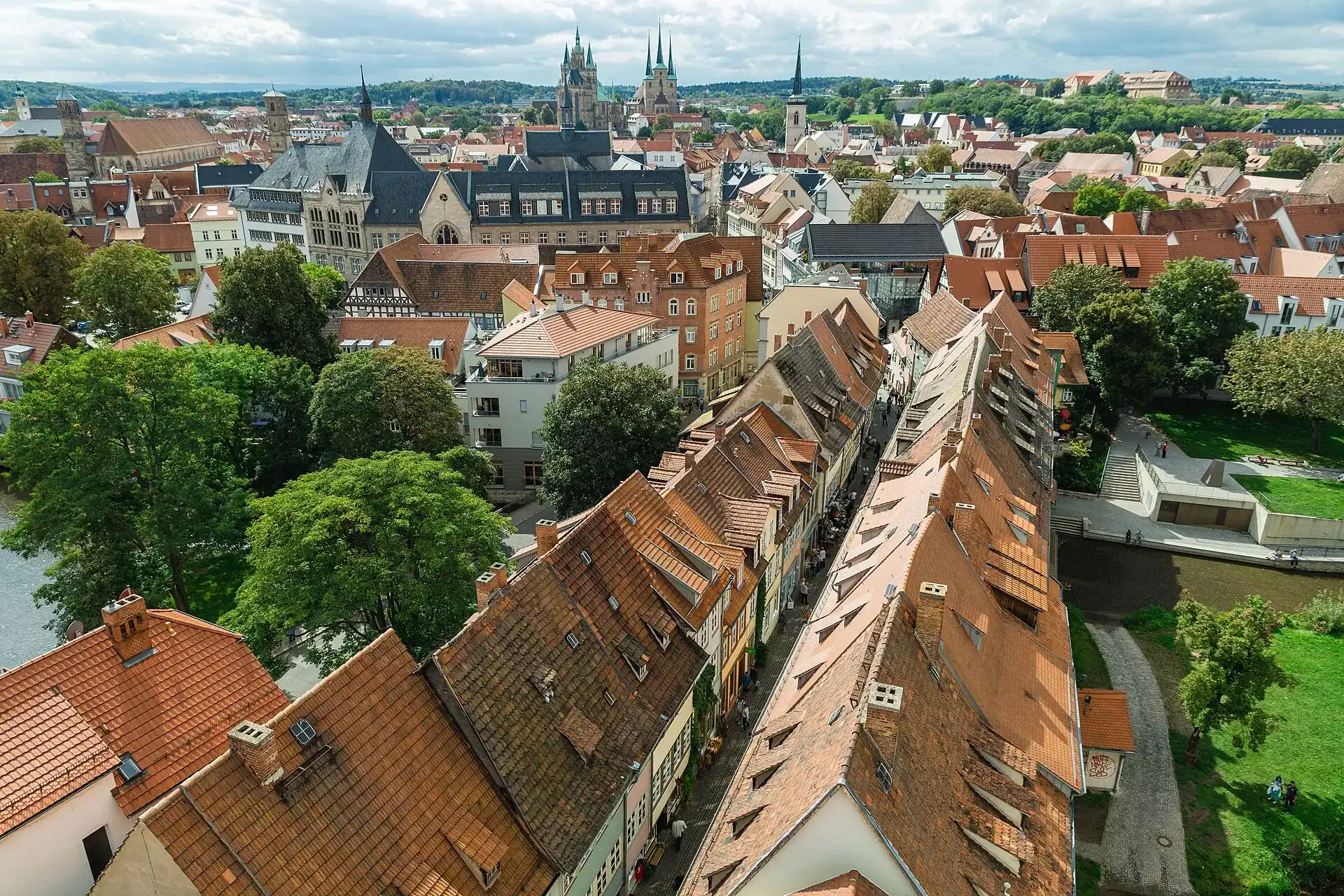 Photo: Eremeev / Wikimedia Commons (CC BY-SA 3.0)