Cost of Living in Civita di Bagnoregio
Where this figure comes from. No cost survey covers Civita di Bagnoregio, so the $1,000 a month above is our own estimate rather than a measurement. On 416 of our 999 city guides the figure is built from a published Numbeo basket, a one-bedroom rent in the centre plus one person's monthly costs without rent, converted to USD; this city is not one of them. How we source everything.
Civita di Bagnoregio itself has almost no long-term housing market: it is a hamlet of a handful of permanent residents, and what few rooms exist are aimed at overnight tourists, not monthly renters. Realistic nomad budgeting means pricing life in nearby Bagnoregio (a five-minute drive or a footbridge-plus-walk away) or Orvieto, the larger rail town 25 minutes further. In Bagnoregio, a simple one-bedroom apartment runs roughly $520 to $750 a month; in Orvieto, expect $635 to $920 for something central. Groceries and a daily espresso are cheap by Western European standards, $290 to $405 a month covers most people who cook regularly, and a trattoria dinner in Bagnoregio or Civita rarely exceeds $29 to $40 per person. The one cost unique to this town is the Civita entry ticket, currently around $6 to $12 per crossing for day visitors (residents and overnight guests of in-town accommodation are typically exempt). All told, a modest single-person budget based in Bagnoregio, including rent, food, transport, and the occasional bridge fee, lands somewhere around $1,270 to $1,730 a month, noticeably lower than Rome or Florence but not dramatically cheaper than other small Umbrian and Lazio hill towns.
Where to Work in Civita di Bagnoregio
There is no coworking space in Civita di Bagnoregio, and honestly none is likely to appear: the town has no cars, a fragile medieval fabric, and a resident population that can be counted on two hands. A couple of restaurants inside the walls, such as Alma Civita, have wifi and quiet tables outside peak lunch hours, but they are not set up for a full workday and staff will not welcome a laptop camped out during service. The realistic move is to work from Bagnoregio, where cafes around Piazza Cavour and the Belvedere overlook (the classic postcard view of Civita across the calanchi) offer decent connections and longer opening hours, or to base in Orvieto, which has more reliable cafe culture, a train station, and enough foot traffic to support all-day laptop sessions without feeling like you are in the way. Home wifi in a rented Bagnoregio or Orvieto apartment is generally fine for video calls, fiber and good FTTC coverage has reached most of this part of Lazio and Umbria, but rural pockets nearby can still lag.
Getting Around Civita di Bagnoregio
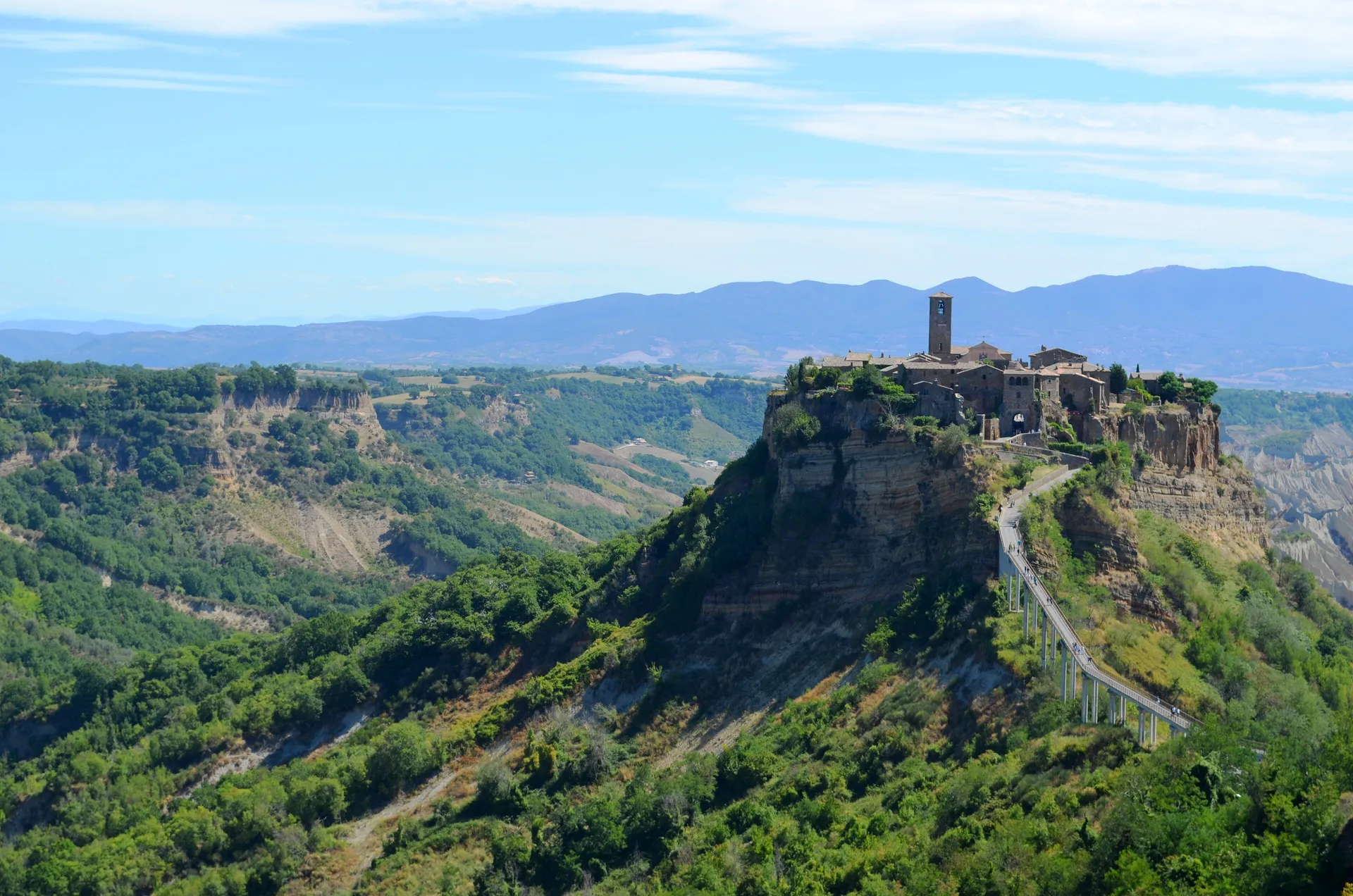
Civita is famously car-free and reachable only on foot, via a roughly 300-metre pedestrian footbridge that climbs from Bagnoregio's edge to the town gate. There is no way around this: luggage, groceries, and daily life all mean walking the bridge, which is fine for a visit but a real friction point for anyone trying to live day to day inside the walls. Bagnoregio itself is small enough to cross on foot in fifteen minutes. Getting to the area without a car means taking a regional bus (Cotral) from Orvieto's train station to Bagnoregio, a ride of about 40 to 50 minutes that runs on a limited, sparse schedule, especially on Sundays. Orvieto sits on the main Rome-Florence rail line, so it is the practical gateway: trains from Rome take around 75 to 90 minutes, from Florence about 2 hours. For anyone planning to explore Tuscia, the wider badlands region, or nearby towns like Civitella d'Agliano and Lubriano, a rental car is genuinely useful and turns a logistically awkward area into an easy one; without one, expect to plan trips around bus timetables.
Sorting transport? Book an airport transfer, or compare car rental on Auto Europe and QEEQ.
Visas for Civita di Bagnoregio
Italy follows the Schengen rules that apply across most of the EU: passport holders from the US, UK, Canada, Australia, and similar countries can stay up to 90 days within any 180-day period without a visa, which covers most short nomad stints comfortably. For a longer stay, Italy introduced a digital nomad visa in 2024 aimed at remote workers employed by companies outside Italy or self-employed professionals with foreign clients; it requires proof of remote work, a minimum income threshold (about $28,540 a year, three times Italy's income threshold for exemption from health charges), health insurance, and accommodation, and it is processed through Italian consulates abroad before entry. There is also a longer-standing self-employment visa route for freelancers with an Italian partita IVA, though it is bureaucratically heavier and involves quota limits in most consulates. None of these visa paths differ for Civita specifically, since it falls under Italian national immigration law, but a place this small has no local immigration office, no English-speaking bureaucratic support, and no expat community to lean on, so anyone pursuing a longer-stay visa should expect to handle paperwork through Viterbo (the provincial capital) or a consulate before arrival, and budget real patience for the process. Long-haul visitors changing planes in Frankfurt or Paris meet the Entry/Exit System there, not at Fiumicino.
Best Time to Visit Civita di Bagnoregio
Late spring (May to early June) and early autumn (September to mid-October) are the sweet spot: daytime temperatures sit comfortably in the low-to-mid 20s Celsius, the calanchi badlands are green or golden depending on the season, and day-tripper crowds, while present, are thinner than in high summer. July and August bring real heat, often 32C-plus with little shade on the footbridge, and the worst crowding of the year, with coach tours arriving from Rome and Florence and the town's narrow lanes filling up by mid-morning. Winter is quiet and atmospheric, sometimes even foggy in a way that makes the "town in the sky" reputation feel literal, but many restaurants and rooms close or run reduced hours between November and February, and a damp chill sets into the stone buildings. For anyone actually trying to work from the area rather than just visit, shoulder season offers the best balance of livable weather, functioning services in Bagnoregio and Orvieto, and a Civita that still feels navigable rather than overrun.
Pros and Cons of Civita di Bagnoregio
The pull is obvious: nowhere else offers this exact combination of medieval stone architecture, dramatic eroded-clay scenery, and near-total car-free silence once the day-trip buses clear out in the evening. Sunset and early morning, when the footbridge empties, are genuinely magical and worth experiencing for days at a time. The honest downsides are significant, though. Civita has essentially no permanent population, no shops beyond a few tourist-facing restaurants and stalls, no pharmacy, no supermarket, and no real infrastructure for daily life; every practical errand means walking the bridge and driving or busing further out. Day-tripper crowds from Rome, Florence, and cruise-excursion buses can be intense from late morning through mid-afternoon, turning a two-street hamlet into a bottleneck. Mobile and wifi coverage inside the walls is inconsistent. And the entry ticket, sensible as a preservation measure, is a small but constant reminder that Civita is set up for tourism, not for residents.
Who Civita di Bagnoregio Is For
Civita di Bagnoregio is not a nomad base, and treating it as one will lead to frustration. It works best as an extraordinary side trip, or as a short, deliberate stay of a few nights in one of the handful of in-town guest rooms, timed for the quiet hours around sunrise and sunset when the crowds are gone. The people who get the most out of this area are remote workers who base themselves in Bagnoregio or Orvieto for a few weeks, treat Civita as a five-minute walk to one of Italy's strangest and most beautiful views, and value slow, rural Tuscia life over amenities, nightlife, or a built-in community of other remote workers, none of which exist here. Anyone who needs consistent coworking infrastructure, a social expat scene, or fast day-to-day errands should look toward Orvieto, or further afield to Rome or Florence, and simply make Civita a day (or overnight) excursion rather than a home base.