Cost of Living in Aït Ben Haddou
Where this figure comes from. No cost survey covers Aït Ben Haddou, so the $700 a month above is our own estimate rather than a measurement. On 416 of our 999 city guides the figure is built from a published Numbeo basket, a one-bedroom rent in the centre plus one person's monthly costs without rent, converted to USD; this city is not one of them. How we source everything.
Aït Ben Haddou is inexpensive by Western standards, though it is a short-stay village rather than a place people settle into for a full month. A realistic monthly budget runs roughly $600 to $1,200 for one person, depending on how simply you live and whether you base yourself in a family guesthouse or a more polished riad. Food, tea, and local transport cost very little, while guided desert excursions and car hire are where money adds up. Cash is essential, as card acceptance is patchy and the nearest reliable ATMs are in Ouarzazate. The ksar itself is officially free to enter, but expect a request for around $2 at the main entrance, presented as a contribution to upkeep, and another dollar or two to step inside the few houses whose families open them to visitors.
- Guesthouse or riad room with breakfast: roughly $20 to $60 per night, less for longer stays.
- Tagine, couscous, or a set menu at a terrace restaurant: about $5 to $12.
- Mint tea, bread, and market produce: a few dollars a day.
- Grand taxi to Ouarzazate: a few dollars for a shared seat, more to charter privately.
Where to Work in Aït Ben Haddou
Plan the visit on the understanding that this village is not a work hub, whatever a booking page implies. There is no coworking space, and wifi in the village is limited and basic, often shared, slow, and prone to dropping, especially at the old ksar across the river where signal is weakest. If you must stay connected, buy a local SIM from Maroc Telecom, Orange, or Inwi and rely on mobile data, which is generally the most dependable option here. Choose a riad or guesthouse that explicitly advertises working wifi. For anything demanding, such as calls, uploads, or a full working day, base yourself in nearby Ouarzazate, which has better connectivity, cafes, and services.
- Buy a Maroc Telecom, Orange, or Inwi SIM and top up data for the most reliable connection.
- Pick a guesthouse that confirms functional wifi rather than assuming it works.
- Treat Ouarzazate, about 30 minutes away, as your fallback for serious online work.
Getting Around Aït Ben Haddou
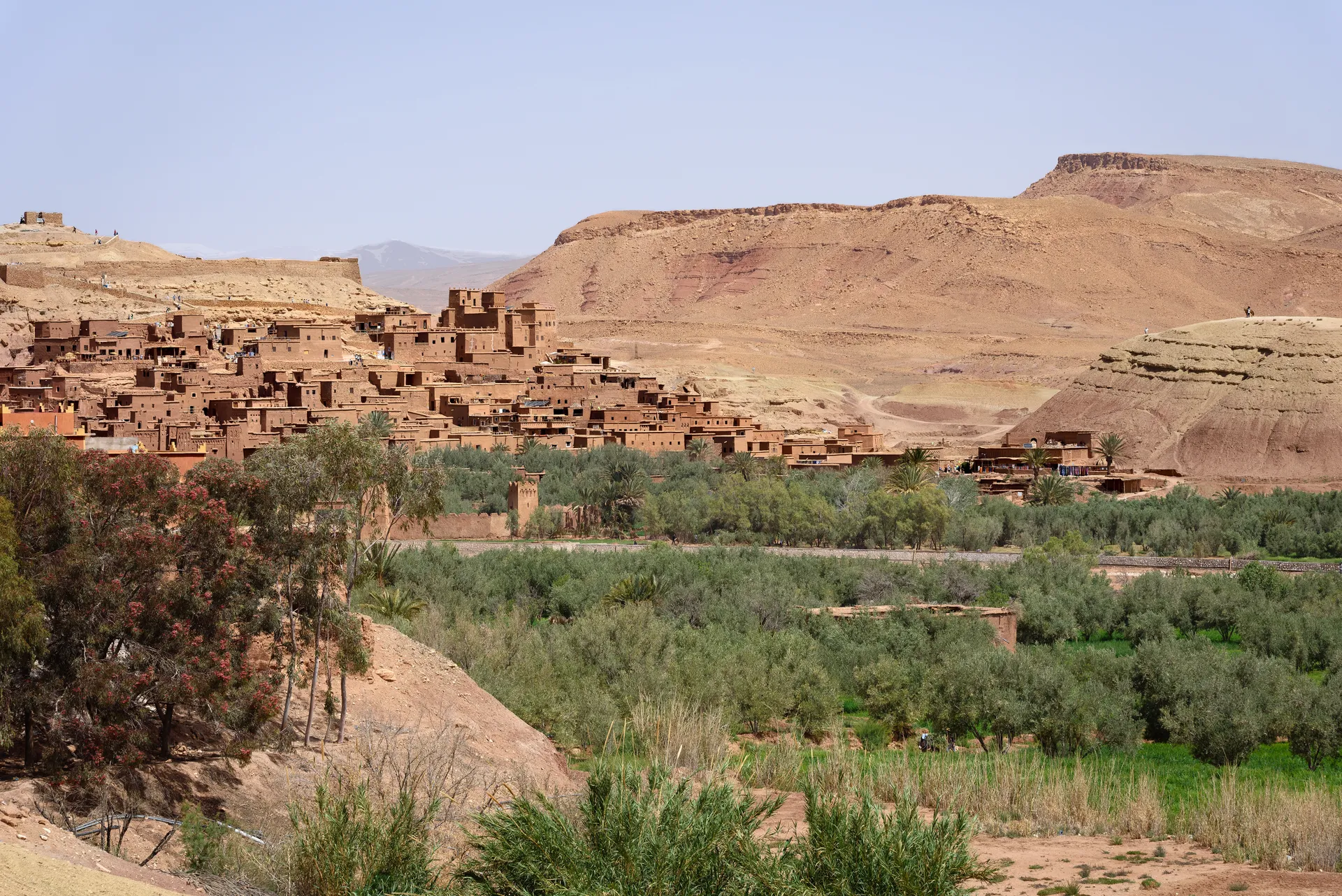
The old ksar itself is explored entirely on foot. You reach it by crossing the Ounila River, either stepping across the stones when the water is low or using the footbridge, then climbing the earthen lanes up the hillside past the kasbahs to the granary at the top. The modern village, with its guesthouses and restaurants, sits on the near bank and is walkable. For everything beyond the village you need wheels. Grand taxis and buses run through Ouarzazate, roughly 30 minutes away, which is the regional transport hub. To explore the wider region you will want a rental car or a driver. With a car, the more rewarding road north runs up the river valley, a track until it was paved around 2012, which climbs past the fortified village of Anemiter to the Glaoui kasbah at Telouet before meeting the Tichka road; it follows the old caravan route the ksar was built to guard.
- On foot for the ksar: cross the river by stepping stones or footbridge, then walk up.
- Grand taxis and Supratours or CTM buses connect via Ouarzazate, about 30 minutes away.
- Car or organized tour for the Draa Valley, Skoura palm grove, and Telouet.
- Over the Tizi n'Tichka pass to Marrakech is roughly a four hour drive.
Sorting transport? Book an airport transfer, or compare car rental on Auto Europe and QEEQ.
Visas for Aït Ben Haddou
Aït Ben Haddou follows Morocco's national entry rules, so there is nothing village-specific to arrange. Citizens of many countries, including the United States, Canada, the United Kingdom, the European Union, Australia, and others, can enter Morocco visa-free for stays of up to 90 days for tourism. You typically arrive through Marrakech or Casablanca and travel overland from there. Photographers drawn by the ksar should leave the drone at home. Morocco has banned bringing drones in without prior authorisation since 2015, customs look for them on arrival and confiscate them, and getting one back means collecting it, sometimes with a storage charge, at the same airport on departure, which rules out flying home from a different city.
- Many nationalities enter Morocco visa-free for up to 90 days of tourism.
- There is no separate permit for Aït Ben Haddou itself.
Best Time to Visit Aït Ben Haddou
The ideal windows are spring, from March to May, and autumn, from September to November, when days are warm and comfortable and the light on the red-mud towers is at its best. Summer here is very hot, with fierce midday sun that makes climbing the ksar exhausting, so plan any summer visit for early morning or late afternoon. Winter days are cool and pleasant but nights turn genuinely cold, so pack layers. Remember this is a conservative rural area, and modest dress is both respectful and practical against sun and dust. Winter's real hazard is on the way in: the Tizi n'Tichka pass on the N9, the main road from Marrakech, closes in heavy snow, and in January 2026 it was shut more than once, so leave a spare day either side of any winter booking.
- Spring and autumn offer the most comfortable temperatures and beautiful light.
- Summer is very hot; visit the ksar early or late in the day.
- Winter days are mild but nights are cold, so bring warm layers.
- Dress modestly out of respect for the local rural culture.
Pros and Cons of Aït Ben Haddou
Aït Ben Haddou is one of the most spectacular earthen villages on earth, a UNESCO World Heritage ksar of packed-mud kasbahs that has starred in countless films and rewards anyone who loves architecture, history, and desert landscapes. It is affordable, safe, and deeply atmospheric, especially at sunrise and sunset. The trade-offs are real, though. Infrastructure is basic, wifi is unreliable, there is no nomad scene or nightlife, and the local economy runs almost entirely on tourism and film. It works as a short, cinematic cultural stop, not as a base for getting work done. Expect visible repair work. The September 2023 earthquake centred in the High Atlas cracked several of the ksar's buildings and damaged parts of the hilltop granary, and restoration backed by the UN's heritage agency and Morocco's culture ministry is still under way in the upper lanes. Only a handful of families still live inside the walls, so once the day-trippers leave the old village is nearly empty and most of the life is on the modern bank.
- Pros: breathtaking UNESCO heritage, low cost, strong safety, incredible photography and history.
- Pros: warm hospitality and easy access to the Draa Valley, Skoura, and the High Atlas.
- Cons: limited wifi, basic services, no coworking, and near-zero nightlife.
- Cons: tiny community and full dependence on tourism make it unsuitable for long-term work.
Who Aït Ben Haddou Is For
Aït Ben Haddou suits the slow-traveling nomad who wants a short, cinematic pause rather than a productive work base. It is perfect for people drawn to history, earthen architecture, film locations, and desert scenery, and for those happy to unplug for a night or two between Marrakech and the Sahara. Photographers, culture lovers, and anyone building a southern Morocco road trip will find it unforgettable. It is not for remote workers who need dependable wifi, a social nomad community, or urban amenities. If that describes you, treat Aït Ben Haddou as a memorable detour and keep Ouarzazate or Marrakech as your working base.
- Great for slow travelers, photographers, and history and film enthusiasts.
- Ideal as a one or two night cultural stop on a southern Morocco route.
- Not suited to workers needing reliable connectivity or a nomad community.