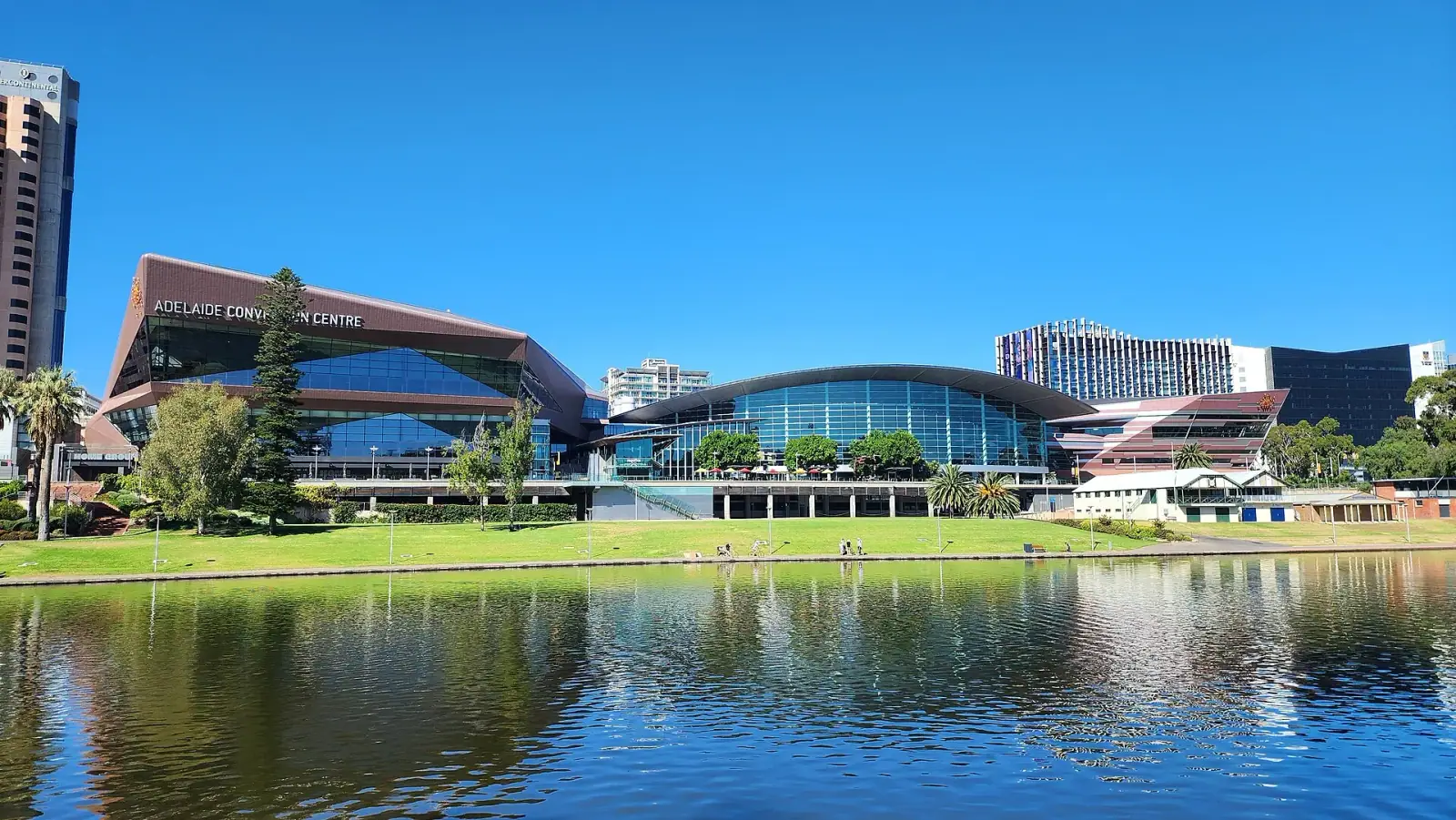
Adelaide Convention Centre and River Torrens under a bright blue sky
Photo: Shkuru Afshar / Wikimedia Commons (CC BY-SA 4.0)
Australia flag

Adelaide

Australia

Experience wine country capital with festival culture and livable charm.

A$1.500
Monthly Budget
--
Current Weather
Mediterranean
Climate Type
70 Mbps
Avg. WiFi Speed
9/10
Safety Score
2,000+
Active Nomads
--
Time Difference
Scroll
0
Nomad Score

Is Adelaide a Good Base for Remote Work?

Experience wine country capital with festival culture and livable charm. English and safety are the standout strengths, with cost the main caveat.

Compare Adelaide vs Melbourne →

Category Breakdown

How Adelaide scores across all 13 factors

Weather in Adelaide

Monthly averages from 2019-2023 (Open-Meteo), and the best time to visit

28°
17°
Jan
26°
16°
Feb
25°
15°
Mar
22°
13°
Apr
17°
11°
May
15°
Jun
14°
Jul
15°
Aug
18°
10°
Sep
20°
11°
Oct
22°
13°
Nov
25°
14°
Dec
Daily high & low (°C)Rainfall (mm/month)Best months to visit

The best time to visit Adelaide for comfortable weather is Jan, Feb, Mar. The warmest month is Jan (around 28°C by day), and the wettest is Jun (about 120mm of rain).

Chasing good weather? See other cities that are warm in Jan, or plan a multi-city route around the seasons. Staying a while in Adelaide? Check visa options, your time-zone overlap and how far your budget stretches, or find it on the world map.

Historical monthly averages, not a forecast. Source: Open-Meteo.

Best Neighborhoods in Adelaide

Where to base yourself for the perfect nomad experience

Adelaide CBD

$$$
Central & Convenient

The compact heart of South Australia

Adelaide's CBD is one of Australia's most walkable city centers - a perfect grid surrounded by parklands. You'll find everything from Central Market's produce to Rundle Mall shopping within easy walking distance.

Best for: First-time visitors, convenience seekers, and those who want everything walkable
✓ Pros
  • Highly walkable
  • Central Market
  • Free trams
  • All amenities
✗ Cons
  • Quieter weekends
  • Less character
  • Higher rents

North Adelaide

$$$$
Upscale & Historic

Adelaide's elegant historic quarter

Just north of the parklands, North Adelaide is the city's most prestigious address - heritage buildings, tree-lined streets, and O'Connell Street's cafe scene create an upscale village atmosphere.

Best for: Those seeking elegance, food lovers, and architecture enthusiasts
✓ Pros
  • Beautiful architecture
  • Great dining on O'Connell
  • Quiet
  • Near parklands
✗ Cons
  • Expensive
  • Limited nightlife
  • Requires car for some errands

Glenelg

$$
Beach & Relaxed

Adelaide's beloved beach suburb

Glenelg is Adelaide's original beach resort - a historic tram connects it to the CBD while Jetty Road offers restaurants, bars, and that classic Australian beach town vibe.

Best for: Beach lovers, families, and those wanting a holiday-within-a-city feel
✓ Pros
  • Beautiful beach
  • Tram to city
  • Jetty Road dining
  • Sunset dolphins
✗ Cons
  • Touristy in summer
  • 30 min from CBD
  • Crowded weekends

Norwood

$$$
Trendy & Leafy

Adelaide's trendy eastern hub

The Parade in Norwood is one of Adelaide's best strips - cafes, boutiques, cinemas, and restaurants line this leafy street. It's where hipsters meet families in a perfectly gentrified setting.

Best for: Young professionals, cafe culture lovers, and those seeking suburban cool
✓ Pros
  • The Parade cafes
  • Leafy streets
  • Good transport
  • Village feel
✗ Cons
  • Parking difficult
  • Crowded Parade
  • Higher prices

Henley Beach

$$
Coastal & Relaxed

Laid-back coastal Adelaide living

Henley Beach is Glenelg's more relaxed cousin - still beachside but with a more local, less touristy feel. The square offers great cafes and the sunsets over the Gulf are spectacular.

Best for: Beach lovers seeking authenticity, surfers, and sunset chasers
✓ Pros
  • Great beach
  • Local feel
  • Amazing sunsets
  • Good cafes
✗ Cons
  • Limited transport
  • Quiet evenings
  • Far from city

Cost of Living in Adelaide

Adelaide is the most affordable major city in Australia for nomads, running roughly 15-20% cheaper than Sydney or Melbourne. Here is a realistic monthly breakdown:

  • Rent, 1-bed in CBD or North Adelaide: AUD 1,500-2,000 (~USD 980-1,300)
  • Rent, 1-bed in inner suburbs (Torrensville, Prospect, Unley): AUD 1,100-1,400 (~USD 720-920)
  • Groceries: AUD 350-500/month (~USD 230-325)
  • Eating out (mix of casual and sit-down): AUD 400-600/month (~USD 260-390)
  • Coworking hot desk: AUD 200-330/month (~USD 130-215)
  • Public transport (Adelaide Metro pass): AUD 60-100/month (~USD 39-65)
  • Utilities (if not included in rent): AUD 100-180/month (~USD 65-118)

Total monthly range: AUD 2,400-3,600 (~USD 1,570-2,350) depending on lifestyle and accommodation choice. A single person living in a cheaper inner suburb, cooking most meals, and using a hot-desk a few days a week can realistically land around AUD 2,600/month.

Where to Work

Adelaide has a healthy and growing coworking scene concentrated in the CBD. Hub Australia on Pirie Street is the most established option, with a barista cafe on-site, reliable gigabit-class WiFi, and a professional atmosphere. WOTSO on Flinders Street is a more casual alternative with a rooftop terrace and no lock-in contracts. Little City Coworking runs several suburban locations in Prospect and Unley for those who prefer to avoid the CBD entirely.

Cafe culture is genuine in Adelaide, particularly along Rundle Street, Leigh Street, and the Central Market precinct. Most inner-city cafes deliver 35-60 Mbps download during off-peak hours, which is workable for video calls. Adelaide's fixed-line broadband averages around 148 Mbps download citywide, and 5G coverage is good across the inner suburbs. You will not struggle to find a working environment with reliable WiFi, though peak lunch hours in popular cafes can slow things down.

The honest caveat: Adelaide is not a major nomad hub, so dedicated nomad communities are thin. The coworking spaces are well-run but not buzzing with international remote workers in the way Lisbon or Chiang Mai are.

Getting Around

The CBD is compact and genuinely walkable. Most daily needs, restaurants, markets, and coworking spaces sit within a 15-20 minute walk of each other. The free tram covers the length of the city centre between the Entertainment Centre and South Terrace, running every 10-15 minutes from early morning to midnight, which covers a lot of ground without spending anything.

Beyond the CBD, Adelaide is a car-centric city. Trains and buses reach the suburbs but frequency drops off significantly outside peak hours. If you plan to explore the Barossa Valley, McLaren Vale, or the beaches at Glenelg regularly, renting a car or using a car-share service (GoGet has a presence here) will make your life easier.

Getting to and from Adelaide Airport is straightforward. The J1 and J2 bus routes run every 15-30 minutes and reach the CBD in about 15 minutes for AUD 5. A rideshare or taxi costs roughly AUD 25-35. There is no rail link to the airport yet, though one is proposed.

Visas and Staying Long-Term

Australia does not offer a dedicated digital nomad visa as of 2025. Your main options depend on nationality:

  • Tourist/Visitor Visa (subclass 600): Available to most nationalities, allows stays of up to 3 months per entry (some nationalities can apply for a 12-month multiple-entry version). You cannot extend this visa onshore.
  • Electronic Travel Authority (ETA, subclass 601): For eligible passport holders including the US, UK, Canada, and most of Western Europe. Valid for 12 months with unlimited entries, each stay up to 3 months. Easy to apply for via the Australian ETA app.
  • Working Holiday Visa (subclass 417 or 462): For those aged 18-35 (up to 45 for some countries). Allows a 12-month stay with the option to work. After completing 3 months of specified regional work, you may extend for a second year.

If you work remotely for a foreign employer and do not earn Australian income, doing so on a tourist visa is a grey area that many nomads navigate. Always confirm your specific situation with an immigration lawyer or the official Australian Department of Home Affairs website (homeaffairs.gov.au).

Best Time to Visit

Adelaide has a Mediterranean climate: hot, dry summers and mild, wetter winters. The best windows for remote work are autumn (March to May) and spring (September to November). Daytime temperatures sit between 18-26°C, skies are clear, and the city is at its most lively without the oppressive heat of summer.

Summer (December to February) is the riskiest period for productivity. Heatwaves above 40°C are common in January and February. Air conditioning is standard in apartments and coworking spaces, but the heat is draining and power outages can occur during extreme events.

Winter (June to August) is quiet and affordable, with temperatures around 8-16°C. It rains more frequently but never heavily for long. If you prefer cooler weather and lower costs, winter works fine. The city slows down socially, but that suits heads-down work periods.

Pros and Cons

Pros

  • Most affordable major Australian city, noticeably cheaper than Sydney or Melbourne
  • Safe, clean, and genuinely liveable with almost no language barrier
  • Excellent food scene, world-class wine regions within 45 minutes, stunning coastal beaches nearby
  • Compact CBD that is easy to walk, low daily friction
  • Reliable broadband and mobile internet throughout the inner city
  • Mediterranean climate means plenty of sunshine outside of summer extremes

Cons

  • Still expensive by global standards; Southeast Asia or Eastern Europe will stretch your budget much further
  • No dedicated nomad visa; tourist stays cap at 3 months per entry for most passports
  • Thin nomad community; not easy to find other remote workers at coworking events
  • Car-dependent beyond the CBD; public transport to suburbs is infrequent
  • Summer heatwaves are brutal and can disrupt daily routines
  • Long-haul to reach from Europe or the Americas; flight costs and jetlag add friction

Who Adelaide Is Best For

Adelaide suits nomads who already have Australia on their bucket list and want an easygoing base that is cheaper than Sydney or Melbourne without sacrificing quality of life. It is a good fit if you value personal safety, excellent food and wine, clean urban surroundings, and outdoor access, and you are not dependent on a large nomad scene for your social life or professional connections.

It also works well for Working Holiday visa holders who want a lower-cost city to anchor themselves while exploring South Australia. Couples or solo workers who self-direct their social life will find it easier to settle in than those relying on structured nomad meetups.

Skip Adelaide if you are budget-constrained and comparing it against Southeast Asia or Latin America options. At AUD 2,600-3,600/month, you are paying close to Western European prices for a city that lacks the established nomad infrastructure of Lisbon, Berlin, or Medellin. It is also not the right pick if you need short-hop access to other major nomad hubs, since flights from Adelaide are long and often involve a connection.

Where to Stay in Adelaide

Top neighborhoods and accommodations for digital nomads

Avani Adelaide Residences

Aparthotel
CBD

Spacious suites with rooftop pool and a prime CBD address, ideal for longer remote-work stays.

Check availability →

Majestic Old Lion Apartments

Serviced apartments
North Adelaide

Self-contained apartments with free unlimited WiFi minutes from CBD cafes, the Zoo and Adelaide Oval.

Check availability →

Hume Serviced Apartments

Serviced apartments
Hutt Street

Fully self-contained apartments on walkable Hutt Street, offering kitchen and laundry for extended stays.

Check availability →

The Franklin Boutique Hotel

Boutique hotel
CBD West End

Centrally located boutique hotel steps from Central Market and Rundle Mall with highly rated staff and value.

Check availability →

YHA Adelaide Central

Hostel
CBD

Top-rated CBD hostel with 100Mbps fibre WiFi, communal kitchen and social spaces ideal for solo nomads.

Check availability →

Browse apartments, aparthotels and hotels across Adelaide. Compare prices and book a base that suits a remote-work stay.

See available stays in Adelaide →

Affiliate link. See our disclosure.

Best Coworking Spaces

Where nomads get work done in Adelaide

Hub Australia Adelaide

Premium coworking
CBD

Professional coworking space on Pirie Street with barista cafe, high-speed internet, meeting rooms, and bike storage.

Visit website →

WOTSO Adelaide

Flexible coworking
CBD

Coworking space on Flinders Street offering hot desks, private offices, and a rooftop terrace with no lock-in contracts.

Visit website →

Little City Coworking Prospect

Suburban coworking
Prospect

Quiet dedicated-desk coworking space in Prospect surrounded by cafes and shops, 5 minutes from the CBD.

Visit website →

The Innovation Factory

Creative coworking
CBD

Coworking and creative workspace at 60 Halifax Street with hot desks, dedicated desks, and private offices in the city centre.

View on Maps →

Zuma Caffe

Market cafe
CBD

Beloved cafe inside Adelaide Central Market serving coffee and all-day food with ample seating and a lively market atmosphere.

View on Maps →

Room 19

Laptop-friendly cafe
East End

Popular Rundle Street cafe with reliable WiFi, power points, quality coffee, and a welcoming atmosphere for remote workers.

View on Maps →

Where to Eat & Drink

Best food and drink spots in Adelaide

Africola

African-inspired
East End

Bold, acclaimed South African-inspired restaurant on East Terrace known for fire-cooked meats, spicy dishes, and inventive cocktails.

Visit website →

Fugazzi Bar and Dining Room

Italian-American
CBD

New York-inspired Italo-American dining room on Leigh Street with marble interiors, handmade pasta, and standout cocktails.

Visit website →

Osteria Oggi

Italian
CBD

Acclaimed Italian restaurant on Leigh Street making fresh pasta daily in a cobblestone-floored space styled like an Italian piazza.

Visit website →

Parwana Afghan Kitchen

Afghan
Torrensville

Family-run Afghan restaurant on Henley Beach Road beloved for aromatic rice dishes, handmade dumplings, and generous share platters.

Visit website →

Maybe Mae

Cocktail bar
CBD

Underground 1950s-styled cocktail bar hidden below Peel Street with leather booths, art deco decor, and an award-winning drinks menu.

Visit website →

Clever Little Tailor

Small bar
CBD

Iconic small bar that helped put Peel Street on the map, serving classic cocktails, craft beers, and a tight wine list in a cosy interior.

Visit website →

What Do Nomads Say?

Vote on how accurate these scores are based on your experience

Cities with a Similar Vibe to Adelaide

Different places that score alike across our 13 categories, if you like Adelaide, these tend to feel similar.

In the rankings

Where Adelaide ranks

Adelaide features in 1 of our 32 city rankings.

  1. 10Best cities in Oceania

Frequently Asked Questions About Adelaide

How much does it cost to live in Adelaide as a digital nomad?

Budget roughly a moderate amount a month in Adelaide for a furnished place, food, coworking, and transport. The most popular central areas cost more; suburbs and local spots cost noticeably less.

Is the internet fast enough for remote work in Adelaide?

Adelaide rates 7 out of 10 for WiFi in our scoring, so it handles video calls and daily remote work good. Carry a local SIM with data as a backup for cafes and travel days.

Is Adelaide safe for digital nomads?

Our safety score for Adelaide is 9/10, excellent for nomads. As anywhere, watch your belongings, favor busier streets after dark, and research neighborhoods before you book.

Is Adelaide a good city for digital nomads overall?

Adelaide stands out for English and safety among remote workers. With a typical budget near a moderate amount a month and a growing nomad scene, it suits anyone whose priorities line up with those strengths.