Cost of Living in Victoria Falls
Where this figure comes from. No cost survey covers Victoria Falls, so the $1,100 a month above is our own estimate rather than a measurement. On 416 of our 999 city guides the figure is built from a published Numbeo basket, a one-bedroom rent in the centre plus one person's monthly costs without rent, converted to USD; this city is not one of them. How we source everything.
Budget around $1,100 a month as a solo remote worker in Victoria Falls, which is high for Zimbabwe and reflects a town whose entire economy is tourism. A one-bedroom place runs roughly $400 to $700. Food and goods are priced for visitors in the centre and considerably less in the residential areas of Chinotimba. Zimbabwe's currency history is its own subject: the country uses United States dollars for most transactions alongside the ZiG, introduced in April 2024 after a series of failed currencies, and prices in dollars are the reliable ones. This is our own estimate rather than measured data. Park entry to the falls is around $50 for non-residents each visit, so anyone staying a while should ask about the local rate rather than paying it repeatedly.
Where to Work in Victoria Falls
Victoria Falls has better connectivity than most of Zimbabwe because tourism demands it: fibre reaches the town centre and the lodges at workable speeds, and mobile data from Econet and NetOne covers the area, though Zimbabwean data prices are high. Power cuts are a national problem driven partly by low water at Kariba, and load shedding is routine, so lodges and serious businesses run on generators or solar. There is no coworking. English is an official language and universally used, which makes Zimbabwe one of the easier African countries to work from. Data is sold in bundles rather than by the gigabyte and works out at several times European prices, which makes a lodge with its own fibre worth paying for. Zimbabwe has one of the highest literacy rates on the continent and an education system that was once the envy of the region, which is why the guides, drivers and lodge managers here are often far more qualified than the job requires and why so many of their contemporaries left. That history sits under every conversation about the economy. For an outsider it means a working relationship that is easy from the first day and unusually well informed.
Getting Around Victoria Falls
Victoria Falls is a small town and its centre is walkable, with the falls themselves a fifteen-minute walk from the main street, though warthogs and the occasional elephant on the roads are a genuine consideration rather than a joke. Taxis and shuttles cover the lodges. The Victoria Falls Bridge crosses to Zambia and Livingstone, and walking across it is straightforward with the right visa. Victoria Falls airport has direct flights from Johannesburg, Nairobi, Addis Ababa and Cape Town. Hwange National Park, one of Africa's great elephant reserves, is two hours south. Livingstone is fifteen minutes across the bridge and has its own airport, which is sometimes the cheaper way in or out of the region. An overnight train still runs south to the second city, leaving in the evening and arriving in the morning, and it is slow, unreliable and one of the great cheap journeys anywhere on the continent, with a sleeper berth costing a few dollars. The bridge across the gorge was finished in 1905 and carries a road, a railway and a bungee platform on the same deck, which is a strange combination to walk over with a passport in your pocket.
Sorting transport? Book an airport transfer, or compare car rental on Auto Europe and QEEQ.
Visas for Victoria Falls
Zimbabwe issues visas on arrival to most nationalities at the airport and land borders, typically around $30 for a single entry and $45 for a double. The more useful option here is the KAZA UniVisa, roughly $50, which covers both Zimbabwe and Zambia for thirty days and allows unlimited crossings between them plus a day trip into Botswana at Kazungula, which matters a great deal in a town where the falls are split across a border. There is no remote work visa. Longer stays require an extension applied for locally. The UniVisa is not always offered unprompted at the border and is worth asking for by name, since the alternative is paying twice to see both sides. The border posts keep fixed hours and close at night, so a day on the far side has a deadline attached and missing it means a hotel nobody planned for. The combined visa is not open to every nationality and the list is worth reading before counting on it. Employment by a local company requires a permit that the company itself has to sponsor, and it is a serious application, so a remote worker in practice lives on a visitor stamp renewed with care.
Best Time to Visit Victoria Falls
The falls are a different sight in every season and there is no single best time, only a choice. February to May is peak flow, when the Zambezi is at its highest and the spray is so heavy that the falls are often invisible from close range and the viewing paths are drenched. June to August is the balanced window, with strong water and clear views, and it is the busiest. September to December is low water, when the eastern cataracts can dry to bare rock but the Devil's Pool on the Zambian side opens and the rafting below the gorge is at its best. Rafting below the gorge closes during peak flow, roughly March to June, because the water is too high to run safely. When the river is full, the nights around a full moon throw a lunar rainbow across the gorge, and the park opens late for it on a few evenings each month, which is the one thing here that genuinely cannot be seen anywhere else on this scale. Game viewing works to the inverse of that calendar: once the bush dries out the animals concentrate at the waterholes, and that is when the park two hours away is at its best.
Pros and Cons of Victoria Falls
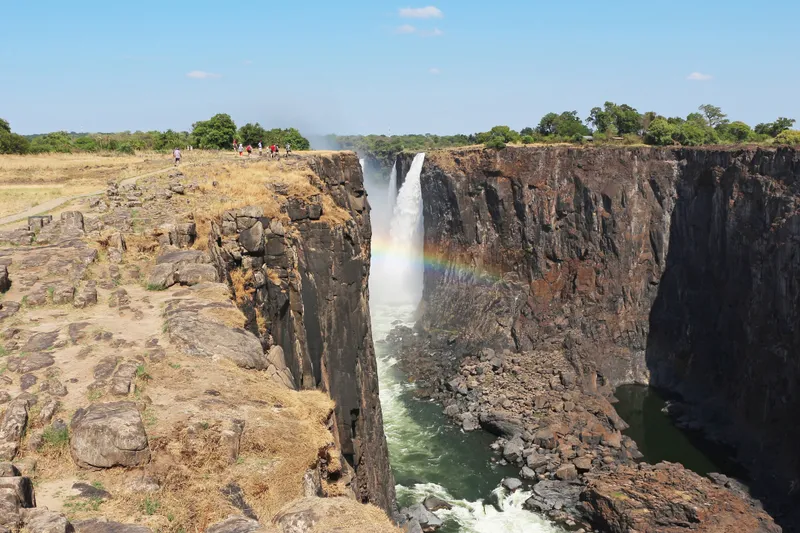
Victoria Falls is a kilometre and a half of river dropping a hundred metres into a gorge, twice the height of Niagara, and living beside it does not stop being remarkable. Hwange and Chobe are both within reach, the rafting below the falls is world class, and English is universal. The town is entirely a tourism economy and nothing else with the prices that implies, Zimbabwe's power and currency problems are constant background noise, there is no nomad community, and everything beyond the falls and the parks requires organising a trip. In high water the spray on the viewing path is heavy enough to soak a bag, which is worth knowing before walking down with a laptop in it.
Who Victoria Falls Is For
Living beside one of the natural wonders of the world with a national park two hours away, for work that tolerates the power going off. Anything beyond a month or two starts to strain. This is a small town, and even a waterfall on this scale eventually stops stopping you in the street. Tourism pricing here applies to whoever is standing there, resident or not, which makes a tight budget difficult to hold. Reliable power is the other problem, and it is a national one rather than a local one. The UniVisa makes treating Livingstone as the same town entirely practical. It also works for anyone whose own work is seasonal, since the town follows the river and the low-water months are noticeably cheaper and quieter.
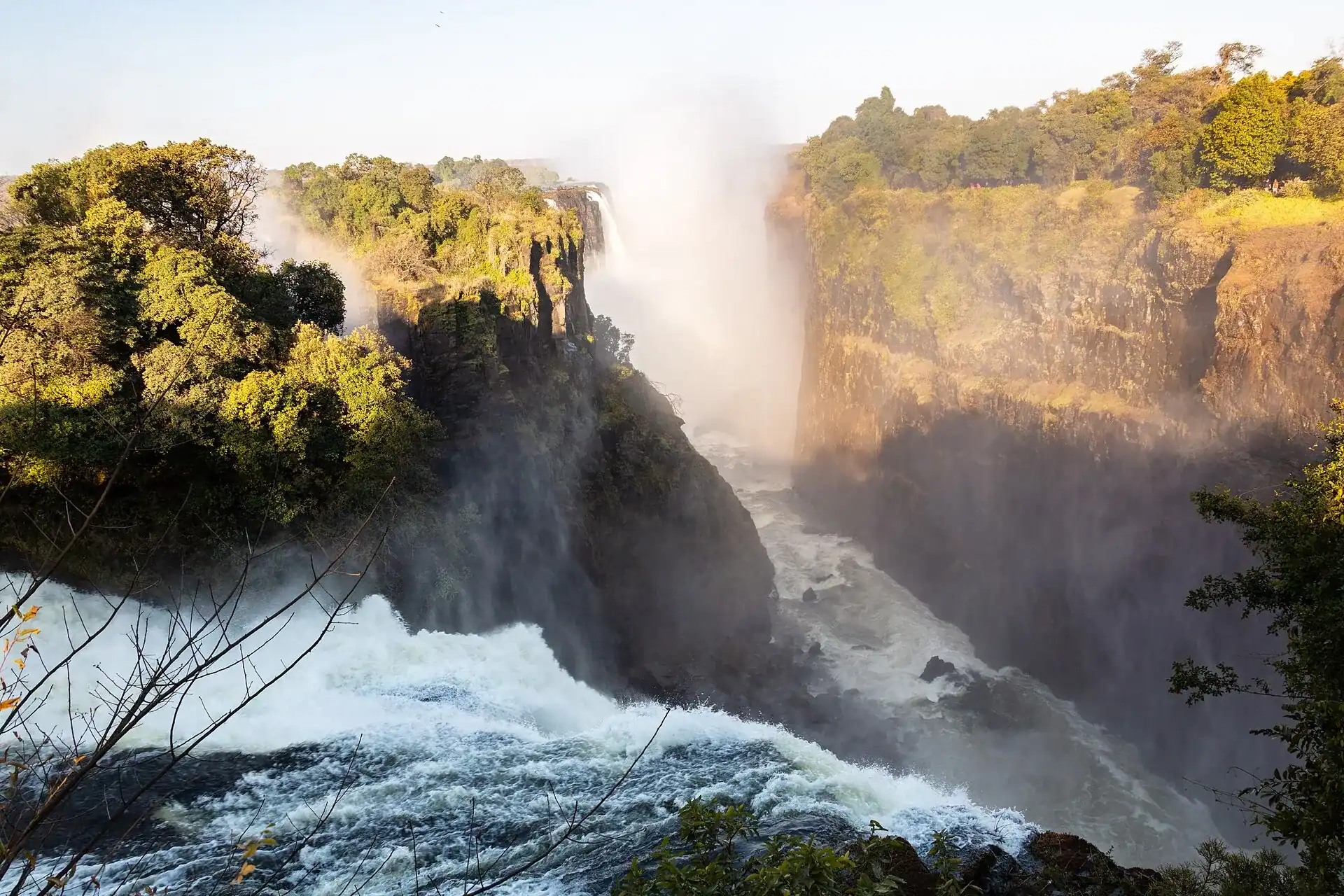 Photo: Diego Delso / Wikimedia Commons (CC BY-SA 4.0)