Cost of Living in Saint-Pierre
Where this figure comes from. No cost survey covers Saint-Pierre, so the $2,100 a month above is our own estimate rather than a measurement. On 416 of our 999 city guides the figure is built from a published Numbeo basket, a one-bedroom rent in the centre plus one person's monthly costs without rent, converted to USD; this city is not one of them. How we source everything.
Budget around $2,100 a month. A one-bedroom runs roughly $700 to $1,100, and the housing stock is small, wooden and brightly painted, which is the town's defining look. Groceries arrive by ship from Halifax and by air, and prices reflect that: this is French retail with North Atlantic freight on top. The local fish is excellent and cheap. Heating is a serious budget line, since the winters are long and the buildings are old. Eating out is limited to a handful of restaurants but the bread, cheese and wine are genuinely French, shipped from France. The euro is the currency. Value added tax simply does not exist here, since the archipelago sits outside the European customs area, and what stands in its place is a local duty charged on goods as they land, which is why the shelf price of an imported item bears no simple relation to what the same thing costs on the mainland. Fuel oil arrives by ship and is bought by the tankful, and what an old timber house gets through between October and May is the number that decides whether a year here is affordable. Social security runs through a local fund rather than the national one, with its own rates and its own card.
Where to Work in Saint-Pierre
Connectivity is good. Saint Pierre and Miquelon has a fibre connection through Canada and French telecoms infrastructure on the islands, so speeds in the town are workable and reliable, with mobile coverage across the inhabited areas. Power is reliable. There is no coworking. The time zone is unusual and worth noting: the archipelago runs three hours behind GMT, which is thirty minutes ahead of Newfoundland next door and an hour ahead of the Canadian mainland, and it observes European daylight saving dates rather than North American ones. The archipelago uses the euro while everything within reach of it runs on Canadian dollars, so a shopping trip to Newfoundland means a currency change as well as a border, and card acceptance here is patchier than in France.
Getting Around Saint-Pierre
Saint-Pierre is walkable end to end in twenty minutes and the island is only about twenty six square kilometres, with a road network you exhaust in an afternoon. Cars exist and are barely needed. Miquelon, the larger island, is reached by a ferry that takes about an hour and has its own small settlement and a long sand isthmus with wild horses on it. Saint-Pierre Airport connects to Montreal, Halifax and St John's, and a ferry runs to Fortune in Newfoundland in about ninety minutes. Anyone crossing to Newfoundland should book the ferry ahead in summer and expect it to be cancelled in rough weather, which happens often enough to build slack into any plan. A small boat runs in summer to the abandoned village on the island across the harbour, which was still inhabited within living memory and is kept now as an open-air museum with a church, a school and a wreck on the shore. It is the best half day here. Driving is on the right with plates and rules from the mainland, and the fuel comes in at a price nobody from either neighbouring country would recognise. Bicycles work in summer and are pointless for half the year.
Sorting transport? Book an airport transfer, or compare car rental on Auto Europe and QEEQ.
Visas for Saint-Pierre
Saint Pierre and Miquelon is a French overseas collectivity, part of France but outside the European Union and outside Schengen, so a Schengen visa does not admit you and time here does not count against a Schengen allowance. French and European Union citizens have freedom of movement and may live and work here. Most Western nationalities enter visa-free for up to ninety days. Arriving overland means transiting Canada, so Canadian entry rules apply first, and that catches out people who assumed a French territory would be simple. Anyone flying in from Canada should also carry proof of onward travel, since the airline checks it and the archipelago's schedules leave little room to improvise a departure. A pet travelling with you has to satisfy two sets of rules rather than one, because almost every route in crosses another country first and that country applies its own conditions to an animal in transit. The same logic catches anybody carrying prescription medicines or professional equipment. Carry the rules in writing, because a check-in desk will not know them. Freedom of movement here comes attached to a labour market of a few thousand jobs, most of them public, so the right to work and the chance of work are quite different propositions.
Best Time to Visit Saint-Pierre
July to September is the season, and it is a short one: temperatures reach around eighteen degrees, the fog lifts more often and the ferry and flight schedules are at their fullest. Winter from December to March is cold, windy and snowy, with the sea often too rough for the ferry. Fog is the defining weather here and can sit over the islands for days in any season, which is why the approach to the airport is so often diverted. Spring is late and cold. The Basque and Breton festivals in August are the liveliest weeks of the year, and they are when the archipelago's fishing heritage is most visible in the town. The capelin roll in early summer brings small silver fish onto the beaches in their millions to spawn, and everyone goes down to watch and to gather them, which is the clearest sign the season has finally turned. Snow clearing is a municipal operation that runs through the night, and the streets are usually passable by morning however much fell. Midwinter is the social season in a town this size, with the halls booked solid between the feasts and nobody going anywhere else in any case.
Pros and Cons of Saint-Pierre
This is genuinely France, with French administration, French food, French schools and the euro, sitting twenty kilometres off the coast of Newfoundland, and no other place on earth offers quite that combination. The town is small, safe and remarkably pretty in its painted timber. The weather is the price: cold, wet and foggy for most of the year, on top of the isolation, a population of about six thousand, and a stock of things to do that runs out inside a single week for most people. The islands also hold the only guillotine ever used in North America, which was shipped from Martinique in 1889, used once, and is now in the museum.
Who Saint-Pierre Is For
This suits French speakers who want North America without leaving France, anyone drawn to the North Atlantic, and people with a working reason to be here in fisheries or administration. The Prohibition era ran through these islands on an enormous scale. Liquor moved from here into the United States all through the 1920s, and the warehouses that held it are still standing. Sunshine, choice and company are three things six thousand people on a fogbound North Atlantic archipelago cannot supply, and French is required, because English is thin on the ground here despite Canada being twenty kilometres away. It suits anyone with time rather than a schedule, since arriving means either the ferry from Fortune in Newfoundland or a small aircraft, and both defer to the fog that can close the islands for days together.
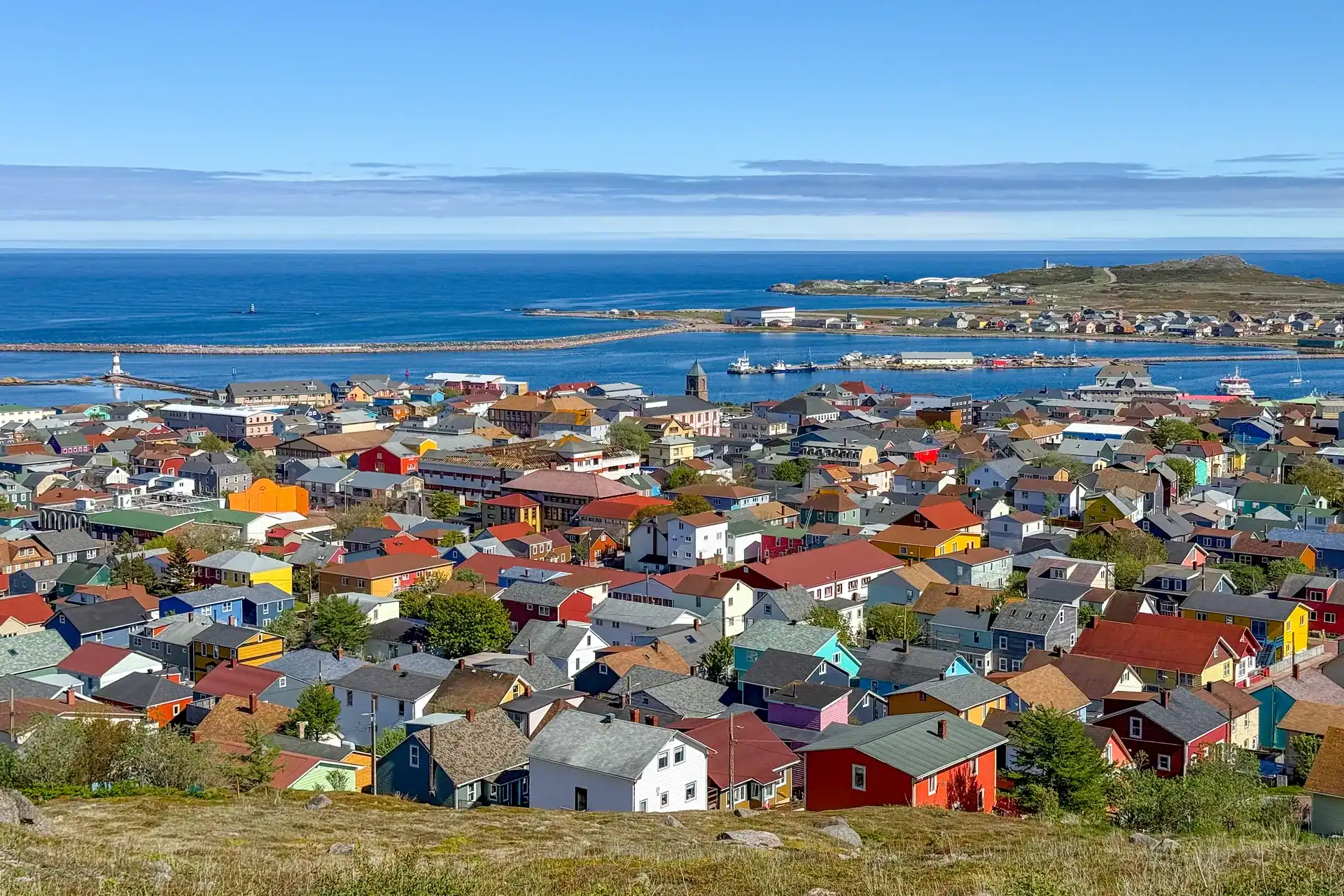 Photo: Quintin Soloviev & Hayden Soloviev / Wikimedia Commons (CC BY 4.0)