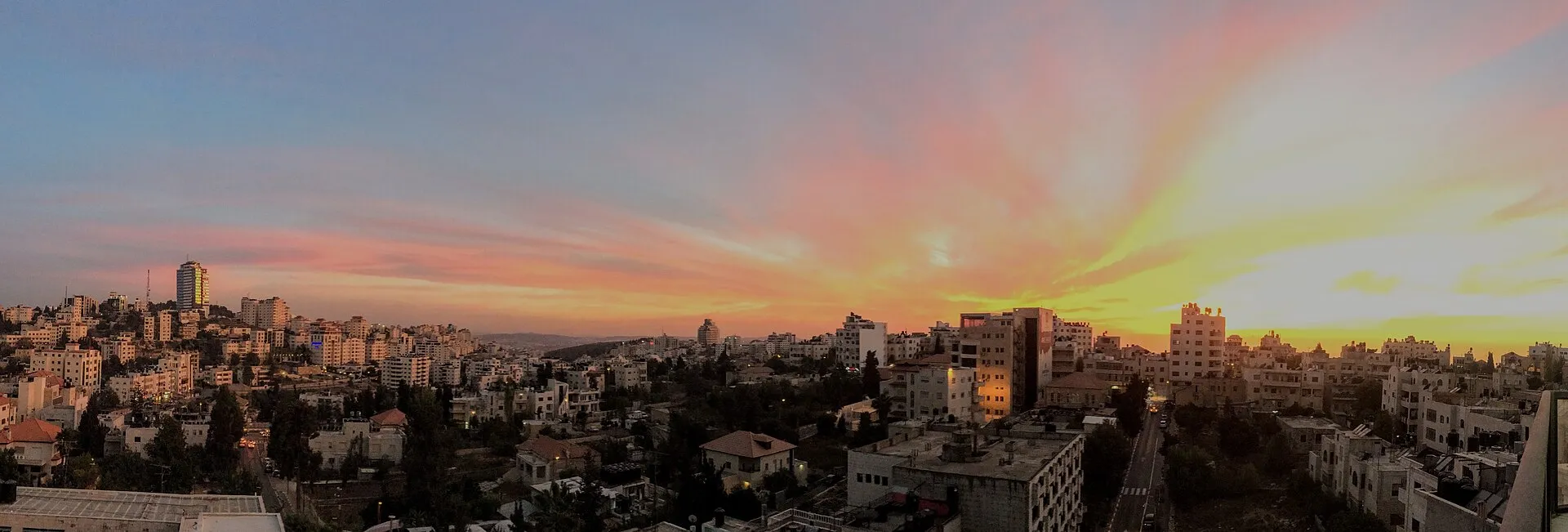
Panoramic view of Ramallah at sunset, showing the city's white limestone buildings spread across rolling hills
Photo: Fjmustak / Wikimedia Commons (CC BY-SA 4.0)
Palestine flag

Ramallah

Palestine

Palestinian resilience and creativity, rooftop cafes, art galleries, and hillside sunsets.

$1.700
Monthly Budget
--
Current Weather
Mediterranean
Climate Type
60 Mbps
Avg. WiFi Speed
4/10
Safety Score
500+
Active Nomads
--
Time Difference
Scroll
0
Nomad Score

Ramallah for Digital Nomads: The Honest Take

Palestinian resilience and creativity, rooftop cafes, art galleries, and hillside sunsets. A mediterranean climate and strong food make Ramallah an easy base, and at about $1,700 a month it fits a range of budgets. Keep visa access in mind.

Compare Ramallah vs Tel Aviv →

Category Breakdown

How Ramallah scores across all 13 factors

Weather in Ramallah

Monthly averages from 2019-2023 (Open-Meteo), and the best time to visit

12°
Jan
12°
Feb
15°
Mar
21°
10°
Apr
26°
14°
May
28°
16°
Jun
30°
18°
Jul
31°
18°
Aug
30°
18°
Sep
26°
15°
Oct
20°
12°
Nov
15°
Dec
Daily high & low (°C)Rainfall (mm/month)Best months to visit

The best time to visit Ramallah for comfortable weather is Jul, Aug, Sep. The warmest month is Aug (around 31°C by day), and the wettest is Jan (about 89mm of rain).

Chasing good weather? See other cities that are warm in Jul, or plan a multi-city route around the seasons. Staying a while in Ramallah? Check visa options, your time-zone overlap and how far your budget stretches, or find it on the world map.

Historical monthly averages, not a forecast. Source: Open-Meteo.

Best Neighborhoods in Ramallah

Where to base yourself for the perfect nomad experience

Al-Manara

$
Cultural dynamic

Central square of Palestinian culture

The main square and surrounding streets form Ramallah's commercial and social heart. Cafes, restaurants, and cultural venues buzz with artists, activists, and young Palestinians creating vibrant urban culture.

Best for: Culture seekers and social travelers
✓ Pros
  • Cultural hub
  • Great cafes
  • Vibrant nightlife
  • Central location
✗ Cons
  • Traffic congestion
  • Can be loud
  • Political demonstrations

Ein Munjed

$$
Residential peaceful

Hillside views and residential calm

This upper neighborhood offers panoramic views of the surrounding hills and a quieter residential atmosphere. Families and professionals appreciate the tree-lined streets and modern apartments.

Best for: Long-term stays seeking quiet
✓ Pros
  • Beautiful views
  • Peaceful streets
  • Family area
  • Modern housing
✗ Cons
  • Uphill walks
  • Far from nightlife
  • Limited dining

Al-Tireh

$$
Upscale international

Upscale living with international presence

This affluent neighborhood hosts NGO offices, diplomatic residences, and upscale restaurants. International workers and wealthy Palestinians create a cosmopolitan atmosphere with quality services.

Best for: Expats and business visitors
✓ Pros
  • Quality dining
  • International community
  • Safe area
  • Good services
✗ Cons
  • Expensive
  • Less authentic
  • Needs car

Al-Bireh

$
Local traditional

Twin city with local character

Technically a separate city merged with Ramallah, Al-Bireh offers more local Palestinian life. Traditional markets, family restaurants, and everyday commerce provide authentic experiences.

Best for: Cultural immersion seekers
✓ Pros
  • Authentic atmosphere
  • Lower prices
  • Local markets
  • Real Palestine
✗ Cons
  • Less polished
  • Arabic helpful
  • Basic services

Um Al-Sharayet

$
Emerging trendy

Growing neighborhood with young energy

This developing area attracts young professionals and students with affordable rents and emerging cafe culture. New businesses open regularly as the neighborhood gentrifies while maintaining accessibility.

Best for: Budget-conscious creatives
✓ Pros
  • Affordable rents
  • Young crowd
  • New cafes
  • Good value
✗ Cons
  • Still developing
  • Some rough edges
  • Limited nightlife

Cost of Living in Ramallah

Ramallah uses the Israeli shekel (ILS) alongside the US dollar, both widely accepted. For a single remote worker, budget roughly $1,400-2,300 per month depending on your lifestyle.

  • Rent, 1-bedroom central (Al-Masyoun, city center): ILS 1,800-2,200 / $500-600 per month
  • Rent, 1-bedroom cheaper areas (Bireh, Beitunia outskirts): ILS 1,100-1,600 / $300-430 per month
  • Groceries: ILS 800-1,200 / $220-330 per month for one person cooking at home
  • Eating out (local Palestinian restaurant): ILS 30-60 / $8-17 per meal
  • Coffee in a cafe: ILS 12-16 / $3-4
  • Beer (bar): ILS 18-22 / $5-6
  • Coworking hot-desk: approximately ILS 840 / $228 per month
  • Local transport (taxi within city): ILS 10-15 / $3-4 per trip; shared servees (minivans) cost ILS 3-5
  • Mobile data (10GB): approximately ILS 65 / $18 per month

Realistic monthly total: $1,000-1,600 living locally. If you eat out often and rent centrally, plan for the higher end. Your actual spending depends heavily on habits: Ramallah is very affordable by regional standards if you eat where locals eat.

Where to Work

Ramallah has a small but real coworking scene, partly driven by the Palestinian startup and NGO community. The most established spaces are centrally located and cater to a mix of local professionals, diaspora returnees, and international development workers.

uMake (Ammar Tower, city center) is the best-equipped option, with four meeting rooms, an onsite cafe, outdoor terraces, high-speed fiber, 24-hour access, and a strong community vibe. It is consistently the top choice for remote workers. Sidekick Workplaces and The Work Shop (near Plaza Mall) offer flexible desk memberships in modern settings with reliable internet and a quieter atmosphere suited to focused work.

Cafe culture in Ramallah is vibrant and laptop-friendly. Many coffee shops around Al-Masyoun and downtown welcome workers during off-peak hours. However, WiFi at cafes varies: speeds hover around 5-8 Mbps and can drop during busy periods. For video calls and large uploads, a proper coworking space is a safer bet. Expect speeds of 6-15 Mbps on average, which handles most remote work but can feel sluggish for heavy tasks.

Getting Around

The center of Ramallah is compact and walkable. Most restaurants, cafes, banks, and shops in Al-Masyoun and the old city are reachable on foot in under 20 minutes.

For longer distances, taxis are the main option. They run on a fixed ILS 10 meter-start rate within the city. Shared servees (minivans) cover fixed routes within Ramallah and to nearby towns like Bireh for ILS 3-5. There is no metro or tram.

Inter-city travel to Bethlehem, Nablus, Jericho, and Hebron uses shared service taxis departing from the central bus station. Shared taxis to Bethlehem cost around ILS 8-12 and take 30-50 minutes depending on checkpoint waits.

Getting to the airport: There is no Palestinian airport in the West Bank. You use Ben Gurion Airport (TLV) near Tel Aviv. From Ramallah, take a shared taxi to Jerusalem's Damascus Gate (ILS 8-10), then a taxi or shared service to the airport (ILS 100-200 depending on negotiation). Budget 2-3 hours for the full journey and factor in checkpoint crossing time. Israeli-licensed vehicles cannot be used by Palestinian plates on certain roads, which adds complexity.

Visas and Staying Long-Term

Palestine has no independent visa regime for the West Bank: entry is controlled entirely by Israeli authorities. You enter through Israeli-controlled crossings, primarily Ben Gurion Airport or the Allenby Bridge (King Hussein Bridge) from Jordan.

As of January 2025, most Western passport holders (EU, US, UK, Canada, Australia) must obtain an Israeli Electronic Travel Authorization (ETA-IL) before arrival. The ETA is valid for two years and covers stays of up to 90 days. No separate Palestinian visa exists for the West Bank.

Israeli border officers grant tourist entry at their discretion and may question the purpose of visiting the West Bank specifically. Stays are typically granted for 90 days. Extensions require leaving and re-entering the country. There is no digital nomad visa for Palestine. Some travelers stay long-term through NGO, university, or volunteer arrangements that provide institutional backing.

Always confirm current entry rules with your country's foreign affairs ministry and the Israeli immigration authority before travel.

Best Time to Visit

Ramallah sits at around 880 meters elevation, giving it a Mediterranean climate with cooler summers than the coast and cold, occasionally snowy winters.

Spring (March-May) is the most pleasant season for remote workers: temperatures of 15-22C, green hills, no rain disruptions, and the city's cafe terraces in full use. Autumn (September-November) is equally comfortable, with warm days around 20-28C and a lively cultural calendar.

Summer (June-August) is dry and hot, peaking at 30-35C, though the elevation keeps it cooler than Tel Aviv. Many locals and expats are active during this period; the outdoor bar and pool scene is at its busiest.

Winter (December-February) brings cold temperatures (5-12C), rain, and occasional snow that can disrupt movement. Coworking spaces stay warm and operational, but the political and security situation can also be more tense during this period. Spring and autumn give you the best combination of weather, mobility, and a relaxed city atmosphere.

Pros and Cons

  • Affordable cost of living if you adapt to local habits
  • Rich cultural scene: film festivals, live music, art galleries, and a genuine cosmopolitan edge rare in the region
  • Excellent food: Palestinian cuisine at its most diverse, plus international restaurants of real quality
  • Warm hospitality and a welcoming attitude toward foreign visitors and workers
  • Growing startup and NGO community makes it easy to find like-minded professionals
  • Unique experience with deep historical and cultural significance
  • Unpredictable security situation: Israeli military operations, checkpoints, and occasional civil unrest can disrupt daily life with little warning
  • Slow and inconsistent internet (averaging 6 Mbps) limits productivity for bandwidth-heavy work
  • No airport: getting to Ben Gurion adds 2-3 hours and checkpoint uncertainty every trip
  • Entry and exit at Israeli checkpoints can be stressful, time-consuming, or denied without explanation
  • Limited banking access for foreigners; international cards work in some ATMs but not all
  • Travel advisories from many Western governments currently recommend against or urge caution for West Bank travel

Who Ramallah Is Best For

Ramallah suits remote workers who are already drawn to the region for personal, cultural, or political reasons and want to experience Palestinian life firsthand. Journalists, researchers, humanitarian professionals, and academics find the city an especially rich base. It also works well for travelers who want a low-cost, socially vibrant city with a genuinely unique atmosphere and are comfortable with an elevated level of uncertainty in day-to-day logistics.

It is not ideal for nomads who need absolute reliability: fast internet, frictionless border crossings, and predictable movement are not guaranteed. If you depend on low-latency video calls, large file uploads, or need to travel frequently by air, Ramallah will test your patience. Travelers from countries with complicated relationships with Israel may face difficulties at border crossings. Anyone unwilling to engage honestly with a politically complex context should look elsewhere.
Where to Stay in Ramallah

Top neighborhoods and accommodations for digital nomads

Reggenza Hotel Downtown Ramallah

Hotel
Downtown Al Manara

Two-minute walk from Al Manara Square with free WiFi, balconies, and a 9.2 Booking.com score for location and value.

Check availability →

Lavender Boutique Hotel

Boutique hotel
Al Nuzha

Quiet residential street five minutes from downtown, free WiFi, rooftop terrace, and a 5/5 TripAdvisor score across 67 reviews.

Check availability →

Carmel Hotel

Hotel
Al Masyoun

Upscale property with a 24-hour business center, meeting rooms, free WiFi, and panoramic city views six minutes from the city center.

Check availability →

Al-Istiklal Suites

Serviced apartments
Al Bireh Business District

43 fully equipped suites with high-speed internet, kitchen, laundry, and 24/7 security in Ramallah's central business district.

Check availability →

Olive Tree Hostel

Hostel
Al Jinan Al Bireh

Top-rated hostel with free WiFi, garden common area, local breakfast, and no curfew, ideal for solo nomads on a budget.

Check availability →

Browse apartments, aparthotels and hotels across Ramallah. Compare prices and book a base that suits a remote-work stay.

See available stays in Ramallah →

Affiliate link. See our disclosure.

Best Coworking Spaces

Where nomads get work done in Ramallah

uMake

Coworking space
City Center

Full-service coworking hub in Ammar Tower with cafe, outdoor terrace, meeting rooms, and a strong startup community.

Visit website →

Sidekick Workplaces

Coworking space
City Center

Professional flexible workspace near Ramallah city center offering dedicated desks, private offices, and conference rooms.

Visit website →

The Work Shop

Coworking space
Plaza Mall Area

Creative coworking space near Plaza Mall with flexible desks, meeting rooms, and high-speed internet for freelancers and small teams.

View on Maps →

Pronto Lounge and Kitchen

Restaurant cafe
City Hall Area

Ramallah institution since 1997 serving Italian food and beer; popular with journalists, NGO workers, and laptop regulars.

View on Maps →

Garage Coffee Shop and Bar

Cafe bar
Ramallah Taht

Bohemian cafe-bar behind Al Huda Gas Station attracting creatives, expats, and travelers with strong coffee and a relaxed vibe.

View on Maps →

Khalil Sakakini Cultural Centre Cafe

Cultural cafe
Al-Masyoun

Quiet cafe inside Ramallah's main cultural center, ideal for focused laptop work in a calm, arts-oriented setting.

Visit website →

Where to Eat & Drink

Best food and drink spots in Ramallah

Darna Restaurant

Palestinian fine dining
City Center

Beautifully restored stone-building restaurant serving refined Palestinian and Mediterranean cuisine ranked among Ramallah's best.

Visit website →

Azure Restaurant

Restaurant bar
Al-Masyoun

Family-run restaurant-bar in a 1956 stone home on Al Ma'ahed St, known for Ramallah's best steaks and a warm atmosphere.

View on Maps →

SnowBar Garden

Outdoor restaurant bar
West Ramallah

Iconic pine-tree garden venue with a pool, fire pits, and casual Middle Eastern and Western food served in a stunning outdoor setting.

Visit website →

Ziryab Restaurant

Palestinian restaurant
Old City

Traditional Palestinian restaurant in the old city serving authentic local dishes including mansaf and maqluba in a heritage setting.

View on Maps →

Granada Bar and Restaurant

Bar restaurant
City Center

Long-standing Ramallah bar with live music nights, Palestinian food, and a lively crowd of locals and internationals on weekends.

View on Maps →

Janan's Kitchen

Palestinian restaurant
Al-Masyoun

Homestyle Palestinian cooking in an intimate setting praised for its musakhan, fresh mezze, and warm family-run service.

View on Maps →

What Do Nomads Say?

Vote on how accurate these scores are based on your experience

Cities with a Similar Vibe to Ramallah

Different places that score alike across our 13 categories, if you like Ramallah, these tend to feel similar.

Frequently Asked Questions About Ramallah

How much does it cost to live in Ramallah as a digital nomad?

A comfortable nomad budget in Ramallah is around $1,700 a month: a furnished rental, food, coworking, and getting around. Live a little outside the center or eat local to spend less.

Is the internet fast enough for remote work in Ramallah?

With a WiFi score of 6/10, connectivity in Ramallah is workable for calls and focused work. A prepaid local SIM keeps you online when you are away from the apartment.

Is Ramallah safe for digital nomads?

Ramallah scores 4 out of 10 for safety in our ratings, which is patchy for solo travel and long stays. Use normal precautions at night and with valuables, and choose well-reviewed areas.

Is Ramallah a good city for digital nomads overall?

For nomads, Ramallah is worth a look if you value food and culture. Costs sit near $1,700 a month and the community keeps growing, though, like anywhere, it will not match every checklist.