Cost of Living in New Plymouth
Where this figure comes from. No cost survey covers New Plymouth, so the $1,650 a month above is our own estimate rather than a measurement. On 416 of our 999 city guides the figure is built from a published Numbeo basket, a one-bedroom rent in the centre plus one person's monthly costs without rent, converted to USD; this city is not one of them. How we source everything.
Budget around $1,650 a month as a solo remote worker in New Plymouth, which is among the cheaper options in New Zealand while keeping a full range of services. A one-bedroom flat runs roughly $800 to $1,150. New Zealand grocery prices are high and imported goods carry a premium that surprises arrivals from Europe or Asia. The region's economy rests on dairy and on oil and gas, which keeps wages and some prices higher than a town this size would otherwise support. This is our own estimate rather than a reconciliation against measured data. The local market is distorted from both ends. Fonterra's plant near Hawera is among the largest dairy factories in the world, and the payout to farmers swings the regional economy far harder than eighty thousand people ordinarily would, so a good season lifts rents and a bad one softens them. The energy sector pulls the other way, paying salaries the local labour market could not otherwise support and taking rents up with them. The effect for a remote worker is that costs here follow a milk price and a gas price, neither of which has anything to do with the town.
Where to Work in New Plymouth
New Plymouth has limited formal coworking, with a small number of spaces serving the energy sector that dominates local professional employment. Fibre is widely available at reliable speeds and typical New Zealand pricing, and mobile coverage is comprehensive in town and patchy on the mountain and around the coast. The Len Lye Centre and the town's arts programme give the place a creative layer unusual for its size. As everywhere in New Zealand, confirm the connection at a specific property rather than assuming it is in place. Anyone whose work depends on being seen in person should understand that the nearest city of any size is four hours away by road. The first oil well in this country was drilled at Moturoa inside what is now the city, in 1865, which makes the region's energy history older than most of the industry anywhere. The Maui field offshore carried the national gas supply for decades and is now in decline, which is why the technical workforce here has been steadily retraining into wind, hydrogen and geothermal, and why a newcomer with engineering skills finds more technical conversation here than this far from a city has any right to offer.
Getting Around New Plymouth
New Plymouth is compact and the Coastal Walkway runs thirteen kilometres along the shore from the port to Bell Block, which functions as the town's main artery for walking and cycling rather than as a recreational path. A local bus network covers the suburbs. Egmont National Park and the trailheads onto Mount Taranaki are half an hour inland. The airport has domestic connections. Everything beyond the town, the Surf Highway, the Forgotten World Highway and the mountain, needs a car. The Surf Highway 45 runs around the coast from the town and is the route to almost every break in the region, which is what most people here use a car for. Egmont National Park is a near-perfect circle on the map, a boundary drawn in 1900 as a radius of about nine and a half kilometres from the summit, and the line between dark forest inside it and green farmland outside is sharp enough to be obvious from an aircraft. Every road onto the mountain stops at that edge, which is why the three main trailheads are the only realistic ways up and why they fill on a clear weekend.
Sorting transport? Book an airport transfer, or compare car rental on Auto Europe and QEEQ.
Visas for New Plymouth
New Zealand's 2025 clarification that visitors may work remotely for a foreign employer changed the practical position considerably. Most Western nationals get an NZeTA and up to three months on arrival, extendable in some cases to a maximum of nine months within eighteen. Working Holiday visas cover a defined list of nationalities and ages with twelve months of work rights. Longer stays go through the accredited employer route or the skilled residence pathway. The region's oil and gas sector has historically sponsored skilled workers, which is one of the few employer-led routes into New Zealand outside the main centres. New Zealand charges an International Visitor Conservation and Tourism Levy on arrival, paid alongside the NZeTA rather than separately, and it was raised sharply in late 2024. It funds conservation and tourism infrastructure of exactly the kind the national park here depends on. Australians and a few other categories are exempt. It is small against the cost of a flight but it is a real line, and it falls again on a fresh visa rather than once per person.
Best Time to Visit New Plymouth
December to March is the warm half, with daytime temperatures around twenty-two and the sea swimmable. Taranaki is wet: the mountain catches weather off the Tasman and rain falls in every month, so a dry spell is luck rather than season. February is the most settled month. Winter from June to August is mild at sea level, with highs around thirteen, while the mountain holds snow and the ski field operates. The famous view of a symmetrical volcanic cone depends entirely on the cloud lifting. Locals will tell you the mountain is visible about one day in three, which is worth knowing before booking a trip around the view. The mountain makes its own weather and the numbers are stark: the summit takes several times the rainfall of the town below it, and conditions at the trailhead say very little about conditions two hours up. Search and rescue call-outs run high for a peak this accessible, because the walk starts easy and the last section is alpine. The Festival of Lights runs through Pukekura Park from December to February and is the reliable summer fixture whatever the cloud is doing.
Pros and Cons of New Plymouth
New Plymouth has one of the most striking settings of any town in this dataset: a near-perfect volcanic cone thirty minutes inland, a thirteen-kilometre coastal walkway through the middle, and consistent surf along the Surf Highway. The Len Lye Centre is a serious gallery for a town this size. It is remote even by the standards of New Zealand, the weather is genuinely wet, there is no international community, and the local economy's dependence on oil and gas makes its future a live local question. The town is also on the wrong side of the island for most itineraries, so it is rarely somewhere people pass through by accident. The mountain became a legal person in 2025, recognised as an entity holding its own rights and vested in a body that speaks for it, following Te Urewera and the Whanganui River, and its official name is now Taranaki Maunga. That settlement sits on top of a much harder history: Taranaki land was confiscated in the 1860s, and in 1881 the government sent troops into Parihaka, a settlement built on deliberate non-violent resistance, arresting its leaders and dispersing its people. The Crown apologised in 2017. Parihaka is forty minutes from the town and open to visitors.
Who New Plymouth Is For
New Zealand work rights and a life organised around the mountain and the surf, in a town that has real services and an unexpectedly good arts scene. It works for climbers and trampers, since Mount Taranaki is a serious objective rather than a walk. No international community has formed here, the mountain makes dependable sunshine impossible to promise, and the professional network begins and ends with the energy sector. The cultural life here runs well ahead of the population. A serious kinetic art gallery and a WOMAD festival every March are not what a town this far from anywhere would normally sustain. It is not a place to arrive expecting company. It suits a surfer who does not need warm water, since the breaks along the coast road work on almost any swell and the crowd stays thin even in summer. It suits somebody with a professional reason to be here, because the energy transition arguments are live and the people having them are all in one town. Anyone coming for the cone on the postcard should build the trip around something else and treat a clear day as a bonus, which is the only way to arrive and not leave disappointed.
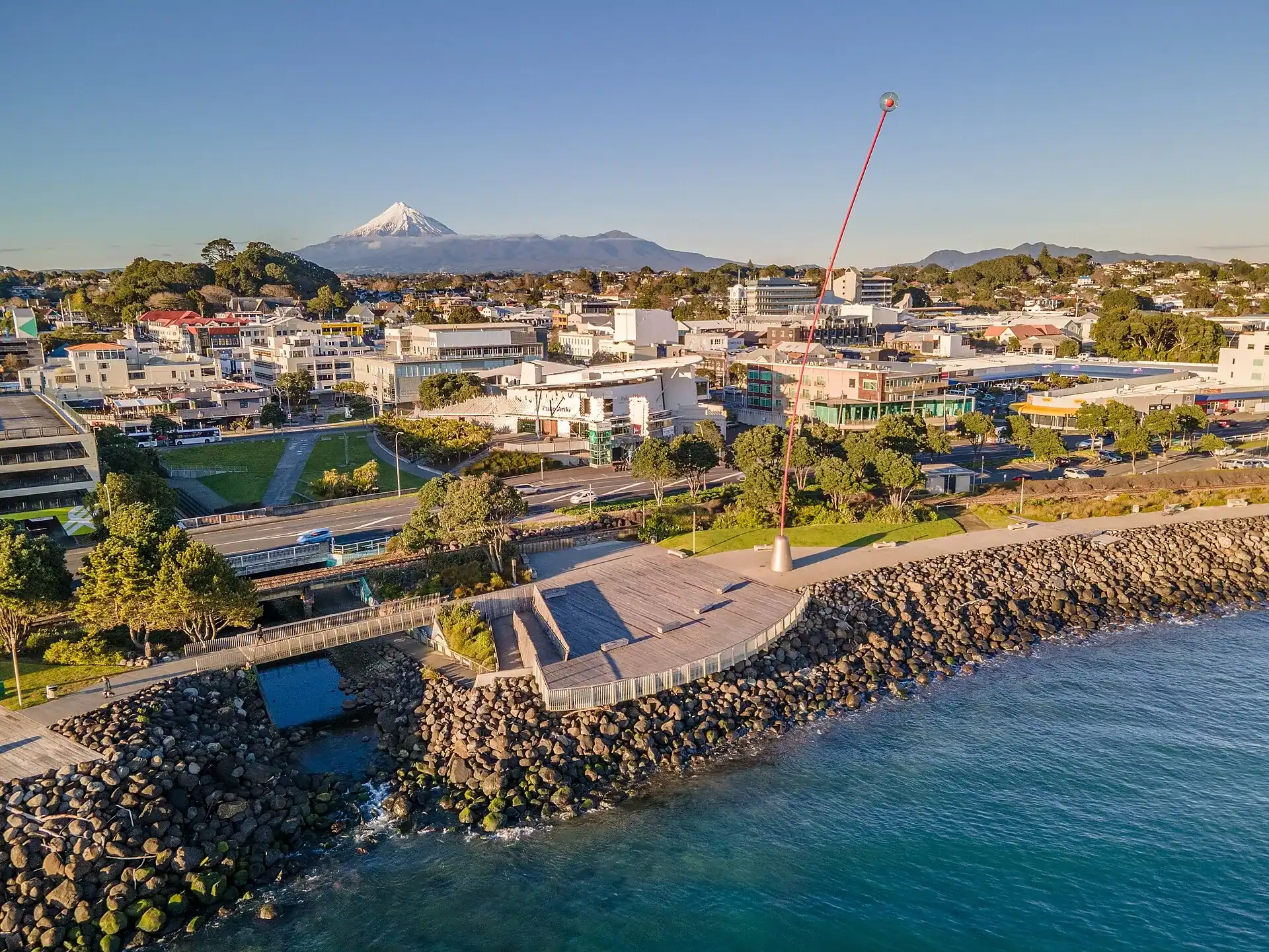 Photo: Mknz24 / Wikimedia Commons (CC BY-SA 4.0)