Cost of Living in Grenoble
Real market data
Source: Numbeo · August 2026
$1,760/moSolo nomad1-bed centre + living costs
$2,500/moCoupleshared 1-bed + costs
$1,550/moLean / localcheaper area + costs
- 1-bed rent, city centre$850€735
- 1-bed rent, outside centre$640€554
- Monthly costs excl. rent (1 person)$920€797
- Meal, inexpensive restaurant$17€15
- Monthly transit pass$79€68
- Buy price, per m² (centre)$3,980€3,454
Prices are from Numbeo (August 2026), converted to USD at $1 = €0.87 (01 Aug 2026). The monthly living-costs figure is our transparent one-person basket, groceries, a few meals out, utilities, phone, internet, transport and essentials, priced from those figures. Solo adds central rent; couple and lean are estimates from the same numbers. The guide below quotes its own monthly range, which is a different measurement rather than a competing one: this table prices a defined basket at the figures above, while that range is a judgement about how somebody actually lives here.
Grenoble is noticeably cheaper than Paris but comparable to other mid-size French cities. Expect to spend more than in Southeast Asia or Eastern Europe, but less than Geneva or Zurich just across the border.
- Rent, central studio (Hyper-Centre, Presqu'ile): $800-1,100/month
- Rent, cheaper area (Ile Verte, Berriat, outlying tracts): $570-800/month
- Groceries: $230-340/month shopping at Lidl or a local market
- Eating out (lunch menu or kebab): $11-17 per meal; a sit-down dinner with wine runs $28-46
- Coworking hot desk: $190-280/month at a dedicated space; cafe coworking runs $5.50-11/session
- Local transport (tram/bus pass): $34-63/month; cycling is effectively free
- Total realistic range: $1,350-2,300/month for a working nomad on a sensible budget
Students and long-term residents manage on under $1,150, but nomad pricing for accommodation without a local guarantor tends to push costs higher. Airbnb short-lets run two to three times rental-market rates, so finding a furnished monthly rental via a local agency or Le Bon Coin makes a real difference.
Where to Work
Grenoble has a healthy coworking scene built partly on its large university and tech sector. You will not struggle to find a desk.
Dedicated Coworking
The Babel Community (near the Bastille, Saint-Laurent) is a modern 600 m2 space with fast fiber, ergonomic desks, meeting rooms, and city views; day passes run $23, monthly open space $230. Minimistan (Vieux Temples, city centre) operates out of a converted convent, blending coworking with a cafe, bar, and cultural events; pricing is $23/day or $250/month. Cowork In Grenoble (co-work.fr) is one of the oldest and most established spaces, known for a strong entrepreneurial community. Cap Cowork at Caserne de Bonne offers 25 desks and private offices from $23/day.
Cafe Work Culture
L'Impertinence (32 rue Saint-Jacques) is a dedicated cafe-coworking hybrid where you pay by the hour and drinks are included, making it genuinely laptop-friendly rather than a place that merely tolerates laptops. French Coffee Shop on Place Claveyson has strong WiFi and a 4.5 Google rating. Most regular Grenoble cafes do not welcome long laptop sessions during peak hours; the hybrid spaces above are the safer bet.
WiFi
All dedicated coworking spaces offer fiber-grade connections. Public WiFi is available in some tram stops and city squares but is inconsistent. A French SIM with a data plan (around $11-17/month for 20-30 GB) gives you a reliable backup.
Getting Around
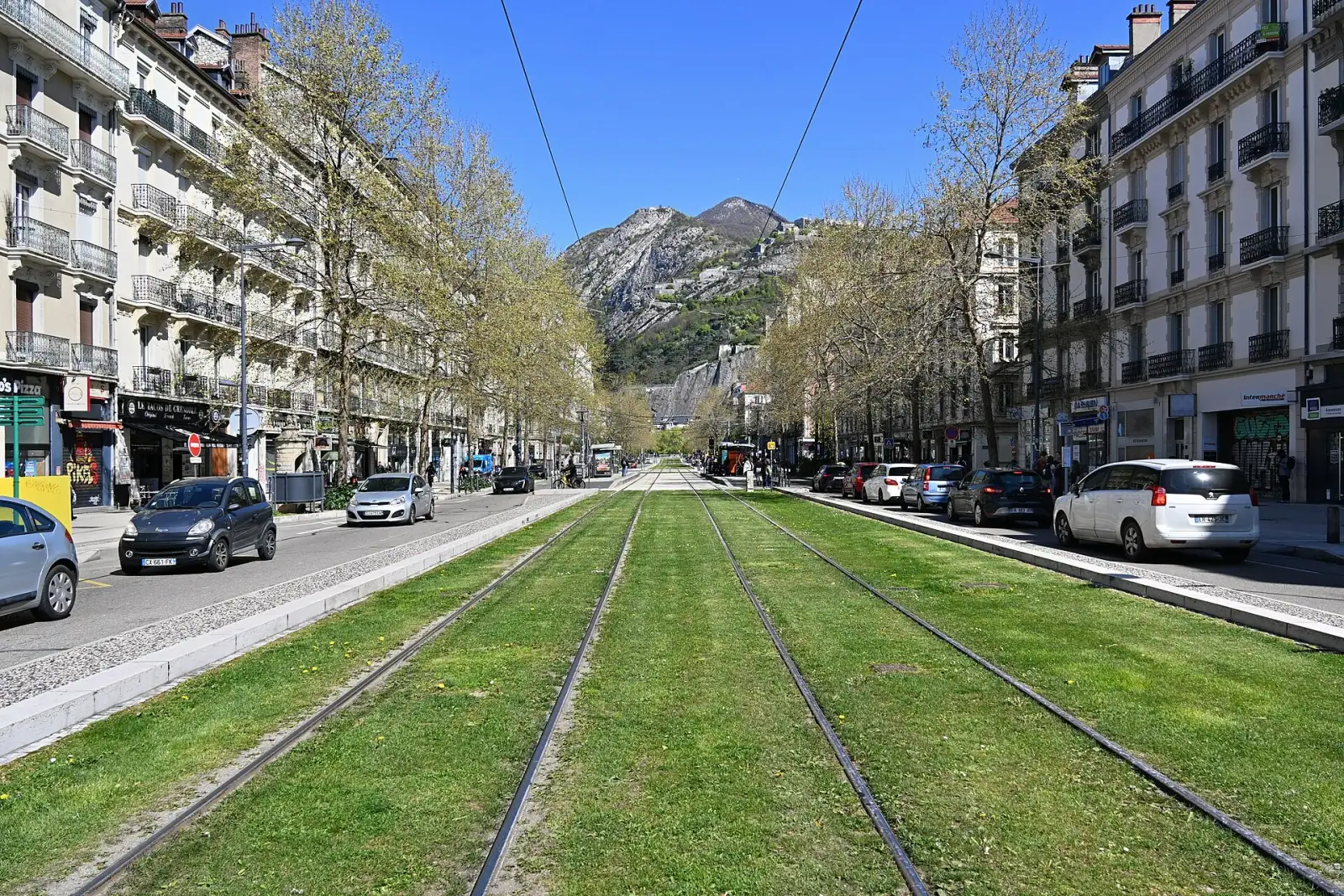
Grenoble is exceptionally bikeable, often cited as France's top cycling city. The flat city centre, a dense grid of bike lanes, and a widely used bike-share system (Metrovelo) mean many residents own no car at all.
The tram network (5 lines, M Reso) covers the city and runs frequently, with a day ticket around $2 and a monthly pass around $57. Buses extend coverage to the hillside suburbs. The system is 100 percent accessible.
Walking across the compact city centre takes 20-25 minutes. Most coworking spaces, restaurants, and supermarkets are within easy walking or cycling distance of central neighborhoods.
Getting to and from the Airport
There is no major international hub in Grenoble itself. Lyon-Saint Exupery Airport (LYS), roughly 100 km away, is the main option; a direct shuttle (Satobus/Altibus) runs several times daily and takes about 1 hour 15 minutes, costing around $28-34. Geneva Airport (GVA) is served by Flixbus and Altibus in about 2 hours. Grenoble-Isere Airport (GNB), 45 km away, handles seasonal and some low-cost routes but has very limited schedule. By train, Grenoble connects easily to Paris (3 hours by TGV via Lyon) and Lyon (1 hour 15 minutes by regional rail).
Sorting transport? Book an airport transfer, or compare car rental on Auto Europe and QEEQ.
Visas and Staying Long-Term
Citizens of the US, Canada, UK, Australia, and most other Western countries can enter France (and the broader Schengen Area) without a visa for up to 90 days within any 180-day period. You cannot legally work for foreign clients on a standard tourist entry under French law, though this is rarely enforced for short stays.
France has no dedicated digital nomad visa. For stays beyond 90 days your main options are the Long-Stay Visitor Visa (VLS-TS), which allows you to live in France up to one year (renewable) while working remotely for a non-French employer, and the Profession Liberale visa, suited to freelancers or self-employed workers who have clients. Both require application at a French consulate in your home country before arrival, proof of sufficient funds, and health insurance.
Best Time to Visit
Grenoble sits in a bowl surrounded by the Alps, which shapes its climate sharply. Winters (December to February) are genuinely cold, with temperatures often dropping below 0C at night and persistent fog known as brouillard settling in the valley. The surrounding ski areas are at their best, but the city itself can feel grey and cold during this period.
Spring (April to May) and early autumn (September to October) are the sweet spots for remote work. Temperatures are mild (15-22C), the mountains are dramatic, outdoor terraces are open, and the city is at its most liveable. Summer (June to August) is warm to hot (25-33C on peak days) and dry, with long evenings. July and August see some locals leave for holidays, which quiets cafes and coworking spaces but also reduces energy in the city.
For the best combination of reliable weather, pleasant temperatures, and an active city vibe, aim for May-June or September-October.
Pros and Cons
Pros
- Dramatically lower cost than Paris while still being a genuine French city
- Outstanding natural setting with hiking, skiing, and cycling right on the doorstep
- Good coworking infrastructure shaped by a large student and tech population
- Compact, very walkable and bikeable city centre
- Strong food scene with local Dauphine cuisine, markets, and Michelin-starred options
- Easy rail connections to Lyon, Paris, and onward European destinations
Cons
- Winter valley fog and cold can be oppressive for months at a stretch
- Air quality is poor on still winter days when pollution gets trapped in the valley
- Some outer neighborhoods have elevated crime rates; parts of the city centre require awareness at night
- English is less widely spoken than in larger French cities, which can slow down admin tasks
- No direct long-haul flights; getting to international hubs takes 1-2 hours by shuttle or bus
- No official digital nomad visa for France means longer stays require paperwork and planning
Who Grenoble Is Best For
Grenoble suits nomads who want to base themselves in a real French city without paying Paris prices, and who genuinely value outdoor access. If you plan to ski in winter or hike and climb in summer, the location is hard to beat. It also works well for people who are comfortable in French (or willing to learn) and who want a quieter, more local experience than the big tourist centres.
It is a particularly good fit for tech workers and researchers: the city has a large engineering and semiconductor cluster (STMicroelectronics, Schneider, and CEA labs are all here) which means coworking spaces have a professional, focused culture rather than a party-hostel vibe.
Skip Grenoble if you prioritise warm weather year-round, a large English-speaking community, or a buzzing international nomad social scene. It is also not ideal if you need frequent cheap direct flights, since the nearest major airports require a dedicated trip. And if grey winter days and cold affect your productivity, the valley fog season from November to March is something to take seriously before committing to a long stay.