Cost of Living in Frankfurt
Real market data
Source: Numbeo · August 2026
$2,410/moSolo nomad1-bed centre + living costs
$3,230/moCoupleshared 1-bed + costs
$2,190/moLean / localcheaper area + costs
- 1-bed rent, city centre$1,380€1,201
- 1-bed rent, outside centre$1,160€1,009
- Monthly costs excl. rent (1 person)$1,030€893
- Meal, inexpensive restaurant$17€15
- Monthly transit pass$73€63
- Buy price, per m² (centre)$8,320€7,227
Prices are from Numbeo (August 2026), converted to USD at $1 = €0.87 (01 Aug 2026). The monthly living-costs figure is our transparent one-person basket, groceries, a few meals out, utilities, phone, internet, transport and essentials, priced from those figures. Solo adds central rent; couple and lean are estimates from the same numbers. The guide below quotes its own monthly range, which is a different measurement rather than a competing one: this table prices a defined basket at the figures above, while that range is a judgement about how somebody actually lives here.
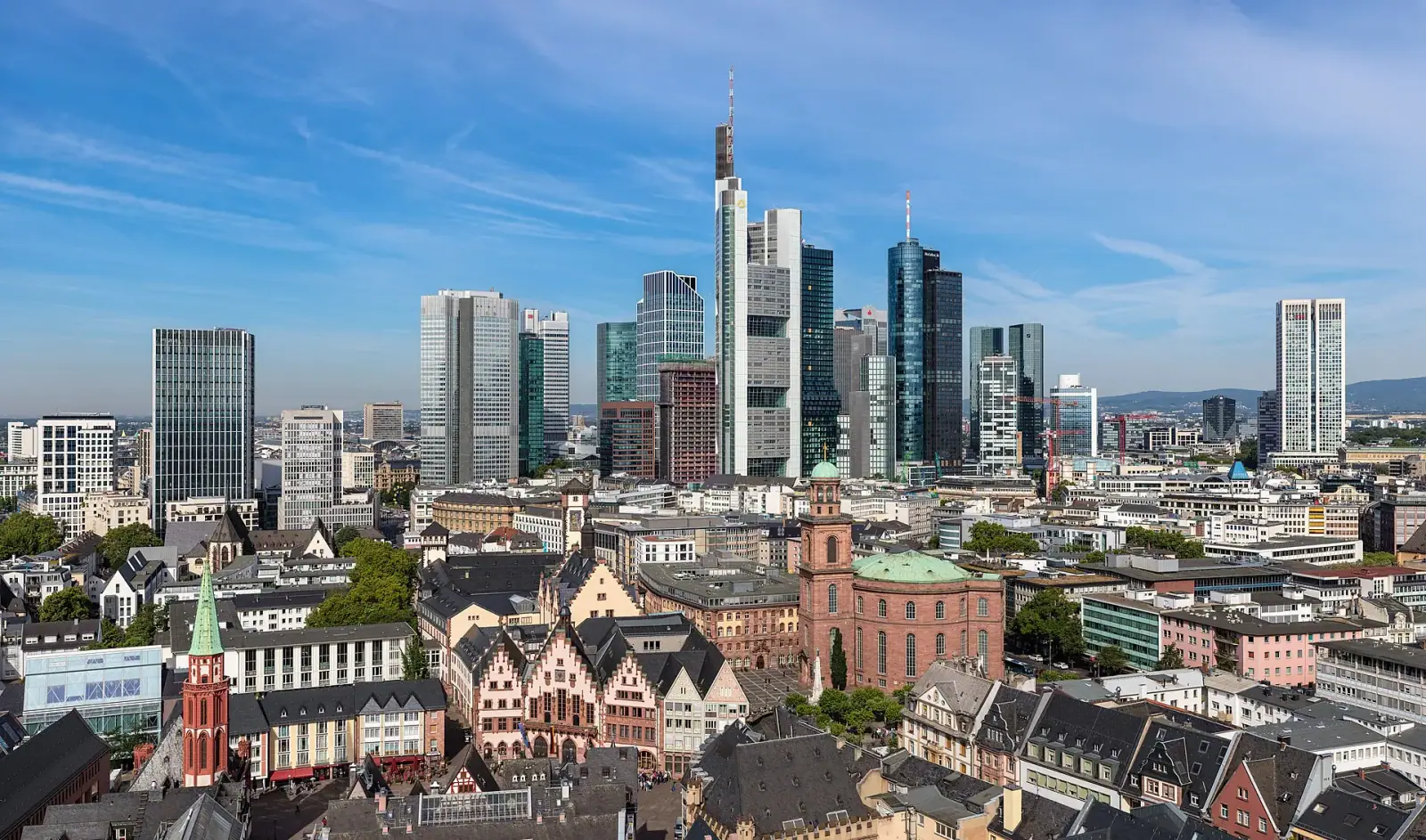
Frankfurt is one of Western Europe's priciest cities, anchored by its role as the EU's main financial hub. Budget carefully: it is possible to live lean here, but the city will punish you if you assume it is like cheaper German cities.
A central one-bedroom apartment (Innenstadt, Westend, Sachsenhausen) runs $1,380-1,840/month. Moving a few stops out to Bornheim, Gallusviertel, or Fechenheim drops that to $1,040-1,380/month. Short-term furnished rentals add a 30-50% premium over unfurnished prices.
- Groceries (self-catering): $230-370/month at Aldi, Lidl, or Rewe
- Eating out: $14-21 for a lunch special; $29-52 for dinner at a mid-range restaurant
- Coworking hot desk: $290-520/month for a day-pass bundle or monthly plan; daily drop-in $29-52
- Local transport: $73/month for the Germany-wide Deutschlandticket, which covers all local and regional public transit
- Utilities + internet (if not included): $115-205/month
Realistic monthly total: $2,420-3,680 for a solo nomad living comfortably but not extravagantly. The lower end requires a cheaper area, cooking most meals, and a monthly coworking pass over daily drop-ins.
Where to Work
Frankfurt has solid coworking infrastructure concentrated in the Bankenviertel (banking district) and around the Hauptbahnhof. Mindspace Frankfurt occupies prime real estate in the financial district with fast, reliable fibre and a professional atmosphere; expect $345-520/month for a hot-desk package. Tribes Frankfurt runs multiple locations including Garden Tower and Marienforum, all well-connected and suited to client calls. Villa Gründergeist in Westend is a quieter, community-oriented option at $240/month for a full-time desk.
Cafe-work culture exists but is uneven. Hoppenworth and Ploch (multiple locations) is the most nomad-friendly coffee chain in the city: good beans, sockets available, and staff who do not rush you. Einstein Kaffee is spacious and tolerates longer stays. A handful of spots have weak or nonexistent WiFi, so bring a mobile hotspot as backup. Laptop-friendly cafes cluster in Nordend and Bornheim; the city center is dominated by tourist-focused spots with slower connections.
Internet quality is strong overall. Frankfurt is a global internet exchange point (DE-CIX), and residential and coworking fibre in modern buildings is fast. Public WiFi is patchier; do not rely on it for video calls.
Getting Around
Frankfurt's public transport network is excellent. The U-Bahn (metro), S-Bahn (suburban rail), trams, and buses cover the city well. The Deutschlandticket at $73/month is the single best transport purchase you can make: it covers every local and regional train, bus, tram, and U-Bahn across Germany, including the S-Bahn to the airport. Buy it via the RMV app, which has an English-language interface.
The city center is very walkable. The area between the Hauptbahnhof, Zeil shopping street, and the riverside Museumsufer is compact and pedestrian-friendly. Cycling infrastructure is decent but not best-in-class for Germany.
Frankfurt Airport (FRA) is a major advantage: it is Europe's second-busiest hub with direct flights to nearly everywhere. The S8 and S9 trains connect it to the city center in about 11 minutes from the airport's regional station. If you fly frequently, Frankfurt's airport proximity is a genuine perk over cities like Berlin or Munich.
Sorting transport? Book an airport transfer, or compare car rental on Auto Europe and QEEQ.
Visas and Staying Long-Term
Citizens of the US, UK, Canada, Australia, and most other wealthy countries enter Germany visa-free for short stays. You can spend up to 90 days in any 180-day window across the entire Schengen Area, which covers 27 European countries combined, not 90 days in Germany alone.
Germany does not offer a dedicated digital nomad visa. For stays beyond 90 days working remotely or freelancing, your realistic option is the Freiberufler (freelance) visa, which requires you to demonstrate viable client contracts, proof of income, and health insurance. The application process is bureaucratic and typically takes several months; you need to be in Germany to complete it. Germany digitalized its visa application system from 2025 onward, but in-person appointments are still required at the Auslanderbehorde.
Best Time to Visit
Frankfurt's climate is temperate with genuine seasons. Winters (December-February) are grey, damp, and cold (around 2-5°C / 36-41°F), with short daylight hours that make outdoor life grim. July and August can push 30°C / 86°F, which is pleasant but brings more tourists and higher accommodation prices.
For remote work, the sweet spots are April-May and September-October. Temperatures sit between 14-22°C / 57-72°F, daylight is long, the city's parks and riverfront are enjoyable after hours, and crowds thin compared to peak summer. Autumn also coincides with Frankfurt's strong conference season (the Frankfurt Book Fair in October draws global crowds, so book accommodation early if visiting then). Spring brings outdoor markets and the city at its most livable.
Avoid January and February unless you like working in a coat indoors at German cafe temperatures.
Pros and Cons
- Airport access: FRA is one of Europe's top hubs; 11 minutes from the city center by train
- Internet infrastructure: Frankfurt hosts DE-CIX, the largest internet exchange on Earth
- Transport: Reliable, comprehensive; the Deutschlandticket covers all of Germany for $73/month
- Safety: Very safe city overall, including at night
- English proficiency: High in professional settings; the financial industry runs on English; most restaurants and shops manage fine
- Efficiency: Things work, trains mostly run on time, bureaucracy aside
- Cost: One of Germany's most expensive cities; rent is punishing by European nomad-city standards
- Personality: Frankfurt can feel transactional and corporate; the city center lacks the street-level character of Berlin or Hamburg
- Bureaucracy: Any paperwork involving the Auslanderbehorde tests your patience; German administration is slow and form-heavy
- Weather: Winters are grey and prolonged; not a sunshine destination
- Nightlife geography: The scene is scattered and requires local knowledge to navigate well
Who Frankfurt Is Best For
Frankfurt works best for nomads who need serious airport connectivity: if you travel to clients monthly or hop between European cities weekly, no German city matches it. It also suits people in finance, consulting, or tech who want proximity to a dense network of European corporate headquarters, or who are scoping whether Germany-based freelancing makes sense for them long-term.
The city rewards professionals on higher budgets who value reliability and infrastructure over lifestyle richness. If you budget above $3,450/month, live well, and value efficient transport and first-class internet, Frankfurt delivers consistently.
Skip Frankfurt if you are on a tight budget, if you prioritize culture and community over function, or if you want a city with a relaxed pace and warm climate. Nomads chasing vibes and low costs will find better value in Lisbon, Tbilisi, or even Berlin. Frankfurt is a tool, not a destination, and it is an excellent one if you need what it offers.