Cost of Living in Swansea
Real market data
Source: Numbeo · June 2026
$2,060/moSolo nomad1-bed centre + living costs
$2,820/moCoupleshared 1-bed + costs
$1,820/moLean / localcheaper area + costs
- 1-bed rent, city centre$1,100£821
- 1-bed rent, outside centre$860£642
- Monthly costs excl. rent (1 person)$950£709
- Meal, inexpensive restaurant$20£15
- Monthly transit pass$97£72
- Buy price, per m² (centre)$3,920£2,915
Prices are from Numbeo (June 2026), converted to USD at $1 = £0.74 (01 Aug 2026). The monthly living-costs figure is our transparent one-person basket, groceries, a few meals out, utilities, phone, internet, transport and essentials, priced from those figures. Solo adds central rent; couple and lean are estimates from the same numbers.
Budget around $2,060 a month, which makes Swansea one of the cheaper cities in Britain. A one-bedroom runs roughly $550 to $850, well below Cardiff and a fraction of Bristol across the water. Groceries are ordinary British prices. Eating out is inexpensive by British standards and the covered market, the largest in Wales, sells cockles and laverbread that are genuinely local specialities. Utilities run through a mild but wet winter. Council tax applies separately and catches people out when comparing with continental Europe, where the equivalent is often bundled into rent. Fibre runs about $35 to $50 a month and a coworking desk $130 to $220. Council tax on a one-bedroom flat in Swansea is roughly $130 to $180 a month depending on band, and it is charged on top of rent rather than included, which is the line that makes British costs look lower than they are to anyone comparing with a continental listing. Student demand shapes the market around Uplands and Brynmill, so a lease signed in August costs more than the same flat in January. Rents in Sketty and Killay sit above the centre and below Mumbles, which is where the price of a sea view starts.
Where to Work in Swansea
Connectivity is good. Fibre reaches most of Swansea at reasonable speeds, mobile coverage is comprehensive and power is reliable. There is a coworking scene helped by Swansea University, which has two campuses including one directly on the beach at Singleton, and by a small technology sector the Welsh Government has actively funded. The time zone is GMT with British summer time, which serves Europe and North America equally well. Welsh Government schemes for business support are available and are more generous than the English equivalents. Anyone comparing Welsh cities should note that Cardiff has the larger professional market and that Swansea's costs run roughly a third lower for a comparable flat. Swansea Bay has been the focus of a long-running city deal and a proposed tidal lagoon that was approved and then cancelled, and the digital and energy sector that grew around those plans is a real if modest part of the local economy. Cardiff is an hour by train and is where most professional networking in south Wales actually happens, which many Swansea-based freelancers simply build into their week.
Getting Around Swansea
Swansea is walkable in the centre and along the Maritime Quarter, with buses covering the rest and a good cycle route along Swansea Bay to Mumbles. A car is genuinely useful for Gower, since the bus service to the best beaches is limited and seasonal. The railway station has direct trains to Cardiff in an hour and London in about three. Cardiff Airport is around an hour by road. The bay path itself, running five miles along the sand to Mumbles pier, is the best thing about getting around here. The bus to Rhossili takes over an hour and runs a handful of times a day in summer and barely at all in winter, which is why anyone serious about Gower ends up with a car. The Gower Way and the Wales Coast Path both cross the peninsula on foot if the timetable defeats you. Mumbles is the end of the bay path and the start of Gower proper, and the old Mumbles Railway that ran there was the world's first passenger railway service.
Sorting transport? Book an airport transfer, or compare car rental on Auto Europe and QEEQ.
Visas for Swansea
Swansea follows UK-wide entry rules, and visa nationals apply for a standard visitor visa before they travel. Visitors may not work for a British employer, though remote work for an overseas employer during a visit is permitted within narrow limits that are worth reading carefully. There is no digital nomad visa. Longer stays require a sponsored work visa, the Global Talent route or the Graduate route, which is relevant here given the university, and the salary thresholds rose substantially in 2024. Anyone using the Graduate route should apply before the student visa expires, since the application must be made from inside the United Kingdom and cannot be filed late. The Electronic Travel Authorisation became mandatory for most visa-exempt nationalities through 2024 and 2025 and is applied for online for $27, valid two years and multiple entry, and airlines check it before boarding.
Best Time to Visit Swansea
May to September is the best window, with July around nineteen degrees and Gower at its finest, though south Wales is genuinely wet and rain is possible in every month. April and October are quieter and often clear. Winter from November to March is mild and very wet, with the Atlantic weather arriving directly. The surf on Gower is best in autumn and winter when the swells are larger, which is when the beaches empty of everyone except the people who came for that. Anyone visiting Rhossili at the western end of Gower should aim for low tide, when the Worm's Head causeway opens for a few hours and the whole bay is walkable. Swansea receives around 1,100 millimetres of rain a year, roughly double London's, and the Gower peninsula catches Atlantic weather before anywhere else in Britain, which is the honest context for any month you pick. The Gower beaches face south and west, so Rhossili takes the full Atlantic swell while Three Cliffs and Oxwich stay comparatively sheltered.
Pros and Cons of Swansea
Gower is what people come for: in 1956 it became the first designated Area of Outstanding Natural Beauty in Britain, and it holds Rhossili, Three Cliffs Bay and a run of beaches that would be famous anywhere with a better climate than this one. The city has a five mile bay path, a covered market, a good university and very low costs. Swansea itself took the blitz of 1941 and was rebuilt in a hurry, and Dylan Thomas called it an ugly lovely town in a phrase the city has never quite escaped since. Swansea also has the largest indoor market in Wales and the Dylan Thomas Centre, and the Uplands district where he grew up survived the bombing largely intact, which is where the town he described is still legible. The National Waterfront Museum on the Maritime Quarter is free and covers the industrial history that made and unmade the place.
Who Swansea Is For
Surfers, walkers and anyone whose priority is Gower, which is genuinely one of the best stretches of coast in Britain and sits twenty minutes from the city centre. It suits students and academics, given the university. It suits anyone wanting a very cheap British base with good rail links. The Blitz took most of the old town and what replaced it is plain, so beauty here means the Gower rather than the streets. Persistent Atlantic rain is the other daily fact, and south Wales receives a great deal of it in every season. Swansea Bay has one of the largest tidal ranges in the world, and the research into how to exploit it sits in the university here, so marine energy is a real field to arrive into. Cardiff is the comparison, and the trade is a third cheaper, considerably less to do, and Gower twenty minutes away instead of an hour.
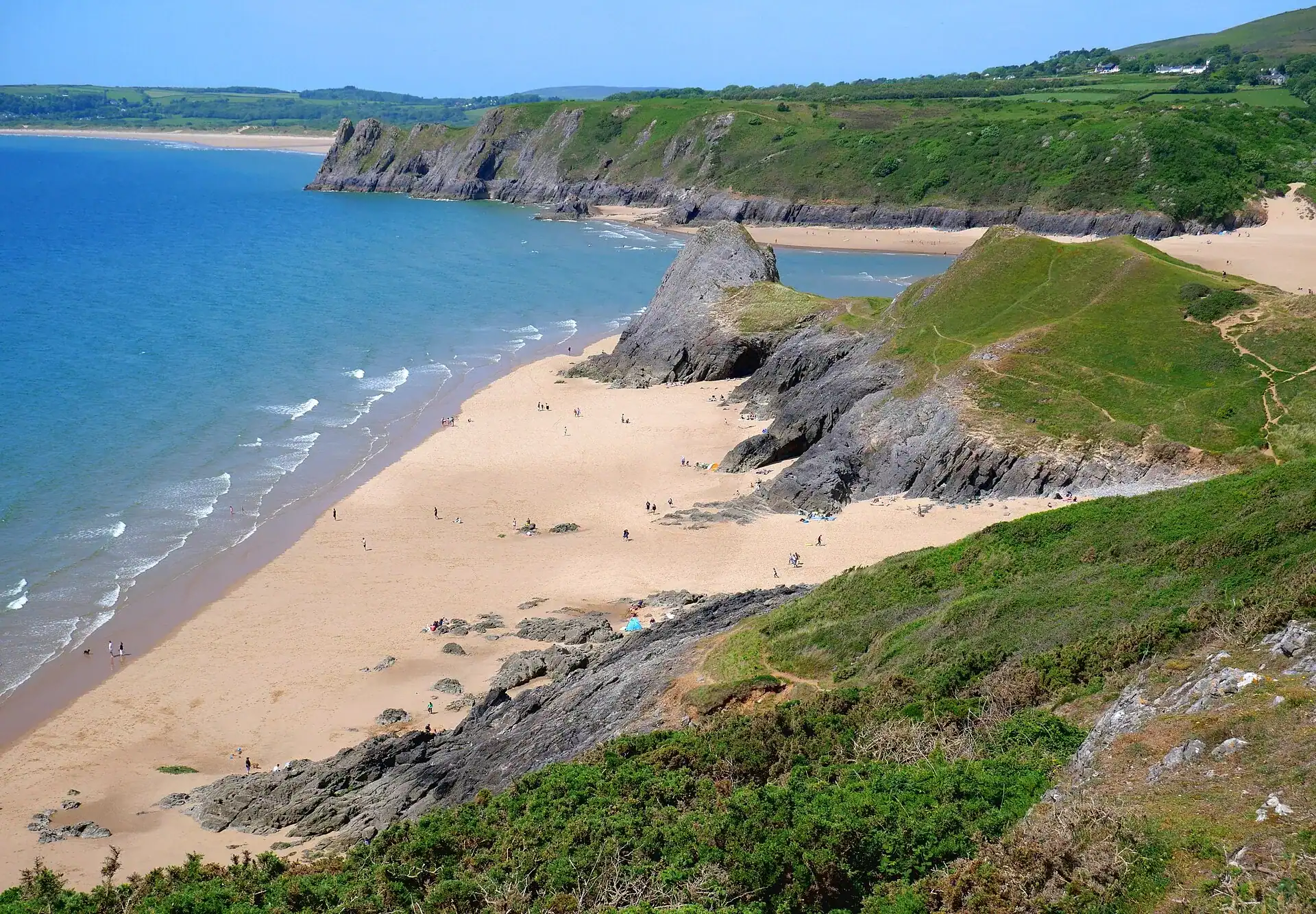 Photo: Chrissieminton / Wikimedia Commons (CC BY-SA 4.0)