Cost of Living in Plymouth
Real market data
Source: Numbeo · September 2026
$2,260/moSolo nomad1-bed centre + living costs
$3,240/moCoupleshared 1-bed + costs
$2,260/moLean / localcheaper area + costs
- 1-bed rent, city centre$1,050£777
- 1-bed rent, outside centre$1,050£778
- Monthly costs excl. rent (1 person)$1,220£904
- Meal, inexpensive restaurant$23£17
- Monthly transit pass$130£99
- Buy price, per m² (centre)$4,900£3,640
Prices are from Numbeo (September 2026), converted to USD at $1 = £0.74 (01 Aug 2026). The monthly living-costs figure is our transparent one-person basket, groceries, a few meals out, utilities, phone, internet, transport and essentials, priced from those figures. Solo adds central rent; couple and lean are estimates from the same numbers.
Budget around $2,260 a month. A one-bedroom runs roughly $650 to $1,000, cheaper than Bristol or Exeter and considerably cheaper than the Cornish coast an hour west, where second homes have pushed prices well beyond local wages. Groceries are ordinary British prices. Eating out is moderate and the seafood, particularly the crab and the scallops landed at the Barbican, is very good. Utilities run through a mild damp winter. Council tax applies separately. The naval dockyard is the city's largest employer and shapes the housing market considerably. Anyone comparing with Cornwall should note that the second home effect across the Tamar has pushed coastal village prices well beyond Plymouth's, which is why many people commute in. A deposit is capped at five weeks of rent by law and has to sit in an approved protection scheme, which a tenant can check online using the reference the landlord is obliged to supply. Landlords must also run an immigration status check before granting a tenancy, so a passport and a visa document are part of the first viewing rather than the last. Water charges in this region are the highest in the country, the price of a very long coastline served by a small population, and the electricity standing charge sits at the top of the national range too.
Where to Work in Plymouth
Connectivity is good. Fibre reaches most of Plymouth at reasonable speeds, mobile coverage is comprehensive and power is reliable. There is a coworking scene helped by the University of Plymouth and by a marine technology sector that is genuinely significant: the city hosts serious marine research and autonomous vessel work. The time zone is GMT with British summer time. Plymouth's position at the far southwestern end of the rail network means physical travel is slower than the connectivity suggests, which is worth weighing. Anyone in marine science should look at the Plymouth Marine Laboratory and the National Marine Aquarium, both of which anchor a research cluster that is genuinely internationally regarded. A freeport designation covering the port and the land around it was granted a few years ago, with customs and tax reliefs attached, and it is the one policy lever the city has been handed to widen an economy that leans heavily on defence. The dockyard itself is run under contract by a private engineering group rather than directly by the navy, which is why the job adverts do not read like military ones. Wages across the region sit below the national average while the skills on offer do not, which is the arbitrage a remote worker is actually exploiting.
Getting Around Plymouth
Plymouth is hilly and spread out, with the Hoe, the Barbican and the city centre walkable but the suburbs requiring buses, which cover the city adequately. The railway station has trains to London in about three and a half hours and to Penzance in two. Plymouth's airport closed in 2011, so Exeter or Bristol are the practical air connections. The ferry to Roscoff in Brittany and Santander in Spain leaves from Millbay, and the Cremyll and Torpoint ferries cross the Tamar into Cornwall. Anyone crossing into Cornwall should know that the Torpoint chain ferry runs around the clock and that the Tamar road bridge is the alternative if the ferry queue is long.
Sorting transport? Book an airport transfer, or compare car rental on Auto Europe and QEEQ.
Visas for Plymouth
Entry for a Plymouth stay works as anywhere in the UK: non-visa nationals mostly need a $27 Electronic Travel Authorisation before they fly, and visa nationals a standard visitor visa. Visitors may not work for a British employer, though remote work for an overseas employer is permitted within limits. There is no digital nomad visa. Longer stays require a sponsored work visa, the Global Talent route or the Graduate route. The naval dockyard and the marine sector are both areas where sponsored roles exist, though security clearance requirements apply to a good deal of it. Anyone considering dockyard or defence work should be aware that a great deal of it requires British nationality and security clearance, which narrows the route considerably. The health surcharge is the cost people forget: it is paid up front for the entire length of a visa, runs well over a thousand dollars a year per person, and a family of four pays it four times over before anybody lands. Salary thresholds on the sponsored route were raised sharply in 2024, which closed off a number of jobs that had been viable the year before. Physical residence cards have been replaced by an online record, so proving status now means logging in and generating a share code rather than showing a document.
Best Time to Visit Plymouth
May to September is the best window, with July around nineteen degrees and Devon and Cornwall at their best, though the school holidays in late July and August fill every road and beach in the southwest. April, May and September are the sweet spots. Winter from November to March is mild, wet and windy, with Atlantic storms arriving directly. Dartmoor is walkable year round and is genuinely dangerous in bad weather, which the moor's rescue teams are called out for regularly. Anyone walking on Dartmoor should carry a map and a compass rather than relying on a phone, since the moor has almost no landmarks and the weather closes in fast. Single-handed transatlantic races have started from the Sound since 1960, and when a fleet is gathering in June the waterfront fills with boats and crews from a dozen countries for a fortnight. The cold is not what defines the season here so much as the dark and the noise: the light goes before four in the afternoon in December and the gales come in off the water in sequence rather than singly. Spring arrives early on this coast, with daffodils out in February while much of the country is still frozen, which is the compensation for the wet half of the year.
Pros and Cons of Plymouth
Position is what Plymouth has: Dartmoor twenty minutes to the north, Cornwall across the Tamar, the Devon coast to the east, and a natural harbour that has been Britain's western naval base since the sixteenth century. The Barbican survived the wartime bombing and the Hoe with Smeaton's Tower is a genuinely good piece of public space. The city centre was flattened in 1941 and rebuilt as a postwar grid that few people love, and the naval dependence has left the economy narrower than it should be by now. Plymouth also has the largest naval base in western Europe at Devonport, which shapes the city's economy, its politics and a good deal of its social life.
Who Plymouth Is For
Sailors, divers and walkers above all, since the Sound, Dartmoor and the Cornish coast are all immediately available. It suits people in marine science or engineering, since that sector is real here. It suits anyone wanting a southwestern base at less than Cornish prices. Frequent air travel is awkward from here, since the nearest useful airport is over an hour up the road, and the city centre is post-war concrete rather than anything handsome, whatever the Hoe and the Barbican do to compensate. The Mayflower left from the Barbican in 1620. The steps are still there, the streets around them are largely intact, and the whole thing sits at the end of an ordinary walk through town.
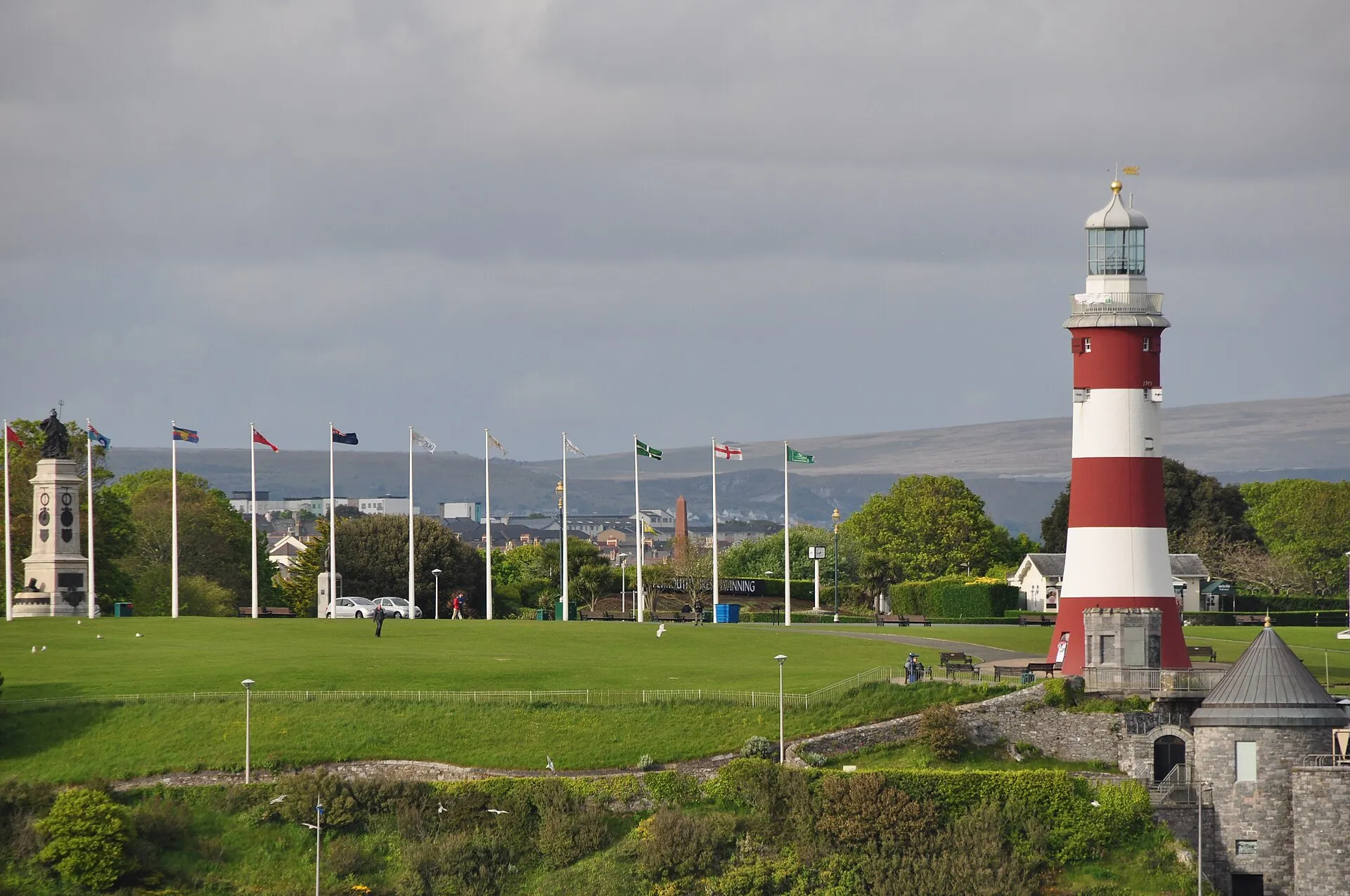 Photo: Lewis Clarke / Wikimedia Commons (CC BY-SA 2.0)