Cost of Living in Minsk
Where this figure comes from. No cost survey covers Minsk, so the $750 a month above is our own estimate rather than a measurement. On 416 of our 999 city guides the figure is built from a published Numbeo basket, a one-bedroom rent in the centre plus one person's monthly costs without rent, converted to USD; this city is not one of them. How we source everything.
Budget around $750 a month, which makes Minsk one of the cheapest capitals in Europe. A one-bedroom runs roughly $250 to $450, with the centre and the areas near the metro at the top and the Soviet-era microdistricts considerably cheaper. Groceries are inexpensive and Belarusian dairy and produce are good. Eating out is genuinely cheap: a full meal in an ordinary cafe costs a few dollars and even the better restaurants are modest by European standards. Utilities are low and heating is centralised. The Belarusian ruble was redenominated in 2016, so older prices need a factor of ten thousand applied. The practical difficulty is not the price level but paying anything at all. Foreign cards frequently fail, so most visitors run on cash exchanged locally, and how much you bring in becomes a planning decision rather than an afterthought. Rentals are usually arranged through an agency for a fee, and a landlord will need your registration details, since foreigners must be registered at their address. Imported goods have narrowed in range and risen in price under sanctions, so the cheapness applies most to what Belarus makes itself, which is a good deal of the food.
Where to Work in Minsk
Connectivity is good and this is not an accident. Belarus built a serious software industry through its High Technology Park, which produced World of Tanks and Viber among others, so fibre is widespread, speeds are decent and prices are low. Mobile coverage is comprehensive and power is reliable. Coworking exists in the centre and the standard is reasonable. The complication is not technical: international payment cards issued abroad often do not work, several Western services are unavailable, and sanctions make banking and receiving money genuinely awkward. Plan the money side before arriving. A large part of that software industry relocated, to Poland, Lithuania, Georgia and elsewhere, so the sector that built the infrastructure is considerably thinner on the ground than the infrastructure itself suggests. And a number of Western sites and services are blocked or unreliable, which makes a VPN standard equipment for most foreign workers here, though the legal position on that is ambiguous rather than settled. Russian is the working language of almost everything.
Getting Around Minsk
Minsk has a clean, cheap and fast metro with three lines, and the fare is a few cents. Buses, trolleybuses and trams cover the rest, and the city was rebuilt after 1944 on a scale that makes it easy to navigate and long to walk: Independence Avenue runs fifteen kilometres in a straight line. Taxis and Yandex Go are cheap. Minsk National Airport connects to Moscow, Istanbul, Dubai and a shrinking set of other destinations, since European Union carriers no longer fly here and European airspace is closed to Belarusian ones. Getting in is now the harder part of any trip here. Most travellers arrive by air through Istanbul or Dubai, or overland from Russia, while the land borders with Poland, Lithuania and Latvia have been variously restricted, closed or reduced to a handful of crossings with long queues. Rail links to Moscow are frequent and comfortable, and the once-easy train to Vilnius no longer runs. From the airport a bus and a train both reach the centre in about an hour, and taxis are cheap enough that most visitors simply take one.
Sorting transport? Book an airport transfer, or compare car rental on Auto Europe and QEEQ.
Visas for Minsk
Belarus operates a visa-free scheme that has expanded considerably: citizens of most European countries, including the whole European Union, may enter for up to thirty days without a visa. The conditions matter. The visa-free entry generally applies when arriving at Minsk National Airport or by certain land crossings, requires medical insurance, and specifically excludes arrival from or departure to Russia, because that border is not an international one and has no controls. There is no remote work visa. Anyone entering overland should also note that Belarus requires compulsory medical insurance bought locally at the border, and that the paperwork is checked rather than assumed. Foreigners staying beyond a short period must register their place of residence, which a hotel does automatically and a private landlord generally does not, and it is checked on the way out. The Russia exclusion works in both directions and catches people planning to leave overland towards Moscow, which is not a legal exit for a visa-free visitor. Anyone holding Belarusian citizenship alongside another should take specific advice, since Belarus does not recognise the second one.
Best Time to Visit Minsk
May to September is the comfortable window, with temperatures around twenty two degrees in July and long evenings. Winter from December to February is properly cold, often around minus five to minus ten, with snow on the ground for months, though the city clears it efficiently and the metro makes it manageable. April and October are grey and wet. Minsk is greener than its reputation suggests, with large parks along the Svislach river, and summer is when that shows. Independence Day on the third of July is the biggest event in the calendar. Winter days are short as well as cold, with the light gone by four in December, and that does more to shape a stay than the temperature does. Summer empties the city at weekends, when a large share of residents leave for dachas outside it, so August here is quiet in a rather pleasant way. Kupalle at midsummer is marked with bonfires and water outside the city, and the autumn mushroom season is a national preoccupation rather than a pastime.
Pros and Cons of Minsk
Minsk trades on cost, order and a coherent architectural idea: the city was almost entirely destroyed in the Second World War and rebuilt in Stalinist neoclassicism on a monumental scale, which produces something genuinely unlike anywhere else. It is clean, very safe from street crime, the metro works and living costs are a fraction of the rest of Europe. The objection is political rather than practical. Belarus is an authoritarian state, the 2020 protests were suppressed severely, sanctions complicate money and travel, and the war next door shapes everything. The city's Great Patriotic War museum and the memorial at Khatyn also make plain how completely Belarus was destroyed between 1941 and 1944, which explains a great deal about the country. Photographing government buildings, police or infrastructure attracts attention, and political conversation can put a local at risk even where the visitor faces nothing worse than inconvenience. Check as well whether your travel insurance is valid here at all, since a number of policies now exclude the country outright and people tend to discover that at the point of claiming.
Who Minsk Is For
A specific reason is what brings people: family connections, business ties, Russian-language study, or an interest in Soviet urbanism, which the city offers in an unusually complete form. It suits developers, given the local industry. Western banking does not function smoothly here and sanctions make that unlikely to change soon. Political expression carries real consequences in Belarus, which anybody considering a stay should weigh honestly rather than assume around, and the flight options out have narrowed to the point where an easy visa run is no longer available. Belovezhskaya Pushcha on the Polish border justifies the trip by itself. It is the last surviving stretch of the primeval woodland that once covered the whole European plain, and wild bison still live in it. Anyone looking for a cheap, Russian-speaking base without the complications should look at Georgia or Armenia first, which is where most of the people who would once have considered this city have gone. Journalists, researchers and anyone with a public record of political writing should take specific advice before travelling rather than rely on general guidance. For everyone else it works better as a visit of weeks than as a base of months.
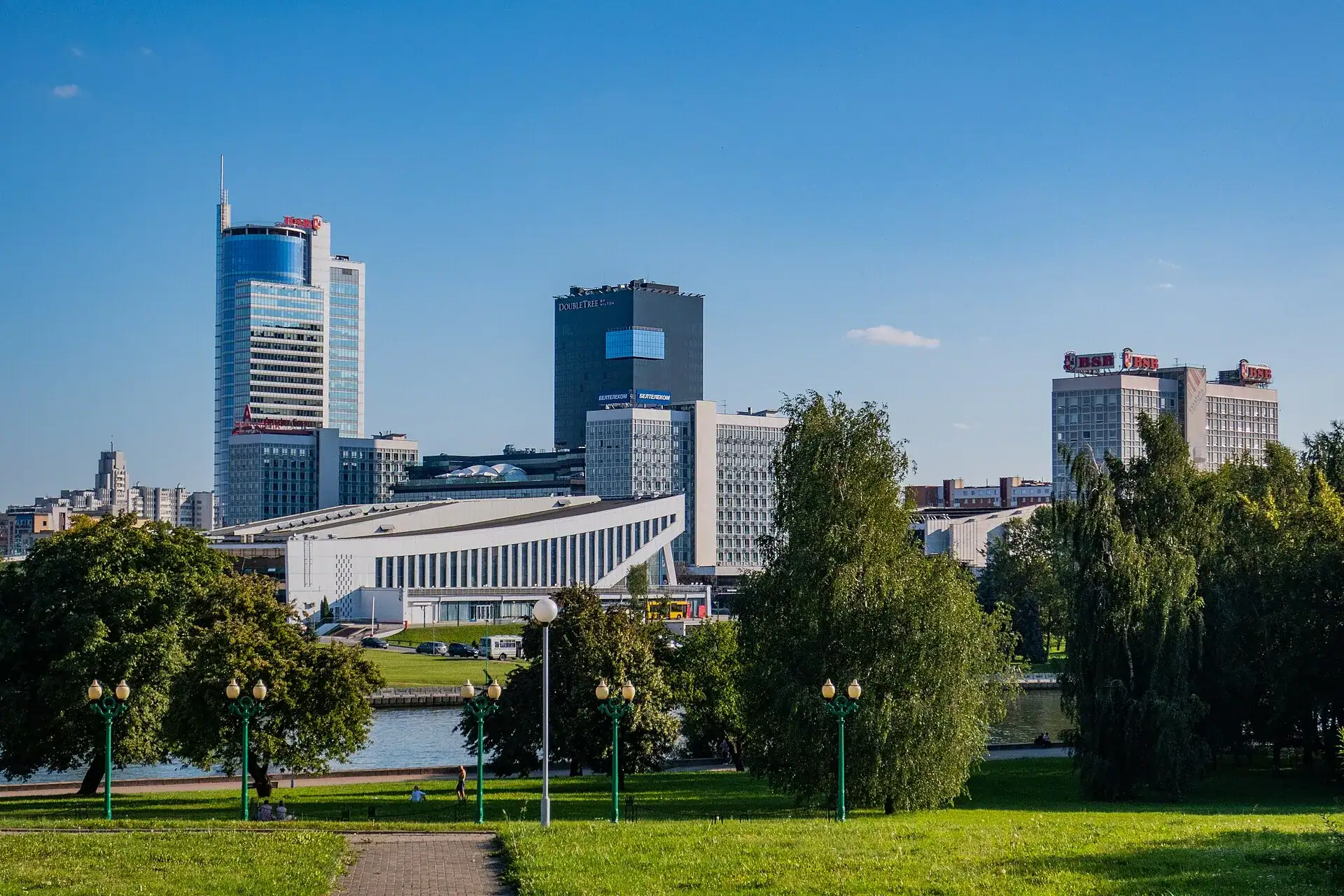 Photo: Homoatrox / Wikimedia Commons (CC BY-SA 3.0)