Cost of Living in Hurghada
Real market data
Source: Numbeo · September 2026
$440/moSolo nomad1-bed centre + living costs
$610/moCoupleshared 1-bed + costs
$340/moLean / localcheaper area + costs
- 1-bed rent, city centre$220E£11,453
- 1-bed rent, outside centre$120E£6,221
- Monthly costs excl. rent (1 person)$210E£10,973
- Meal, inexpensive restaurant$4E£205
- Monthly transit pass$6E£300
- Buy price, per m² (centre)$560E£28,543
Prices are from Numbeo (September 2026), converted to USD at $1 = E£51.11 (01 Aug 2026). The monthly living-costs figure is our transparent one-person basket, groceries, a few meals out, utilities, phone, internet, transport and essentials, priced from those figures. Solo adds central rent; couple and lean are estimates from the same numbers.
Budget roughly $440 a month as a solo remote worker in Hurghada, which makes it one of the cheapest places on any warm sea. A one-bedroom apartment in El Kawther, El Mamsha or Dahar runs about $200 to $350 on a long lease, and this is a market with enormous supply thanks to years of resort construction, so bargaining works and sea views are affordable. Groceries land around $130 to $190. A koshary or local lunch is $2 to $4, a restaurant dinner $8 to $15, and a coffee about $1.50. A dive with a local centre is $30 to $45. Utilities add $40 to $90, dominated by summer air conditioning. Egyptian currency movements make budgeting in dollars sensible.
Where to Work in Hurghada
Hurghada has a small coworking presence catering to a mostly Russian, Ukrainian and German resident population, with desks around $70 to $130 a month, plus a good number of cafes along El Mamsha and in the newer districts that are entirely used to laptops. The remote-work population here is substantial but informal, and much of it is Russian-speaking, which shapes the social scene. Connectivity is decent: fibre has reached the main residential areas and Egyptian mobile data is cheap with good coverage. The recurring practical issues are power interruptions during summer peak load and Egypt's periodic restrictions on some voice-over-internet services, which is worth checking before relying on a specific calling platform. Diving is an industry here rather than a pastime, and the instructor and boat economy is what most foreign residents are actually employed in, which shapes everything from the rental market to when the bars are busy. Seasonality is sharper than the weather implies: the charter flights set the rhythm, and a town full in one month can be half empty in the next under the same sunshine. Anyone working to a European clock will find the offset small enough to ignore, and that is a quiet part of why this coast works at all.
Getting Around Hurghada
Hurghada is strung along about 40 kilometres of coast, from Dahar in the north through Sekalla and El Mamsha to the resort strips at Sahl Hasheesh and Makadi Bay in the south, so it is not a walking city between districts though each is walkable within itself. Microbuses run the main road for well under a dollar and are the local way to move. Taxis and ride-hailing apps are cheap and widely used. Many residents keep a scooter. Hurghada international airport is central and served by a large number of European charter and scheduled routes, which is one of the town's genuine advantages. Buses run to Cairo in about five hours and to Luxor in four. There is no railway anywhere on this coast, which is why every long journey begins on a bus, and the road inland to the valley crosses a range of bare mountains with checkpoints along it where a passport gets looked at. The coastal highway runs north for hours past resort after resort and is the way to reach the rest of the shoreline. Within town the microbuses have no route numbers and no stops, so the way to learn the network is to ask which direction a driver is going and get in.
Sorting transport? Book an airport transfer, or compare car rental on Auto Europe and QEEQ.
Visas for Hurghada
Egypt grants most Western passports a 30-day visa on arrival, purchased at the airport, or through an e-Visa obtained online in advance, and this is renewable in-country at a passport office. Longer stays are usually handled by repeated renewals, which is a well-established if bureaucratic practice, and many long-term foreign residents in Hurghada operate this way. Egypt has discussed a digital nomad visa but as of writing has not implemented one, so there is no purpose-built route. Property ownership by foreigners is permitted and is a common basis for longer residence applications, which is one reason the Red Sea resorts have such a large permanent foreign population. Renewals are handled at the local passport office rather than in the capital, a real advantage of basing yourself on this coast, and the queue is shorter than the reputation of the system suggests. Bring the original entry card, since losing it turns a routine renewal into a week of letters. Overstaying is settled as a fine at the airport on the way out, and while people do it, the fine rises with the length and a long one can attract a ban on returning. Marriage and study are the two routes that produce a genuine multi-year status.
Best Time to Visit Hurghada
October to April is the comfortable season in Hurghada: daytime highs in the low to high twenties, sea temperatures still warm enough to dive comfortably with a thin wetsuit, and the whole town at its most pleasant. This is also high season for European visitors, particularly around Christmas and Easter. Summer, June to September, is extremely hot, regularly above 38 degrees and sometimes far more, and while the humidity is low and the sea is warm, it limits what can be done outdoors between mid-morning and late afternoon. The wind blows almost year-round, which is why Hurghada is a major kitesurfing centre, and it takes some of the edge off the heat. The khamaseen is the spring nuisance: a hot wind off the desert that lifts sand into the air for a couple of days together, cuts visibility underwater and coats everything left outdoors. It passes quickly, though it can still spoil a dive trip booked months earlier. Water temperature swings further than most people expect, warm enough in autumn for a shorty and cold enough late in winter that a five millimetre suit earns its place in the luggage. Mornings at the turn of the seasons want a fleece on an open boat.
Pros and Cons of Hurghada
Hurghada offers year-round sun, one of the world's best reef diving destinations on the doorstep, prices among the lowest for any coastal city, and an international airport in the middle of town with direct flights across Europe. There is a large, established foreign resident population, so the practicalities of settling are well trodden. It is a purpose-built resort city with little historic character and a great deal of unfinished construction around it. Summer heat is genuinely extreme. Egypt's currency instability and periodic internet service restrictions add friction. The foreign community is largely Russian and German rather than an English-speaking nomad crowd, and cultural norms outside the resorts require some adjustment.
Who Hurghada Is For
Divers and kitesurfers who want warmth on very little money, and who would rather have a real international airport than charm, are the people who come. A European winter spent somewhere warm and inexpensive is the basic calculation, and it holds up. The Red Sea reefs become a regular part of the week rather than something saved up for once a year. It works for those comfortable in a Russian and German-speaking expatriate environment. Historic atmosphere is absent from a town built in the 1980s, the foreign community speaks Russian and German rather than English, the summers are brutal, and Egyptian politics offer no predictability to plan around. Dahab, four hours north in Sinai, is the smaller, more characterful alternative with a longer-established travelling crowd.
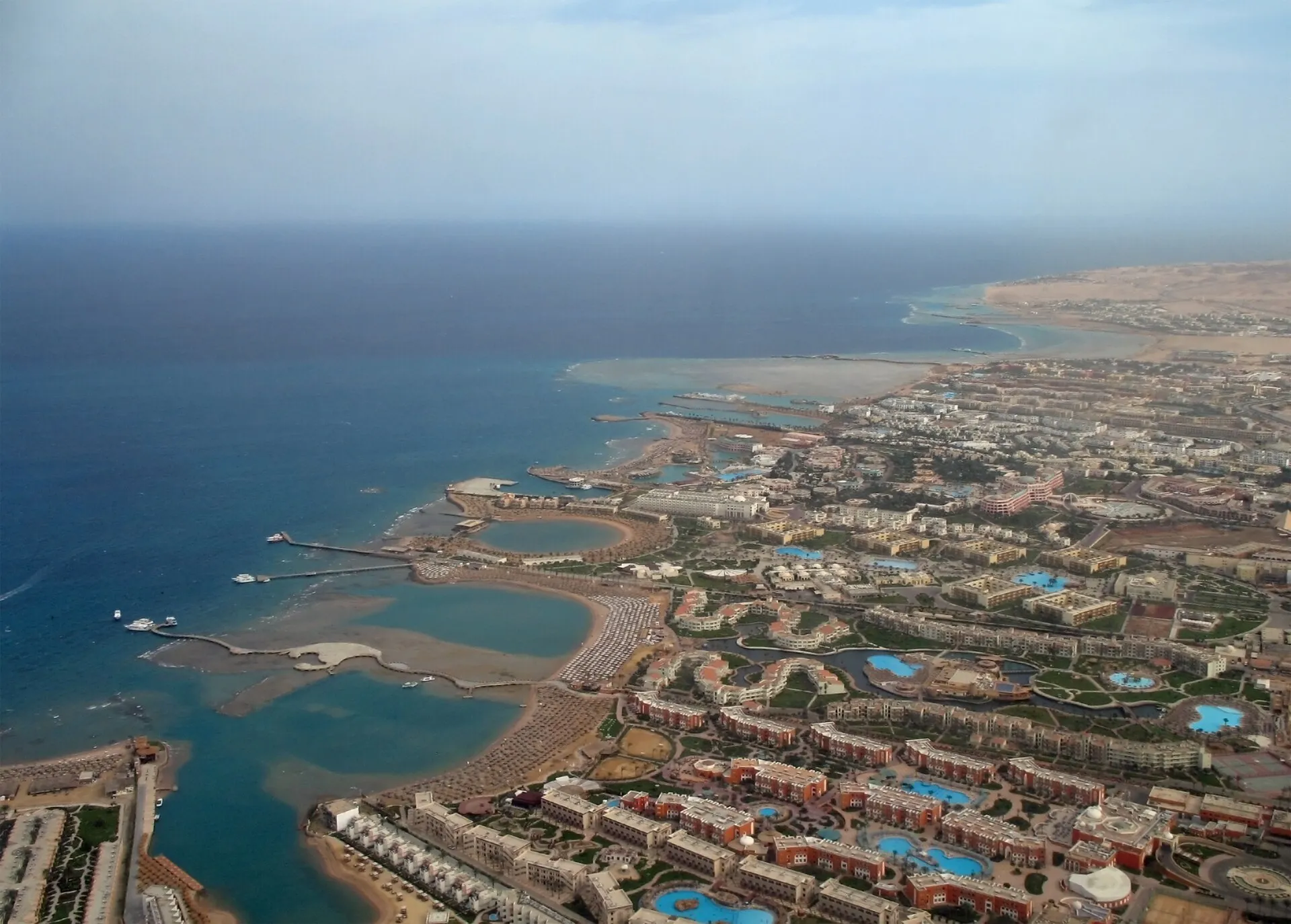 Photo: Marc Ryckaert / Wikimedia Commons (CC BY 3.0)