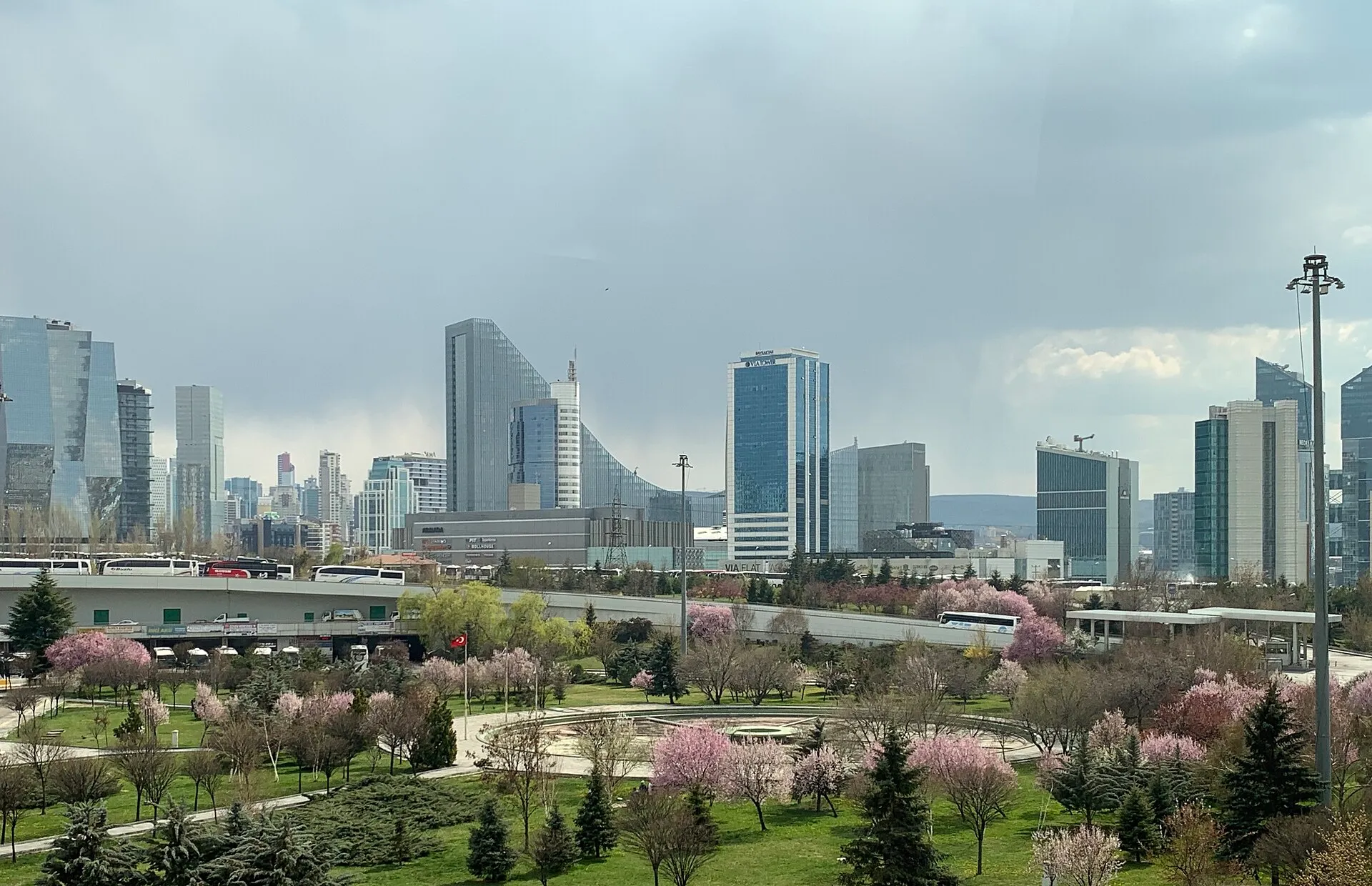
The modern skyline of Ankara rising behind a park in spring blossom
Photo: Boubacar Amadou Cisse / Wikimedia Commons (CC BY-SA 4.0)
Turkey flag

Ankara

Turkey

Turkey's working capital: ministries, universities, and none of Istanbul's crowds.

$1,060-1,260
Monthly Budget
--
Current Weather
Continental
Climate Type
6/10
WiFi Score
7/10
Safety Score
UTC+3
Timezone
0
Nomad Score

Setting Up as a Nomad in Ankara

Turkey's working capital: ministries, universities, and none of Istanbul's crowds. Ankara pairs low costs with fast WiFi and a continental climate, all for about $1,260 a month. If anything, the language barrier lags.

Nomad Facts at a Glance

The practical basics for Ankara, Turkey

CurrencyLira (₺, TRY)
LanguageTurkish
Plugs & powerType C/F · 230V / 50Hz
Tap waterBottled or filtered
Tipping5-10%
Ride-hailingBiTaksi, Uber (taxi)
Emergency112
Mobile dataeSIM: Airalo / Holafly
Driving sideRight
Dialling code+90
Time zoneUTC+3
Best time to visitJun, Jul, Sep

Country-level guidance to get you oriented, not a substitute for checking locally. Numbers and norms can change; 112 reaches emergency services from most mobiles worldwide.

Category Breakdown

How Ankara scores across all 13 factors

Ankara's Nomad Score is 5.4 out of 10, from 13 category ratings (each out of 10): Climate 5, Cost of Living 7, WiFi 6, Nightlife 6, Nature 4, Safety 7, Food 7, Nomad Community 4, English 4, Visa Ease 8, Culture 7, Cleanliness 6, Air Quality 5.

Weather in Ankara

30-year monthly averages (1991-2020) from a local weather station, and the best time to visit

5°
-2°
Jan
8°
-1°
Feb
13°
2°
Mar
17°
6°
Apr
23°
11°
May
28°
14°
Jun
31°
17°
Jul
31°
17°
Aug
26°
13°
Sep
20°
8°
Oct
14°
3°
Nov
7°
0°
Dec
Daily high & low (°C)Rainfall (mm/month)Best months to visit

The best time to visit Ankara for comfortable weather is Jun, Jul, Sep. The warmest month is Jul (around 31°C by day), and the wettest is Apr (about 49mm of rain).

Chasing good weather? See other cities that are warm in Jun, or plan a multi-city route around the seasons, or search flights when you are ready to move. Staying a while in Ankara? Check visa options, your time-zone overlap and how far your budget stretches, or find it on the world map.

Climate normals for 1991-2020 measured at the Ankara / Central weather station, 3 km away. Historical averages, not a forecast. Source: Meteostat and its data providers (CC BY 4.0).

Best Neighborhoods in Ankara

Where to base yourself for the perfect nomad experience

Kizilay

$$
Central & Dense

The city's central square, students and cheap eating

Ankara's functional heart, where the metro lines cross and where the bookshops, cheap restaurants, student bars and political life of the capital concentrate. It is dense, loud and entirely practical, with the ministries a short walk south and everything reachable on the metro.

Best for: Anyone who wants the metro, the bookshops and cheap eating on the doorstep
Pros
  • Both metro lines and every bus route
  • Dense cheap restaurants and student bars
  • Everything practical within a short walk
Cons
  • Loud, crowded and short of green space
  • Demonstrations and heavy policing at times
  • Older apartment stock

Cankaya and Kavaklidere

$$$$
Diplomatic & Leafy

The embassy districts, leafier and considerably calmer

The southern hillside where the embassies, the better restaurants and the wine bars of Tunali Hilmi sit among tree-lined streets. It is the most comfortable part of Ankara, with the largest concentration of foreign residents and the best food in the city.

Best for: Longer stays wanting a calm district and the international community
Pros
  • The best restaurants and wine bars in the city
  • Embassies and the international community nearby
  • Tree-lined and quieter than Kizilay
Cons
  • The highest rents in Ankara
  • Steep streets in places
  • Heavy security presence around some embassies

Ulus and the Citadel

$
Historic & Cheap

The old town below the walls, with the best museum in Turkey

The historic core around the Ottoman citadel, holding the Museum of Anatolian Civilisations, the Roman temple, the old bazaar and the surviving timber houses inside the walls. It is the oldest and cheapest part of Ankara and by a distance the most interesting to walk.

Best for: Budget stays that want the citadel and the museums rather than the modern city
Pros
  • The Museum of Anatolian Civilisations on the doorstep
  • The lowest rents anywhere central
  • Genuine Ottoman streets inside the walls
Cons
  • Run down in parts and less comfortable at night
  • Older housing in poor condition
  • Few modern services

Bahcelievler and Emek

$$
Student & Lively

The university belt around Hacettepe and the campuses

The western residential districts around the universities, with the seventh street bar strip, cheap student restaurants and low-rise apartment buildings. It has the liveliest and cheapest social life in Ankara and a population that is overwhelmingly under twenty-five.

Best for: Budget stays that want the student bars and the cheapest central rents
Pros
  • Cheap student bars and restaurants throughout
  • Rents well below Cankaya
  • Metro and buses into the centre
Cons
  • Quiet outside term
  • Plain apartment blocks
  • Loud on term-time nights

Cayyolu and the Western Suburbs

$$$
Suburban & Modern

New apartment complexes out west, space and quiet

The planned residential expansion west of the city along the metro extension, with modern gated apartment complexes, supermarkets, schools and considerably more space than anything central. It is where Ankara's professional families have moved, and the metro takes about half an hour into Kizilay.

Best for: Longer stays wanting a modern, well-built flat and quiet
Pros
  • Modern, well-insulated apartments
  • Metro line direct into the centre
  • Cleaner air and more green space
Cons
  • Half an hour to the centre
  • Car-dependent for anything off the metro
  • Generic and short on street life

Cost of Living in Ankara

Real market data Source: Numbeo · September 2026
$1,260/moSolo nomad1-bed centre + living costs
$1,660/moCoupleshared 1-bed + costs
$1,060/moLean / localcheaper area + costs
  • 1-bed rent, city centre$760₺36,024
  • 1-bed rent, outside centre$560₺26,676
  • Monthly costs excl. rent (1 person)$500₺23,819
  • Meal, inexpensive restaurant$11₺500
  • Monthly transit pass$13₺600
  • Buy price, per m² (centre)$1,760₺83,500

Prices are from Numbeo (September 2026), converted to USD at $1 = ₺47.54 (01 Aug 2026). The monthly living-costs figure is our transparent one-person basket, groceries, a few meals out, utilities, phone, internet, transport and essentials, priced from those figures. Solo adds central rent; couple and lean are estimates from the same numbers.

Budget roughly $1,260 a month as a solo remote worker in Ankara, which makes it appreciably cheaper than Istanbul for a similar standard of city living. A one-bedroom apartment in Cankaya, Kizilay or Bahcelievler runs about $300 to $450, and the newer districts out towards Cayyolu cost about the same for more space and a longer commute. Groceries land around $180 to $250, helped by neighbourhood pazar markets that undercut supermarkets on produce by a wide margin. A lunch of doner or pide is $3 to $5, a proper restaurant dinner with drinks $15 to $25, and a monthly transit pass about $25. Utilities run $60 to $110 and spike in winter, when Ankara's continental climate makes heating a real line item rather than an afterthought. Rent increases on a continuing tenancy were capped by law through the worst of the inflation and the cap has since lapsed, leaving a wide gap between what a sitting tenant pays and what a newcomer is quoted, which is why so many flats change hands quietly between people who already know each other. An agency takes its commission on a new let. A deposit of a month or two is standard and comes back slowly if at all, so expect to argue for it.

Where to Work in Ankara

Ankara is a government and university city rather than a tourist one, and its working spaces reflect that. Coworking clusters around Kizilay, Cankaya and the technology parks attached to METU and Bilkent, where rates run about $90 to $150 a month and the other members are more likely to be Turkish founders and engineers than visiting nomads. Cafe culture is strong and laptop-friendly, particularly in the student areas around Bahcelievler and Tunali Hilmi, and third-wave coffee has arrived properly in the last few years. Fixed-line internet is fast and cheap, and mobile data is good, though foreign SIM cards get throttled after 120 days unless the handset is registered, which is a well-known and expensive piece of Turkish bureaucracy worth planning around. The defence and aerospace industry is concentrated in this city and nowhere else, and the engineering firms attached to it are the reason the technology parks exist at all. None of that work is open to a foreigner without clearance. What it does produce is a city full of engineers, a serious supply of technical meetups, and a professional culture that starts at half past eight in the morning and means it.

Getting Around Ankara

Ankara has a metro with four lines plus the older Ankaray light rail, and between them they cover the spine of the city from Kizilay outwards. Buses and shared dolmus minibuses fill everything else, and an Ankarakart smart card pays for all of it at roughly $0.40 a ride. The city is spread out and hilly, so walking works within a neighbourhood rather than between them. Taxis are metered, plentiful and cheap by European standards. The high-speed train to Istanbul takes about four and a half hours and to Konya under two, both from Ankara YHT station, and is much more pleasant than flying. Esenboga airport is 28km north with a frequent Havas bus. Traffic is heavy at rush hour and driving is not recommended for newcomers. The fast rail network keeps extending east from here, with a line to Sivas opened a couple of years ago, which makes the city the hinge of the whole system rather than one end of it. Journeys that used to mean a flight are now a morning on a train. Within the city the hills mean a metro station can sit a long way below the street, and the escalators at some of them take longer than the ride between stops.

Sorting transport? Book an airport transfer, or compare car rental on Auto Europe and QEEQ.

Visas for Ankara

Turkey grants most Western passports a 90-day stay in any 180-day period, with EU, UK and Canadian citizens entering visa-free and some nationalities needing an e-Visa bought online in advance. Turkey does have a Digital Nomad Visa, which starts with a Digital Nomad Identification Certificate for graduates aged 21 to 55 earning $3,000 a month from abroad, and for anyone outside that scheme the short-term residence permit, the kisa donem ikamet, is the standard route for staying longer. It is applied for online through the e-ikamet system, requires proof of address, health insurance and funds, and has become noticeably harder to obtain in Istanbul in recent years. Ankara is generally reported as more straightforward. Turkey also has a well-known citizenship-by-investment property route. Anyone planning to stay should start the residence process well before the 90 days expire. Every embassy in the country is in this city, which matters more than it sounds: applying for a visa to somewhere else, having a document legalised or replacing a lost passport all happen here rather than in the bigger city on the coast, and people travel up for a morning appointment. That is a real practical advantage of basing here. Appointment systems are online and the slots go quickly, so book before travelling rather than after arriving.

Best Time to Visit Ankara

Ankara sits on the Anatolian plateau at about 900 metres, which gives it a genuinely continental climate and four distinct seasons. Spring, April to early June, and autumn, September to October, are the best: warm days, cool nights, clear light and comfortable walking weather. Summer is hot and very dry, with highs in the low thirties, but the altitude keeps nights cool and the humidity is low, so it is far more bearable than the coast. Winter, December to February, is genuinely cold, regularly below freezing, with snow and grey skies, and air quality dips as heating ramps up. There is no tourist season to speak of, so accommodation prices are stable year-round, which is one quiet advantage of a city that does not live on visitors.

Pros and Cons of Ankara

Ankara is cheap, functional and largely undiscovered by remote workers, which is either its main appeal or its main problem depending on what you want. It has a real metro, excellent and inexpensive food, a serious university and technology sector, fast internet, and a central position that puts the whole of Anatolia within reach by good trains. It is far calmer and less crowded than Istanbul. It is not a beautiful city, the tourist sights amount to a strong museum and a hilltop citadel, and there is almost no international nomad community here at all. English is limited outside the universities and technology parks. Winters are cold and the air quality suffers. Anyone arriving expecting Istanbul's drama will find a working capital instead.

Who Ankara Is For

The point of the place is living in Turkey properly rather than passing through it, which means learning some Turkish and valuing low costs and a functioning city over scenery and easy company. Anybody building ties to the Turkish technology sector has business here, and the rail network makes this the obvious base for working through Anatolia. A good many people arrive because Istanbul turned out to be either too much or too expensive. It is a reasonable choice for families, with safe neighbourhoods and good private schools. An English-speaking environment, an existing nomad crowd, a beach and nightlife on any scale are all missing here, and no amount of patience will produce them. Those wanting Turkey with all of that should look at Istanbul, Izmir or the coast.
Where to Stay in Ankara

Top neighborhoods and accommodations for digital nomads

We have not yet verified specific places to stay in Ankara. When we list one it will name the source we checked it against, the same as every other figure on this page, and until then we would rather show nothing than a name we have not confirmed. The neighbourhood guide above says which parts of the city to look in, which is the more useful half of the answer anyway.

Best Coworking Spaces

Where nomads get work done in Ankara

We have not yet verified specific coworking spaces in Ankara. When we list one it will name the source we checked it against, the same as every other figure on this page, and until then we would rather show nothing than a name we have not confirmed. The guide sections above cover what working from Ankara is actually like, including connection speeds and cafe culture.

Where to Eat & Drink

Best food and drink spots in Ankara

We have not yet verified specific places to eat in Ankara. When we list one it will name the source we checked it against, the same as every other figure on this page, and until then we would rather show nothing than a name we have not confirmed. The guide sections above cover what eating in Ankara costs and what the city is known for.

Services in Ankara in a Language You Speak

131 providers in Ankara, listed by the language they work in. Every language claim names the source it came from.

Legal & visa75Translators & interpreters50Doctors & clinics2Schools2Accountants & tax1Dentists1

ArabicBulgarianEnglishFrenchGeorgianGermanItalianPersian+2

See all 131 providers in Ankara →

Cities with a Similar Vibe to Ankara

Different places that score alike across our 13 categories, if you like Ankara, these tend to feel similar.

In the rankings

Ankara in our rankings

  1. Best cities in Middle East→
  2. Best cities in Turkey→

A comfortable solo budget in Ankara is about $1,260/mo, a mid-range budget by nomad standards.

Frequently Asked Questions About Ankara

How much does it cost to live in Ankara as a digital nomad?

A comfortable nomad budget in Ankara is around $1,260 a month, covering a furnished rental, food, coworking, and getting around. You can spend less by living outside the center and eating local, or more in the most popular neighborhoods.

Is the internet fast enough for remote work in Ankara?

Ankara rates 6 out of 10 for WiFi in our scoring, so connectivity is average for video calls and everyday remote work. A local SIM with a data plan is a smart backup for cafes, coworking, and travel days.

Is Ankara safe for digital nomads?

Ankara scores 7 out of 10 for safety in our ratings, which is good for solo travelers and long stays. Use the usual precautions with valuables and at night, and favor well-reviewed neighborhoods when you choose where to stay.

Is Ankara a good city for digital nomads overall?

Ankara stands out for affordability and fast internet among remote workers. With a typical budget near $1,260 a month and a growing nomad scene, it is worth a look if those priorities match what you want from a base.