Cost of Living in Vlorë
Where this figure comes from. No cost survey covers Vlorë, so the $750 a month above is our own estimate rather than a measurement. On 416 of our 999 city guides the figure is built from a published Numbeo basket, a one-bedroom rent in the centre plus one person's monthly costs without rent, converted to USD; this city is not one of them. How we source everything.
Budget roughly $750 a month as a solo remote worker in Vlorë, which makes it one of the cheapest coastal cities in Europe. A one-bedroom apartment near the seafront runs about $250 to $400 on a long lease, with newer builds along the Lungomare promenade at the upper end and older blocks inland at the lower. Summer short-lets are far more expensive, so a year-round contract signed in autumn is the sensible approach. Groceries land around $170 to $230, with local produce very cheap and imported goods less so. A meal in a local restaurant is $6 to $10, a seafood dinner with wine $15 to $22, and coffee about $1. A monthly transit pass is negligible; most people walk. Utilities add $50 to $110. One bill catches newcomers in January. Albania has almost no household gas network, so most flats are heated by the same split air conditioner that cools them in summer, and a cold month can add more to the electricity bill than August did; ask a landlord for last winter's statements before signing.
Where to Work in Vlorë
Vlorë has no established coworking scene, and remote workers here work from apartments or cafes. Albanian cafe culture is dense and unhurried, and the seafront promenade has a long line of places where a laptop draws no attention. The practical constraint is connectivity: Albania's fixed-line internet has improved considerably and fibre is available in the newer buildings along the seafront, but older stock can be poor, so testing the actual connection before signing is essential. Mobile data is cheap and 4G coverage along the coast is good, which makes tethering a workable backup. Tirana, two hours away, has the country's coworking spaces and technology community if you need them occasionally. English is common among younger Albanians. Italian is understood here far more widely than any schooling explains, because a generation grew up watching television broadcast across the strait, and that is why the country now runs a large call centre industry serving Italian companies. It is the biggest white-collar employer outside the capital. For a foreigner the useful part is that a second European language is in the air, and that the working day already runs on the same clock as the market it serves.
Getting Around Vlorë
Vlorë is walkable along its seafront, and the Lungomare promenade, rebuilt in recent years, runs for several kilometres and functions as the city's main artery for walking and cycling. Furgon minibuses and city buses cover the rest cheaply. Most residents walk. The city is the gateway to the Albanian Riviera: the Llogara pass climbs south into the mountains and drops down to Himarë, Dhërmi and Sarandë, and a car or scooter transforms what is reachable. Buses run south along that road in summer and less often in winter. Tirana is about two hours north by the SH8 and the motorway, and Tirana airport is the country's only significant international gateway. Ferries cross to Brindisi in Italy from the port. A second international airport has been built on the flats north of the city and its opening has slipped more than once, but when it runs it changes access to this whole coast completely, so check its status rather than planning around either answer. Driving here rewards defensive habits: overtaking on blind bends is normal and lane markings are treated as decoration. Furgons leave when full from an informal stand rather than to a timetable, and asking twice is standard practice.
Sorting transport? Book an airport transfer, or compare car rental on Auto Europe and QEEQ.
Visas for Vlorë
Albania is not in the European Union or Schengen, and it has one of the most generous entry policies in Europe: most Western passports, including EU, UK, US, Canadian and Australian, receive 90 days visa-free, and US citizens are granted a full year. That single fact makes Albania unusually easy for non-EU remote workers who have exhausted their Schengen allowance. Albania introduced a Unique Permit that covers residence and work in one application, and has publicised a digital nomad arrangement for remote workers, though the practical experience of applying is still developing and the rules have shifted since launch. Registering as a self-employed person here is cheap and quick and produces a tax number that a bank will accept, which is the route most long-stayers take rather than waiting on a residence decision. A lease has to be registered with the tax office before it counts as proof of address, and a landlord who has never registered one will need persuading. Buying property is open to foreigners under fewer restrictions than most of the region applies.
Best Time to Visit Vlorë
May, June, September and October are the best months in Vlorë: warm sea, comfortable air in the mid twenties, and the coast open but not overrun. July and August are hot, into the low thirties, and the Albanian Riviera fills with domestic and regional holidaymakers, pushing prices up sharply and the beaches to capacity. Winter is mild, around 12 to 15 degrees in the day, wet, and very quiet, with much of the coastal tourism infrastructure closed from November to April. Vlorë itself, unlike the smaller Riviera villages, is a real city of over 100,000 and stays open through the winter, which makes it a far more practical year-round base than Himarë or Ksamil. The diaspora comes home in August, from Italy and Greece and Germany, and that flow rather than foreign tourism is what actually fills the coast road and the restaurants, which is why the number plates on the parked cars are worth a look. In the middle of March the country marks the arrival of summer with a public holiday and a great deal of picnicking, whatever the weather happens to be doing. Snow closes the pass south a few times most winters.
Pros and Cons of Vlorë
Vlorë sits where the Adriatic meets the Ionian, which is a genuinely dramatic piece of geography, and it offers a warm coast at prices no European Union country can match. Albania's visa-free allowance is the longest in the region, the food is good and cheap, the people are notably welcoming to foreigners, and the Riviera south of the Llogara pass is one of the last stretches of undeveloped Mediterranean coast. Infrastructure is the weak point here, and an uneven one at that: roads, water supply and the internet all vary from one address to the next. Construction is everywhere and often unattractive. There is no nomad community and very little English outside the young. Healthcare beyond basics means Tirana, and the beaches in the city itself are unremarkable compared with those further south. The best of the city lies just offshore. The Karaburun peninsula and Sazan island form the country's first marine park, declared in 2010, and boats from the harbour reach coves and sea caves along cliffs that no road touches, which is the strongest argument for living here rather than in a village further down the coast.
Who Vlorë Is For
Anyone who has used up their Schengen days and needs somewhere in Europe that does not count against them will find a warm coast here on a very small budget, provided they are comfortable with a country still visibly building itself. A real city as a base for the Albanian Riviera, instead of a resort that empties out in October, is the argument. Low cost and long visa-free stays are what people accept in exchange for polish. Infrastructure here is something to plan around rather than assume, English will not carry a day, there is no established foreign community, and serious healthcare means a drive to Tirana. Tirana is the practical alternative for those wanting Albania with more of all of that.
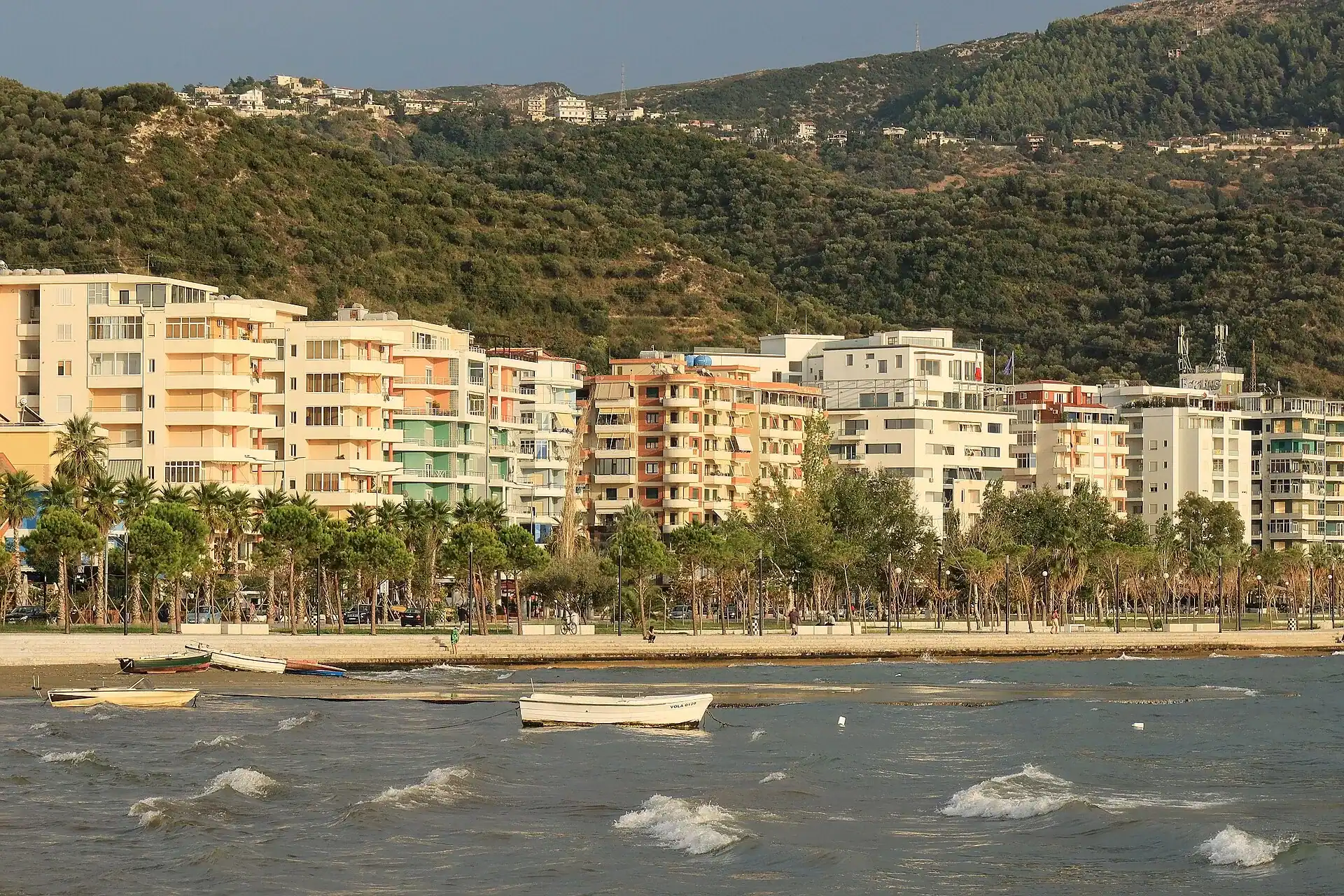 Photo: Julien Seguinot / Wikimedia Commons (CC BY-SA 2.0)