Cost of Living in Nassau
Where this figure comes from. No cost survey covers Nassau, so the $2,600 a month above is our own estimate rather than a measurement. On 416 of our 999 city guides the figure is built from a published Numbeo basket, a one-bedroom rent in the centre plus one person's monthly costs without rent, converted to USD; this city is not one of them. How we source everything.
Budget around $2,600 a month as a solo remote worker in Nassau, which is expensive for what it is and reflects an economy built entirely on tourism and offshore finance. A one-bedroom flat runs roughly $1,200 to $1,800, with Cable Beach and the areas near Paradise Island at the top of that. Groceries are the standing complaint: the Bahamas imports around ninety per cent of its food and the customs duty is heavy, so a supermarket shop costs roughly double the American equivalent. There is no income tax. The Bahamian dollar is pegged one to one with the United States dollar and both circulate. This is our own estimate rather than measured data. Fibre runs about $80 to $140 a month and a coworking desk $200 to $350. Electricity is expensive because it is generated from imported fuel, and running air conditioning through the summer can add $200 to $350. Rents on the western side towards Lyford Cay run well above Cable Beach, while the older neighbourhoods inland are a fraction of both, which is where the price differences on this island actually sit. Health insurance is required under the permit and Bahamian private cover is expensive, so it should be priced before the application rather than after.
Where to Work in Nassau
Nassau's connectivity is good in the developed areas, with fibre from Cable Bahamas and Aliv reaching most of New Providence at workable speeds and comprehensive mobile coverage. There is a small coworking presence, some of it created around the BEATS remote work permit. Power outages happen and anyone whose work cannot pause should ask what backup a building has before signing. The Bahamas runs on Eastern time with daylight saving, which keeps Nassau aligned with New York year-round and makes it the most convenient Caribbean base for anyone working American hours. Most of the region keeps standard time all year, so a base elsewhere in the islands drifts an hour against American clients for half of every year and this one never does. The BEATS permit also carries no income tax on money earned under it, which is the substantive financial benefit alongside the year. Cable Beach and Palmdale have the most reliable fibre coverage on the island.
Getting Around Nassau
New Providence is a small island and Nassau covers most of it. Downtown around Bay Street is walkable, though it is built for cruise passengers and empties when the ships leave. Jitney minibuses cover the island cheaply and are the way most residents move; they stop running in the early evening. Taxis are expensive and metered fares are frequently a negotiation. Driving is on the left in cars mostly imported with left-hand drive, which is as strange as it sounds. Lynden Pindling airport has more direct connections to the United States than any other Caribbean airport, and the Family Islands are short hops by light aircraft. The Exumas are a forty-minute flight or a longer ferry, and Eleuthera and Long Island are similar hops, which is how most permit holders actually use the country. Rock Sound and George Town both have airstrips with several services a day from Nassau. Jitneys run numbered routes from the depot near the British Colonial and stop when flagged, and the fare is a flat dollar and a quarter regardless of distance.
Sorting transport? Book an airport transfer, or compare car rental on Auto Europe and QEEQ.
Visas for Nassau
The Bahamas Extended Access Travel Stay, known as BEATS, is a one-year renewable permit for remote workers and students employed or enrolled outside the country, with an application fee of around $1,000 plus a smaller processing charge. It is handled online and is one of the more straightforward schemes in the region. Short visits are visa-free for most Western nationalities for up to ninety days, and British citizens receive longer. There is no income tax on money earned under the permit, which is the substantive benefit alongside the length. Anyone applying should note that the permit covers the whole country, so it can be used from a Family Island rather than from New Providence. Applications are made online through the Bahamas Immigration portal and are usually decided within a few weeks, and the permit covers dependants at an additional fee per person. Renewal is straightforward for a second year.
Best Time to Visit Nassau
December to April is the dry, cooler season, with daytime temperatures around twenty-six, low humidity and the calmest seas, and it is when prices and crowds peak. May to November is hotter and considerably wetter, and the Atlantic hurricane season runs through it; the Bahamas sits directly in the track and Hurricane Dorian in 2019 was catastrophic for Abaco and Grand Bahama, though Nassau was largely spared. September and October carry the highest risk and the lowest prices. Junkanoo, the street parade with its costumes and goatskin drums, runs on Boxing Day and New Year's Day. Junkanoo starts in the small hours and runs until dawn on both days, and the competing groups spend the year building costumes for it, which makes it a genuine civic institution rather than a performance for visitors. Water temperature stays above twenty-four degrees all year, which makes the Bahamas one of the few places in the region where winter diving needs no wetsuit beyond a shorty. Sea temperature peaks near thirty degrees in August.
Pros and Cons of Nassau
Nassau has the best flight connections to the United States of any Caribbean capital, a one-year remote work permit, no income tax, and seven hundred islands behind it that almost no visitor reaches. The water in the Exumas is as good as anywhere on earth. Nassau itself is expensive to live in, dominated by cruise tourism along Bay Street, and carries a crime problem that residents and foreign governments both take seriously, with specific areas that visitors are consistently advised to avoid. The island is developed rather than beautiful, and the beauty is elsewhere in the chain. Andros, the largest island in the chain and one of the least visited, holds the third-longest barrier reef in the world and a blue hole system that is still being surveyed, and it is an hour from Nassau. Nassau's own beaches are decent rather than remarkable by Bahamian standards.
Who Nassau Is For
American working hours and a Caribbean base a short flight from the east coast, with the paperwork solved for a year and no income tax on it. It works best for people who treat Nassau as the airport and the Family Islands as the point, since the Exumas, Eleuthera and Long Island are what the country actually offers. A budget will not survive Bahamian prices for long. Anybody moving here should also read the current safety guidance for New Providence properly, because a place that receives millions of tourists is not therefore uniformly safe, and the distinction matters by neighbourhood. Nobody has a better reason to be here than a sailor. The Exumas rank among the great cruising grounds of the Atlantic, and this is where boats get provisioned, cleared and repaired before heading down the chain. Next to Bermuda it is half the rent, twice the crime, considerably better islands behind it and a permit that costs a third as much.
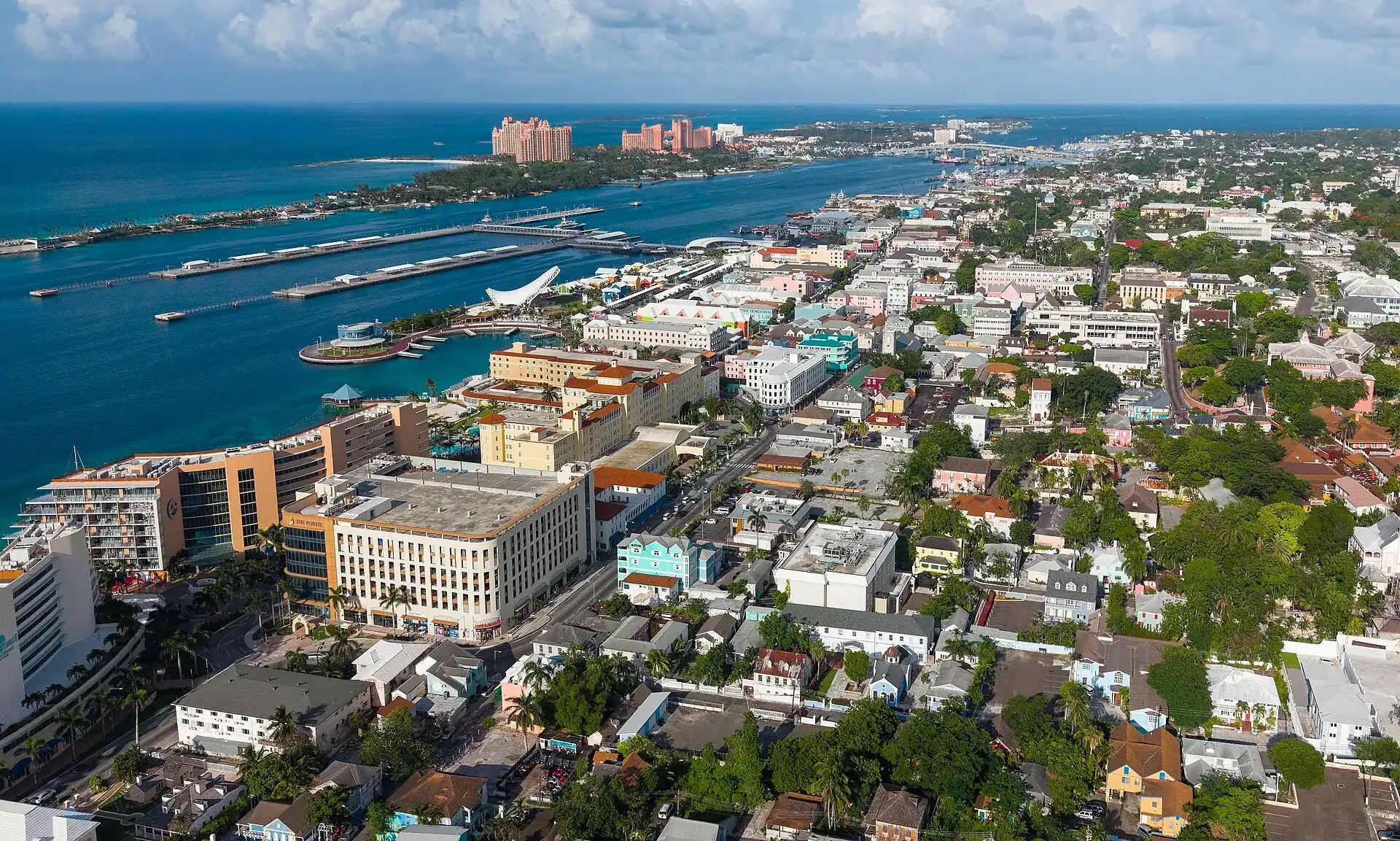 Photo: Quintin Soloviev / Wikimedia Commons (CC BY 4.0)