Cost of Living in Luanda
Where this figure comes from. No cost survey covers Luanda, so the $2,100 a month above is our own estimate rather than a measurement. On 416 of our 999 city guides the figure is built from a published Numbeo basket, a one-bedroom rent in the centre plus one person's monthly costs without rent, converted to USD; this city is not one of them. How we source everything.
Budget around $2,100 a month. Luanda was repeatedly ranked the most expensive city in the world for expatriates through the 2010s, and while the kwanza's fall has changed that, costs for anyone living an imported lifestyle remain high. A one-bedroom runs roughly $700 to $1,300, with the Ilha and the Marginal at the top. Imported groceries are very expensive; the local markets are cheap and the fish is excellent. Eating out splits sharply between local canteens at a few dollars and expatriate restaurants at European prices. The kwanza has devalued substantially and cash still matters. Housing splits into two markets that barely touch. Expatriate compounds and serviced apartments are priced in dollars against oil-company budgets, while the ordinary rental market runs in kwanza at a fraction of that, and which one you enter depends almost entirely on whether an employer is paying. At the upper end, paying for security is simply part of what a household spends. The state built enormous satellite developments to house the middle the city lacked, of which Kilamba south of town is the best known, and they filled slowly and expensively.
Where to Work in Luanda
Connectivity is moderate. Angola has submarine cable capacity and Luanda has fibre in the better districts, with speeds workable for normal remote work, though prices are high relative to income. Mobile data from Unitel and Africell is widespread and Africell's entry improved both price and coverage. Power cuts happen and generators are standard. There is a small but growing coworking scene aimed at the local startup community. The time zone is one hour ahead of GMT, which makes European hours straightforward. Anyone planning to work here should also budget for a generator or a building that has one, since the outages are frequent enough to interrupt a working day regularly. Oil is the whole economy and everything else follows from it: the sector funds the state, sets the exchange rate and determines whether the country is in an expansion or a contraction, and the diversification programmes have not yet changed that. Chinese firms built much of the visible infrastructure over the past two decades under oil-backed arrangements, which is why the construction is recent and the debt is long. For an outsider the practical effect is that professional life runs through personal introduction rather than open advertisement.
Getting Around Luanda
Luanda's traffic is the defining daily experience: the city has grown far faster than its roads and journeys that look short take an hour. The blue and white candongueiro minibuses cover the city cheaply and chaotically. Taxis and Yango are available and reasonable. A new light rail and the expanded Marginal have helped a little. Dr Antonio Agostinho Neto International Airport opened in 2023 about forty kilometres south, replacing the old Quatro de Fevereiro, with connections to Lisbon, Sao Paulo, Dubai and across Africa. Anyone travelling to the new airport should allow considerably more time than the distance suggests, since the road south leaves the city through some of its worst traffic. Sea traffic is the underused alternative. Boats cross the bay to the Ilha and run down the coast, which avoids the roads entirely for some journeys, and residents who have worked out the routes use them. Nobody walks between districts, both because of the distances and because the pavements are not built for it. Ride-hailing has changed the city considerably for anyone without a driver, though surge pricing in the evening rush makes a short trip cost what a long one does at noon.
Sorting transport? Book an airport transfer, or compare car rental on Auto Europe and QEEQ.
Visas for Luanda
Angola transformed its visa regime in 2018 and again since, and it is now far more open than its reputation. Citizens of a long list of countries, including much of Europe, the United States and Brazil, receive up to thirty days visa-free on arrival, and an e-visa covers most of the rest. A yellow fever certificate is required. There is no remote work visa. Longer stays require a work or residence visa applied for in advance, and the process remains slow. Anyone extending a stay should start the process early, since Angolan administrative procedures are slow and overstaying carries fines that are enforced at the airport. Angola signed a mutual visa waiver with Portugal and several other lusophone states, part of a wider Community of Portuguese Language Countries arrangement, which covers most of the traffic that actually moves in and out of the country. Work permits are employer-sponsored and slow, and the local partner requirements for foreign companies are substantial.
Best Time to Visit Luanda
May to September is the cacimbo, the cool dry season, and the practical window: temperatures around twenty four degrees with overcast skies and almost no rain. October to April is the hot rainy season, humid and up to thirty degrees, with heavy downpours that flood parts of the city. The Benguela current keeps the coast cooler than its latitude suggests, which is why Luanda is drier and milder than Kinshasa on the same parallel. The beaches south at Cabo Ledo are best in the dry season. Anyone heading south should note that Kissama National Park is about seventy kilometres away and that the Benguela railway inland reaches the highlands in a day. The cacimbo brings a low grey overcast rather than rain, and visitors expecting African sunshine in July are consistently surprised by weeks of flat cloud that never quite breaks. It is still the right season to come, since the alternative is heat and flooding. Carnival in February and March is a serious national event with parades along the Marginal, and it falls squarely in the wet half, which is the trade for seeing it.
Pros and Cons of Luanda
The setting is genuinely dramatic, a city curved around its bay, with a Portuguese colonial core, one of the most energetic music scenes in Africa in kuduro and semba, and an economy opening up after decades of closure. Angolan cooking is excellent. The cost is high, the traffic is worse, and a serious gap runs between the wealth on the Marginal and the musseque settlements immediately behind it. Street crime is a real concern, infrastructure is uneven, and the civil war that ended in 2002 still shapes the country. Luanda's Ilha, the sand spit closing the bay, also holds most of the city's beach bars and restaurants and is where the city goes at weekends. The gap between the Marginal and the musseques is the defining social fact rather than a footnote, and Angola's inequality is among the most extreme measured anywhere, which a visitor sees within an hour of arriving. Healthcare for anything serious means Portugal or South Africa, and the companies that post people here carry that cover as standard. Set against all of it, the country has been at peace since 2002 and a generation has now grown up with no memory of the fighting, which has done more to the city than any building programme.
Who Luanda Is For
Work in oil, gas, construction, diplomacy or development, and Portuguese especially, since business runs in it and English will get you nowhere. Angolan music is exported across the whole continent, and both semba and kuduro came out of this city rather than being adopted by it. It does not suit budget travellers, anyone who needs to move around a city quickly, or anyone without a local network, because Luanda is difficult to navigate without one and expensive to navigate badly. The Atlantic slave trade ran through this city more heavily than through any other. Luanda was its largest single port, and the Museu Nacional da Escravatura stands on the site of the chapel where captives were baptised before embarking. The honest framing is that almost nobody comes to Angola independently, and the ones who do arrive with a contract, a posting or a family connection. Costs assume an employer. Anyone drawn to Portuguese-speaking Africa with a free hand should look at Cape Verde or Mozambique first, both of which are far easier to enter and to move around. What Luanda offers that neither does is a real capital city, with the scale, the music and the friction that implies.
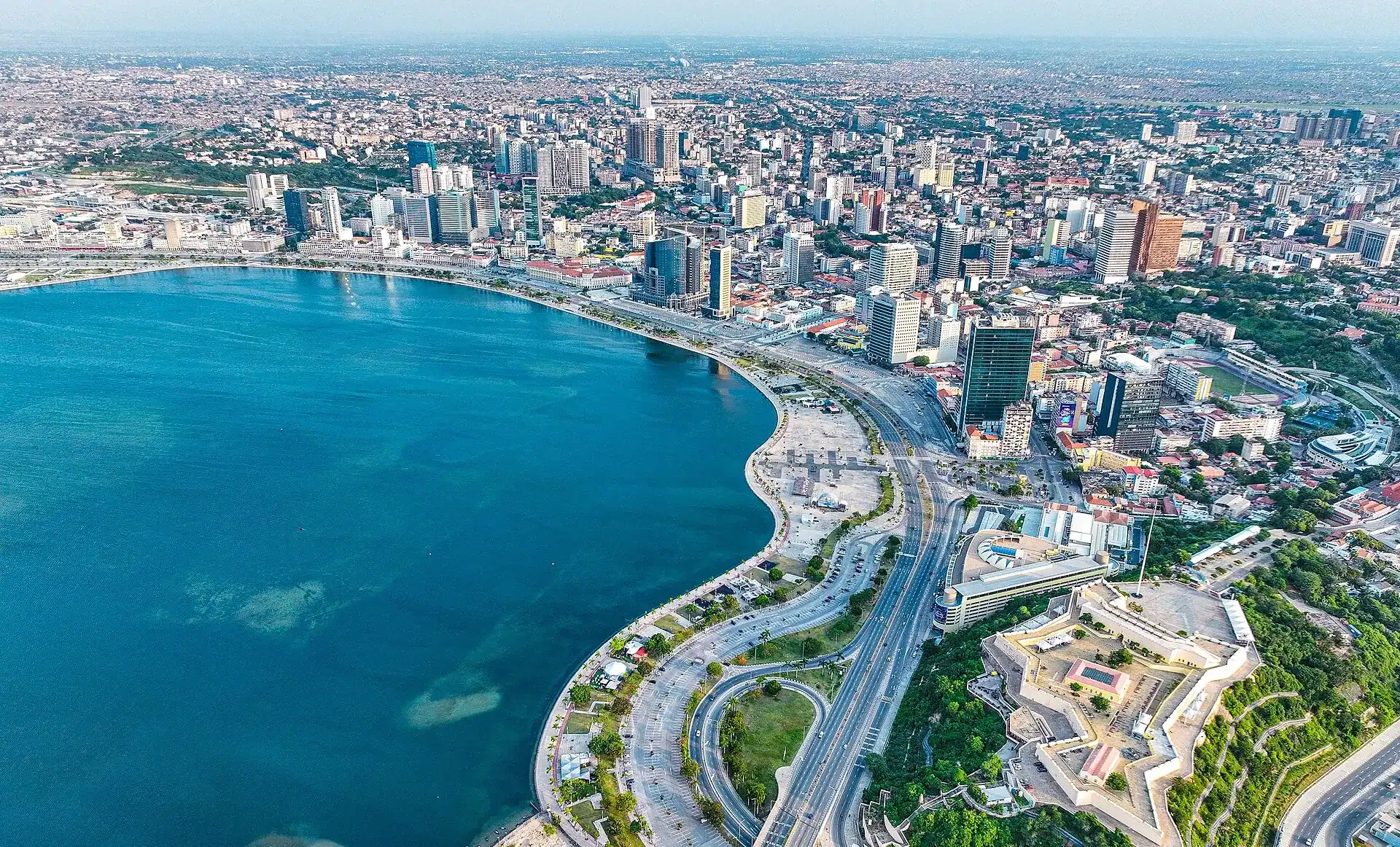 Photo: Iamdelcioborges / Wikimedia Commons (CC BY 4.0)