Cost of Living in Hull
Real market data
Source: Numbeo · June 2026
$1,670/moSolo nomad1-bed centre + living costs
$2,380/moCoupleshared 1-bed + costs
$1,610/moLean / localcheaper area + costs
- 1-bed rent, city centre$790£590
- 1-bed rent, outside centre$730£539
- Monthly costs excl. rent (1 person)$880£655
- Meal, inexpensive restaurant$21£15
- Monthly transit pass$98£73
- Buy price, per m² (centre)$4,100£3,050
Prices are from Numbeo (June 2026), converted to USD at $1 = £0.74 (01 Aug 2026). The monthly living-costs figure is our transparent one-person basket, groceries, a few meals out, utilities, phone, internet, transport and essentials, priced from those figures. Solo adds central rent; couple and lean are estimates from the same numbers.
Budget around $1,670 a month, which makes Hull the cheapest city on this site in the United Kingdom. A one-bedroom runs roughly $500 to $800 and house prices here are among the lowest in England, which is the single most striking economic fact about the place. Groceries are ordinary British prices. Eating out is inexpensive and the fish, unsurprisingly for a city that was one of the world's great fishing ports, is good. Utilities run through a cold dry winter. Council tax applies separately. Anyone comparing with Leeds an hour west should note that Hull's housing runs roughly forty per cent lower for an equivalent property, which is the largest such gap in northern England. The broadband is the exception to the cheapness rather than part of it. A single operator has served this city alone for over a century, and with no competitor the tariffs sit above what the rest of Britain pays for a slower product, which is the price of having had fibre a decade early. Buying rather than renting is where the numbers become genuinely unusual, since terraced houses here change hands for less than a deposit would cost in the south, which is why a small but steady stream of arrivals here came specifically to buy rather than to rent.
Where to Work in Hull
Connectivity is very good and genuinely unusual. Hull is served by KCOM rather than BT, a legacy of the city owning its own telephone network since 1902, and that operator rolled out full fibre to essentially every property years before the rest of the country, which is why the phone boxes are cream rather than red. Speeds and reliability are among the best in Britain. There is a coworking scene around the Fruit Market quarter and a growing digital sector. The time zone is GMT with British summer time. The estuary is the economic story now. Turbine blades are manufactured on the Humber for the North Sea wind farms, the freeport designation covers sites on both banks, and the supply chain around all of it is where the region's investment has gone. That is heavy industry rather than services, so it employs engineers and fitters rather than laptops, but it is why the city has money arriving at all. The university's medical school and the digital cluster around the Fruit Market are the other two poles.
Getting Around Hull
Hull is flat and compact, and the Old Town, the Fruit Market and the marina are all walkable, with the bus network covering the rest and cycling genuinely easy on level ground. Trains reach Leeds in an hour and London in under three. Humberside Airport is limited, so Leeds Bradford or Manchester are the practical connections. The overnight ferry to Rotterdam and Zeebrugge leaves from the King George Dock, which is an unusually civilised way to reach the continent. Anyone taking the overnight ferry should book a cabin rather than a seat, since the crossing to Rotterdam takes about eleven hours and arrives early in the morning. The Humber Bridge held the record for the longest single span in the world for seventeen years and still carries a toll, which is the thing to know before assuming the south bank is casually reachable. Rail runs east to west far better than north to south, so Manchester and Leeds are easy while Newcastle or Birmingham involve changes. An open-access operator competes with the main franchise on the London route, which is unusual in Britain and keeps those fares lower than the distance suggests.
Sorting transport? Book an airport transfer, or compare car rental on Auto Europe and QEEQ.
Visas for Hull
To visit Hull, most travellers who can enter the UK without a visa first buy an Electronic Travel Authorisation for $27; everyone else needs a standard visitor visa. Visitors may not work for a British employer, though remote work for an overseas employer is permitted within limits. There is no digital nomad visa. Longer stays require a sponsored work visa or the Graduate route, which applies to graduates of the University of Hull and lets them stay and work for two years after finishing without a sponsor. Anyone using the Graduate route should apply from inside the United Kingdom before the student visa runs out, since the application cannot be filed from abroad or after expiry. Anyone thinking past a first visa should understand how settlement actually works, because it constrains the years in between: indefinite leave to remain generally needs five continuous years on a qualifying route, and absences above a set number of days in any twelve-month period reset the clock, which catches remote workers who assumed they could spend half the year elsewhere. The High Potential Individual visa is the other route worth knowing, open to recent graduates of a defined list of overseas universities and requiring no sponsor at all.
Best Time to Visit Hull
May to September is the best window, with July around eighteen degrees and Hull benefiting from being on the dry east coast, which gets substantially less rain than Manchester or Cardiff. April and October are cool and clear. Winter from November to March is cold and dark rather than wet, with the wind coming off the North Sea and across the Humber flats with nothing to stop it. The Freedom Festival in September is the city's largest event and is genuinely good. Anyone here in winter should expect the Humber wind, which arrives across flat estuary country with nothing to break it and makes the temperature feel considerably lower. Winter carries a specific risk here rather than merely a cold one. The city sits low against a tidal estuary and a North Sea surge, when it coincides with a high spring tide, is what floods Hull rather than rainfall; the 2007 and 2013 events are both within living memory and the defences have been rebuilt since. Anyone renting at ground level should ask which flood zone the address sits in, which is public information and takes a minute to check.
Pros and Cons of Hull
Hull is the cheapest city in England to live in and has the best internet in the country, which is a combination that exists nowhere else in Britain, along with a genuinely handsome Old Town, The Deep aquarium in a building that projects over the Humber, and the 2017 City of Culture year that left real infrastructure behind rather than a slogan. The city has struggled economically since the fishing collapsed in the 1970s, the deprivation that followed is still visible, and it is a long way from anywhere else in England. Flood risk is the structural fact underneath the cheap housing, and it is worth saying plainly rather than leaving implied: much of the city lies at or below the level of the Humber, a substantial share of properties are in a designated flood zone, and insurance reflects that. Considerable money has gone into defences since 2007 and the lagoon scheme protects much of the west. Day-to-day safety is not a concern here at all, and the medical school and teaching hospital give it better healthcare than a place of this size usually has.
Who Hull Is For
The best broadband in Britain at the lowest housing cost, which is a serious argument if the work is the point. It suits students and graduates, given the university and the Graduate route. Maritime history is the obvious subject and Philip Larkin the less obvious one: he ran the university library here for thirty years and wrote most of his work in the city. Nothing is near Hull, which sits at the end of the line rather than on the way to anywhere, and the city has not been prosperous for a long time. Both facts shape a stay more than any amount of regeneration marketing suggests. Wilberforce was born in Hull, and the house he grew up in is now a museum of the slave trade and of its ending. The city treats that as its own story and not a borrowed national one. Among the northern English options, Leeds has the jobs and the prices to match, Sheffield has the hills, Newcastle has the nightlife, and this city has the lowest housing cost in England attached to the fastest domestic internet in it. That combination suits one person very specifically: somebody whose income arrives from elsewhere and who would rather own outright than rent forever.
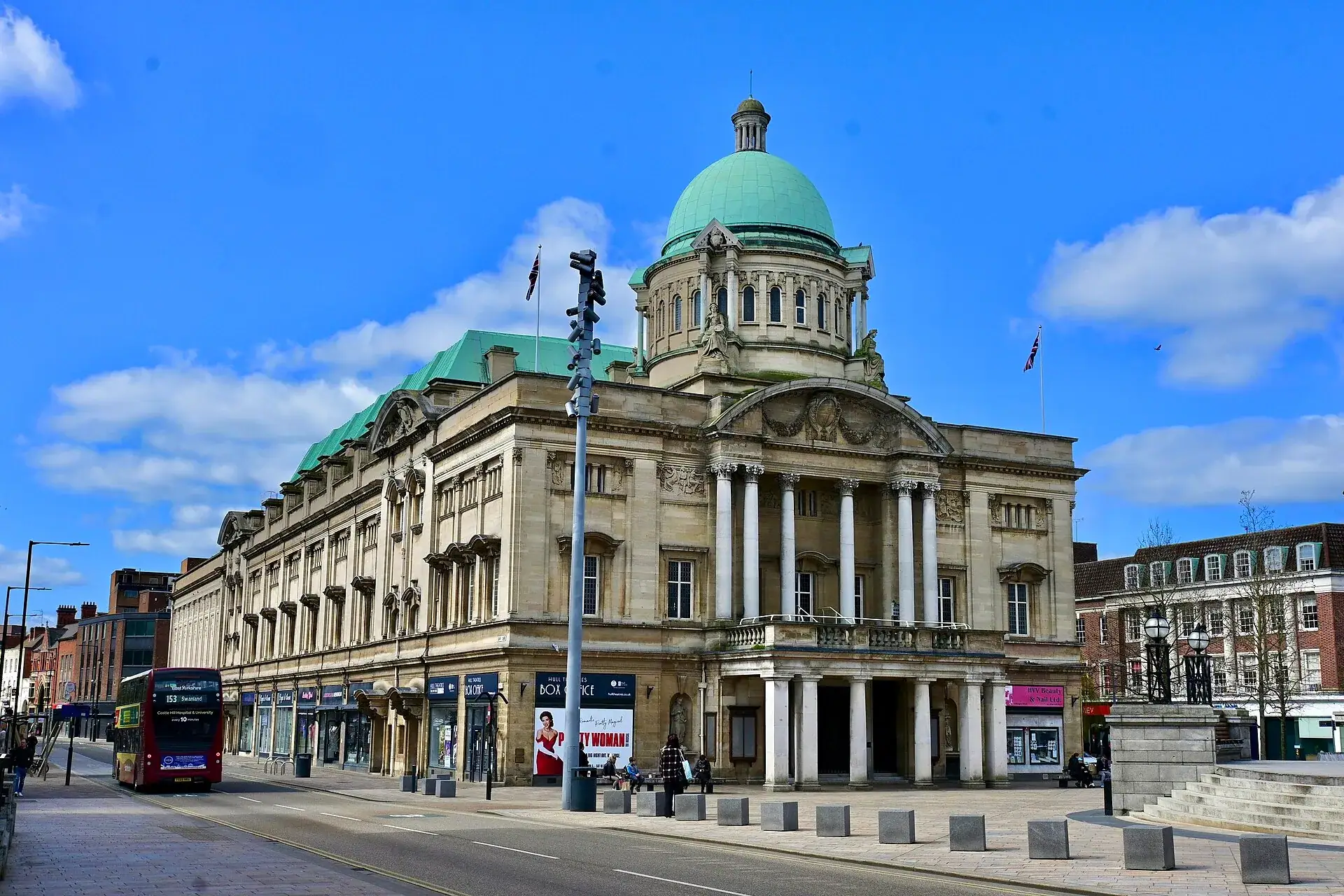 Photo: Hullian111 / Wikimedia Commons (CC BY-SA 4.0)