Cost of Living in Aberdeen
Real market data
Source: Numbeo · September 2026
$1,960/moSolo nomad1-bed centre + living costs
$2,860/moCoupleshared 1-bed + costs
$1,920/moLean / localcheaper area + costs
- 1-bed rent, city centre$840£625
- 1-bed rent, outside centre$790£591
- Monthly costs excl. rent (1 person)$1,120£834
- Meal, inexpensive restaurant$20£15
- Monthly transit pass$120£90
- Buy price, per m² (centre)$2,310£1,720
Prices are from Numbeo (September 2026), converted to USD at $1 = £0.74 (01 Aug 2026). The monthly living-costs figure is our transparent one-person basket, groceries, a few meals out, utilities, phone, internet, transport and essentials, priced from those figures. Solo adds central rent; couple and lean are estimates from the same numbers.
Budget around $1,960 a month, which makes Aberdeen noticeably cheaper than Edinburgh and considerably cheaper than London. A one-bedroom runs roughly $700 to $1,100, and the market has softened as the oil industry contracted, so there is more choice than there was. Groceries are ordinary British prices. Eating out is moderate and the seafood is genuinely good. Utilities are a real cost, since the winters are long, though Scotland's housing is generally better insulated than England's. Council tax is a separate annual charge that catches people out when they compare with mainland Europe. Scottish tenancies work differently from English ones and in the tenant's favour: the private residential tenancy is open-ended with no fixed term, notice from the tenant is short, and the deposit goes into a government-approved scheme. That makes a trial stay far less risky here than in most of Europe. The market has a student rhythm, tightening through August and September around the two universities and loosening afterwards. Heating is the line that moves most, and a granite tenement with single glazing costs a great deal more to keep warm than a modern build.
Where to Work in Aberdeen
Connectivity is good. Fibre reaches most of Aberdeen at reasonable speeds, mobile coverage is comprehensive and power is reliable. There is a real coworking scene and a substantial professional base, since the city has been the centre of the North Sea oil and gas industry for fifty years and is now trying to convert that expertise into offshore wind and hydrogen. The universities add a research layer. The time zone is GMT with British summer time, which is the most convenient position on this site for anyone splitting work between Europe and North America. The professional culture here is unusually contractor-shaped, a legacy of an industry that has always hired in project cycles, which means freelance and day-rate working is normal and understood rather than unusual. Robert Gordon University and the University of Aberdeen anchor the research side, the latter founded in 1495. The offshore wind build-out in the North Sea is where the money and the hiring have moved, and anyone with subsea, marine or project engineering experience will find this one of the few cities in Britain actively short of them.
Getting Around Aberdeen
Aberdeen is walkable in the centre along Union Street and compact enough to cover on foot or by bicycle, though the wind and the rain temper the enthusiasm. Buses cover the city and First Aberdeen runs a decent network. Aberdeen Airport has flights across the United Kingdom, to several European cities and, unusually, a great many helicopter movements to the offshore platforms. Trains run to Edinburgh in about two and a half hours and to London in seven. The ferry to Orkney and Shetland leaves from the harbour. Anyone driving north should know that the coast road towards Peterhead and Fraserburgh passes some of the best cliff scenery in Scotland and takes about an hour. The bypass, opened in 2019, changed driving in and around the city considerably and is the reason the coast and Deeside are as quick to reach as they now are. There is no tram or metro and none is planned, so buses and the park-and-ride sites do the work. Cycling infrastructure is improving but patchy, and the wind is a more serious deterrent than any of the hills.
Sorting transport? Book an airport transfer, or compare car rental on Auto Europe and QEEQ.
Visas for Aberdeen
The United Kingdom requires most non-visa nationals to obtain an Electronic Travel Authorisation, which costs $27, before arrival, which has been phased in and now covers most visitors, and visa nationals need a standard visitor visa. Visitors may not work for a United Kingdom employer, though remote work for an overseas employer during a visit is permitted within limits. There is no digital nomad visa. Longer stays require a sponsored work visa, the Global Talent route, or one of the other categories, and the salary thresholds have risen substantially since 2024. Anyone working remotely for an overseas employer while visiting should read the current visitor rules carefully, since the permitted activities are defined narrowly and have changed recently. Nothing here is specific to Scotland: immigration is reserved to the United Kingdom government, so a Scottish job or a Scottish university confers no separate route, whatever the political argument about that. The graduate route lets students stay and work for a period after finishing, which is how a good many people first arrive in this city, and the immigration health surcharge is payable up front for the whole length of the visa, which is a substantial sum to find at the application stage.
Best Time to Visit Aberdeen
May to September is the best window, with July around eighteen degrees and long days: Aberdeen sits far enough north that midsummer light lasts past ten at night. April and October are cool and changeable. Winter from November to March is dark, wet and windy, with sunrise after eight and sunset before four in December, and the North Sea weather makes it feel rawer than the temperature suggests. Snow falls but rarely settles long in the city. The beach is beautiful and cold in every month. Anyone visiting in summer should also consider the dolphins at Torry Battery, where the Moray Firth population is regularly visible from the headland above the harbour mouth. The haar, a cold sea fog, can sit on the city for days in late spring and early summer while the countryside a few miles inland is in sunshine, which is a particular Aberdeen disappointment. And the northern latitude occasionally works in winter's favour: the aurora is visible from this coast on strong nights, and the dark months that make the city feel long are exactly when it appears. Spectra, the winter light festival in February, exists for that reason.
Pros and Cons of Aberdeen
Aberdeen is built almost entirely from local granite, which gives it an architectural coherence found nowhere else in Britain and which genuinely sparkles in sunlight, and it comes with a long beach, Royal Deeside and the Cairngorms an hour west, and a professional job market that few cities this size can match. Costs are well below the rest of urban Britain. The weather is grey and windy for much of the year, and the economy is still working out what comes after oil, a question the city has been asking for a decade. Union Street, the granite mile that is the city's signature, has struggled badly with retail vacancy as the oil contraction and online shopping arrived together, and the regeneration is under way but visibly unfinished. In its favour, the city is safe, the beach is a genuine two-mile stretch of sand a short walk from the centre, and the food has improved sharply of late as money that came for oil stayed for other reasons. Aberdeen also feels further from London than it is, which cuts both ways.
Who Aberdeen Is For
Energy professionals, engineers and researchers, since the transition from oil to offshore wind is happening here and the expertise is concentrated. It suits hillwalkers and skiers, given the Cairngorms. It suits anyone working across Europe and North America, since the time zone serves both. Sunshine and mild winters are not what the north-east of Scotland offers, the international community is oil-sector rather than general, and anybody arriving from outside the United Kingdom without a sponsored job will find the visa routes narrow and the fees substantial. Aberdeenshire holds more castles per square mile than anywhere else in Britain, and several of them stay open right through the year, not only for the handful of summer months. Anyone choosing a Scottish city should know the trade plainly: Edinburgh is prettier and far more expensive, Glasgow is larger and has the culture, Dundee is cheaper again, and Aberdeen has the salaries, the mountains and the worst weather of the four. The schools are good and nobody commutes far, which matters a great deal more with children than without. Liking a northern winter is a genuine preference and not a pose, and it turns out to be the single best predictor of who ends up staying rather than leaving after one year.
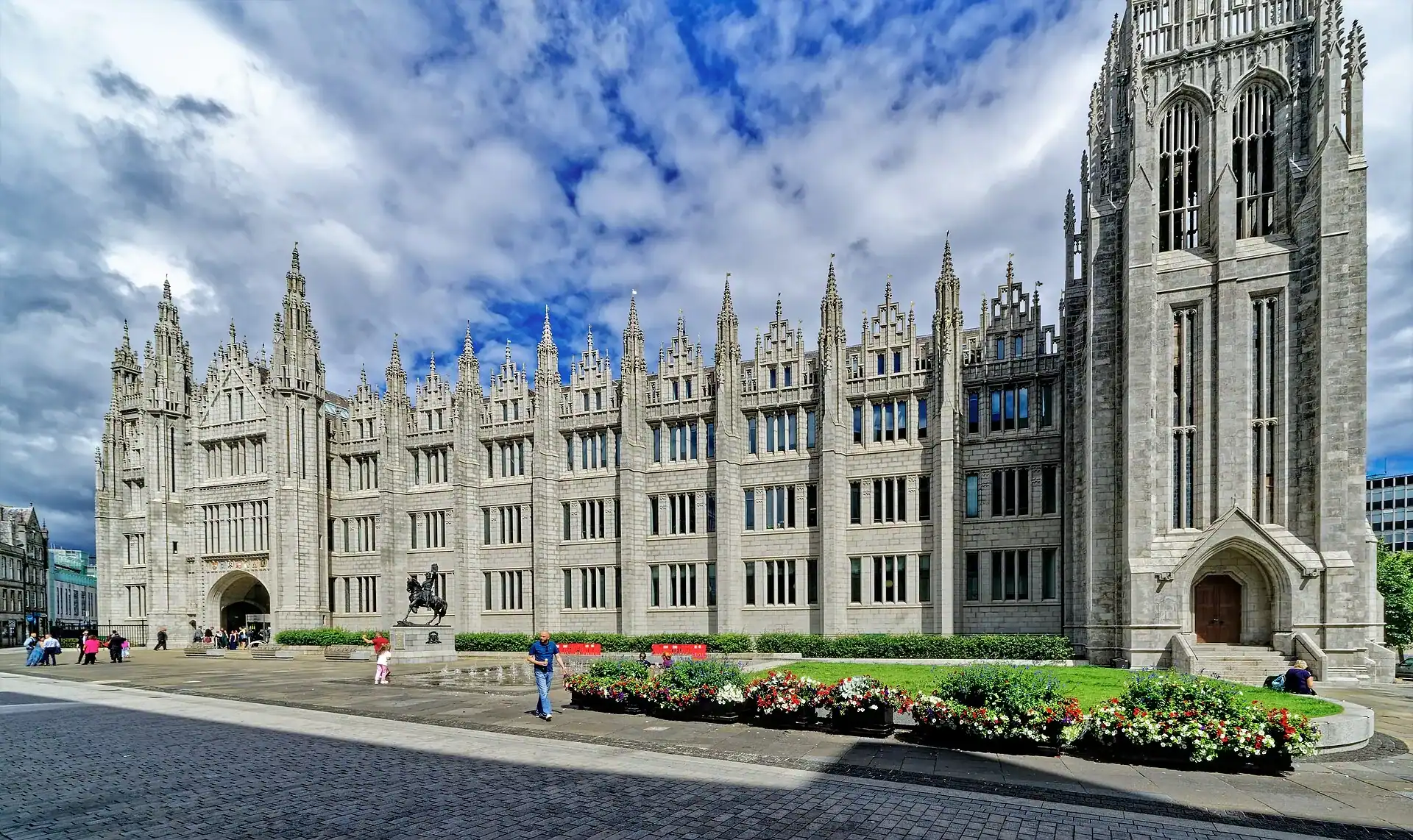 Photo: Holger Uwe Schmitt / Wikimedia Commons (CC BY-SA 4.0)