Cost of Living in Cebu
Real market data
Source: Numbeo · August 2026
$910/moSolo nomad1-bed centre + living costs
$1,230/moCoupleshared 1-bed + costs
$710/moLean / localcheaper area + costs
- 1-bed rent, city centre$510₱31,060
- 1-bed rent, outside centre$310₱19,050
- Monthly costs excl. rent (1 person)$400₱24,714
- Meal, inexpensive restaurant$4₱250
- Monthly transit pass$13₱780
- Buy price, per m² (centre)$2,990₱182,998
Prices are from Numbeo (August 2026), converted to USD at $1 = ₱61.25 (01 Aug 2026). The monthly living-costs figure is our transparent one-person basket, groceries, a few meals out, utilities, phone, internet, transport and essentials, priced from those figures. Solo adds central rent; couple and lean are estimates from the same numbers. The guide below quotes its own monthly range, which is a different measurement rather than a competing one: this table prices a defined basket at the figures above, while that range is a judgement about how somebody actually lives here.
Cebu is one of the most affordable cities in Southeast Asia for remote workers. A solo nomad living modestly can get by on $800-1,100/month, while a more comfortable lifestyle with a central condo runs $1,300-1,800/month.
- Rent, central (IT Park / Cebu Business Park): $325-490/month for a studio or 1BR condo
- Rent, cheaper areas (Mandaue, Talamban, Banilad): $195-325/month
- Groceries: $130-245/month, less if you shop at local wet markets
- Eating out: Carinderia (local canteen) meals $1.50-3; mid-range restaurant dinners $5.50-13
- Coworking hot-desk: $6.50-14/day; $90-140/month for a monthly pass
- Local transport: Jeepney rides under $0.50; Grab rides $1.50-5 around the city
- Monthly total range: $800-1,800 depending on lifestyle and location
The Philippine peso fluctuates. The numbers above are based on mid-2025 exchange rates of roughly PHP 56-58 per USD.
Where to Work
Cebu has a solid and growing coworking scene, centered on IT Park in Lahug and the surrounding business districts. The Company Cebu (IT Park, Mabuhay Tower) and KMC Solutions (Skyrise 4A and 4B, IT Park) are the most polished options, both offering fast fiber internet, meeting rooms, and day or monthly passes. Nest Workspaces (Horizons 101, General Maxilom Ave) is a 24/7 community-focused space popular with creatives and freelancers. Workplace Cafe (Raintree Mall, F. Ramos St) stays open around the clock and costs as little as $0.50 per hour.
Cafe-working culture is strong. Chains and independents alike provide outlets and WiFi, and staff rarely pressure you to leave after one drink. The caveat is that cafe speeds vary widely: typically adequate for emails and messaging, but unreliable for long video calls. For video calls or large uploads, stick to a dedicated coworking space.
In IT Park, fast apartment fiber packages are common. Outside the business districts, speeds and consistency drop noticeably. Mobile data from Globe and Smart is fast for light tasks but not a reliable primary connection for intensive remote work.
Getting Around
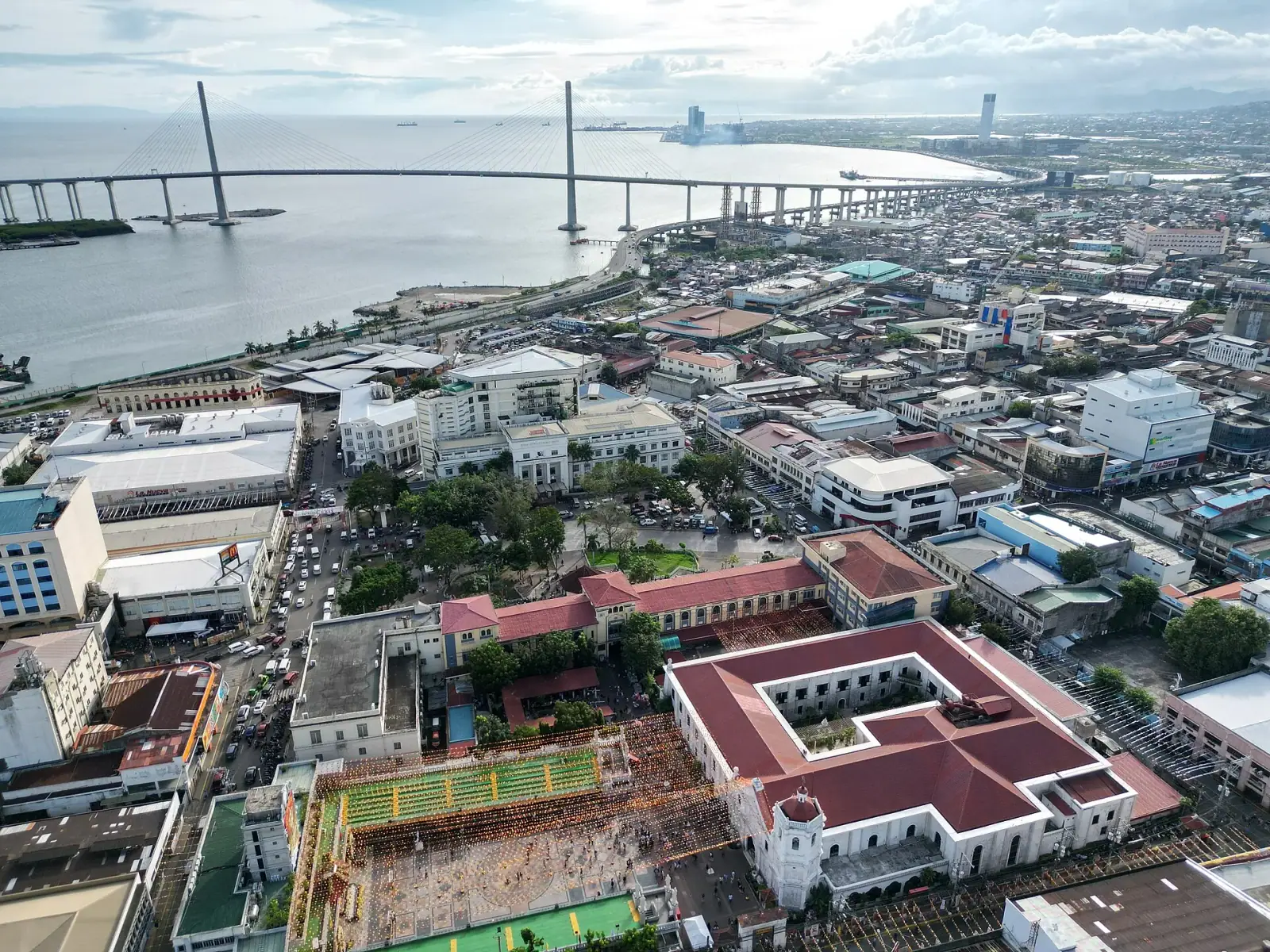
Cebu City is not walkable in the traditional sense. Distances between districts are manageable, but heat, sidewalk conditions, and traffic make walking impractical for anything beyond a few blocks. You will rely on some form of transport for most daily movement.
Jeepneys are the cheapest option (under $0.50 per ride) and cover most major routes, but routes can be confusing for newcomers. Grab (the regional Uber equivalent) is the easiest option and most reliable for non-Filipino speakers, with fares averaging $1.50-4 for most city trips. E-bikes and habal-habal (motorbike taxis) fill gaps in less central areas.
A scooter rental runs $49-82/month and is the most practical option if you plan to explore beyond the city. Traffic congestion is heavy during morning and evening rush hours (7-9 AM, 5-7 PM), especially along the main arterial roads.
Airport access: Mactan-Cebu International Airport (MCIA) is on Mactan Island, roughly 30-45 minutes from IT Park by Grab ($4-6.50 depending on traffic). There is no direct rail link. Budget extra time during peak hours or if your arrival coincides with school traffic near the bridge crossings.
Sorting transport? Book an airport transfer, or compare car rental on Auto Europe and QEEQ.
Visas and Staying Long-Term
Citizens of most Western countries (US, UK, EU, Canada, Australia, and roughly 157 nationalities total) arrive visa-free for 30 days. This initial stamp is extendable at any Bureau of Immigration (BI) office.
- First extension: 29 additional days (total 59 days on the ground), costs roughly $49 at a BI office
- Further extensions: In 1, 2, or 6-month blocks, up to a total of 36 months before you must exit and re-enter
- No digital nomad visa: Executive Order No. 86 created a Philippine Digital Nomad Visa in 2025, but its application process had still not opened by October 2026. Long-stayers use successive tourist extensions or opt for special investor or retirement visas if eligible
- Proof of onward travel: Immigration sometimes asks at the airport, so have a return or onward ticket ready
Best Time to Visit
Cebu sits inside the Philippine typhoon belt, though its climate is relatively benign compared to northern Philippine islands, and it has two distinct seasons.
Dry season (December to May) is the most comfortable window for remote work. Skies are clearer, humidity is lower, and internet-disrupting storms are rare. January through April is the sweet spot: temperatures of 24-32C, minimal rain, and calm seas if you want to explore the nearby islands on weekends. January brings the Sinulog festival, which is spectacular but makes Cebu City very crowded for a week.
Wet season (June to November) brings afternoon downpours and occasional tropical disturbances. Direct typhoon hits on Cebu City are less common than in northern Luzon but do happen, and nearby storms cause flight delays, choppy seas, and temporary internet outages. Accommodation prices drop significantly and crowds thin out, which appeals to long-stayers. September through November is the quietest and cheapest stretch of the year.
For a first visit combining remote work with exploration, February through April offers the best combination of reliable conditions and activity.
Pros and Cons
- Pro: Very low cost of living relative to output quality, especially outside the central business districts
- Pro: English is widely spoken, including in shops, restaurants, and with landlords
- Pro: Excellent island day-trips and diving within 1-2 hours (Moalboal, Malapascua, Bantayan)
- Pro: Warm, outgoing local culture and a growing expat and nomad community
- Pro: Multiple coworking spaces concentrated in IT Park with reliable fiber internet
- Con: Heavy traffic congestion makes the city feel chaotic during rush hours
- Con: Internet reliability drops sharply outside central business districts
- Con: Air quality in Cebu City is moderate and can be noticeably poor near busy roads
- Con: No direct nomad or long-stay visa; bureaucratic extensions are doable but repetitive
- Con: Petty theft (phone snatching, pickpocketing) is present in crowded public spaces and markets
Who Cebu Is Best For
Cebu suits nomads who want low costs combined with English-speaking comfort and do not mind navigating a busy Southeast Asian city. If you are the kind of person who wants to base yourself somewhere affordable, build a routine around a coworking space, and escape to island beaches on weekends, Cebu delivers that package better than almost anywhere else at the price point. It also works well for people doing a longer Southeast Asia loop who want a month or two of stability before moving on.
It is a strong fit for beginner nomads who want a supportive English environment without the language barrier of, say, Vietnam or Indonesia. The local community is welcoming and there are enough other remote workers to make socializing easy.
Cebu is a harder sell for people who prioritize walkability and a pedestrian-friendly urban environment, or who need consistent fast internet at a cafe rather than a dedicated space. It also may not suit those sensitive to urban air quality or who dislike the logistical overhead of visa extensions every few months. If you want Southeast Asia with less city noise and more nature, consider Siargao or Palawan instead.