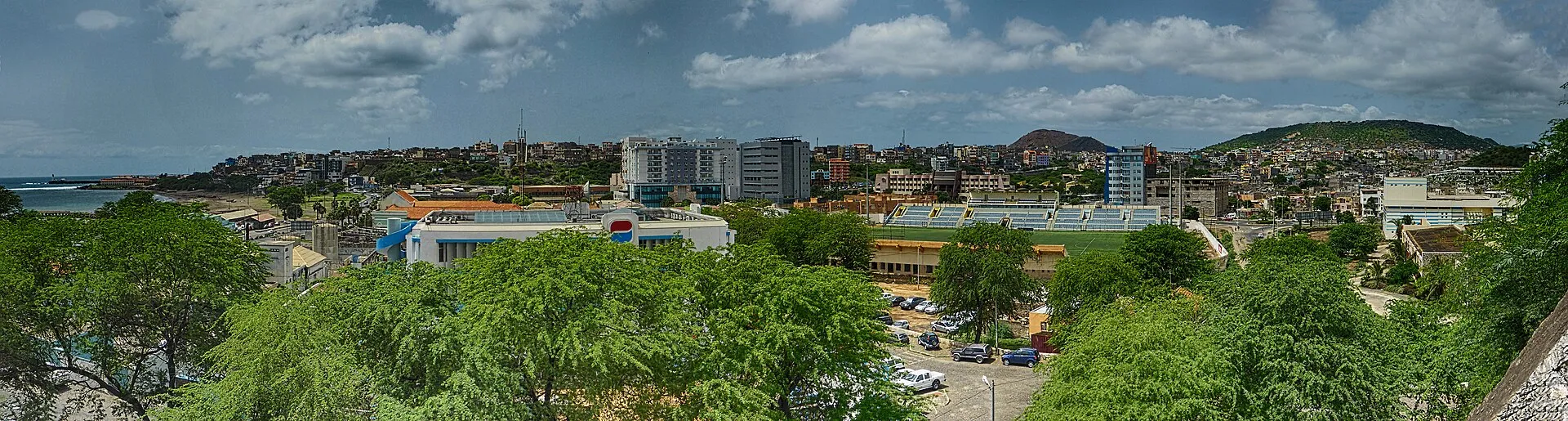
The flight from Lisbon takes about four hours, and it ends on a runway three kilometres from the middle of a capital. Nelson Mandela International Airport sits on the dry south coast of Santiago, the largest island of Cape Verde, just northeast of Praia, and the ride into town is short: about five kilometres along Avenida Aristides Pereira, through the district of Lém-Ferreira, then up Avenida Amílcar Cabral onto the plateau that gives the old centre its name.
Praia is built on volcanic tablelands. Most districts sit on top of one, an achada, with the valleys between them, and the central one is simply called the Plateau, Platô to the people who live here. It was chosen because a flat-topped rock above the harbour was easy to defend against pirates, and the old wall still carries its cannons. In the nineteenth century its streets were laid out on a grid and lined with colonial mansions, and since 2016 the historic centre has been on UNESCO's tentative list.
At the top of Avenida Amílcar Cabral the taxi lets you out by the Mercado Municipal, selling food and crafts from early morning, close to Praça Alexandre Albuquerque, the main square, with the neoclassical Pro-Cathedral of Nossa Senhora da Graça on its east side and the City Hall of 1858. At the south end of the plateau stands the presidential palace, built for the Portuguese governor in the 1890s. Below the cliff to the north, the Sucupira market spreads out beside the stand where shared minibuses leave for the rest of the island.
That is the place: a working capital of about 140,000 people, more than a quarter of the country, where ministries, banks, the main hospital and every international internet cable that reaches Cape Verde come together. It suits a remote worker with a settled job who wants winter warmth, an Atlantic time zone that reaches both Europe and the Americas, and a real city rather than a resort. It does not suit anyone looking for a nomad scene, a beach holiday, or a place to get by without Portuguese. For beaches and wind, our digital nomad guide to Boa Vista and Sal covers the islands where the holiday flights land.
Plan on about $1,400 a month. That is our own estimate, since no cost survey covers Praia, built on a one-bedroom on the Plateau or in Achada Santo António at $470 to $835 a month; in districts such as Palmarejo Grande or Tira Chapéu the same flat costs $210 to $365. Imported goods in the bigger supermarkets are where the island stops being cheap.
| Monthly budget, one person (our estimate) | about $1,400 |
|---|---|
| One-bedroom, Plateau or Achada Santo António | $470 to $835 a month |
| One-bedroom, outer districts | $210 to $365 a month |
| Visa-free stay (EU, UK, US, Canada) | 30 days |
| Remote Working Program, one person | average balance of about $1,730 over 6 months |
| Airport security tax, pre-registered | about $35 (double at the border) |
| Coworking, one month | about $110 to $167 |
| Time zone | UTC-1, all year |
| Rainy months | August to October |
Budget and rents: our estimate on the city page. Program terms: Turismo de Cabo Verde. Tax: Portugal's foreign ministry and the UK Foreign Office. Coworking: the spaces' published prices. Prices are in US dollars at an exchange rate of 95.79 escudos to the dollar on 1 August 2026; the escudo is pegged at 110.265 to the euro.
How long can you stay?
On an EU, British, American or Canadian passport, 30 days without a visa. Australians and New Zealanders need one in advance, since visas on arrival ended for a long list of nationalities on 1 January 2026. Everyone must pre-register on the EASE platform at least five days before arrival and pay the airport security tax, about $35 online. Since 1 July 2026, arriving without the pre-registration means paying double, about $71, at border control.
For longer, Cape Verde has one of the simplest remote-work permits in the Atlantic. The Remote Working Program gives six months, renewable once for six more, to citizens of Europe, North America, the Portuguese-speaking countries and the West African ECOWAS bloc. It tests savings, not salary: an average bank balance of about $1,730 over the last six months, or about $3,110 for a family. The rule is set in euros, so its dollar value moves with the exchange rate.
You apply online and wait about two weeks; do not fly before the approval arrives. Insurance must cover medical evacuation and the repatriation of remains, and at the airport the border police ask to see your documents, including a criminal record certificate and your accommodation booking, before they stamp you in. The fees are small, about $23 for the visa, charged again on renewal, and a one-off airport fee of about $39, and remote workers on the program pay no Cape Verdean income tax.
How does Cape Verde compare?
Our visa finder sets the Remote Working Program beside 39 other digital nomad visas, with each country's money test and length of stay.
Compare digital nomad visas →Where the cables come ashore
This is Praia's real advantage over the beach islands. All of Cape Verde's international cables land here, among them EllaLink to Portugal and Brazil, which came ashore at Achada Grande and went live in June 2022. Sal and Boa Vista reach the world through a domestic link to Santiago; the capital has the routes on its own doorstep.
Do not expect European speeds, though. The national median home line, measured in July 2026, ran at about 39 Mbps down and 14 up, enough for calls and cloud work but thin for heavy uploads. And 5G is not here yet: the government is piloting it in 2026, at Praia's technology park among other sites, with commercial rollout planned from 2027.
So carry two connections. Alou, the brand Cabo Verde Telecom launched in 2023 after absorbing CV Móvel, and Unitel T+, which had more subscribers than Alou on Santiago in 2023, both sell SIMs with monthly data. Ask the landlord for a speed test on the flat's own line before you pay a deposit.
For a desk, the capital has the coworking the other islands lack. Workin' CV, at 19 Rua Justino Lopes on the Plateau, opens Monday to Friday from eight to six, at about $12.50 a day or $110 to $141 a month. Prime Coworking has two branches in Palmarejo, from about $115 a month for a hot desk to about $167 for a dedicated desk with round-the-clock access. Neither publishes a speed, so book a day pass first.
Which achada to live on
Each tableland has its own character, and since taxis are cheap, you can choose for the street rather than the commute.
The Plateau: the working centre
Few people actually live on the Plateau, about a thousand at the 2010 count, which tells you what it is: the city's office, market and meeting place. Flats here put the market, the square, Workin' CV and the restaurants of Rua 5 de Julho outside your door.
Achada Santo António: where most people live
Southwest across the valley, Achada Santo António is the most populous district in the city, with many of the embassies, restaurants with views over the city, and the same price band as the Plateau. It is the practical choice for a longer stay: residential, central and a short ride from everything.
Palmarejo, Prainha and Quebra Canela: towards the sea
West of Achada Santo António, Palmarejo is where the city is growing, and where Prime Coworking has both its branches. Closer to the water, Prainha holds more embassies and runs out to Ponta Temerosa, the island's southern point, where the white octagonal Dona Maria Pia lighthouse marks the entrance to the harbour. Beside it, Quebra Canela has the beach locals and visitors use most, overlooked by a large cross.
A day in the capital
Mornings in Cape Verde's cities start with a pastel, a fried pastry filled with fish, meat or chicken, and in Praia the Mercado Municipal is already busy by then. Lunch could be cachupa, the national dish, a slow-cooked stew of hominy, beans and fish or meat; whatever is left over is fried the next morning with an egg and sausage.
After work, you could walk down to Quebra Canela for a swim. In the evenings Praia has the island's own music: funaná, an accordion music from Santiago that the colonial authorities once tried to keep out of the capital; batuku, sung in call and response and now found only on this island; and morna, the islands' song of longing and departure, on UNESCO's heritage list since 2019. Quintal da Música, a music club on the Plateau, serves live music with its cachupa.
The clock helps the working day. Cape Verde keeps UTC-1 all year: an hour behind London and Lisbon in winter and two in summer, and four hours ahead of New York in winter and three in summer. A morning call with Europe and an afternoon call with the east coast of America fit into one ordinary day.
Santiago beyond the capital
Ten kilometres west, at the mouth of the Ribeira Grande valley, lies Cidade Velha, founded in 1462 and the first European colonial outpost in the tropics. It is a UNESCO World Heritage Site, with a marble pillory from the sixteenth century in its square, the ruins of a cathedral and the Forte Real de São Filipe on the heights above.
Inland the island rises and turns greener. Assomada, 26 kilometres northwest and about 550 metres up, has one of the largest markets on Santiago, and beyond it the Serra Malagueta natural park reaches 1,064 metres, with hiking trails and plants found nowhere else. At the northern tip, Tarrafal has a sandy swimming beach under Monte Graciosa and the museum of the camp where the Portuguese dictatorship held political prisoners from 1936 to 1974.
You reach all of it by aluguer, the shared minibuses and pickups that leave from beside Sucupira and cost from about 50 cents to $6 depending on the distance; tell the conductor "Para!" when you want to get off. Further afield, the ferry to the volcano island of Fogo takes about four hours, and CVsky, the new state airline, has flown the domestic routes since 29 March 2026. Build a day of slack around any island hop.
When to go
Praia has a desert climate: about 210 millimetres of rain a year, almost all of it between August and October, average highs around 27°C and nights around 22°C. That steady warmth is the point of a winter here.
The catch comes from the east. Between November and March, the harmattan carries Saharan dust out over the islands, the same weather that brings the calima to the Canaries, and the sky can turn hazy for days. For clear skies and dry weather, aim for April to July; for an escape from a European winter, accept the haze.
Language, safety and health
Portuguese is the official language, but Kriolu, Cape Verdean Creole, is the first language of nearly everyone. English is not something to count on at the market, the pharmacy or a government counter. A few weeks of Portuguese before you arrive will do more for you here than in most places.
Crime is generally low, but the UK Foreign Office warns of pickpocketing, bag snatching and muggings, particularly in Praia, and advises avoiding unlit, isolated areas after dark. The crowded Mercado Municipal is the place to keep a hand on your phone.
Medical facilities across the country are basic, some medicines are hard to find, and the European health card is not accepted. Praia has the largest hospital, the Hospital Universitário Agostinho Neto on the Plateau, which carried out the country's first kidney transplant in 2026. Buy insurance that covers evacuation, which the Remote Working Program requires anyway.
Praia, Sal or Mindelo?
Choose Praia if your income depends on your connection, if you want the coworking spaces, the hospital and a capital's daily life, and if Portuguese does not scare you. Choose Sal or Boa Vista for beaches and kitesurfing, as our Sal and Boa Vista guide explains, and Mindelo on São Vicente if music and a smaller town appeal more. If what you want is a winter in the Atlantic with a large nomad community attached, our Las Palmas guide covers the obvious alternative, and our Dakar guide the mainland city facing these islands.
If you come: pre-register on EASE five days ahead, apply for the program early if you will stay beyond a month, take two SIMs, and rent on the Plateau or in Achada Santo António. Then walk to the Diogo Gomes monument at the south end of the Plateau one evening, and look out over Gamboa beach and the islet of Santa Maria.
Everything we know about Praia
The cost breakdown, the neighbourhoods, coworking notes and all 13 of our category ratings, on one page.
Open the Praia city guide →Frequently Asked Questions
How much does it cost to live in Praia as a digital nomad?
About $1,400 a month on our estimate. A one-bedroom on the Plateau or in Achada Santo António runs $470 to $835, and $210 to $365 in outer districts such as Palmarejo Grande.
Does Cape Verde have a digital nomad visa?
Yes, the Remote Working Program: six months, renewable once, for citizens of Europe, North America, the Portuguese-speaking countries and ECOWAS. You need an average bank balance of about $1,730 over the last six months, or about $3,110 for a family.
Do I need to pre-register before flying to Cape Verde?
Yes. Register on the EASE platform at least five days before arrival and pay the airport security tax of about $35. Since 1 July 2026, skipping it means paying double at the border.
Is the internet in Praia good enough for remote work?
For most work, yes. Every international cable lands in Praia, and the national median home line runs at about 39 Mbps down. 5G is still a pilot. Keep a second SIM and test the flat's line.
Where can I cowork in Praia?
Workin' CV on the Plateau, from about $110 a month, and Prime Coworking, with two branches in Palmarejo, from about $115 a month. Both sell day passes.
What time zone is Cape Verde in?
UTC-1 all year, with no daylight saving: one hour behind London and Lisbon in winter, two in summer, and three to four hours ahead of New York.
Is Praia safe for remote workers?
Generally, yes. Crime is low, but pickpocketing, bag snatching and muggings occur, particularly in Praia. Avoid unlit, isolated areas after dark and watch your phone in the market.


