
Put a finger on the map at Dakar, where West Africa bulges furthest into the Atlantic, and move it out to sea, west and a little north. The first island it reaches is Boa Vista, the easternmost of Cape Verde, about 450 km from the coast of Senegal, and just to the north of it, Sal. Both are low and bare, made of sand, salt pans and old lava: Sal's highest hill reaches 406 metres, Boa Vista's 387. The capital, Praia, lies far to the southwest on Santiago, a mountain island of a different kind.
That position explains most of what working here is like. With no high ground to break it, the northeast trade wind blows straight across both islands, which is why the kitesurfing world tour opened both its 2025 and 2026 seasons on Sal. Europe is close: about four hours' flying from Lisbon, and on UTC-1 all year, your day runs an hour behind London in winter and two in summer. And islands this flat and dry have no natural water supply to speak of, so the utilities that run the power make the drinking water too.
The map has one catch. Every international internet cable that reaches Cape Verde comes ashore at Praia. Sal and Boa Vista, where most of the holiday flights land, hang off the capital on a domestic submarine ring, and that single fact shapes who should work from them.
So these are islands for a particular remote worker: one whose work survives a modest connection, who wants a beach and wind more than a coworking scene, and who plans in months rather than years. Sal suits most people, with the busiest airport in the country and a working town at Espargos. Boa Vista and its one town, Sal Rei, suit people who want space and quiet. If your income depends on video calls all day, base yourself in the capital and fly over for weekends; our Praia digital nomad guide covers life there.
| Remote Working Program, one person | average balance of about $1,730 over 6 months |
|---|---|
| Program visa fee / airport fee | about $23 / about $39 |
| Airport security tax, pre-registered | about $35 (double at the border) |
| Tourist tax, hotels and similar | about $2.85 a night, 10 nights at most |
| Fixed broadband, national median | 38.6 Mbps down, 14.3 up |
| Central one-bedroom, national average | about $427 a month |
| Flight Sal to Boa Vista | from about $91 |
| Mean wind at Santa Maria, Feb / Aug | about 12 / 7.5 knots |
| Time zone | UTC-1, no summer time |
Program terms: Turismo de Cabo Verde. Security tax: Portugal's foreign ministry. Broadband: Speedtest Global Index, July 2026. Rent: Numbeo, 13 contributors. Fares: CVsky. Wind: Open-Meteo reanalysis, 2019 to 2023. Dollar figures use the ECB exchange rate of 25 September 2026, $1.1403 per euro, and the escudo's peg of 110.265 to the euro.
Sal: a salt island that turned into a beach
Santa Maria, at Sal's southern tip, was founded in 1830 to ship salt. A small rail track carried it to a pier, and the town exported up to 30,000 tonnes a year until Brazil, its main buyer, shut the trade in 1887. Tourism arrived in 1967 with the Morabeza, the country's first resort hotel, and by 2017 almost half of all the hotel beds in Cape Verde were on this one island.
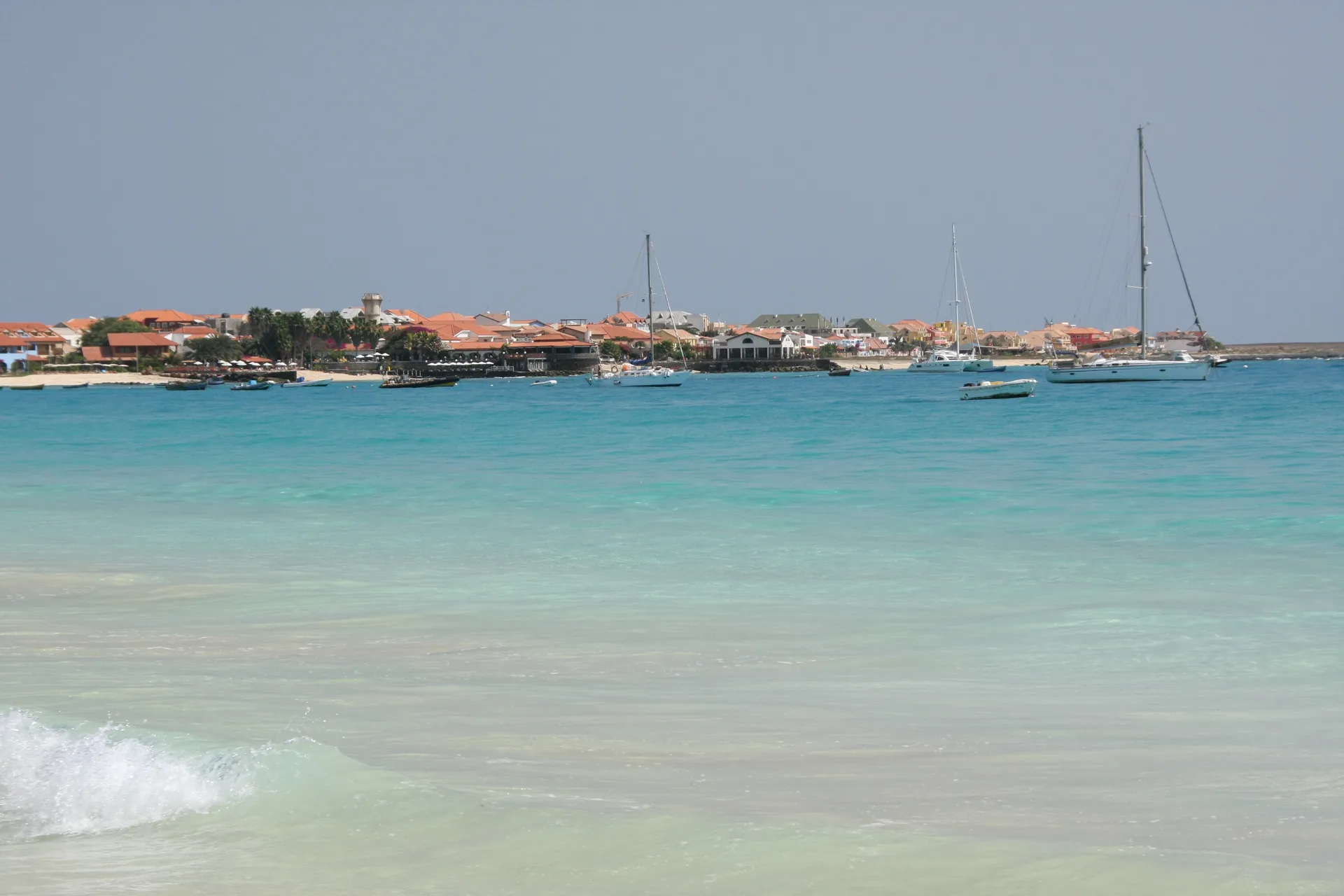
The beach is the reason: eight kilometres of white sand running from the town past Ponta do Sinó to Ponta Preta. The old wooden pier in the middle kept the town's clock. Boats unloaded at dawn, the peixeiras, the fish sellers, weighed and sold tuna and dolphinfish on the planks, and at dusk the far end faced the sun going down into the Atlantic.
Storm swell badly damaged it in October 2024. In September 2025 the government signed for a new pier, 18 months of work, more than twice as long at 120 metres, with separate zones for the fish market and for leisure. Until it opens, expect a building site at the heart of town.
At the far end of the beach, Ponta Preta has a right-hand wave that curls round a rocky point into a sandy bay and can reach six metres. Kite Beach, three kilometres of sand with a steady onshore wind, is the island's all-round kiting spot. Up the island at Pedra de Lume, the salt pans sit inside the crater of an extinct volcano, reached through a tunnel cut in 1804, and the brine is so dense that you float in it without trying.
Espargos, up the road by the airport, is the other Sal: the island capital and commercial centre, with squares, painted façades and around 17,000 residents. Look there for a monthly flat priced for residents rather than holidaymakers.
Boa Vista: dunes, turtles and a town square
Boa Vista is nearly three times Sal's size with fewer people, about 14,500, the emptiest island in the archipelago. Its one real town is Sal Rei, "King Salt", on the northwest coast. Pirates sacked it in 1815 and 1817, and the answer still stands on the Ilhéu de Sal Rei, the islet across the harbour: the Fort Duque de Bragança.
Life in town turns around the Praça de Santa Isabel, a cobbled square with palms and the small church of Santa Isabel, and around the harbour, where the catch is tuna and lobster. Praia de Estoril, sheltered by the islets, is calm enough to swim, while the bay draws windsurfers and kiters. There is little traffic, and the island is a home of morna, the slow, sung form of Cape Verdean music.
Outside Sal Rei the island opens up. The Deserto de Viana is a field of pale dunes up to 50 metres high, built from sand the wind carried over the ocean from the Sahara. Santa Mónica, the longest beach, runs for 11 kilometres. On the north coast the Spanish freighter Cabo Santa Maria has sat in the sand since she ran aground in 1968, close enough to reach on foot.
The beaches also belong to turtles. Cape Verde's loggerheads are the only nesting colony in the eastern Atlantic and the third most important in the world, and Boa Vista takes more than 65 percent of the nests, laid between June and October. From March to May, humpback whales come from the North Atlantic to breed between Sal, Boa Vista, Maio and Santiago.
Staying for months, legally
The paperwork is the same on every island. Cape Verde's Remote Working Program, launched in December 2020, has generous terms: six months, renewable for six more, open to citizens of Europe, North America, the Portuguese-speaking countries and the West African ECOWAS bloc, and exempt from Cape Verdean income tax.
The money test is a savings record, not a salary: an average bank balance of about $1,730 over the last six months, or about $3,110 for a family. The rule is set in euros, so its dollar value moves. Add a passport valid for six months, a first booking, and insurance covering medical evacuation and repatriation. Approval takes about two weeks, and you should not fly before it arrives. Our comparison of digital nomad visas sets these terms against other countries'.
Without the program, most European visitors get 30 days visa-free, but they must pre-register on the EASE platform at least five days before arrival and pay the airport security tax. Since 1 July 2026, skipping the pre-registration means paying double at the border. The program page lists a higher airport fee than the tax itself; budget the higher figure.
Hotels and similar lodgings add a tourist tax for guests 16 and over, but it stops after ten nights in the same place, so a month in one aparthotel costs about $29 in tax, no more than a ten-night holiday.
Where the cable comes ashore
Back to the map. All three international cable systems land at Praia: WACS along the African coast, EllaLink to Portugal and Brazil, and SHARE to Dakar. Cabo Verde Telecom's domestic ring carries the signal on to Sal at Murdeira bay and to Boa Vista at Sal Rei. The capital has three routes to the world; the eastern islands reach all of them through their link to Santiago.
Nobody publishes island-level speeds worth trusting. Nationally, the median fixed connection was 38.6 Mbps down and 14.3 up in July 2026, enough for video calls, if not for moving large files in a hurry. There is no national mobile figure.
Two operators cover both islands: Cabo Verde Telecom, which sells fibre and mobile as Alou, and the Angolan-owned Unitel T+, which a 2023 study for the regulator ARME placed ahead on Sal, Boa Vista and Santiago. A home line of 60 Mbps or more runs about $54 a month nationally. Ask the landlord for a speed test on the flat's own line before you pay a deposit, and carry a SIM from each operator for a backup hotspot.
We know of no verified coworking space on either island, so your desk is the rental. Sal's power comes from the national utility, Electra; Boa Vista is the one island outside it, supplied with electricity and water by the public-private AEB. A 26 MWh battery added at a wind farm in December 2025 is already steadying the grid, but a small UPS for the router is cheap insurance.
A working week in Santa Maria or Sal Rei
The clock suits European clients. At eight in the morning in Santa Maria it is already eleven in Berlin in summer, so an early start lines you up with their day, and your afternoon overlaps with the New York morning. Lunch could be cachupa, the national stew of corn, beans, vegetables and meat, or fish from the day's catch; in Sal Rei, the market by the square sells fruit, tuna and lobster.
At five o'clock the islands take over. In Santa Maria you could walk the beach towards Ponta Preta and watch the kiters work the point; in Sal Rei you could swim at Estoril behind the islets, then sit in the square as the town comes out for the evening.
Weekends are for the coast and the interior. On Sal, float in the crater at Pedra de Lume, or look into the Buracona, a flooded lava tunnel 22 metres deep that glows blue when the sun hits it. On Boa Vista, walk into the Viana dunes, out to the wreck at Cabo Santa Maria, or take a boat from Sal Rei to see the whales in spring.
What a month costs, and what nobody can tell you
No rent survey for Sal or Boa Vista deserves a number. The crowd-sourced pages for Santa Maria and Sal rest on one and two contributors, and the one for Boa Vista had no entries at all.
National figures are firmer, if still rough: a central one-bedroom in Cape Verde averages about $427 a month. Our own estimates for a full month's living are $1,400 in Praia and $950 in Mindelo, editorial rather than survey results.
Santa Maria is built around hotels, and euros change hands freely on both islands, which tells you whom prices are set for. Espargos, with nearly three times Santa Maria's population, is where monthly lets priced for residents are most likely. On either island, ask for the monthly price in writing and in escudos, and compare it with the same flat's weekly holiday rate.
Weighing the islands against the mainland?
Put Praia beside another Atlantic base and compare budget, wifi and all 13 of our category ratings in one view.
Compare cities side by side →Flights, ferries and the channel between the islands
Sal is the gateway. Its airport, six minutes from Espargos and about 16 km from Santa Maria, is the busiest in the country, with flights to Lisbon on TAP and Cabo Verde Airlines, to Frankfurt, Munich and Düsseldorf on TUIfly, and to Dakar on Air Senegal, plus seasonal routes from across Europe.
Boa Vista's airport, about five kilometres from Sal Rei, is the third busiest and almost entirely European leisure traffic: TUI, Neos and TAP, several of them seasonal. For all its closeness to Africa, it has no scheduled flight to the mainland; Dakar means changing on Sal or in Praia.
About 50 km of sea separates Santa Maria from Sal Rei. Since 29 March 2026 the new state airline CVsky has flown the domestic network, after the previous operator, Bestfly, stopped in 2024. Sal to Boa Vista is advertised from about $91, and hops take 20 to 45 minutes, though the airline warns that bad weather can disrupt them. The Redonda Line ferry calls twice a week, about three hours from Sal to Boa Vista and eight on to Praia, with sailings adjusted daily to the sea. For anything with a deadline attached, fly.
The wind sets the calendar
Both islands are drier even than Praia. Modelled data gives Santa Maria about 100 mm of rain a year and Sal Rei about 140, nearly all of it in the official rainy season from mid-August to mid-October, when a heavy storm can flood roads.
The wind follows the opposite curve, strongest in February and weakest in August, and between November and March the harmattan can bring a haze of Saharan dust. Daytime highs climb from about 25°C in February to 30°C in October.
December to March is kite season, windy and busy with European holidaymakers. March to June is the best stretch for steady desk work: dry, still breezy, with humpbacks offshore until May. August to October is hot and the likeliest time for rain to cut roads and flights, but it is when the turtles nest and hatch on Boa Vista.
If something goes wrong
Healthcare in Cape Verde is very basic and limited, and the European health card is not accepted. Each island has a hospital, reached on +238 241 11 62 on Sal and +238 251 11 67 on Boa Vista, but the main public hospital, Dr. Agostinho Neto, is in Praia. For an ambulance, call 130.
That is why the program insists on evacuation cover: after a quad-bike accident, for example, evacuation is very likely. British health authorities have also seen a rise in Shigella and Salmonella among travellers returning from Cape Verde, so drink bottled water and skip the ice. Crime is generally low, though pickpocketing and bag snatching occur on both islands. The authorised taxis are blue and yellow, and swim only where a lifeguard is on duty.
Sal, Boa Vista or Praia?
Look at the map once more. Sal is where the planes land: choose it for the most flights to Europe, the only direct flight to mainland Africa of the two, the shops of Espargos, and Santa Maria's beach and wind a short ride away. Boa Vista, further out towards Africa and emptier, rewards people who want dunes, turtle beaches and quiet evenings in a small town, and whose work tolerates a thinner flight map.
Choose Praia if your income depends on your connection: it has every international cable, the coworking spaces and the main hospital, and Sal is one short flight away. The full numbers are on our Praia city profile, and if music matters more to you than beaches, look at Mindelo on São Vicente. Whichever island you pick, apply for the program before you book, test the line before you sign, and buy the evacuation cover first.
See Cape Verde's numbers in full
Cost of living, internet, safety and all 13 of our category ratings for Praia, before you decide how to split your time between the islands.
Open the Praia city guide →Frequently Asked Questions
Can digital nomads live on Sal or Boa Vista?
Yes, on Cape Verde's Remote Working Program: six months, renewable once, with an average bank balance of about $1,730 over six months. The limits are practical: modest internet and no verified coworking.
How fast is the internet on Sal and Boa Vista?
No reliable island figure exists. The national fixed median was 38.6 Mbps down and 14.3 up in July 2026, and both islands reach the international cables through Praia, so test the flat's own line.
How much money do I need for the Cape Verde remote working visa?
An average bank balance of about $1,730 over the last six months for one person, or about $3,110 for a family, plus a visa fee of about $23 and an airport fee of about $39. Approval takes about two weeks.
How do I get from Sal to Boa Vista?
CVsky flies the route from about $91 in 20 to 45 minutes. The Redonda Line ferry takes about three hours and sails twice a week, weather permitting.
Do I pay tourist tax on a monthly stay?
In hotels and similar lodgings, yes, but only for the first ten nights: about $29 per stay for guests 16 and over, paid at the accommodation.
When is the best time to work from Sal or Boa Vista?
March to June: dry and breezy, with whales offshore until May. December to March has the strongest wind for kitesurfing, and mid-August to mid-October is the rainy season, when turtles nest on Boa Vista.


