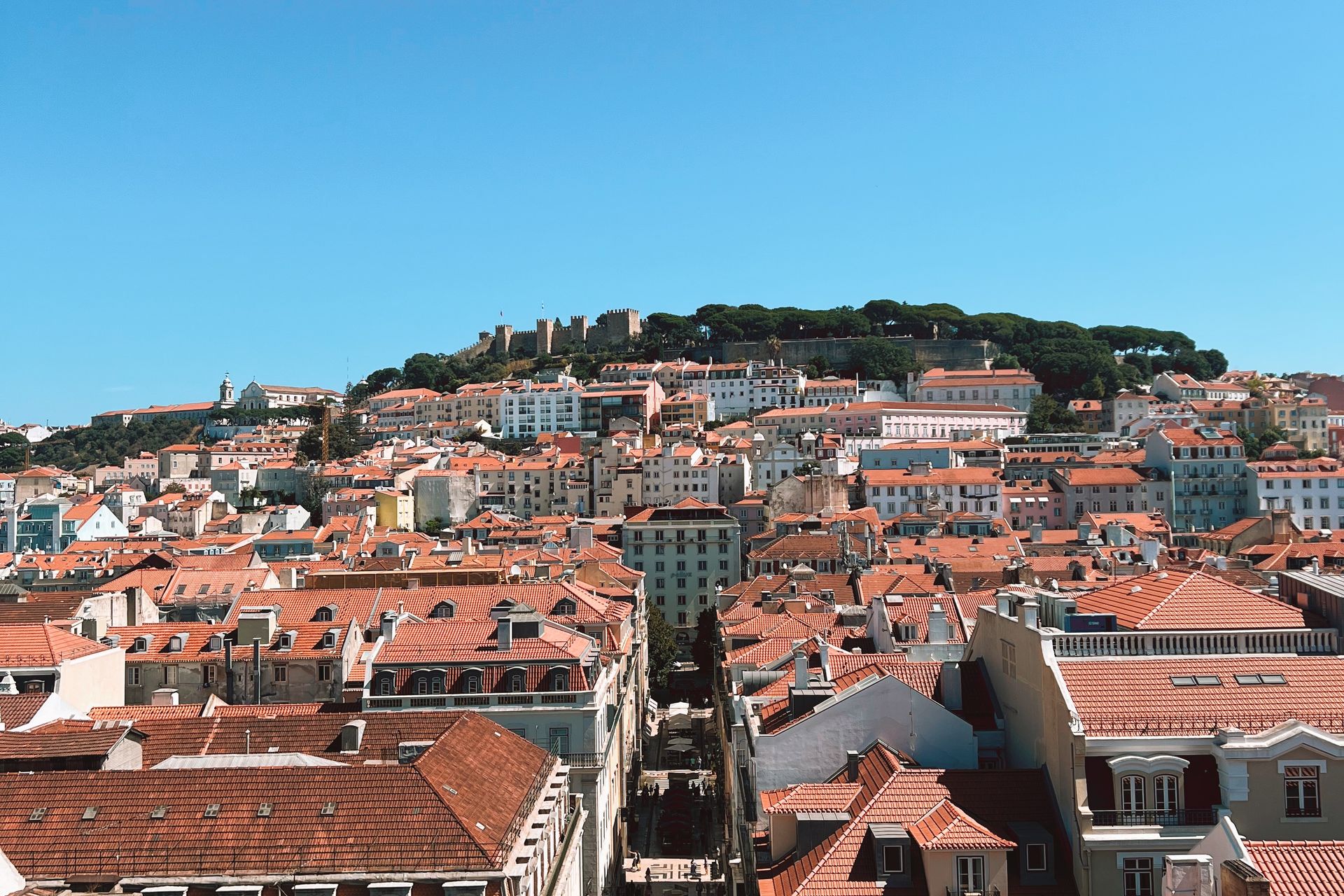

Lisbon is a city built to hold light. Its pavements are small cubes of white limestone set by hand, a craft that began in 1842 in the courtyards of São Jorge Castle and reached Rossio square in 1848 as a pattern of black-and-white waves. Its monuments at Belém are cut from lioz, a pale local limestone. Its façades are tiled, and on the hills above the Tagus the whole city tilts towards a wide river that throws the sun back up at it.
You see it best from the Miradouro da Senhora do Monte, above Graça: the castle to your left, the roofs of Baixa below, and behind them the river and its estuary, glowing and throwing light back onto the rooftops. A little lower, at the Miradouro de Santa Luzia, the trams ring their bells past tiled panels that show Praça do Comércio as it looked before the earthquake of 1755.
That light is most of what draws remote workers here, along with mild winters and a large community of people doing the same thing. It now comes at a price. Lisbon suits you if you earn enough for its rents and, without an EU passport, for its remote-work visa, and if you want a European capital where a December afternoon can still be spent outdoors. It does not suit anyone looking for a cheap base, or for the tax deal that older guides still advertise. That deal is closed.
| Monthly budget, one person, central one-bedroom | about $2,400 |
|---|---|
| Leaner budget, cheaper area | about $1,950 |
| One-bedroom, city centre (user-reported) | $1,700 a month |
| One-bedroom, outside the centre (user-reported) | $1,250 a month |
| New lease, city median, 50 m² flat | about $990 a month |
| Monthly transit pass, city / metro area | $35 / $46 |
| D8 remote-work visa income floor | about $4,240 a month |
| Daylight on 21 June / 21 December | 14 h 56 min / 9 h 30 min |
Budgets and user-reported rents: our city page, from Numbeo's August 2026 prices. New-lease median: INE, Portugal's statistics office, 12 months to March 2026. Euro amounts are converted at the exchange rate of $1.1511 per euro used across our site (1 August 2026).
How long can you stay?
On an American, British, Canadian or Australian passport you get 90 days in any 180 across the Schengen area, and since April 2026 the EU's Entry/Exit System records your fingerprints and every crossing in place of passport stamps. A long spring in Lisbon fits; a year does not, and every week in Paris or Barcelona comes out of the same allowance.
For longer, Portugal has a visa written for remote workers, the D8. The consulates ask for average monthly income over the last three months of at least four times the Portuguese minimum wage, which at the 2026 minimum of $1,059 comes to about $4,240 a month, earned from employers or clients outside Portugal. There is a temporary-stay version for stays of less than a year, and a residence version that leads to a permit from AIMA, the immigration agency, valid for two years and renewable for three.
The D7, often mentioned beside it, is built for pensions, rents and investment income rather than work, with a floor of one minimum wage. If your money comes from a job or clients, the D8 is your visa. Our step-by-step guide to the Portugal digital nomad visa covers documents, fees and timings, and our comparison of digital nomad visas sets it against the alternatives.
The tax story that ended in 2024
For a decade, Lisbon's other attraction was the Non-Habitual Resident regime and its flat 20 percent. It was revoked from 1 January 2024, and the transitional window for people with plans dated 2023 closed on 31 March 2025. People already inside keep it until their ten years run out, so you will still meet them. Their tax bill tells you nothing about yours.
Its successor, IFICI, keeps a 20 percent rate for ten years, but only for listed work certified by Portuguese bodies: research, university teaching, qualified jobs at qualifying Portuguese companies, certified startups. A remote job for a foreign employer is not on the list, and a D8 is built on exactly that kind of job, so the two rarely meet.
What applies instead is the ordinary test. You are tax resident if you spend more than 183 days in Portugal in any 12-month period, or keep a home here you appear to mean as your habitual residence, and residence starts on the first day of your stay. From then on, Portugal taxes your worldwide income at ordinary rates of 12.5 to 48 percent.
Our guide to the NIF, IFICI and the Portuguese return walks through the first year, and the digital nomad tax guide explains how it fits with the rules of the country you left.
Moving your tax home to Lisbon?
The first, split year is where most mistakes happen. Our Lisbon directory lists English-speaking tax advisers, each with the source for the languages they work in.
Browse tax advisers in Lisbon →Choosing your light: where to live
Lisbon's neighbourhoods differ less in rent than in what you see from the window and how steep the walk home is. The official figures make the point: across the city, new leases signed in the year to March 2026 had a median of about $991 a month for 50 square metres, and even the dearest parish was only about a quarter above that.
| Santo António (Avenida da Liberdade) | $1,228 |
|---|---|
| Misericórdia (Bairro Alto, Cais do Sodré) | $1,151 |
| Estrela (Santos, Lapa) | $1,130 |
| Santa Maria Maior (Alfama, Baixa, Castelo) | $1,119 |
| Campo de Ourique | $1,099 |
| São Vicente (Graça) | $1,061 |
| Lisbon, whole municipality | $991 |
| Arroios, Alcântara, Belém | below $991 |
INE, Estatísticas de Rendas da Habitação ao nível local, 1st quarter 2026: median euros per square metre on new leases, April 2025 to March 2026, multiplied by 50.
Alfama and Graça: the morning side
Alfama, the oldest quarter, spills down the slope between the castle and the river and came through the 1755 earthquake largely intact, so its streets are still narrow lanes and stairways. Graça sits above it, on the line of the No. 28 tram, with the two viewpoints that look over the whole centre. Rents in São Vicente, Graça's parish, are among the city's more moderate, but they are also rising faster than the city average. Expect stairs, tour groups by mid-morning and very good evenings.
Baixa and Chiado: the grid the earthquake left
After 1755 the flattened lower town was rebuilt on a straight grid running from Rossio down to Praça do Comércio, which opens straight onto the river. It is flat, central and on the metro. Living here means tourists below your window, but no hill between you and anything.
Bairro Alto, Santos and Cais do Sodré: the evening side
West of the centre, Bairro Alto is the bar quarter, where many bars have had to close at 2 a.m. since 2008 after noise complaints. Below it, Cais do Sodré and Santos run along the river, with the Time Out Market in the old Mercado da Ribeira and the train to the beaches at Cascais. These parishes are among the dearer ones, and worth it if you want the water in your daily route.
Arroios: where the new leases are
North of the centre, around Largo do Intendente and Avenida Almirante Reis, Arroios is one of the densest parishes in Lisbon and the one with the most new rental contracts, 1,604 in the year to March 2026, at rents below the city median, and it sits on the green metro line. For a year rather than a season, start your search here.
A working day in Lisbon's light
Picture a Tuesday in May. The connection will not be your problem: Portugal's median home broadband download is about 252 Mbps, with uploads near half that, but ask whether the flat itself has fibra before you sign. If it is small or dark, a coworking desk solves both problems. Heden's Santa Apolónia space, between the old railway station and the cruise terminal, has floor-to-ceiling windows over the Tagus, with day passes from about $16 and monthly desks from about $172, VAT included.
Lunch is where Lisbon is still kind to a budget: a meal at an inexpensive restaurant costs about $17 on Numbeo's prices. Afterwards, the hills set the pace. The Glória funicular, which carried people up from Restauradores to Bairro Alto, has been out of service since a car derailed on 3 September 2025 and killed 16 people, so plan on stairs and trams.
Five o'clock is what you came for. You could ride the No. 28 tram from Martim Moniz up through Graça and down through Alfama, walk to Senhora do Monte to watch the estuary turn gold, or take the train west from Cais do Sodré to the beaches of Cascais, about 40 minutes along the river. A Navegante pass covers the metro, trams, buses, ferries and trains of all 18 municipalities in the metropolitan area for $46 a month, or the city alone for $35.
The light through the year
In June the sun sets just after nine and the day runs to almost 15 hours. On the evening of 12 June the popular marches parade down Avenida da Liberdade for Santo António, and the old quarters, Alfama, Mouraria, Graça and Castelo, hang coloured globes and garlands over the lanes and fill with the smell of grilled sardines. It is Lisbon at its most generous, and at its most crowded.
July and August bring average highs of 28°C, the year's peak in visitors and in short-term prices. By September the heat eases. In November the Web Summit tech conference comes to town, in 2026 from 9 to 12 November, so book a flat well ahead if your stay overlaps.
Winter is the season Lisbon sells least and that remote workers often like best. On 21 December the sun sets at twenty past five, a good hour later than in London, and January days still reach about 14°C. December is the wettest month, but between showers the low winter sun still falls on white stone and tiles. For a first stay, come between April and June, or in late September and October.
What Lisbon costs now
Our budget for one person in a central one-bedroom is about $2,400 a month, built from Numbeo's user-reported prices: about $1,700 for the flat and $700 for everything else. A smaller flat in a cheaper area brings it nearer $1,950. The official new-lease medians in the table above sit below the user-reported centre rents because they cover every size and street of each parish, not only central one-bedrooms advertised to newcomers.
That makes Lisbon cheaper than Paris, where our budget is about $2,560, and far cheaper than London, but dearer than Porto at about $2,140, and twice the cost of Tbilisi. If the budget is what decides, our guide to a year in Tbilisi shows what the same income buys there, and our tour of Europe's best cities for nomads sets Lisbon among its rivals.
Is Lisbon worth it in 2026?
Yes, if you are clear about what you are paying for. The rent buys a European capital with hills that look over a river, pavements and walls that hold the sun, winters you can spend outside and a city full of people working the way you do. It does not buy a tax break or a bargain. On a non-EU passport, it also takes a D8 and an income of about $4,240 a month.
If you do come: arrive in spring or early autumn, take a short let in Graça, Santos or Arroios while you look for a lease, buy a Navegante pass in the first week, and count your days from the first one. If you stay past six months, or sign a lease you mean to keep, Portugal will count you as resident, and the first return is due the following spring.
All of Lisbon on one page
The full cost table, neighbourhood notes, coworking spaces and our 13 category ratings for Lisbon, before you book a flat.
Open the Lisbon city guide →Frequently Asked Questions
How much does it cost to live in Lisbon as a digital nomad?
About $2,400 a month for one person with a central one-bedroom, or nearer $1,950 in a smaller flat in a cheaper area. User-reported central one-bedroom rents average about $1,700 a month.
What is the income requirement for Portugal's digital nomad visa in 2026?
Average monthly income over the last three months of four times the Portuguese minimum wage, about $4,240 a month in 2026, earned from employers or clients outside Portugal. The residence version leads to a two-year permit, renewable for three.
Is the NHR tax regime still available in Lisbon?
No. It was revoked from 1 January 2024, and the transitional window closed on 31 March 2025. Its successor, IFICI, covers listed research, teaching and startup roles at Portuguese entities, not remote work for a foreign employer.
When does a digital nomad become tax resident in Portugal?
After more than 183 days in Portugal in any 12-month period, or earlier if you keep a home here that looks like your habitual residence. Residence then starts from the first day of the stay.
Which Lisbon neighbourhoods are best for digital nomads?
Graça and Alfama for the views, Baixa for a flat central grid, Santos and Cais do Sodré for the river, and Arroios for a longer lease at rents below the city median. Official rents differ by only about a quarter between parishes.
When is the best time of year to work from Lisbon?
April to June, or late September and October. July and August average 28°C and are the busiest months; December is the wettest, though the sun still sets after five on the shortest day.


