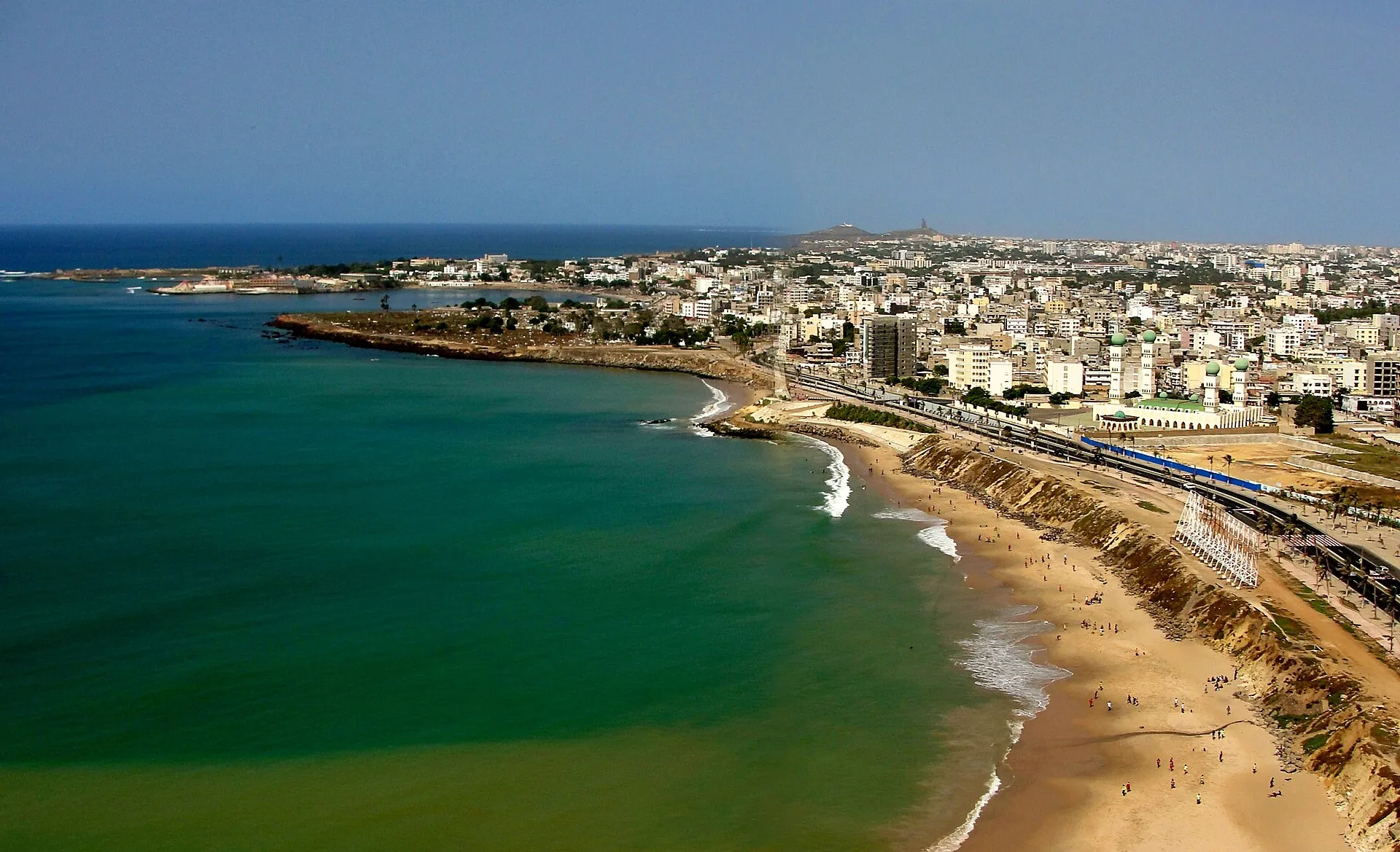
Between six and nine in the morning, while the air is still cool and the traffic still light, the Corniche Ouest belongs to people on foot. Joggers, walkers and cyclists follow the coast road, groups work through fitness sessions facing the Atlantic, street vendors walk the promenade, and out on the water are the fishermen.
On the beach below the white-and-red Mosque of the Divinity in Ouakam, whose two minarets rise 45 metres over the shore, rows of long wooden pirogues wait on the sand, painted with blue waves, gold swirls and rising red suns, many carrying the name of someone the owner loves. At daybreak the crews push them out into the swell.
This is Cap-Vert, the peninsula that forms the westernmost point of Africa, and Dakar spreads across it. Boats come and go from its beaches all day, but the big return comes at the other end of the working day. At Soumbédioune, a horseshoe cove down the same Corniche, the pirogues are hauled up the beach on logs between about four and six, and coffee sellers wait to hand the crews a cup of café Touba, the local coffee spiced with grains of Selim.
A city that runs on the ocean's timetable raises a fair question for anyone who runs on a client's: will the fibre, the power and the visa let you work here? Mostly, yes. A good home line handles video calls, the grid fails about nine times a year, briefly, most Western passports get three months without a visa, and the clock sits on GMT all year.
Dakar suits someone with a flexible schedule and working French who wants a big African capital, a surf break a boat ride away and a month for about $1,490. Skip it if one dropped call can cost you a client, if you need English to get through the day, or if you want a ready-made nomad scene.
| Home broadband median, Senegal | 44.5 Mbps down, 13.3 up |
|---|---|
| Power cuts per Dakar customer, 2024 | 9.1, totalling 6 h 40 min |
| Visa-free stay (US, UK, Canada, most of the EU) | under 3 months |
| Time zone | GMT, no daylight saving |
| One-bedroom, city centre | $830 a month |
| One-bedroom, outside the centre | $440 a month |
| Monthly budget, one person, central flat | about $1,490 |
| Coworking, 30 days at Impact Hub | $105 before VAT |
| Meal in an inexpensive restaurant | about $5 |
Broadband: Ookla Speedtest Global Index, August 2026. Power: Senelec. Rents, meal and budget: Numbeo data via our city page. Prices are in US dollars at an exchange rate of 570 CFA francs to the dollar, the franc being pegged at 655.957 to the euro.
Will the connection carry a video call?
From the right building, yes. Senegal's median home line runs at 44.5 Mbps down and 13.3 Mbps up, with a latency of 7 ms, which is comfortable for calls and screen-sharing. The upload is the number to watch: anyone who ships large video files or backs up to the cloud every evening will feel it.
Fixed lines are still rare. The regulator counted about 950,000 ADSL and fibre lines in the whole country at the end of June 2026, against 23 million mobile internet lines, and in Dakar fibre depends on the building rather than the district. Orange, the largest operator, has an online checker for fibre and 5G that takes a street address: run every listing through it before you pay a deposit.
Your backup is a SIM. Orange carries almost two-thirds of mobile internet lines and Yas, which traded as Free until November 2024, most of the rest. Only about one line in twenty was on 5G in mid-2026, so plan around 4G, and test a flat on the first evening with Sama Réseau, the regulator's own speed app.
What happens when the power goes
It goes, but not for long. In 2024 the average Dakar customer of Senelec, the national utility, had 9.12 interruptions adding up to 6 hours 40 minutes, roughly 44 minutes a cut, and the second half of the year was clearly worse than the first.
That half holds the rainy season, July to October, when outages cluster in heavy rain and wind, and not every building has a generator. Ask whether yours does and whether the router can sit on an inverter, keep a power bank that can run it for an hour, and keep a data bundle for the call you cannot miss.
Ninety days, and a list worth reading
Since 1 May 2015, citizens of the countries on Senegal's exemption list need no visa for a stay of under three months, on a passport valid for at least six more months. The list names 59 countries, among them the United States, Canada, the United Kingdom, 26 EU members, Brazil, India and Japan.
Read it before you book, because it has gaps. Ireland is the one EU member missing, and Switzerland, Norway, Australia and New Zealand are not on it either. The Irish and Swiss gap is smaller than it looks: Senegal's embassy in London lists both as exempt, and Ireland's foreign ministry tells its citizens they need no visa. Norwegians, Australians and New Zealanders are on neither list, so they should settle the entry route with a Senegalese embassy rather than assume a European rule covers them.
At the airport, officials can ask for proof of onward travel and booked accommodation, and refuse entry without them. To stay beyond three months, leave and come back later, or apply for a carte d'étranger at the Direction de la police des étrangers et des titres de voyage before your 90 days run out.
One change is pending. In July 2025 the Council of Ministers adopted an electronic visa for countries that require visas of Senegalese travellers, with no launch date; British and Canadian advice still says visa-free. There is no digital nomad visa at all, and our comparison of digital nomad visas covers the countries that offer one.
Before you fly: tablets, a jab and a clinic list
Malaria is present throughout Senegal, Dakar included, and the CDC recommends preventive medication for all areas, naming atovaquone-proguanil, doxycycline, mefloquine and tafenoquine; chloroquine does not work here. See a travel clinic about six weeks before you fly, because some of these must be started before departure.
The CDC also recommends the yellow fever vaccine from nine months old, though Senegal demands the certificate only if you arrive from, or transit through, a country with yellow fever risk. Meningococcal vaccination is advised too, especially for the dry season from December to June.
Care in Dakar is reasonable and thin elsewhere in the country; the ambulance number is 15. Choose your doctor before you need one: our Dakar services directory lists the doctors, clinics and dentists who work in English, each taken from the UK or US embassy lists.
Need a doctor who speaks your language in Dakar?
Our Dakar directory lists 14 doctors, clinics and dentists who work in English, with the embassy source for each one.
Browse providers in Dakar →Which end of the peninsula to live on
Four million people live in the Dakar region, about 7,500 to the square kilometre, and the traffic follows from that, so choose the district by where you will spend your days. Reliable rents exist only as two levels, about $830 a month for a central one-bedroom and $440 outside the centre: use them as the frame and negotiate.
Les Almadies and Ngor: the tip
At the north-western corner, the Pointe des Almadies is where the continent runs out, with seafood restaurants on the shore. Next door, Ngor is one of the original Lebou villages of the peninsula, its fishing beach facing Ngor Island. Live here if the surf is the reason you came.
Ouakam: the mosque and the hills
Ouakam, another Lebou village, has the Mosque of the Divinity, two beaches, one popular with surfers, and the Mamelles, the twin volcanic hills above it: one carries a lighthouse from 1864, the other the African Renaissance Monument. The national military academy and two air bases are here too.
Mermoz and Sacré-Coeur: the middle
Inland, halfway between the tip and downtown, Mermoz and Sacré-Coeur put you near both coworking spaces with published prices, Jokkolabs in Sacré-Coeur 3 and Impact Hub in neighbouring Keur Gorgui. For a first month, this is the practical choice.
Plateau: the old downtown
At the southern end, Plateau is the historic heart and holds most of the ministries, the presidential palace of 1907 and Place de l'Indépendance. Its domed Kermel market of 1910 was rebuilt to the original design after a fire in 1993, and the TER terminus and the Gorée ferry are close by.
What a month costs, in a currency tied to the euro
Senegal uses the West African CFA franc, and the central bank fixed its parity with the euro on 1 January 1999. So your costs in dollars move exactly as the euro does: if you earn in dollars, a strong euro makes Dakar dearer.
On our cost of living index, a solo month comes to about $1,490: the $830 central one-bedroom plus around $660 for groceries, meals out, utilities, phone, internet and transport. A couple sharing the flat lands near $2,010, and a lean month outside the centre near $1,100.
Cash is the weak spot: Dakar ATMs have low withdrawal limits and regularly run dry. Most people pay by phone instead, with the mobile money apps Orange Money and Wave, and setting one up early saves many trips to the machine.
A working day, from the Corniche to the fish market
The clock is kind to European and American clients. On GMT all year, your morning matches London in winter and still overlaps the US East Coast: nine in New York is one or two in the afternoon here.
Say you start at Impact Hub in Keur Gorgui, open Monday to Friday from 9:00 to 18:00, at about $7 a day or $105 for 30 days before VAT. Jokkolabs publishes no desk prices, so ask. Both close in the evening and at weekends, one more reason the line at home matters.
Lunch could be thiéboudienne, ceebu jën in Wolof: fish, broken rice, dried fish, molluscs and seasonal vegetables, a dish from the fishing communities of Saint-Louis that UNESCO added to its intangible heritage list in 2021. It is eaten from a shared bowl, and in an inexpensive restaurant a meal costs around $5.
You will order it in French, but the table talks in Wolof, the language 68.7% of the region's residents use most; under 2% named French at the 2023 census. French does the leases and bank forms, a few Wolof greetings do the markets, and English is rare outside coworking spaces and embassies.
At five, close the laptop and head for Soumbédioune, where the morning's boats come back in. The day's catch goes on sale on the beach: barracuda, grouper, thiof, sardines, prawns, lobster. Then walk on along the Corniche Ouest as the sun drops into the Atlantic and the sky turns orange, pink and violet.
Two modern lines cut through the traffic: the TER train, every 10 minutes from Monday to Saturday with tickets from $0.88, and the Sunu BRT bus from Petersen to Guédiawaye, with a 30-day pass at $39. Taxis have no meters, so agree the fare first, skip the jakarta motorbike taxis, or use Yango or Heetch. The airport run is still by road.
Islands, a statue and a night of mbalax
The easiest escape starts on Ngor beach, where pirogues cross to Ngor Island in a few minutes. Its bay side has quiet beaches; off the Atlantic side breaks the Ngor Right, the wave in the 1966 surf film The Endless Summer. Riptides are common and beaches mostly unsupervised, with several drownings a year, so learn with a surf school and swim where the locals swim.
Gorée is the other island, two kilometres off the harbour by a 30-minute foot-passenger ferry. There are no cars, most buildings date from the late 18th century, among them the House of Slaves and its Door of No Return, and in 1978 it was among the first twelve UNESCO World Heritage Sites.
On land, climb the Mamelles to the African Renaissance Monument, a family about 50 metres tall, unveiled in 2010 for the 50th anniversary of independence and criticised for its $27 million cost. The Museum of Black Civilisations, opened in 2018, fills a rainy afternoon.
At night, the soundtrack is mbalax, the dance music urban Senegal built in the early 1970s by singing in Wolof over sabar drums, which Youssou N'Dour carried abroad from the band Etoile de Dakar. On a big weekend the national sport, laamb wrestling, fills the arenas, and each bout opens with the bàkk, a wrestler's spoken boast in his own praise.
When should you come?
Come in the dry months. From January to May, highs sit around 24 to 27°C and it barely rains; our city page rates December to February the most comfortable stretch.
The rains, July to October, bring the hottest weather and most of the power cuts: August is the wettest month at about 145 mm. If your income depends on uninterrupted calls, avoid August and September for a first stay.
How careful do you need to be?
Careful, rather than worried. Canada advises a high degree of caution because of crime, and the UK reports that robbery, burglary and assault have become more common in Dakar, sometimes with weapons, and that bag-snatching is rising.
The risk has addresses, and one is the promenade this guide opened on. Pickpockets work both Corniches in the evening, Yoff beach, Place de l'Indépendance and the Gorée ferry terminal, and bags are snatched from passing motorbikes. Walk the Corniche at dawn, carry little after dark, and book airport transport in advance to avoid bogus drivers.
Two legal points apply to every visitor. Foreigners have been prosecuted for joining unapproved protests, which can also close the airport road. Same-sex relations are illegal, and since March 2026 the law carries five to ten years and also punishes their "promotion, support or funding".
Dakar, or Cape Verde across the water?
The obvious alternative sits 570 km offshore. Cape Verde has what Senegal lacks, a six-month remote working visa; our Praia remote work guide covers it, and the Cape Verde city profile sets its costs beside Dakar's. Choose the islands if you need legal certainty for a long stay.
Choose Dakar for a working capital rather than a resort: a fishing fleet on the city beaches, two islands and a surf break within reach, and mbalax on a Saturday. It rewards a long stay, because finding a building with fibre and a generator takes time.
If you go: check your passport against the list, book a travel clinic six weeks out, arrive between December and May, and run every flat through the fibre checker. Then, on the first free evening, walk down to Soumbédioune at five and watch the pirogues come in.
See the whole picture for Dakar
The cost breakdown line by line, the weather month by month and all 13 of our category ratings, on one page, before you sign a lease.
Open the Dakar city guide →Frequently Asked Questions
Do I need a visa to work remotely from Dakar?
Not if your passport is on Senegal's exemption list of 59 countries, which includes the US, the UK, Canada and 26 EU members, for stays under three months. Ireland and Switzerland are missing from the ministry's list but appear on the London embassy's; Norway, Australia and New Zealand are on neither, so ask an embassy.
Does Senegal have a digital nomad visa?
No. Visitors use the visa-free stay of under three months, then either leave and return or apply for a carte d'étranger before the 90 days end. Cape Verde, offshore, offers a six-month remote working visa.
How fast is the internet in Dakar?
Senegal's median home line runs at 44.5 Mbps down and 13.3 Mbps up: fine for video calls, slow for heavy uploads. Fibre depends on the building, and a 4G SIM from Orange or Yas is the realistic backup.
Are power cuts a problem for remote work in Dakar?
They are short but real: about nine cuts in 2024 for the average Dakar customer, totalling 6 hours 40 minutes, with more in the rains. Ask about a generator and keep a power bank for the router.
How much does a month in Dakar cost a digital nomad?
About $1,490 for one person: $830 for a central one-bedroom and around $660 for food, utilities, phone and transport. Living outside the centre brings it near $1,100, and a couple sharing a flat spends about $2,010.
Do I need malaria tablets for Dakar?
Yes. Malaria is present throughout Senegal, Dakar included, and the CDC recommends preventive medication such as atovaquone-proguanil, doxycycline, mefloquine or tafenoquine. See a travel clinic about six weeks before you fly.
Is Dakar safe for digital nomads?
It takes care. Canada advises a high degree of caution because of crime, and pickpockets work the Corniches in the evening, Yoff beach and the Gorée ferry terminal, so carry little after dark.


