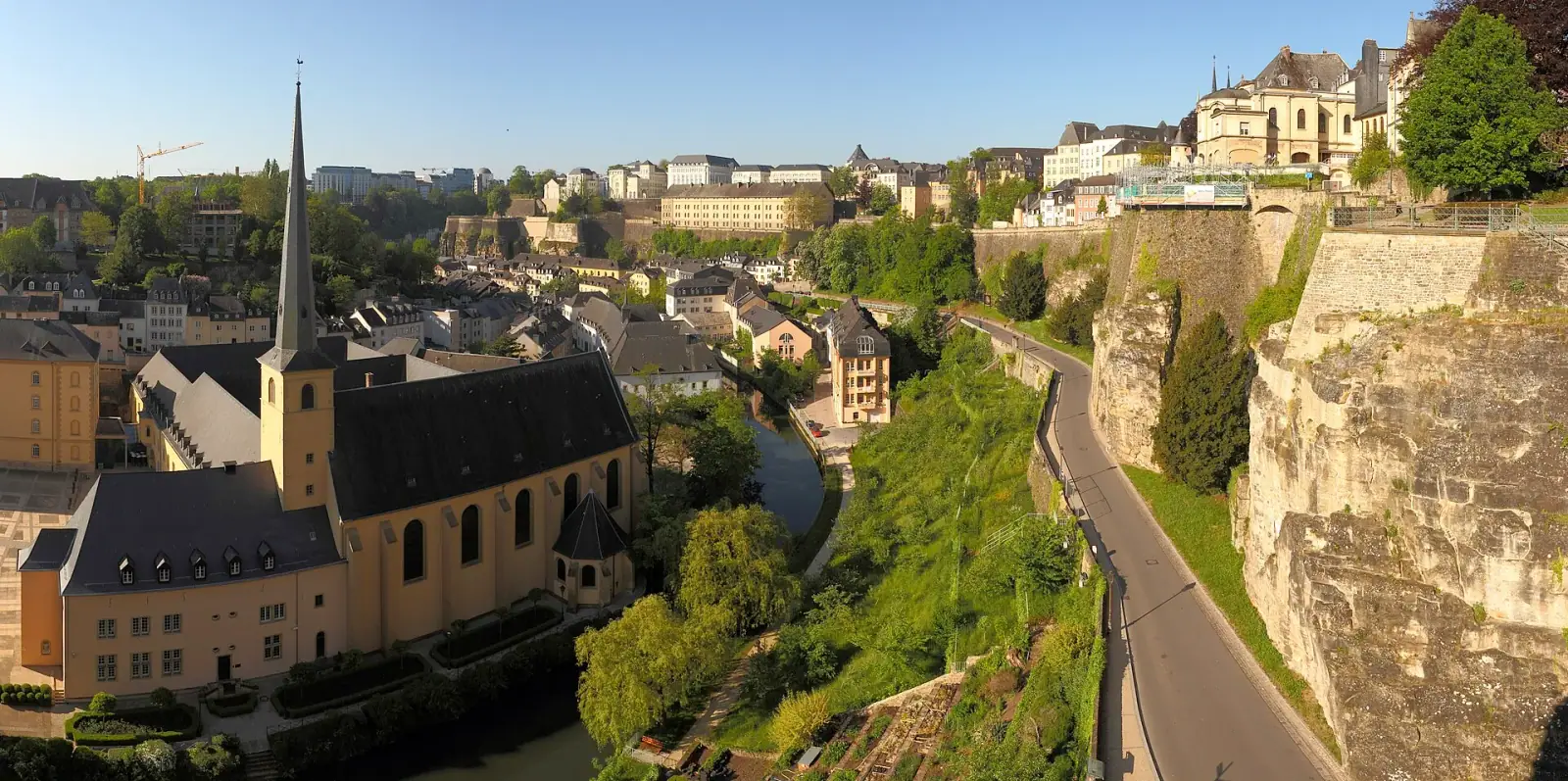

Luxembourg is one of the richest countries on earth, and the tram from the airport costs nothing. Neither does the bus to the forest, nor the train to the French border, nor the red-painted bridge the tram crosses 75 metres above the Alzette valley on its way into town. In a country whose GDP per head runs 139% above the EU average, by far the highest in the Union, the thing you notice first is what you never pay for.
The one bill that makes you feel the wealth is rent. The average apartment advertised in Luxembourg City lets for about $2,318 a month, and a flat by the station for more than $3,000. Groceries and dinners cost what they cost in any Western European capital; the rent is what sets this country apart. Part of the paradox is arithmetic: 237,200 people cross the border every morning from France, Belgium and Germany to work here, adding to that GDP without being counted among the residents it is divided by.
The city they commute into is built on rock. The Old Town sits on a plateau above the Alzette and Pétrusse valleys, and its old quarters and fortifications are a UNESCO World Heritage site. Below its cliffs, the Grund gathers a former abbey and riverside pubs along the Alzette. Across the gorge, the glass and steel of Kirchberg holds the EU's Court of Justice, the concert hall and the modern art museum. A glass lift, a funicular and a tram line knit the levels together, all free.
So here is the verdict. Luxembourg is an easy place to work, with fibre in most homes and free transport, and an expensive place to sleep. With no nomad visa, a non-EU passport means a Schengen visit and no more. It suits a high earner on a short stay, or an EU citizen willing to pay the rent; below the $3,450 a month our city guide sets as the floor, look across the border.
| Average advertised apartment rent, Luxembourg City | $2,318 a month |
|---|---|
| Same, by quarter: Bonnevoie to Gare | $1,618 to $3,066 |
| Maximum deposit | two months' rent |
| Buses, trams and trains inside the country | free |
| Fibre coverage, end of 2025 | 86.6% of homes |
| Measured average fixed download | 207 Mbit/s |
| Coworking desk | $220 to $460 a month |
| Monthly budget, one person, our estimate | $3,220 to $4,600 |
| Stay without a visa, non-EU visitors | 90 days in any 180 |
| Daylight on 21 June / 21 December | 16 h 22 min / 8 h 12 min |
Rents: the housing ministry's Observatoire de l'Habitat, apartments advertised July 2025 to June 2026. Internet: the regulator ILR. Coworking and budget: our Luxembourg City guide. Prices are in US dollars at the European Central Bank's reference exchange rate of EUR 1 = $1.1403 on 25 September 2026.
Will the connection hold?
This is what people search for first, and in Luxembourg it is the easy part. At the end of 2025, fibre reached 86.6% of homes and premises, and a gigabit-capable line 95.9%. Nearly three in four fixed subscriptions already run on fibre.
Measured speed backs that up. The regulator's own test tool, checkmynet.lu, recorded an average fixed download of 207 Mbit/s with 23.7 ms of latency, and notes that home wifi drags those results down, so a wired line should do better. About one test in five still came in under 30 Mbit/s, so test the flat's connection before you commit to it.
The gaps are rural: twelve communes still have fibre at fewer than half their addresses. In the capital this rarely matters; for a farmhouse in the countryside, check the address on the ILR coverage map before you sign.
For a backup, 5G tests averaged 229 Mbit/s down, and POST, the biggest operator, covers the most people. Prepaid SIMs are never anonymous here: since 2017 every card must be registered to its holder, so bring a passport to the shop. An EU SIM works at home prices until you spend more time and data abroad than at home over four months; then your operator may add surcharges.
Every railway station and stop has free CFL wifi, and the citywifi network covers outdoor areas of the capital with a free tier. VPNs belong to its paid tier at $5.59 a month, so treat it as a way to check a map, not as an office.
The one bill that feels like Luxembourg
Rent is where the paradox bites, and advertised rents climbed another 3.0% in the year to the end of 2025. The housing observatory publishes advertised rents for every commune and city quarter, averaged over all apartment sizes, so check a listing against its neighbours before you sign.
The lease rules are kind to tenants: a written lease, a deposit of at most two months' rent, and an agent's fee split equally with the landlord. Pick the quarter by the life you want, because here the quarters really are different worlds.
Ville-Haute: the plateau and the palace
The Old Town is pedestrian streets, the Grand Ducal Palace and the squares where the city meets. On Wednesday and Saturday mornings the Stater Maart fills Place Guillaume II, which everyone calls the Knuedler, with vegetables, cheese, flowers and homemade jam. From the Chemin de la Corniche, the rampart walk the writer Batty Weber called the most beautiful balcony in Europe, you look straight down into the Grund. Flats here average about $2,650.
The Grund and Clausen: the valley below
The Grund has fewer than a thousand residents, riverside pubs and Neimënster, a Benedictine abbey that was a prison until 1985 and now holds concerts. A public lift drops through the cliff from Plateau du Saint-Esprit, sparing you the climb. Next door, Clausen grew up around breweries and is now a nightlife quarter. Grund flats average about $2,561, and only a few dozen are listed at a time.
Gare and Bonnevoie: the station and its south side
The station quarter is the priciest in the city, at about $3,066, with Silversquare's coworking a short walk away and every train and tram at the door. Just behind the tracks, Bonnevoie is where the city lives rather than works: residential streets, international restaurants and the lowest average rent of the big quarters, about $1,618. Its flats are small, though: per square metre it costs more than the city average. If you want a studio, start here.
Kirchberg and Limpertsberg: the plateau across the bridge
Kirchberg is a modern plateau along a 3.5 km avenue with the tram down the middle: EU courts, the Philharmonie, and the Mudam museum inside a rebuilt fortress. Our city guide calls its atmosphere sterile, and it rents like a business district at about $2,908. Limpertsberg, where the Red Bridge lands on the Old Town side, averages about $2,686 and has Intense Coffee, the one café our city guide singles out for laptops.
Tempted by the cheaper side of the border?
Put Luxembourg City next to Trier or Brussels on cost, internet and all 13 of our categories before you sign a lease on either side.
Compare the cities side by side →A weekday between the plateau and the valley
Picture a Tuesday in June. The best free desk in the country is the National Library on Avenue John F. Kennedy in Kirchberg: registration is free from age 14, and while the reading room bans calls, members can book one of eleven group rooms for up to two hours a day, enough for a daily stand-up.
For a desk of your own, our city guide prices The Office in the Old Town from about $220 a month and Silversquare by the station around $455. Café work is thin, since restaurants turn tables at lunch and do not want laptops, so budget for a desk.
Lunch could be gromperekichelcher, the onion-and-parsley potato fritters sold at markets and fairs, or, on a colder day, Judd mat Gaardebounen, smoked pork collar with broad beans and potatoes, the nearest thing the country has to a national dish.
Five o'clock is when the paradox pays out. You could walk to the Pescatore park on the edge of the Old Town and ride the Pfaffenthal lift, a glass cabin with a glass floor that drops 60 metres to the valley in 30 seconds, free until one in the morning. Or go underground: the Bock casemates, galleries cut up to 40 metres into the rock, could shelter 35,000 people during the two world wars. Seventeen kilometres of them survive, and a ticket to walk the open section costs about $13.
Getting there costs nothing. The buses, trams and trains inside the country have been free since 1 March 2020, first class apart. The tram runs 16 km from the airport, reached in March 2025, through Kirchberg and the station to the Cloche d'Or, and a funicular drops from it to the Pfaffenthal-Kirchberg railway station.
The village that gave Schengen its name
The visa question starts, fittingly, in Luxembourg. Schengen is a wine village on the Moselle where the borders of Luxembourg, France and Germany meet, and the agreement that abolished border checks was signed there in 1985. Its rules now decide your stay: on an American, British, Canadian or Australian passport you get 90 days in any 180, counted across every Schengen country, so a week in Paris comes out of the same allowance.
Luxembourg has no digital nomad visa and no freelancer visa. The immigration portal says a third-country national needs a work permit for paid activity during a stay under three months, lists exemptions for business travellers, visiting lecturers and athletes, and says nothing about remote work for a foreign employer. Because the rule does not settle remote work either way, keep the work in the background of a visit rather than making it the reason for one.
One local formality catches visitors out: within three days of arriving, you must declare yourself at the commune or fill in an accommodation form where you stay, which a hotel handles at check-in. If a legal long stay is the priority, our comparison of digital nomad visas lists the European countries that do issue one.
Staying past 90 days
On an EU passport, Luxembourg turns from a sprint into a base. Declare your arrival at the commune within eight days, then apply there within three months for a registration certificate, issued on the spot, as long as you work or can support yourself with health insurance that covers you here.
From outside the EU there are three routes, none built for a nomad. The self-employed residence permit must be approved before you enter, costs $91, is normally decided within three months and lasts up to three years, but the business has to serve an economic or social interest of Luxembourg. A freelancer with foreign clients will struggle to show that.
The other two need a local job: the EU Blue Card, with a contract of at least six months paying $74,863 a year, and the ordinary salaried permit, which the employer can only use after offering the post to local candidates for three weeks. For most non-EU remote workers, the honest plan is a Schengen visit well under 90 days.
Why so many live across the border
Those 237,200 commuters are the other half of the paradox, and a model for a nomad. Our estimate for a month in Trier, the nearest German city in our guides, is $1,650, under a third of our Luxembourg City figure. The catch is that free transport stops at the frontier, so price in a cross-border ticket for the days you come in.
If your employer and clients are abroad, that is simple: you pay tax where you live, and our guide to how digital nomads are taxed explains how residence decides it.
The border rules bite only if a Luxembourg company employs you. Then residents of France, Belgium and Germany can work up to 34 days a year outside Luxembourg while it keeps the right to tax the whole salary, part days included. Social security runs on its own line, and since July 2023 lets cross-border staff telework up to 49.9% of their time, on conditions and after a declaration.
Three languages on one bus
Ride a bus from Bonnevoie up to Kirchberg and you could hear Luxembourgish from the driver, French from the commuters and Portuguese from the back seats. It is not a figure of speech: foreigners make up about 70% of the capital's population, and the Portuguese are the largest community in the country, one resident in eight.
French, German and Luxembourgish are all official, but only the French text of the law is authentic, so leases and tax letters usually arrive in French. English runs the banks and the EU institutions, and 80% of residents speak it. You can live here in English; expect to read your lease in French.
Weekends, light and the calendar
The weekend escape is the Müllerthal, a corner of the east nicknamed Little Switzerland for its sandstone rock formations, moss-covered forests and small streams. The Mullerthal Trail loops 112 km through it from Echternach, the country's oldest town, and passes the Schiessentümpel, a waterfall with a small bridge across it. The Moselle vineyards and the village of Schengen are the gentler alternative.
In late June the sun sets at ten to ten, which leaves the whole evening for the Corniche or a terrace in the Grund. From late August the Schueberfouer, a funfair founded in 1340, fills the Glacis with rides and potato fritters and ends with fireworks over the Red Bridge. Arrive in December instead and the sun sets at twenty to five on grey, damp days, while the Winterlights markets light Place d'Armes and Place de la Constitution.
For a first stay, aim for June or September. Winter works only if you are happy to spend it indoors at a desk, which the library and the coworking spaces make easy.
Is the paradox worth paying for?
Luxembourg gives you for nothing what other cities charge for: the tram, the train, the glass lift into the valley, a library desk, the most beautiful balcony in Europe. It charges you for a roof. Our estimate runs from $3,220 to $4,600 a month for one person in a mid-priced quarter, and about $5,500 to live centrally and eat out often.
If you come on a non-EU passport, plan two to four weeks inside a Schengen rotation, rent a furnished flat in Bonnevoie or Limpertsberg, and file the arrival form within three days. On an EU passport, register at the commune and sign a real lease. If the rent does not fit, do what 237,200 people do every day: live in Trier and come in for the day, or weigh Brussels, at about $2,580 a month by our estimate. Our cost of living index and our ranking of European cities for digital nomads set Luxembourg against its neighbours.
Everything we hold on Luxembourg City
Neighbourhoods, monthly weather, the coworking list and all 13 category ratings, on one page before you book.
Open the Luxembourg City guide →Frequently Asked Questions
Is the internet in Luxembourg good enough for remote work?
Yes. Fibre reached 86.6% of homes and premises at the end of 2025, and the regulator's test tool measured an average fixed download of 207 Mbit/s. A few rural communes lag, so check an address outside the capital.
Is public transport really free in Luxembourg, for visitors too?
Yes. Buses, trams and trains inside the country have been free for everyone since 1 March 2020, including the tram to the airport. First class on trains still needs a ticket, and free travel ends at the border.
How much is rent in Luxembourg City?
The average advertised apartment rent was about $2,318 a month between July 2025 and June 2026. It ranged from about $1,618 in Bonnevoie to $3,066 by the station. Deposits are capped at two months' rent, and agents' fees are split with the landlord.
Does Luxembourg have a digital nomad visa?
No. Non-EU visitors get 90 days in any 180 across Schengen. Longer stays need a residence permit, such as the self-employed permit, approved before entry for $91, or the EU Blue Card with a salary of at least $74,863. EU citizens register at their commune.
How much does it cost to live in Luxembourg as a digital nomad?
By our estimate, $3,220 to $4,600 a month for one person in a mid-priced quarter, and about $5,500 to live centrally and eat out often. Rent is most of the difference; transport costs nothing.
Is it cheaper to live across the border from Luxembourg?
Usually, which is why about 237,200 people commute in from France, Belgium and Germany. Our estimate for a month in Trier is $1,650. Free transport stops at the border, and if a Luxembourg company employs you, the 34-day telework rule applies.
Do you need French to live in Luxembourg?
Not day to day: 80% of residents speak English. French is the language of paperwork, so leases and commune forms usually come in French.
What is the best time of year to work from Luxembourg?
June or September. June has more than 16 hours of daylight; December has about eight, with grey days and the Winterlights Christmas markets.


