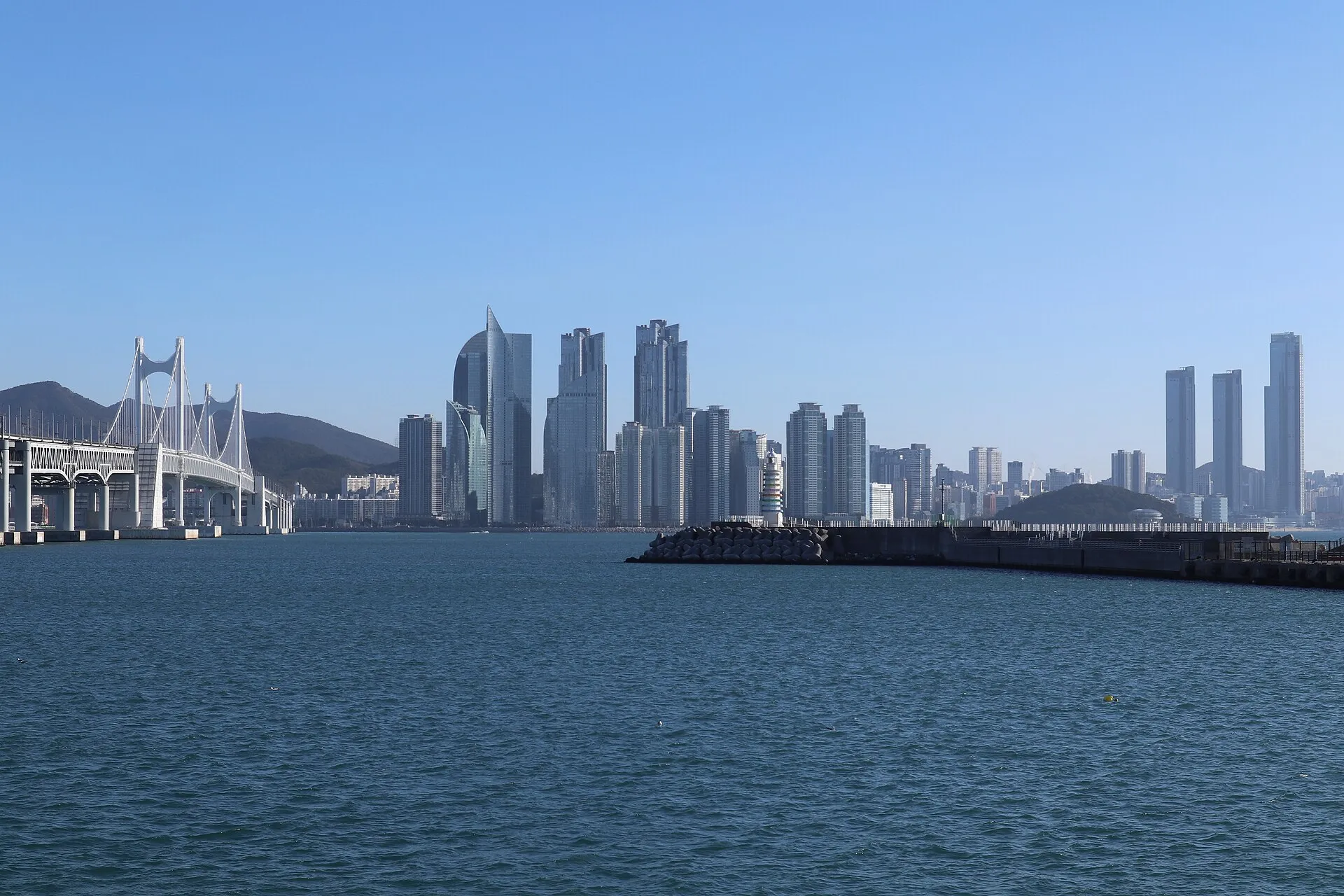
When it gets dark over Suyeong Bay, Gwangan Bridge lights up. The double-deck bridge carries eight lanes for 7.4 kilometres across the water, from Namcheon-dong to Centum City, and its lights can show more than 100,000 colours in displays that change with the seasons. The best seat is the sand at Gwangalli Beach, with the towers of Haeundae's Marine City to the left of the span and the bay opening to the sea beyond.
On Saturday evenings the show gets bigger. A drone display, the first permanent one in Korea, rises over the beach for about twelve minutes, at seven and nine o'clock from October to February. And on 7 November 2026 the Busan Fireworks Festival fills the same stretch of sky for an hour, as it does every autumn.
The bridge is a good way to understand the city. Busan is about 3.2 million people living along a coastline of bays and headlands, with seven public beaches, and behind them a wall of hills: Geumjeongsan, which in 2025 became Korea's first national park inside a major city. Mountains meet the sea here, and the bridge is how the city crosses from one bay to the next.
Busan has some of the fastest internet in the world, streets that feel safe at any hour, a beach you can reach by metro and a port city's food, and its nomad visa asks for less income here than in Seoul. The price is language: outside the tourist strips, daily life runs in Korean. If you can live with that, Busan is one of the most comfortable cities in Asia to work from. If you need English to be easy, it is not.
| One-bedroom, city centre / outside | $670 / $340 a month |
|---|---|
| Monthly budget, one person, central flat | about $1,400 |
| Monthly transit pass | $56 |
| Korean home broadband, median down / up | 251 / 190 Mbps |
| Coworking hot desk, monthly | from $62.52 |
| F-1-D nomad visa in Busan, ages 18 to 34 | $36,400 a year |
| F-1-D nomad visa in Busan, 35 and over | $54,600 a year |
| Average high, January / August | 7°C / 29°C |
Rents, budget and transit: our figures, priced from Numbeo's August 2026 data. Broadband: Ookla's Speedtest Global Index for South Korea, August 2026. Coworking: Pathfinder's published hot-desk rate. Visa: Ministry of Justice, July 2026. Climate: Open-Meteo averages for 2019 to 2023. Prices are in US dollars at the site's exchange rate of 1,439.43 won per dollar on 1 August 2026.
Working under the bridge: internet and desks
Connectivity is the one thing you can stop worrying about. Across South Korea, the median home broadband line downloads about 251 Mbps and uploads about 190 Mbps, and the median mobile connection is just as fast. Uploads that size are rare anywhere, and they are what make large files and video calls painless. Even the metro trains carry wifi, which Busan is moving onto 5G during 2026.
Cafés do much of the work. Korean cafés are big, bright and full of power sockets, and working in them is normal, though the polite habit is to order something every hour or two.
For a fixed desk, Pathfinder runs four coworking spaces in Busan, with hot desks from about $62.52 a month and 24-hour access. Its Nampo branch, two minutes from Jungang station, doubles as an official Busan workation centre and opens every day of the year. WeWork has a floor in the BIFC tower in Munhyeon-dong for anyone who needs meeting rooms and a corporate address.
Where to live along the bay
Busan is long and thin, folded around headlands and hills, so two places that look close on the map can be a long ride apart. Choose a district by the metro line you will use every day.
Gwangalli: the bridge view
This is where you watch the lights, and where we would start. The beach faces the bridge head-on, a long row of cafés and bars lines the sand, and the Saturday drones fly overhead. On our figures a central one-bedroom in Busan rents for about $670 a month; around Gwangan and Seomyeon, our city guide's range on a standard monthly lease is $625 to $1,040.
Haeundae: the famous beach
One bay east, at the far end of the bridge, Haeundae is Busan's best-known beach, with high-rise hotels, the Marine City towers and the most English you will hear in the city. It is the easiest landing and the priciest, at $835 to $1,250 for a decent one-bedroom near the beach on our figures. Beyond it, the old coastal railway is now Blueline Park, where small sky capsules run two kilometres along the coast, seven to ten metres above the shore.
Seomyeon: the middle
Seomyeon is the commercial heart and the station where metro lines 1 and 2 cross. There is no beach, but nothing is far away, and the side streets are full of the laptop-friendly cafés the city is known for. It suits anyone who will spend more days at a desk than on the sand.
Nampo-dong and Yeongdo: the old port
Down by the old harbour, Nampo-dong has Jagalchi fish market, the street food of BIFF Square and Gukje Market. Across the bridge to Yeongdo island, the old houses of Huinnyeoul village were remodelled into an art village in 2011. Rents are lower and the English is scarcer. For a second month, when you know the city, this is the most characterful part of it.
What a month in Busan costs
On our figures, one person with a central one-bedroom spends about $1,400 a month, a couple sharing about $1,990, and a leaner month in a cheaper district about $1,070. That is about $470 less than Seoul, where the same basket comes to about $1,870, mostly because central rent is lower here, and about $300 more than Fukuoka across the strait.
Eating out keeps the month reasonable. A meal at an inexpensive restaurant costs about $7 on our figures, and a bowl of dwaeji gukbap, Busan's pork and rice soup, $6.25 to $8.34.
The trap is housing. Korean leases often run on jeonse, a lump-sum deposit of a large share of the flat's value, or on wolse, a smaller deposit plus rent. On a short stay you will almost always pay more per month for a serviced apartment or an officetel, the studio-and-office buildings common in Korean cities, in exchange for not tying up a deposit.
The visa that rewards leaving Seoul
Most Western passport holders can visit South Korea without a visa: 90 days for Americans, Britons, Australians and EU citizens, and longer for Canadians. The K-ETA travel authorisation that normally applies is suspended for many of those passports until 31 December 2026. The ministry does not publish the list; you find out when you scan your passport on the K-ETA site.
For longer, the F-1-D workation visa became a permanent category on 30 June 2026, and its income floor depends on where you live. Outside Seoul, Incheon and Gyeonggi, which includes Busan, applicants aged 18 to 34 need about $36,400 a year, and those 35 and over or bringing family about $54,600. In the capital region the same applicants need about $54,600 and $72,800. Busan, in other words, is cheaper to qualify for as well as to live in.
The rest of the rules are the same everywhere. You must work for a company outside Korea and have at least a year in the same field, hold private health insurance covering at least about $69,500, and you may not work for Korean employers. Permits run a year at a time, up to three years, and visitors already in Korea on a B-1, B-2 or C-3 entry can switch without leaving. Our comparison of digital nomad visas shows how Korea's floor sits against the rest.
Need a doctor in Busan?
Our Busan directory lists doctors by the language they work in, from Japanese to English, with the official list each claim comes from.
See doctors in Busan →Living in Korean
This is the honest weakness. Outside Haeundae's beach strip and a handful of international restaurants, menus, delivery apps, landlords and pharmacies work in Korean. The metro, with its English signs and announcements, is the exception, and it is the part of the city you will use most.
Technology closes much of the rest of the gap. A camera translation app reads menus and notices, and Kakao's k.ride app, built for foreigners, books the same taxis Koreans hail with Kakao T, with no Korean account and a foreign card. Learn to read hangul, the Korean alphabet, in your first week: it is phonetic, so place names and loan words on signs start making sense almost at once.
Eating along the coast
Busan's food is a port city's food. Jagalchi, by the old harbour, is one of the largest seafood markets in Korea, open from five in the morning, selling live and dried fish; it became the city's fish market after the Korean War.
Two of the city's dishes come from the Korean War. Refugees from Hamheung in the north, who had grown up on buckwheat noodles, made milmyeon from the wheat flour that arrived with American aid. And in July 1953, shortly before the armistice, a fish-cake shop opened in Bongnae Market on Yeongdo to feed refugees; as Samjin Eomuk it is now the oldest fish-cake maker in the city. Dwaeji gukbap came later: a 2019 count found more than 700 restaurants in Busan that specialise in it.
Seasons over the bay
The bridge looks best in autumn, and so does the city. October and November are mild and drier, with the Busan International Film Festival in October and the fireworks in November. May is the other good month, once spring's yellow dust from the mainland has mostly passed.
Summer is hot and wet. The rainy season in the south normally runs from late June to late July, which makes July the wettest month, and August averages highs around 29°C. Typhoons can reach Korea in late summer, though recent years have been quiet, with none making landfall since 2023. Winter is cold and dry, with January nights below freezing but little snow.
Getting around, and across to Japan
Four metro lines and 114 stations cover the city, with the airport light rail and the Donghae line on the same cards. A ride costs $1.11 by card for up to ten kilometres. From Gimhae airport, take the light rail and change at Sasang or Daejeo. To Seoul, the KTX averaged about two hours and 48 minutes this year, with only a few trains close to two hours 20.
The sea route is the one no other Korean city matches. The Camellia Line ferry to Fukuoka leaves Busan at half past ten at night and arrives at half past seven the next morning; the day sailing back takes six hours. The fast boat that once made the crossing in about three and a half hours stopped in 2024. Our guide to Fukuoka covers the city on the other side.
Busan, Seoul or Fukuoka?
Seoul has the bigger international crowd and more coworking choice, at about $470 a month more and a higher visa floor. Fukuoka is cheaper, smaller and a night's sail away, with its own language barrier. Busan sits between them: Korea's infrastructure and food, the sea and the mountains in the same view, and a nomad visa priced for people who choose a second city.
Come in October or May, rent near Gwangalli or Seomyeon on a monthly let, learn hangul in the first week and keep a translation app close. Then go down to the beach on a Saturday night and watch the bridge change colour. Our ranking of Asia's best cities for nomads puts Busan in context, and the comparison tool sets any two cities side by side.
The full Busan picture
Every cost line, the five neighbourhoods, the weather by month and all 13 of our category ratings.
Open the Busan city guide →Frequently Asked Questions
How much does it cost to live in Busan as a digital nomad?
About $1,400 a month for one person with a central one-bedroom, on our figures, or about $1,070 for a leaner month. A central one-bedroom rents for about $670 and a meal at an inexpensive restaurant costs about $7.
Is the internet in Busan good for remote work?
Yes. South Korea's median home broadband line downloads about 251 Mbps and uploads about 190 Mbps, and mobile data is as fast. Cafés are built for working, and coworking hot desks start at about $62.52 a month.
How much income do you need for Korea's digital nomad visa in Busan?
About $36,400 a year if you are 18 to 34, and about $54,600 if you are 35 or over or bring family. In Seoul, Incheon and Gyeonggi the same tiers are about $54,600 and $72,800. The visa runs a year at a time, up to three years.
Do you need K-ETA to visit Busan?
Many Western passports are exempt until 31 December 2026. The government does not publish the list, so scan your passport on the K-ETA site: an exempt passport triggers a message saying so.
What is the best neighbourhood in Busan for digital nomads?
Gwangalli for the beach and the bridge view, Seomyeon for the centre and the metro, Haeundae for the easiest landing at the highest rents. Nampo-dong and Yeongdo are cheaper and more local.
When is the best time to work from Busan?
October and November, which are dry and clear, or May. Late June to late July is the rainy season, August is hot and humid, spring brings yellow dust, and winter nights fall below freezing.
How do you get from Busan to Fukuoka?
By the overnight Camellia Line ferry, leaving Busan at 10:30 p.m. and arriving at 7:30 a.m., or by a short flight. The fast ferry that took about three and a half hours stopped running in 2024.


