
Start with the calendar, not the map. If the month you can get away is February, the Gulf looks ideal. In Dubai the afternoons average about 25°C, warm enough to eat outside by the creek, and Muscat's harbour promenade is at its most walkable. But in 2027 Ramadan is expected to begin on 8 February, and for four weeks the Gulf will work shorter days, eat after sunset and come alive after dark.
Move the month to July and the map turns over. Dubai's average high is 41°C and even August nights average 29°C, while Istanbul tops out around 28°C and its ferries cross the Bosphorus all day. The one Gulf coast that cools in summer is Salalah, in the south of Oman, where the monsoon brings cloud and drizzle over the hills. Pick October instead and the Levant opens up: Tel Aviv and Amman both sit near 27°C, and the Turkish coast has shed its heat before the heaviest rain.
So ask which city suits the month you have. From November to March, go to the Gulf: Dubai for the fastest mobile internet on earth at $3,350 a month, Muscat for the same winter at well under half the price. In May, June, September and October, go to Tel Aviv for English and company, or to Amman for a month near $1,000. In July and August, go to Istanbul.
Our year-round ranking of the best digital nomad cities in the Middle East puts Tel Aviv first. For a single month, the calendar reorders it.
| City | Best months | July high | One person, a month | Entry (UK passport) |
|---|---|---|---|---|
| Dubai | Nov, Dec, Mar | 41°C | $3,350 | Free on arrival, 90 days |
| Ras Al Khaimah | Nov, Dec, Mar | 43°C | $1,540 | As Dubai |
| Doha | Nov, Mar, Apr | 42°C | $2,640 | 30 days, extendable |
| Muscat | Dec, Feb, Mar | 38°C | $1,360 | 14 days, then a visa |
| Salalah | Dec to Feb, or the monsoon | 29°C | $1,200 (estimate) | 14 days, then a visa |
| Amman | Jun, Sep, Oct | 32°C | $990 | $56 on arrival |
| Tel Aviv | May, Jun, Oct | 29°C | $3,560 | ETA-IL, 90 days |
| Istanbul | Jul, Aug, Sep | 28°C | $1,520 | Visa-free, 90 days |
| Antalya | Jun, Sep, Oct | 34°C | $1,220 | Visa-free, 90 days |
Highs: long-term averages from each national weather service, published by the World Meteorological Organization; recent summers run hotter. Costs: our one-person budgets from Numbeo's August 2026 prices, or our estimate where Numbeo has none. Entry: UK Foreign Office, September 2026. Dollar figures use the exchange rates our city pages use for 1 August 2026: AED 3.67, JOD 0.71, OMR 0.38 and SAR 3.75 to the dollar.
Whatever month you pick: the region in September 2026
One thing sits above the calendar this year. Since 8 July 2026 the UK Foreign Office has reported Iranian strikes and retaliatory attacks on US military and civilian infrastructure across the region, naming the UAE, Qatar, Oman, Jordan and Bahrain among the places hit. Its UAE travel advice, still current on 29 September 2026, says the greatest risk is falling debris from interceptions and tells visitors to expect flight cancellations and periodic airspace closures.
It does not advise against travel to any city in this piece. Its warnings cover Gaza and zones of northern Israel, not Tel Aviv; parts of Beirut and its southern suburbs; the strips along Syria's borders with Turkey and Jordan; and Abha and Khamis Mushait in southern Saudi Arabia. For one month, that means flights and a flat you can cancel, and reading the advice again the week you fly.
Dubai, November to March: the creek and the abras
For all its towers, Dubai's old centre is a strip of water. The creek has split the town into Deira and Bur Dubai since before there was a skyline, and wooden abras, the city's oldest public transport, still leave every few minutes from Al Ghubaiba for Al Sabkha on the Deira side, for a fare of about 27 cents. On the far bank wait the Gold and Spice Souks.
Behind the Bur Dubai landing, the Al Fahidi neighbourhood keeps the lanes and coral-stone courtyard houses that pearl and textile merchants from Bastak, in Persia, built from the 1890s. Their wind towers caught the breeze above the roofs and pushed it down into the rooms. The houses now hold museums, galleries and cafés, and on a January afternoon, around 24°C, they are a fine walk after a morning's work.
In July, at 41°C, life moves into the malls, the metro and the coworking spaces, and many expats leave, which brings lower costs and quieter desks. A summer month works if all you need is a chair and a connection; come between November and March for the city itself.
The connection is Dubai's case in any season. In Ookla's Speedtest Global Index for August 2026, the UAE has the world's fastest median mobile download, 676 Mbps, and the second-fastest home broadband. Entry is as easy: British, American, Canadian, Australian and most EU citizens get a free visa on arrival covering 90 days in 180, while Irish passports get 30 days that can be extended in the country.
The catch is price: $3,350 a month for one person, with a central one-bedroom around $2,440. Our Dubai guide for digital nomads goes district by district. For the same network for less, Ras Al Khaimah, where the Hajar Mountains meet the northern coast, comes to about $1,540, with few other remote workers and an even hotter July than Dubai's.
Calls, and staying longer
Plan your calls before you land. The regulator, TDRA, treats internet calling as a licensed service and says operators "most probably will block" unapproved apps. By March 2020 it had approved Teams, Zoom, Skype for Business, Google Meet and Webex; WhatsApp and FaceTime calls were not on that list. Move client calls to those platforms, and warn family.
If a month becomes a year, the virtual work visa needs a salary of at least $3,500 a month from an employer abroad, health insurance and a medical test. The Dubai residency directorate's fees come to about $128 for the two permits, each processed in 48 hours.
Doha: a corniche made for winter mornings
Doha lives along one curve of water. The Corniche runs seven kilometres around the crescent of Doha Bay, from I. M. Pei's Museum of Islamic Art, on its own island just offshore, past the dhow docks to the glass towers of West Bay. Early mornings belong to joggers and cyclists using the cooler air; evenings, to families picnicking in its parks.
Inland, Souq Waqif, restored in traditional Qatari style after a fire, in work finished in 2008, sells spices, robes and, in its own section, falcons with the GPS trackers to go with them. It fills up after dark, which in a November of 30°C highs is when Doha is at its best.
British citizens get a 30-day waiver on arrival, extendable through the Ministry of Interior, and Qatar's mobile median of 536 Mbps is the world's second fastest. But at $2,640 a month, with little nature and a small nomad community, Doha is better as a week between flights than as a month's base.
Muscat, Doha or Ras Al Khaimah for your winter month?
Put two or three cities side by side on cost, wifi, climate and visa access.
Compare Middle East cities →Muscat: the corniche, the souq and the mountains
Muscat is the Gulf capital that keeps mountains in the frame. In Muttrah, the old port quarter, a three-kilometre corniche lined with cafés follows the harbour from a fish market and marina to Muttrah Fort, with the bare rock of the Hajar Mountains rising straight behind the houses. Off it, Muttrah Souq, some two hundred years old and the oldest market in Oman, sells textiles, jewellery and Omani and Indian crafts.
When the coast warms up, the Jebel Akhdar, the "green mountain", rises past 3,000 metres about 150 km away, up a road for four-wheel drives only, to terraced orchards of pomegranates and roses where rosewater is still distilled.
This is the Gulf month that costs least: $1,360 for one person, a central one-bedroom around $680, in a city we rate highly for safety. The weak points are a small nomad scene and Oman's home broadband, a median of 107 Mbps. Highs near 40°C in May and June make December to March the window.
British citizens get 14 days without a visa; longer needs one, online through the Royal Oman Police portal or on arrival, and overstaying costs up to $26 a day. For a month, get the visa before day 14.
The February question: Ramadan 2027
Back to the month this piece opened on. Ramadan moves about 11 days earlier each year, and in 2027 it lands in the Gulf's best weather: on the Umm al-Qura calendar it is expected to run from 8 February to 8 March 2027, with Eid al-Fitr on 9 March. Moon sighting can shift either end by a day.
In Saudi Arabia, Qatar and Oman, the Foreign Office tells visitors not to eat, drink, smoke or chew gum in public in daytime, even in a car. For the UAE it says this "may cause offence", and malls keep dining options for non-Muslims while some restaurants close until iftar, the sunset meal.
UAE labour law also cuts private-sector hours by two a day, so local offices keep shorter days. A February in Dubai still works if you run errands in the morning and socialise after dark, with offices closed for several days around Eid. If you would rather not work around it, take January or late March.
Amman in spring or autumn: a white city on its hills
Amman climbs. It began on seven hills, the jabals, and now spreads over nineteen, between 700 and 1,100 metres up, its buildings faced almost without exception in pale limestone, so the city reads as white blocks stacked up the slopes. Downtown, in the valley, a 6,000-seat Roman theatre from the second century is cut into the hillside, facing north to keep the sun out of the audience's eyes, and looks across at the Citadel. Up on Jabal Amman, Rainbow Street runs to rooftop restaurants and bars.
The altitude sets Amman's calendar: around 27°C in October, but 12°C in January, with nights near 4°C, winter rain and snow once or twice a year. Come in spring, June, September or October.
It is the cheapest connected month in the region: $990 for one person, a central one-bedroom around $420. Jordan's home broadband median is a solid 199 Mbps, its mobile data a weak 49, so choose a flat with a verified fixed line.
Watch two thresholds. A visa on arrival costs $56. Stay more than 14 days and you must report to a police station; stay more than 30 and you need an HIV test and a $28 health certificate, so book 30 nights, not 31. If Petra is on your list, the Jordan Pass, $99 to $113 bought before arrival, waives the visa fee as long as you stay at least two whole nights.
Tel Aviv in May, June or October: the whole city faces the sea
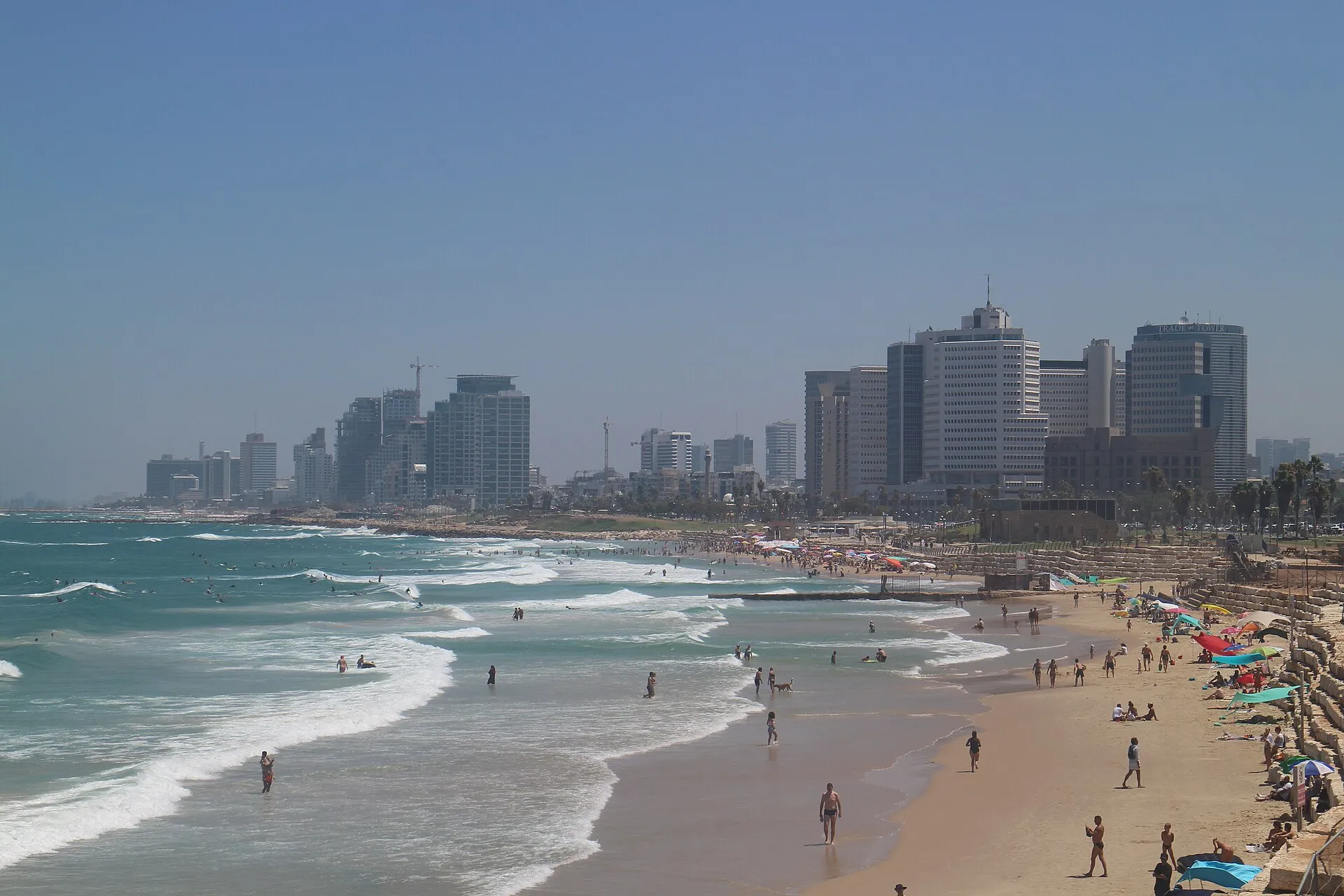
Tel Aviv faces the sea along its entire length. The promenade runs from the old port of Jaffa north to the Tel Aviv port, past Aviv, Gordon, Hilton and Metzizim beaches. A few blocks inland is the White City: more than 4,000 buildings from the 1930s in the International Style, many by German Jewish architects who had fled Nazi Germany, a UNESCO World Heritage site since 2003, strung along Rothschild Boulevard and around Dizengoff Square.
Lunch could be at the Carmel Market, open every day but Saturday, with artists' stalls along Nahalat Binyamin on Tuesdays and Fridays. The week has its own calendar: buses and trains generally stop from Friday evening to Saturday's sunset, so plan Saturdays on foot or by bike along the sea.
May, June and October bring highs of 25 to 27°C; winter brings the rain. Tel Aviv tops our ranking on English, company, food and nightlife rather than value, at $3,560 a month. Home broadband is fast, a median of 298 Mbps, mobile data middling.
Entry is an online ETA-IL, valid two years for visits of up to 90 days. Safety is the part to watch: the Foreign Office warns of rocket and drone attacks throughout Israel, so book on terms you can cancel. Our Tel Aviv city guide breaks down the neighbourhoods.
Istanbul in July and August: a city that commutes by ferry
Istanbul crosses between continents by boat. The city's white and orange ferries run 32 lines between 53 piers, carried 40 million passengers in 2023 and go back to 1851. The crossing from Eminönü or Karaköy to Kadıköy, on the Asian side, takes 15 to 20 minutes: time for a glass of tea and a simit from the sellers on board, while Topkapı Palace, Hagia Sophia and the six minarets of the Blue Mosque slide past behind you.
That makes summer the Istanbul month. August averages 28.5°C, cooler than Tel Aviv or Amman, and a weekend can be a longer ferry to the Princes' Islands. January, at 9°C, is a coat-and-heater month. Culture and food are the reasons to come, and on culture no city we rate in the region scores higher.
Budget $1,520 for one person, with a central one-bedroom around $980. Turkish home broadband is slow for the region, a median of 84 Mbps, and mobile data faster, so a Turkish SIM is a sensible second line. The Istanbul city page splits the districts by budget.
British citizens stay 90 days in any 180 without a visa, on a passport valid 150 days beyond arrival. For longer, Turkey's digital nomad visa asks for $3,000 a month, a degree and an age of 21 to 55, and is open to EU, UK, US, Canadian and a few other passports, but not Australian ones.
Antalya and Fethiye: the coast in June and autumn
On the Mediterranean, Antalya's old town, Kaleiçi, wraps around its ancient harbour, now a marina, with cobbled lanes of red-tiled Ottoman houses entered through Hadrian's Gate. At $1,220 a month it costs about a third of what Tel Aviv does. Fethiye, to the west, starts the Lycian Way, a waymarked 760 km trail along the coast to Antalya, at its best in spring and autumn, and costs about $1,250.
Antalya reaches 34°C in July and its rain builds from October to a December peak, so pick June, September or October, and ask any host for a speed test, since home internet is the weak point. Our Antalya guide maps the neighbourhoods.
July in the Gulf after all: Salalah's monsoon
If your month is July or August and it must be the Gulf, go south. In Salalah, on the Arabian Sea near Yemen, the khareef monsoon blows from about June to early September: warm, humid air crosses the cool sea, turns to fog and drizzle, and the hills go green. August averages 27°C. It is a quiet month with few other remote workers, at an estimated $1,200, on Muscat's entry rules.
Riyadh and Beirut: harder to fit into any month
Saudi entry is easy with the eVisa, and Riyadh's budget is a reasonable $1,780. But summer highs reach 44°C, the nomad scene is thin, and the Foreign Office records Houthi missile and drone attacks aimed at the city. Even in its good months, Dubai is the easier base.
Beirut has some of the region's best nightlife and food and the lowest safety rating of any city here. Lebanon's home broadband median of 22 Mbps ranks 141st of 149 countries, which alone rules out a month of video calls.
Pick your month, then your city
Find the month you have, then the city.
| Your month | Go to | Why then |
|---|---|---|
| Nov, Dec, Mar | Dubai | 26 to 31°C, fastest internet, free entry; $3,350 |
| Dec to Mar, on a budget | Muscat | Same winter for $1,360; visa before day 14 |
| Nov to Mar, heads down | Ras Al Khaimah | UAE internet for about $1,540 |
| 8 Feb to 8 Mar 2027 | Dubai, or outside the Gulf | Softest Ramadan rules for visitors; shorter office hours |
| Apr, May | Amman or Tel Aviv | 23 to 28°C; Amman for $990 |
| Jun | Tel Aviv, Antalya, Fethiye | Sea season before the peak heat |
| Jul, Aug | Istanbul | 28°C, ferries, $1,520, no visa |
| Jul, Aug, must be Gulf | Salalah | Monsoon highs of 27 to 29°C; very quiet |
| Sep, Oct | Amman, Antalya, Fethiye, Tel Aviv | Heat easing, heavy rain still ahead |
Doha and Beirut are missing on purpose, for the reasons above. Both stay on our Middle East tier list, which grades all 51 cities we rate there from A to F. If one month becomes six, the income thresholds for the UAE, Turkey and the other countries that offer a remote-work visa are in our digital nomad visa finder.
See the full Middle East ranking
All 15 cities, from Tel Aviv to Abu Dhabi, with each one's monthly budget, safety and wifi, and the reasoning behind its place.
Open the Middle East ranking →Frequently Asked Questions
What is the best Middle East city for digital nomads?
Over a whole year, Tel Aviv, for English, company, food and nightlife, at about $3,560 a month. Alanya, on the Turkish coast, comes second for about $950, and Dubai is the highest-placed Gulf city.
Which Middle East city is best for one month of remote work?
It depends on the month: Dubai or Muscat from November to March, Amman or Tel Aviv in spring and autumn, and Istanbul in July and August, or Salalah if it must be the Gulf.
Can you make WhatsApp calls in Dubai while working remotely?
Not reliably. The regulator, TDRA, says calling apps must be licensed or approved and operators will probably block the rest. WhatsApp and FaceTime calls were not on its 2020 list; Teams, Zoom and Google Meet were.
Which Middle East countries have a digital nomad visa?
The UAE's virtual work visa needs $3,500 a month from an employer abroad, health insurance and a medical test, for one renewable year. Turkey's asks for $3,000 a month, a degree and an age of 21 to 55, for a listed set of nationalities.
How hot does Dubai get in summer?
The long-term average high is 41°C in July, with August nights near 29°C, and recent summers run hotter. Work moves indoors, and costs ease as many expats leave.
When is Ramadan 2027, and does it affect remote work?
It is expected from 8 February to 8 March 2027, with Eid al-Fitr on 9 March. UAE private-sector hours drop by two a day, and in Saudi Arabia, Qatar and Oman visitors should not eat or drink in public in daytime.
What is the cheapest Middle East city for a month of remote work?
Amman, at about $990 a month for one person, then Salalah at $1,200 and Antalya at $1,220. Amman adds a $56 visa on arrival and police registration after 14 days.


