
Open a map of Dubai and follow the red line. It starts in the east at Centrepoint, runs past both airport terminals and drops underground through Deira, crossing beneath the old creek between Union and BurJuman stations. Then it climbs back into the open and runs south-west beside Sheikh Zayed Road, a highway of seven or eight lanes each way, past the towers of the financial centre, the Burj Khalifa, the malls and media parks, all the way to the Marina and beyond.
That is the Dubai Metro's Red Line, opened at nine minutes past nine on the evening of 9 September 2009 and driverless from the first day. It is the closest thing the city has to a spine, and the best way to think about where to live: from the old souks to the beach, most of what a remote worker needs sits near one of its stations. Pick your stop and you have picked your Dubai.
The verdict comes before the tour. Dubai is for remote workers who will pay for speed and order: the fastest mobile internet in the world, free entry on arrival for most Western passports, a one-year remote-work visa and no personal income tax. It is not for anyone counting every dollar, anyone who wilts in heat, or anyone unwilling to keep an eye on a region that has seen missile and drone attacks in 2026.
| Monthly budget, one person, central one-bedroom | about $3,350 |
|---|---|
| Leaner budget, cheaper area | about $2,400 |
| One-bedroom, centre / outside (user-reported) | $2,440 / $1,500 a month |
| Metro, 30-day pass, one zone / all zones | $38 / $95 |
| Abra across the creek | about $0.27 |
| Visit visa on arrival, US, UK, most EU | 90 days in 180, free |
| Remote-work visa, minimum income | $3,500 a month |
| Average high, January / August | 24°C / 41°C |
Budgets and rents: our city page, from Numbeo's August 2026 prices. Fares: RTA. Entry: UK Foreign Office and GDRFA. The dirham is pegged at 3.6725 to the US dollar, the rate used for every conversion here.
The old end: the creek, Deira and Bur Dubai
Get off at Union or BurJuman and walk towards the water. The creek split the town into Deira and Bur Dubai long before the towers, dhows still load and unload cargo along its docks, and wooden abras cross it all day. The ride from the Bur Dubai abra station to Deira Old Souq costs about 27 cents, paid in cash, and drops you at the gold and spice souks.
On the Bur Dubai side, the Al Fahidi neighbourhood keeps the courtyard houses that merchants built from the 1890s out of coral stone, gypsum and teak, topped with wind towers that caught the breeze and pushed it down into the rooms. On a January afternoon, at about 24°C, the lanes make a good walk after a morning at the desk.
This is the cheapest end of the line to live on. The creek districts rent for well below the Marina or Downtown, and you get the city's oldest streets and some of its cheapest food. What you give up is polish: older buildings, more basic infrastructure and a longer ride to the beach. For a budget stay of several months, it is the end to start from.
The middle: the financial district, Downtown and Business Bay
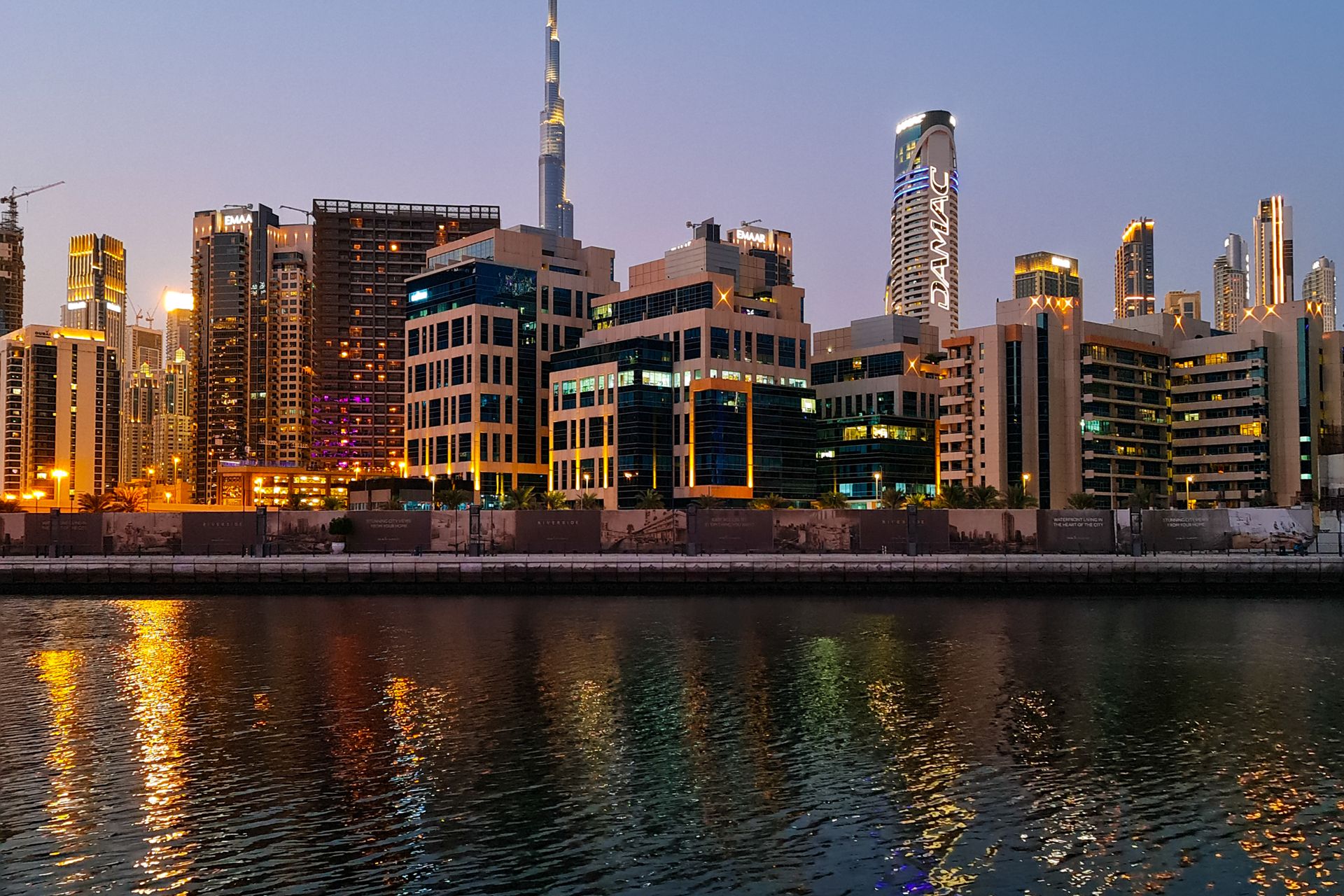
South of the creek the line rises onto its viaduct beside Sheikh Zayed Road, and the stations read like an index of modern Dubai: World Trade Centre, Emirates Towers, Financial Centre, Burj Khalifa/Dubai Mall, Business Bay. The Burj Khalifa, opened in January 2010, rises 829.8 metres beside its station. Business Bay lies just south of Downtown, threaded by the Dubai Water Canal, which extended the creek inland and opened in November 2016.
This stretch is where rents are highest: our figure for a central one-bedroom is about $2,440 a month. WeWork's One Central building, by the World Trade Centre, sells coworking from about $395 a month. Live here if you want the city's showpieces outside your window and a short commute; skip it if the budget matters more than the view.
Halfway: Al Barsha and Al Quoz
Further down the line, Mall of the Emirates station serves Al Barsha, a district of villas in its inner blocks and high-rises around Barsha Heights, with an indoor ski slope, Ski Dubai, inside the mall. Halfway between the old city and the Marina, it is a practical base for a longer stay.
Across the highway lies Al Quoz, an industrial district where Alserkal Avenue has turned warehouses into a cluster of 17 galleries and almost 100 businesses, with the Quoz Arts Fest each January. Its foundation runs the Common Room, where registration is free and you can drop in to find a desk; it is meant for artists and researchers, and closed on Fridays and Sundays.
The far end: Internet City, JLT and the Marina
The last stretch most remote workers use begins at Dubai Internet City and ends among the towers of the Marina. Jumeirah Lake Towers, served by the DMCC station, is 80 towers built around three artificial lakes; across the highway, the Marina wraps a canal about 3 kilometres long with almost 8 kilometres of waterside walkways. The Dubai Tram links the DMCC and Sobha Realty stations to the Marina and the beach at JBR.
This is Dubai's most popular expat district, walkable by local standards and close to the sea, and you pay central prices for it. JLT, across the road, is the usual compromise: the same metro and tram, a lake instead of a canal, and generally lower rents. For a first month, base yourself here.
Staying legally, and what the tax-free part means
American, British, Canadian, Australian and most EU passport holders get a free visit visa on arrival, valid for up to 90 days over a 180-day period. Irish passport holders get 30 days, extendable inside the country. A visit visa is not a work visa, though, and the UK Foreign Office warns that people caught working on one can be fined, jailed or deported.
For a longer stay there is a visa built for remote workers. The Dubai residency directorate asks for proof of a monthly income of at least $3,500 from an employer or business outside the UAE, health insurance and a passport valid for six months. The entry permit and the residence permit cost about $128 together in government fees, each processed in 48 hours, plus a medical test and an Emirates ID, and the permit runs for a year.
The tax side is simpler than it sounds and narrower than it is sold. The UAE has no personal income tax, but your home country decides whether you still owe tax there: Americans always do, and others only stop once they have properly left. Our digital nomad tax guide explains how. If you invoice through your own business, UAE corporate tax applies once its turnover passes about $272,300 a year, and working for UAE clients needs a different permit.
Visa, contract or permit question in Dubai?
Our Dubai directory lists English-speaking lawyers, each with the source for the languages they work in, so you can check before you call.
Browse lawyers in Dubai →A working day on the line
The connection will not hold you back. In Ookla's index the UAE has the world's fastest median mobile download, about 676 Mbps, and the second-fastest home broadband, at about 382. Calls are another matter. The telecoms regulator treats internet calling as a licensed service, and the apps it approved by 2020 were Teams, Zoom, Skype for Business, Google Meet and Webex; WhatsApp and FaceTime calls were not on that list. Put client calls on the approved platforms.
The metro carries the rest of the day. A 30-day pass covers the metro, the tram and RTA buses, $38 for one zone or $95 for all of them, so the tram to the beach after work costs nothing extra. Government offices and schools have kept a Saturday and Sunday weekend since January 2022, with a short Friday, and private companies choose their own week, so check your clients' calendar as well as your own.
Plan around Ramadan too, expected from about 8 February to 8 March 2027. Private-sector working hours drop by two hours a day, and eating, drinking or smoking in public in daytime, even in your car, can cause offence. Restaurants in malls still serve during the day, and most others open fully at iftar.
When to come
The calendar decides more here than the map. From November to March the city lives outdoors: January averages about 24°C, Kite Beach in Umm Suqeim fills with food trucks under a view of the Burj Al Arab, and inland, the man-made Al Qudra Lakes draw flamingos and cyclists to an 84-kilometre desert track. Our city page marks March, November and December as the best months.
From June to September, averages climb to around 40°C and peak at 41°C in August. Life moves into the malls, the coworking spaces and the air-conditioned metro. A summer stay works if all you need is a chair and a connection; come in winter for the city itself.
The region in 2026
One more thing belongs on the map this year. Iran struck targets in the UAE between late February and a ceasefire in April 2026, and on 16 March a drone set a fuel tank on fire at Dubai International Airport, halting flights until mid-morning. Since 8 July, the UK Foreign Office reports, there have been further strikes and retaliatory attacks across the region against US military and civilian infrastructure.
Its travel advice for the UAE stops short of advising against travel, but warns of flight cancellations and periodic airspace closures, and says the greatest risk is from falling debris from interceptions. For a stay of a month or more, that means refundable flights, a cancellable lease, insurance that covers the region, and reading the advice again the week you fly.
What it costs
Our budget for one person in a central one-bedroom is about $3,350 a month: about $2,440 for the flat and $910 for everything else, from Numbeo's user-reported prices. A smaller place further out brings it nearer $2,400. Our city page also notes that landlords on longer leases usually want the year's rent in one to four post-dated cheques, which ties up capital before you move in.
That puts Dubai well below London, at about $4,380 on our figures, but far above Abu Dhabi, at about $2,700, or Ras Al Khaimah, further up the coast, at about $1,540. If budget decides, our guides to Bangkok on a budget and to a year in Tbilisi show what the same money buys elsewhere, and our guide to the Middle East's best cities for a month of remote work compares the region month by month.
Who Dubai suits
Choose Dubai if your income is high and your work runs on bandwidth, if your clients sit in Europe or Asia, since the city's clock falls between them, and if you would rather ride a driverless train to a coworking desk than negotiate a bad connection. Come between November and March, take a furnished place near a Red Line station, and buy the 30-day pass on day one.
Look elsewhere if you are watching every dollar, if you need a walkable old town with crooked streets on your doorstep every day, or if regional risk would keep you awake. For a longer stay, the remote-work visa is straightforward; compare it with the other countries in our nomad visa finder before you commit.
Everything else about Dubai
The full cost table, neighbourhood notes, coworking spaces and our 13 category ratings for Dubai, on one page.
Open the Dubai city guide →Frequently Asked Questions
How much does it cost to live in Dubai as a digital nomad?
About $3,350 a month for one person with a central one-bedroom, or nearer $2,400 in a smaller place further out. User-reported rents average about $2,440 for a central one-bedroom and $1,500 outside the centre.
Which area of Dubai is best for digital nomads?
Dubai Marina or JLT for a first month, both on the Red Line and the tram, near the beach. Downtown and Business Bay put you among the coworking spaces at the highest rents; Deira and Bur Dubai, by the creek, are the cheapest end of the line.
Does Dubai have a digital nomad visa?
Yes. The remote-work visa needs a monthly income of at least $3,500 from outside the UAE, health insurance and a passport valid for six months. Government fees come to about $128, and the permit lasts a year.
Can I work remotely in Dubai on a tourist visa?
The visit visa gives US, UK and most EU citizens 90 days in 180, but it is not a work visa, and the UK Foreign Office warns that working on one can lead to a fine, prison or deportation.
Do digital nomads pay tax in Dubai?
The UAE has no personal income tax, but your home country may still tax you, and US citizens always owe a return. A business you run yourself falls under UAE corporate tax once turnover passes about $272,300 a year.
Can I make WhatsApp calls in Dubai?
Plan not to. The regulator treats internet calling as licensed; Teams, Zoom, Skype for Business, Google Meet and Webex were approved, while WhatsApp and FaceTime calls were not on the list.
Is it safe to travel to Dubai in 2026?
The UK Foreign Office does not advise against travel, but after Iranian strikes in 2026 it warns of flight cancellations, airspace closures and debris from interceptions. Book flexibly and check the advice before you fly.


