
Walk into BWork on Jalan Nelayan in Canggu without a membership and the day pass costs $16.57. Read the small print and you know exactly what it buys: 24 hours of desk and wifi from the moment you register, one hour in a call room, ten printed pages. It is walk-in only, the spots are limited, and the staff suggest you come early.
That receipt is the most useful thing to compare across Bali's coworking spaces, because every space writes it differently. One pass lasts until midnight, another until six the next morning. One includes ninety minutes of phone booth, another nothing but coffee. Only one space in this guide states on its own site that it has a backup generator, and that matters on an island where, on 2 May 2025, the power went out across Bali for hours.
The map has also changed. Dojo Bali, the Canggu space older guides still open with, closed in December 2022, and Hubud in Ubud has been shut since the pandemic. What is open in 2026 is a shorter list, and every space below was checked against its own website.
If your days are full of calls, read the receipts for call rooms and backup lines first. If they are not, the cheapest pass near your bed is usually the right one, because Bali traffic punishes a commute more than any desk rewards it.
| Space | Area | Day pass | Unlimited month |
|---|---|---|---|
| BWork | Canggu, Uluwatu | $16.57 | $213 |
| Tropical Nomad | Canggu | $14.41 | $183 |
| Tribal | Pererenan | free with a purchase | none |
| Setter | Ubud, Canggu, Berawa | $16.57 | $221 |
| Outpost | Ubud (two spaces) | $14.30 | $148 |
| Livit Hub, Pro desk | Sanur | $15.24 | $270 |
| FLOW | Sanur | $16.63 | $211 |
| GoWork Park 23 | Kuta, by the airport | $9.98 + VAT | $63 + VAT |
Each space's own published prices, checked on 1 October 2026. Livit's prices include 11 percent VAT; GoWork adds VAT. Tribal's terms come from two independent guides, as its own site does not publish them. Prices are in US dollars at the site's exchange rate of 18,040 rupiah per dollar on 1 August 2026.
City scores at a glance
| City | Nomad Score | Budget | Cost | WiFi | Safety | Community | Climate |
|---|---|---|---|---|---|---|---|
 CangguIndonesia CangguIndonesia |
7.2 | $2,200/mo | 6 | 6 | 7 | 10 | 7 |
| UbudIndonesia |
7.8 | $880/mo | 7 | 5 | 8 | 9 | 7 |
The Nomad HQ ratings, scored 0 to 10 across our 13 categories.
What the receipt does not say
No receipt tells you what happens when the lights go out. Bali's blackout of 2 May 2025 started around four in the afternoon, was traced provisionally to the undersea cable that links Bali's grid to Java's, and was back for more than 940,000 customers by half past seven, with the last restored around three the next morning. Shorter cuts come with heavy rain in the wet season, which runs roughly from October or November into early April.
Of the spaces here, only Outpost in Ubud says it runs a backup generator, and it adds a second internet line from a different provider. The others publish their speed or say nothing at all: FLOW states 150 Mbps, Setter 300 Mbps, Tropical Nomad "up to 500". That is not proof that they lack backup power, only that you should ask before you pay for a month.
The real backup costs almost nothing. Telkomsel's prepaid list currently sells 25 GB valid for 28 days for about $3.88, and a SIM for under $2. Buy one on the first day and tether through any cut that catches you on a call.
Canggu: the receipts on the beach road
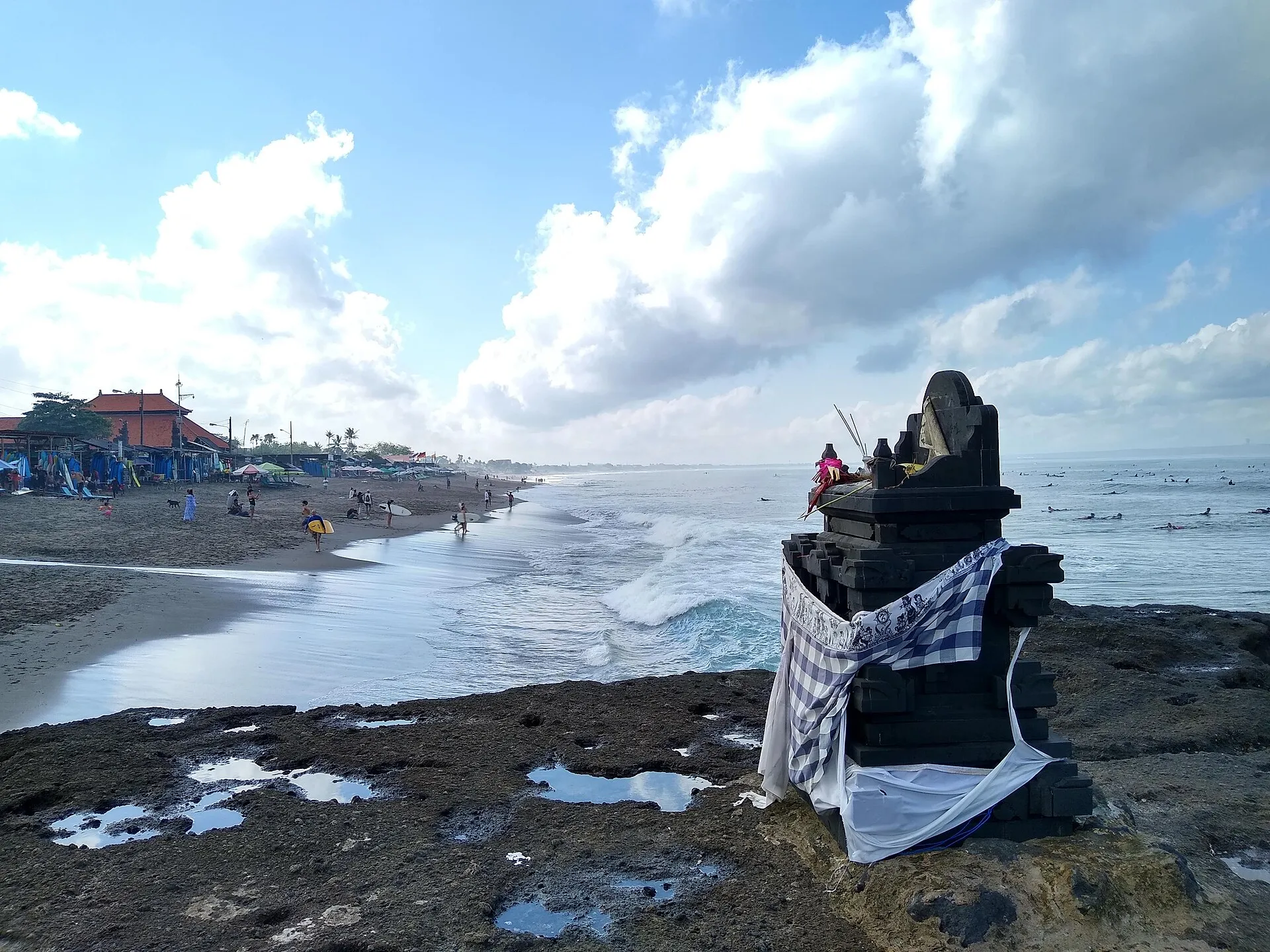
Canggu is a strip of black-sand beaches about ten kilometres long, from Berawa in the south past Batu Bolong, with its temple on the rocks, to Echo Beach and Pererenan. It has the densest cluster of desks on the island and the worst traffic: Jalan Raya Canggu is notoriously jammed. So choose your space by which beach road you live on.
BWork sits on Jalan Nelayan, the road down to Nelayan, the quiet last beach before Berawa. Members get 24-hour access, a pool, showers, lockers and a garden. The reason to pay here is the rooms: a focus room for calls at $3.33 an hour, meeting rooms from $8.31 an hour, and a studio for podcasts.
An unlimited week is $66.52 and a month $213, and the month also opens BWork's larger second space at Uluwatu on the Bukit, four floors with a bouldering wall and a gym. If your calls land after three in the afternoon, the off-peak month, valid from 3 p.m. to 10 a.m., costs $110.86.
Tropical Nomad, on Jalan Subak, sells its time by the hour as well as by the day: a seven-hour pass at $11.09, 50 hours a month at $74.83, 100 hours at $121.95, or unlimited at $182.93, with 24-hour access. For anyone who works half days in cafés and half at a desk, the hour bundles are the cheapest honest way to pay.
Tribal, up the coast in Pererenan, is a hostel with a coworking floor and an infinity pool. It charges no entry fee: two independent guides agree that a drink buys three hours, after which there is a minimum spend of about $5.54. Its own site does not publish the terms, so check at the door. It is the place to meet people on your first week, less so for a day of deep work.
Setter has spaces in Canggu and on Berawa beach as well as in Ubud, all open around the clock, with free coffee and a call booth included in the $16.57 day pass. Its weekly and monthly plans cover all three, which is useful if you split time between the coast and the hills.
Pricing the rest of a Canggu month?
Our Canggu city guide has rent, food and transport costs, the five neighbourhoods and the traffic you will commute through.
Open the Canggu city guide →Ubud: two villages, one membership
Inland, Ubud works at a different pace. Its coworking story began at Hubud, now closed, and continues at Outpost, which runs two spaces on one membership. The original, opened in 2016, is in Nyuh Kuning, a village close to the Sacred Monkey Forest, with an air-conditioned focus room downstairs and an open-air floor upstairs looking out at palm trees.
The second is in Penestanan, on the western edge of town, an artists' village since the 1930s when the painter Walter Spies lived there, surrounded by rice fields. Here the desks sit on the roof of Outpost's own coliving rooms, next to a yoga and sunset deck, so the commute really is a flight of stairs. Nearby, the Campuhan Ridge path climbs about two kilometres along a ridge between two rivers, a popular place to watch the sun go down after work.
Outpost's receipt is the most generous on the island. A $14.30 day pass runs until six the next morning, both spaces are open 24 hours, and the backup generator and second line mean the hours are usable. An unlimited month is $148.45, and a night-owl plan at $89.36 covers 5 p.m. to 8 a.m. for anyone working to American hours. For a lighter month, a 25-hour pass valid for two weeks costs $55.38.
Setter's Ubud space, on Jalan Raya Sanggingan, is the alternative: 35 desks, four focus rooms and a rooftop, at the same prices as its coast spaces.
Sanur: the quiet coast
Sanur, on the east coast, is Bali's oldest beach resort, older than Kuta, with traditional fishing boats drawn up on the sand and Nusa Penida on the horizon. Its two coworking spaces suit people who want the sea without Canggu's crowds.
Livit Hub is a five-minute walk from the seafront, with phone booths, a nap room and a rooftop from which, on clear days, you can see two volcanoes and a neighbouring island. Read its receipt carefully, because it sells two different passes. Basic, at $7.76 a day or $124.72 a month, seats you in the café and on the roof only. Pro, at $15.24 a day with 90 minutes of phone booth, or $270.23 a month, gets you any desk in the building. Prices include VAT.
FLOW, on Jalan Danau Poso, is the most office-like space in this guide: 150 Mbps wifi, private phone booths, a soundproofed quiet room, and an event hall for 50 people. Its $16.63 day pass runs until midnight, while members, from $58.20 a week or $210.64 a month, get in around the clock. There is also a ten-day plan at $133.04 that works for a part-time month.
Kuta: the desk by the airport
GoWork, part of an Indonesian chain, has its Bali space on the third floor of the Park 23 Creative Hub in Tuban, a few minutes from Ngurah Rai airport. A day desk costs $9.98 and a month of shared coworking $62.64, both plus VAT, which makes it the cheapest paid desk in this guide. A dedicated desk starts at $149.67.
Staff are there on weekdays from 9 a.m. to 6 p.m. only, so ask about access outside those hours before you plan an evening of calls. It suits a stopover, or a stay in Kuta or Jimbaran, better than a Canggu month.
Day pass, bundle or month?
The receipts make the arithmetic easy. At BWork, an unlimited month costs about the same as 13 day passes; at Outpost, about ten; at FLOW, about 13. Work at a desk more than three days a week and the month wins at most of them; Livit's Pro desk is the exception, where the month only pays off after about 18 days.
Most people work less than that. If you split your days between the flat, a café and a desk, the part-time plans are better value than either extreme: Outpost's 25 hours, Tropical Nomad's 50, FLOW's ten days, or Livit's Basic month if a café seat on a rooftop is enough. Buy a day pass first, work a full day there, including the late morning when most spaces fill up, and only then commit.
Coworking is also one of the smaller numbers in a Bali budget. Our guide to what Canggu really costs puts it beside rent, food and transport, and if you would rather have the desk and the bed in one place, our look at coliving explains what the lease usually covers.
Working from Bali legally
A desk does not change your visa. Most Western passports enter on Indonesia's visa on arrival, which costs about $27.72 for 30 days and can be extended once for 30 more. Its official list of permitted activities covers tourism and business meetings and does not mention remote work, and it forbids pay from anyone in Indonesia. Indonesia announced in August 2026 that the fee will rise, with no start date set yet.
For a long stay, the E33G remote worker visa is built for exactly this: a year in Indonesia working for a company abroad, for a fee of about $388, with proof of at least $60,000 a year in income and a $2,000 bank balance. Every foreign visitor also pays Bali's tourist levy of about $8.31. Our comparison of digital nomad visas sets the E33G beside the rest of the region, and our list of lawyers in Bali shows the languages each one works in, for help with the paperwork.
Which space for which worker
For a calendar full of calls, take BWork in Canggu or FLOW in Sanur: both sell call rooms by the hour, and FLOW's quiet room is soundproofed. For reliability above everything, Outpost in Ubud, the one space that tells you what happens when the power fails. For a tight budget, GoWork by the airport or Tropical Nomad's hour bundles. For your first week alone on the island, Tribal, where the pool and the hostel do the introductions.
Whichever you choose, read the receipt before the brochure: how many hours the pass lasts, how much call-room time it includes, and whether anyone has thought about the next blackout. Then pick the one closest to where you sleep.
Not sure Bali is the right base?
Our Nomad Taste Wheel matches your priorities, from internet to cost to community, against every city we cover.
Try the Taste Wheel →Frequently Asked Questions About Coworking in Bali
How much does a coworking day pass cost in Bali?
Most day passes cost $14 to $17: $14.30 at Outpost in Ubud, $14.41 at Tropical Nomad, $16.57 at BWork and Setter, $16.63 at FLOW. GoWork in Kuta charges $9.98 plus VAT, and Livit Hub's café-only Basic pass costs $7.76.
How much is a monthly coworking membership in Bali?
Unlimited months run from $62.64 plus VAT at GoWork to $148.45 at Outpost, $182.93 at Tropical Nomad, about $211 to $213 at FLOW and BWork, $221.18 at Setter and $270.23 for Livit Hub's Pro desk.
Which Bali coworking space is best for video calls?
BWork in Canggu and FLOW in Sanur, which sell call rooms by the hour; FLOW's quiet room is soundproofed. Outpost in Ubud has video call booths, a second internet line and a backup generator.
Is Dojo Bali still open?
No. Dojo Bali closed in December 2022, and Hubud in Ubud has been closed since the pandemic. Outpost no longer has a Canggu space; its two Bali spaces are in Ubud.
Which Bali coworking spaces are open 24 hours?
Outpost's two Ubud spaces, Setter, Tropical Nomad and BWork's coworking for members, and FLOW and Livit Hub for registered members. GoWork is staffed on weekdays from 9 a.m. to 6 p.m.
Do Bali coworking spaces have backup power?
Only Outpost in Ubud states on its site that it runs a backup generator. The others do not say, so ask before you buy a month, and carry a Telkomsel SIM as a backup: 25 GB costs about $3.88.
Can you work remotely in Bali on a visa on arrival?
The visa on arrival's official list of activities does not mention remote work and forbids pay from anyone in Indonesia. The E33G remote worker visa covers a year of work for a company abroad, with at least $60,000 a year in income.


