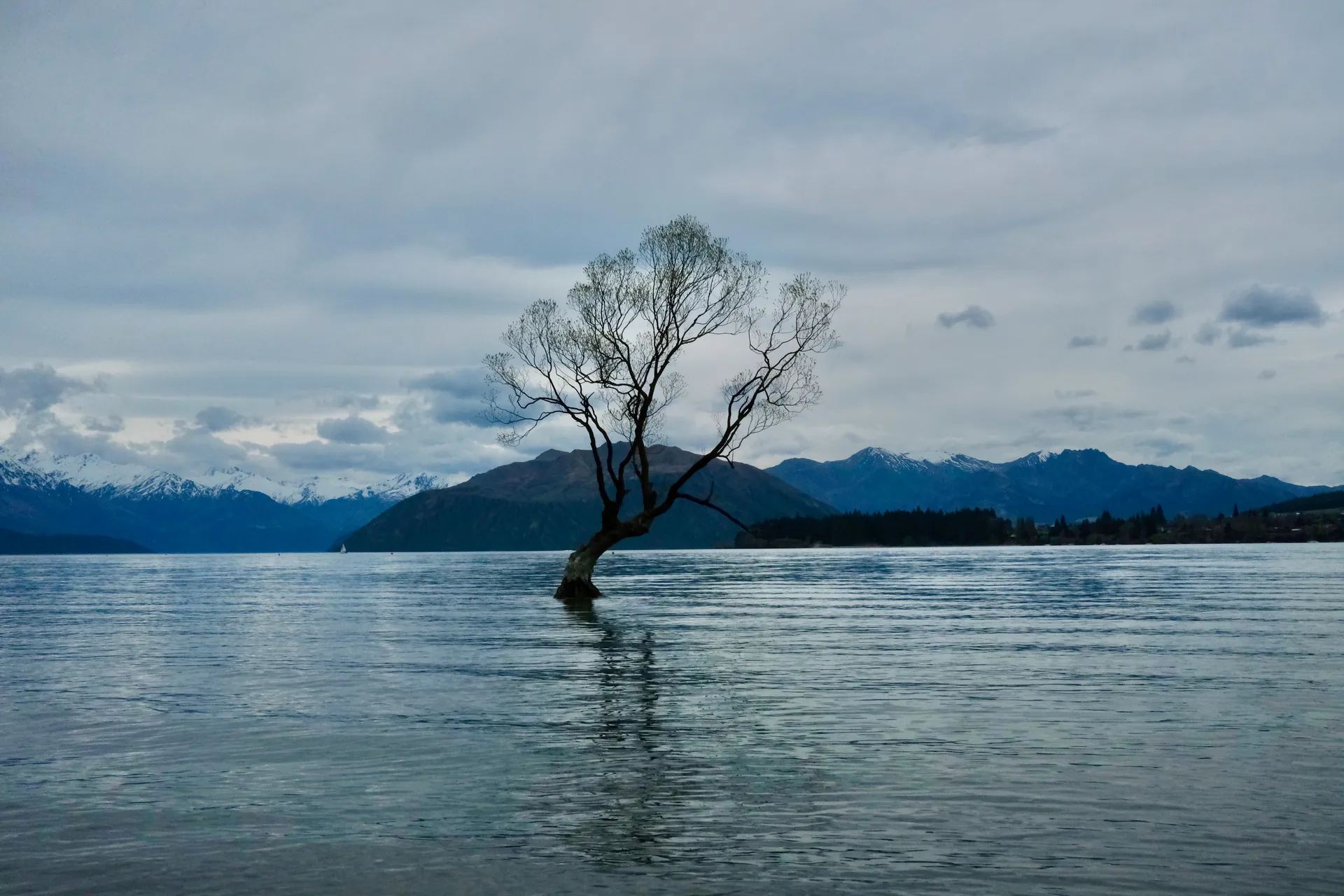

From June to October, Wanaka is a ski town: Cardrona is 45 minutes up the Cardrona Valley, Treble Cone 35 minutes up a switchbacked access road with the lake spread out below it, and on the shortest day the sun rises at 8:19 and sets at 5:11. By December the same town belongs to the water. The sun is up before six and down at half past nine, and the two-kilometre beach on Roys Bay is where people swim, hire kayaks and walk out to a willow that stands in the lake.
The two towns do not fill at the same time. The busiest visitor day of the year falls over Christmas and New Year, when the Rhythm & Alps festival takes over the Cardrona Valley, and visitor numbers swing harder between busy and quiet here than in Queenstown. Rentals run on the other calendar: new leases across the district peak in May and June, in the weeks before the ski fields open, at nearly twice the March level.
So for a remote worker the season is the first decision, and since January 2025 New Zealand lets you make it on a visitor's passport. Visitors may now work for employers and clients abroad for as long as the stay lasts, and in Wanaka a stay can stretch to one winter and the summer after it. Come if you earn from abroad, can spend $2,600 or more a month and work US or Australian hours. Skip it if you want a nomad scene or cheap rent: this is a town of about 13,000 people, and the one coworking space we could verify has three hot desks.
| One-bedroom, median new lease | $1,780 to $2,110 a month |
|---|---|
| All homes, median new lease by area | $2,027 to $2,211 a month |
| Budget for one, working from home | $2,600 to $2,900 a month |
| Budget for one, with a coworking desk | $2,900 to $3,300 a month |
| Coworking at The Cell | $20 a day, $88 a week |
| Cardrona and Treble Cone passes | day from $104, season from $1,048 |
| Stay on a visa waiver | 3 months a visit (UK: 6) |
| Longest visitor stay | 9 months in any 18 |
| Sun on 21 June | 8:19am to 5:11pm |
| Sun on 21 December | 5:52am to 9:30pm |
Rents: Tenancy Services bond data for tenancies begun April to June 2026. Budget: those rents plus Numbeo's non-rent costs for nearby Queenstown. Passes: the operator's published prices. Prices are in US dollars at the European Central Bank's exchange rate of NZ$1 = $0.567 on 25 September 2026.
Winter or summer, the laptop is legal
New Zealand never built a digital nomad visa. It changed the ordinary one instead: every visitor visa applied for since 27 January 2025 allows remote work, and travellers who arrive on an NZeTA get the same conditions. Remote work means work for an employer, company or client outside New Zealand, digital nomads are named outright, and there is no cap on the hours.
The line is drawn at the edge of the local economy. You may not work for a New Zealand employer, sell to people or businesses here, or take a job that needs you on site. Payment in kind counts, so a free week in a lakefront apartment in return for a review is local work. That is also why New Zealand has no row in our digital nomad visa comparison: the permission lives inside the visitor visa.
How long you get depends on your passport. Americans, Canadians, Germans and Britons travel on a visa waiver with an NZeTA, which costs about $10 in the app or $13 on the web, plus a $57 tourism levy; allow 72 hours for approval. That gives three months a visit, six for British citizens, and no more than six months in any twelve. Australians need neither.
Three months covers one season: a ski winter from June, or a lake summer from December. To see both towns, apply for a Visitor Visa before your time runs out. It costs from $250 and allows nine months in any eighteen. At the border you may be asked for an onward ticket and about $567 in funds for each month of the stay.
Nine months is also the tax line
The second change came in April 2026. Under Inland Revenue's non-resident visitor rule, anyone arriving from 1 April 2026 can be present for up to 275 days in any 18 months without becoming tax resident, and the usual 183-day test does not apply. Part days count as whole days. From day 276 you are resident.
It holds only while every condition does: you were not tax resident here before, you neither work for a New Zealand resident nor sell anything here, your work does not need you here, you are here lawfully, you claim no Working for Families credits, and you are liable to tax where you live. Break one and the ordinary rules come back.
Nine months in eighteen is roughly 275 days, so keep to the visitor visa and you keep to the tax rule. One trap: the immigration page on remote work still quotes the old 92-day and 183-day figures, but tax residence is Inland Revenue's call. Your home country taxes you on its own terms either way, which our guide to how digital nomads are taxed explains.
The lakefront, the tree and where to live
Wanaka sits at the southern end of a lake 45 kilometres long and 311 metres deep, with the mountains across the water. The centre is compact: its shops, cafés, galleries and outdoor gear stores sit on Ardmore Street, which runs along the lakefront, and Helwick Street, which meets it. Between Ardmore Street and the beach runs a strip of reserve with a walking and cycling path, part of Te Araroa, the trail that crosses the length of the country.
Follow that path along Roys Bay for under two kilometres and you reach That Wanaka Tree. It began as a post in a fence built out into the lake to stop stock from Wanaka Station wandering along the bay, and the willow branch it was cut from took root; a resident remembered it growing in 1939. A misty photograph of it won New Zealand Geographic's photo of the year in 2014, and photographers have come for sunrise and sunset ever since.
Where you rent decides which part of that walk is yours. Wanaka Waterfront, the area along the lake, had a median new lease of about $2,088 a month in the quarter from April 2026. Wanaka Central, around the town centre, came in at $2,027 and puts the market and the cinema a short walk away.
Albert Town, a separate settlement on the Clutha River just below the lake's outlet, matches the waterfront at about $2,088. From its car park the Outlet Track follows the river towards Wanaka, golden in autumn and shaded in summer: your run or ride into town. Wanaka North and Wanaka West were the dearest areas, at about $2,157 and $2,211.
Rent runs on the ski calendar
Rent here can be read from signed leases, not adverts: landlords must lodge every bond, and the lodgements are published as rental bond data. Across the Queenstown-Lakes District, new leases in July 2026 had a median of $454 a week, against $335 for New Zealand as a whole, and the Wanaka areas ran higher still.
Most of those leases are houses. One-bedroom lets are few, only 24 new ones in Wanaka North in a whole quarter, and they cost $1,780 to $2,110 a month depending on the area. The figures are provisional during a system migration, so read them as a level, not a trend.
The season shows in the timing. District lodgements peaked in May and June in both 2025 and 2026, with over 320 new bonds in May against 174 in March. Those are the weeks before the ski fields open, and a winter lease hunted in May competes with everyone arriving for the season. Look in March or April, or have the flat settled before you fly.
Summer has its own catch. Holiday homes and flatmate arrangements sit outside the Residential Tenancies Act, so a furnished holiday let gives you none of its protections unless the agreement opts in. For a season, a short fixed-term tenancy of up to 90 days is the form built for you: it ends on the agreed date, becomes periodic only if it runs to day 91, and caps the bond at four weeks' rent, about $1,814 at the district median.
Is Wanaka worth the rent?
Set Wanaka beside Queenstown or any other city: budget, internet and all 13 of our ratings, side by side.
Compare Wanaka with other cities →Fibre, three hot desks and a long way to Zoom
In town the connection is the easy part. The national Ultra-Fast Broadband programme covered Wanaka and Lake Hawea, some 4,695 premises, before it finished in 2022, and the centre had fibre years earlier. On fibre, speed is a plan you choose: nationally, the Fibre 500 plan measured 508 Mbps down and 109 up at single-digit latency. Out in the Cardrona Valley or on a rural block you are on Starlink, measured at up to 245 Mbps, or 4G fixed wireless, which fell to 37 Mbps at peak. Ask which one the house has.
Distance shows in the call, not the download: from New Zealand fibre, Google Meet and Teams answered in under 50 ms, Zoom in 144 to 158. On Zoom you will notice the delay.
For a desk away from the flat there is The Cell on Anderson Road, open around the clock, at $20 a day or $88 a week. It has only three hot desks, and its full-time desks and private offices had waiting lists, so book ahead and treat home as the office.
Whose working day fits Wanaka's
Wanaka runs on New Zealand time, UTC+13 from 27 September 2026 to 4 April 2027 and UTC+12 in winter. In the lake summer, a 9am start here is 3pm the previous afternoon in New York and 8pm the previous evening in London. Americans overlap with your morning and Sydney is two hours behind; with a European team, someone takes the call at night. Test your team's hours in our time zone overlap finder before you commit to a season.
A weekday in each season
Say it is February. An American client's working day ends before your lunch, and the sun does not set until about nine. You could walk the lakefront path to the tree, swim off the beach at Roys Bay, or climb Mount Iron, two kilometres from town, for a 360-degree view over the lake and the Alps. On Thursday afternoons, all year round, the farmers' market sets up on Ardmore Street, just back from the lake.
Now say it is July. The fields are open, and on a clear day you could ski the morning at Treble Cone and log on in the afternoon. The sun is gone by half past five, and the evening moves indoors: to Cinema Paradiso on Brownston Street, say, where the seats are couches, recliners and a Morris Minor, and the film stops halfway so everyone can fetch warm cookies from the café next door.
No town in New Zealand has a wider choice of snow within reach, but the summer day gives you four hours of light after work. Pick the one you would rather have on a Tuesday.
Weekends: Roys Peak, the glacier and the ski roads
The walk everyone has seen is Roys Peak: a full-day climb of more than 1,200 metres to a summit at 1,578, with the famous viewpoint over the lake about half an hour below the top. It is steep and busy enough that the car park fills, and because it crosses farmland it closes for lambing from 1 October to 10 November every year. A spring arrival should plan for another hill.
Further in, Mount Aspiring, Tititea in Māori, rises to 3,033 metres, the only New Zealand summit above 3,000 outside the Aoraki/Mount Cook park. An hour's drive up the Matukituki valley, the last 30 kilometres unsealed and the final stretch through fords, brings you to the Raspberry Creek car park. From there the Rob Roy Glacier Track climbs through beech forest to a view of the ice, ten kilometres and four to five hours return.
In winter the weekend moves uphill. Treble Cone, now run with Cardrona, is known for its views over the lake to Mount Aspiring and for advanced terrain; Cardrona suits every level and runs half-pipes and terrain parks. On the valley road there, the Cardrona Hotel has served travellers since the gold rush of 1863. If you ski most weekends, the season pass beats day passes from the eleventh day.
What a month in Wanaka costs
No cost survey covers Wanaka itself, so the budget borrows Queenstown's, an hour away: about $802 a month for one person's costs without rent. Add a one-bedroom and you need roughly $2,600 to $2,900 a month working from home, or $2,900 to $3,300 with a weekly desk at The Cell. The $2,360 estimate on our city page prices rent at the district's lower quartile rather the one-bedroom median, so plan on these figures.
A ski winter adds the passes and a 35 to 45 minute drive each way to the fields, and a lease signed in March or April, before the May rush, is the cheaper one.
Getting there, and what happens if you get hurt
The main gateway is Queenstown Airport, 60 minutes away over the Crown Range Road or through the Kawarau Gorge, with daily flights to Auckland, Wellington and Christchurch and direct routes to Sydney, Melbourne, Brisbane and the Gold Coast. Christchurch is five and a half hours by road. If you would rather live beside the airport, our Queenstown guide covers the bigger town over the hill.
Wanaka has no emergency department, and neither does the rest of Central Otago. The nearest are Lakes District Hospital in Frankton and Dunedin Public Hospital; call 111 in an emergency. The overnight acute care clinic in Wanaka runs from 11pm to 9am, but it takes no walk-ins, so call Healthline on 0800 611 116 first, and expect visitor fees.
ACC, New Zealand's no-fault accident scheme, covers visitors like everyone else, which matters in a town built around ski slopes and mountain tracks. Illness is not an accident, and visitors pay for their own care, so bring health insurance for the whole stay.
Which Wanaka to choose
Choose by the Tuesday you want. For long evenings, swimming and the big walks, come for the lake town from late January, after the New Year peak, and stay into autumn while the Outlet Track turns gold. For the mountain on your doorstep, come for the ski town, sign the lease before May and accept dark evenings by half past five. On a Visitor Visa you can do one after the other, inside both the nine-month limit and the 275-day tax line.
Either way, Wanaka is small, dear and quiet, and its rewards are outdoors. For a bigger rental market on the same island, look at Christchurch, where a central one-bedroom averages about $1,213 a month, well below any Wanaka median. The scores, cost table and neighbourhood notes are in our Wanaka city guide.
How does Wanaka rank in Oceania?
Our Oceania ranking sets Wanaka against Queenstown, Nelson, Melbourne and the rest of the region on the same 13 categories.
See the Oceania ranking →Frequently Asked Questions
Can I work remotely from Wanaka on a visitor visa?
Yes. Every visitor visa applied for since 27 January 2025, and every NZeTA arrival, allows remote work for employers or clients outside New Zealand with no limit on hours. You may not work for a New Zealand employer or sell to people or businesses in New Zealand.
How long can a digital nomad stay in Wanaka?
On a visa waiver with an NZeTA, three months a visit, or six for UK citizens, and no more than six months in any twelve. A Visitor Visa, from $250, allows up to nine months in any eighteen, enough for one winter and the following summer.
Do remote workers in Wanaka pay New Zealand income tax?
Not if they qualify as non-resident visitors. Arrivals from 1 April 2026 can be present for up to 275 days in any 18 months, working only for offshore employers or clients and paying tax at home, without becoming tax resident. From day 276 they are.
How much does it cost to live in Wanaka per month?
About $2,600 to $2,900 working from home, or $2,900 to $3,300 with a coworking desk. New one-bedroom leases had medians of $1,780 to $2,110 a month in 2026, and other costs run near $800.
Is winter or summer better for working from Wanaka?
Summer gives light until half past nine, lake swimming and the big walks; winter puts Cardrona and Treble Cone within 45 minutes but ends the day at about five. Winter leases are hardest to find in May and June.
Where is the nearest hospital to Wanaka?
The nearest emergency departments are Lakes District Hospital in Frankton and Dunedin Public Hospital. In Wanaka, an overnight clinic runs from 11pm to 9am if you call Healthline on 0800 611 116 first. ACC covers visitors' accident injuries, but not illness.


