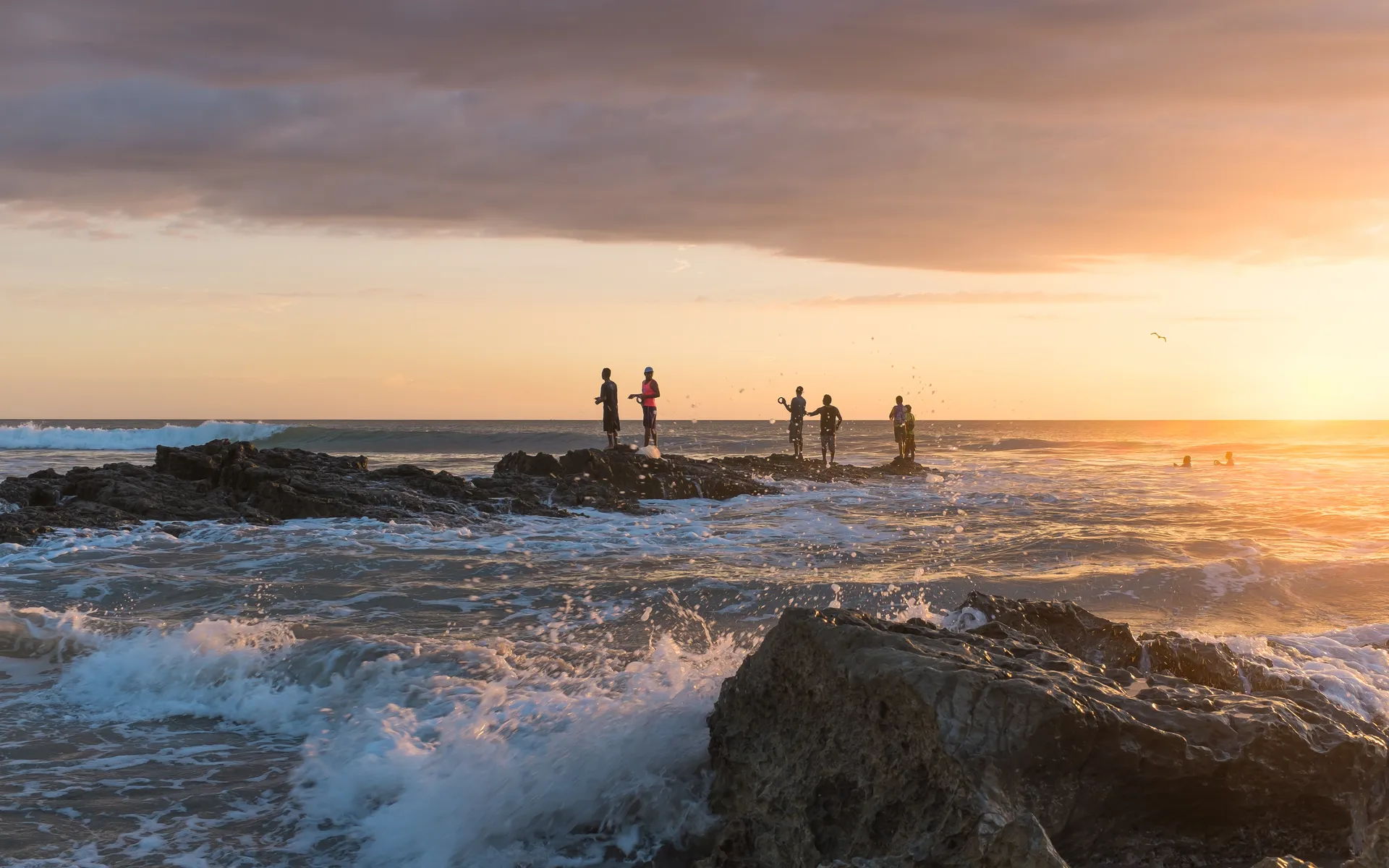

In Santa Teresa the working day is set by the sea. Twice a day the Pacific climbs the beach and twice it falls back, close to three metres at the big spring tides, and each day the whole cycle arrives about fifty minutes later than the day before. The main beach break is best from low to mid tide; at high water the waves close out on the sand. So the hour when the surf is good slides from dawn towards lunch over a week, and a remote worker here learns to read the official tide table before the calendar.
The other rhythm used to be dust. For years the single road that runs along this coast, from Mal País at the southern tip through Playa Carmen and Santa Teresa to Playa Hermosa, was dirt: a haze over the shopfronts in the dry months and a brown slurry the locals call chilate in the rains. In 2018 an environmental lawyer filed a legal action over the dust. Asphalt arrived in stages, from Playa Carmen in 2021 to the stretch through Santa Teresa itself in July 2025.
By December 2025 the complaint had turned around. A residents' group named after the howler monkeys, Somos Congos, wrote to the district council that the new Santa Teresa road brings speeding and puts wildlife at risk, and asked for speed bumps. The last 1.2 kilometres to Playa Hermosa are still unpaved, and so are most of the side roads where the jungle houses are.
Between the tide and the road you have most of what Santa Teresa is: a strip of surf town on the southern tip of the Nicoya Peninsula, facing west into the open Pacific, with yoga studios, beach clubs, sodas and a sunset that pulls the whole town down to the sand every evening. It suits a remote worker whose job is mostly asynchronous, who surfs or wants to learn, and who can live with a small social world. It does not suit a call-heavy calendar in the rainy season, a tight budget, or anyone who needs a city.
Plan on about $1,400 a month, our own estimate, since no cost survey covers the town, and on anywhere between $1,200 and $2,200 depending on the house and how often you eat out. That is the expensive end of Costa Rica. The town is a long way from anywhere: a ferry and a drive from San José, or about five hours by road from Liberia.
| Monthly budget, one person (our estimate) | about $1,400 |
|---|---|
| Typical range | $1,200 to $2,200 |
| Tourist stay, US, Canadian and EU passports | up to 180 days |
| Digital nomad visa, income | $3,000 a month ($4,000 with family) |
| Digital nomad visa, length | 1 year, renewable once |
| Puntarenas to Paquera ferry | 8 sailings a day, about 70 min |
| Dry season | December to March |
| Wettest months | September and October |
| Time zone | UTC-6, no daylight saving |
Budget: our estimate, not a survey. Visa: Law 10008. Tourist stay: Executive Decree 44187-MGP. Ferry: published Naviera Tambor timetable. Seasons: Costa Rica's National Meteorological Institute (IMN).
How long can you stay?
Longer than most surf towns allow. Since September 2023, visitors from the US, Canada and the EU can be granted up to 180 days per visit. The officer at the airport decides how many you actually get, and asks for an onward ticket and proof of at least $100 a month to live on. Count the days in your passport stamp, not the ones in the rule, because a stay of 90 days or more cannot be extended once you are in.
For a whole year, Costa Rica has a proper digital nomad visa. Law 10008 asks for income of at least $3,000 a month earned abroad, or $4,000 with your family, and health insurance for the whole stay. It runs a year and can be renewed once, but only if you spent at least 180 days in the country in the first year.
The perks are what make it worth the paperwork. Your foreign income is not taxed in Costa Rica, your home driving licence stays valid, you can bring your laptop and work equipment in without import duty, and you can open a savings account at a local bank. Fees run to about $190 in total. If you plan a full season from December to April and then some, apply; if you are coming for three months of surf, the tourist stamp is enough. Our digital nomad visa finder sets Costa Rica's terms beside the other 39 we track.
Will the connection hold?
Plan for it to wobble. Fibre has reached the developed tourist strip, but outside it many houses still rely on satellite, and a heavy afternoon storm in the rainy season can take down power and the line together. Everyday work and most calls are fine; a board presentation at four in the afternoon in October is a risk you choose.
Three habits cover most of it. Ask the landlord whether the house has fibre or satellite, and run a speed test before you pay. Buy a local SIM with a real data allowance and treat it as your backup line from day one. And put the calls that matter in the morning, when the sky is usually clear and, conveniently, the tide often is not yet right for surfing.
For a desk outside the house, the choice is small. The two hotels that were once Selina now trade under new names, and one of them, ESO Santa Teresa, keeps a working coworking room alongside the hostel. Several other spaces come and go with the seasons, so check what is open the week you arrive rather than trusting an old list.
Where on the road to live
The names people use are stretches of one coast road rather than districts, and since the road is what joins them, where you sleep decides how much of your day is spent on it.
Playa Carmen: the crossroads
This is where the road from Cóbano meets the coast, at the junction everyone calls the cruce. It has a supermarket and The Bakery, open since 2009 about 100 metres north of the crossroads. It is the practical choice: paved, central, and the easiest place to live without riding every day.
Santa Teresa: the middle of the strip
North of the cruce, the main stretch has most of the restaurants, the beach clubs and the nightlife, and since 2025 smooth asphalt. That brought the end of the dust and the start of the speeding, so pick a house set back from the road if you want to sleep.
Playa Hermosa: the dirt end
At the northern end, Hermosa is quieter, with a long beach where beginners do best at mid to high tide. It is also where the asphalt stops. The final stretch is still dirt, dusty in the dry months and soft in the rains, and the council left its paving out of the December 2025 budget.
Mal País: the old fishing village
South of the cruce, Mal País started as a fishing village and still feels like the edge of the map. At low tide its slabs of volcanic rock hold pools full of fish, crabs and sea urchins; as the tide turns, the waves start breaking over them. Beyond it the road runs on towards Cabuya and the nature reserve at the tip.
Rent is the biggest swing in the budget: a shared jungle house or a modest studio sits at the bottom of the range, a one-bedroom near the beach at the top. Book the dry season months ahead.
A day between the tides
Say the low tide falls at seven in the morning in February. You could paddle out at first light, while the wind is still offshore, which on this coast usually holds until about ten. By then the water is filling in, and you have the hottest hours of the day for work.
Lunch could be a casado at a soda, one of the small family kitchens: rice, beans, plantain, salad and a piece of fish or meat on one plate, for a fraction of what the beach-club menus charge. Cooking most nights and eating at sodas is the single biggest lever on a month here.
A week later the low tide has moved to around midday, and the day turns over: work at dawn, surf at lunch, back to the screen in the afternoon. Whatever the tide does, the evening is fixed. The beaches face west, and at sunset the town walks down to the sand to watch the sun drop into the Pacific.
Visa paperwork for Costa Rica?
Our San José directory lists English-speaking lawyers and translators, each with the source for the languages they work in.
Browse lawyers in San José →What the road still costs you
Getting here is a journey in itself. From San José the classic route is a drive to Puntarenas and the car ferry across the Gulf of Nicoya to Paquera, eight sailings a day, a little over an hour on the water, then the drive over the hills to the coast: about five and a half hours in all. Sansa flies from San José to the Cóbano airstrip, about fifteen minutes from town, which costs more and saves hours.
Once here, most people rent a scooter or a quad. The new asphalt makes the main road faster, which is the problem, and the side roads are loose dirt. Wear a helmet and ride slower than the traffic: when two riders were taken across the gulf to hospital after a crash in 2022, the local press noted that neither had one.
The road also decides what happens if you get hurt. Three private emergency services work around the clock in the district, and there is a public clinic in Cóbano. Serious cases go to the ferry at Paquera and across the gulf to the Monseñor Sanabria hospital in Puntarenas, so buy insurance that covers evacuation. In the water, rip currents are the other risk, and the main cause of swimming accidents in Santa Teresa according to its lifeguards: learn to spot one, and ask about the day's conditions before you go out of your depth.
Weekends at the tip of the peninsula
Follow the coast south and you reach the Cabo Blanco reserve, Costa Rica's first protected area, bought in 1963 by Karen Mogensen and Nicolás Wessberg to save the forest at the end of the peninsula. Its trails lead through forest with howler and white-faced monkeys, coatis and white-tailed deer to a beach at the cape.
On the gulf side, Montezuma has a river that drops in three waterfalls, and boats leave Montezuma, Mal País and Santa Teresa for snorkelling days at Isla Tortuga. Each makes a day that ends, as everything here does, back on the beach before the sun goes down.
When to go
The dry season runs from December to March, with April on the edge: sunshine, steady surf, reliable power and the highest prices, with houses booked well ahead. From May the rains come, mostly as afternoon storms, broken by a short dry spell in July and August.
September and October are the heaviest months, when the peninsula gets most of its roughly 1,900 millimetres a year. The town empties, prices fall, and the side roads turn to chilate. For a first stay, aim for late November to January or for the dry spell in July; save October for when you know your work can survive a dropped connection.
Santa Teresa or somewhere easier?
If you surf, Santa Teresa is worth its prices: few places put waves this consistent at the end of a working day, with a 180-day stamp or a year-long visa to stay for them. If the surf is a nice extra rather than the point, the same money buys more elsewhere. Tamarindo, up the coast in Guanacaste, is closer to Liberia airport and easier to reach, and our ranking of Latin American cities for remote work has cheaper places with better connections.
If you do come: arrive with an onward ticket and count the days in your stamp, check whether the house has fibre, live near the cruce unless you love riding, and print the tide table. Then plan the week around it.
See the full Santa Teresa profile
Costs, neighbourhoods, coworking notes and all 13 of our category ratings on one page.
Open the Santa Teresa city guide →Frequently Asked Questions
Is the road to Santa Teresa paved now?
Mostly. The road from Cóbano is asphalt to the coast, and the main stretch through Santa Teresa was paved in 2025. The last 1.2 km to Playa Hermosa and most side roads are still dirt.
How much does a month in Santa Teresa cost?
About $1,400 for one person on our estimate, within a range of $1,200 to $2,200. Rent and restaurant meals drive the difference; shared houses and sodas keep it low.
How long can I stay in Costa Rica as a tourist?
US, Canadian and EU citizens can be granted up to 180 days per visit, at the officer's discretion, with an onward ticket and proof of funds. A stay of 90 days or more cannot be extended.
What does the Costa Rica digital nomad visa require?
Income from abroad of at least $3,000 a month, or $4,000 with family, plus health insurance for the whole stay. It lasts a year and can be renewed once if you spent 180 days in the country.
Is the internet in Santa Teresa good enough for remote work?
For most work, yes. Fibre covers the main tourist strip, but outside it many homes use satellite, and storms can cut power. Check the line before you book and keep a local SIM as backup.
When is the best time to surf and work in Santa Teresa?
December to March for dry weather and reliable power. Day to day, surf the main beach from low to mid tide and plan work around it, since the tide moves about 50 minutes later each day.
Where is the nearest hospital to Santa Teresa?
The Monseñor Sanabria hospital in Puntarenas, across the gulf by ferry from Paquera. Locally there is a public clinic in Cóbano and three private emergency services.


