Ballarò starts early. By half past seven the stalls are open in the narrow streets of the Albergheria, running from Piazza Casa Professa down towards the old bastions on Corso Tukory, and the vendors have begun the abbanniata: the loud, half-sung cries in Palermo dialect that announce what is fresh and what it costs.
Tuna is cut to order on the fish counters. Produce from the countryside around the city is piled on the barrows, and between them the street-food stands fry panelle, the chickpea fritters, and potato croquettes, and sell sfincione from three-wheeled carts.
This is the oldest market in the city, and its name most likely comes from the Arab traders who founded it more than a thousand years ago, outside the walls of the time. It still serves the neighbourhood rather than the visitor: the people who live around it, from old Palermitan families to the newer communities that have settled in the Albergheria, do their shopping here every day but Sunday.
Walk through Ballarò and you learn three things about Palermo that matter to anyone thinking of living here. People eat well, outdoors and cheaply. The historic centre is lived in, dense and a little rough at the edges. And the city runs on Italian, not English. Each of those is a reason to come, or a reason not to.
So here is the verdict. Palermo suits you if you want a big, characterful Mediterranean city at about $1,490 a month on our one-person budget, care more about food and history than about a polished nomad scene, and are willing to learn some Italian. It is the wrong choice if you need a large ready-made community, want to work from cafés all day, or are easily worn down by noise, heat and uneven streets.
| Monthly budget, one person, central one-bedroom | about $1,490 |
|---|---|
| One-bedroom rent, city centre | $760 a month |
| One-bedroom rent, outside the centre | $510 a month |
| Meal in an inexpensive restaurant | $16 |
| Monthly transit pass | $37 |
| Fixed coworking desk, neu [nòi] | about $161 a month |
| Flexible desk, neu [nòi] | from about $17 a day |
| Italy's nomad visa, income floor | about $28,540 a year |
| Average high, January / August | 15.1°C / 31.4°C |
| Wettest month | November, 94 mm |
Budget, rents, the meal and the transit pass: the Numbeo figures on our Palermo page (August 2026); the budget is our one-person basket priced from them. Coworking: neu [nòi]'s published prices. Visa: the rule as published by Italian consulates. Weather: 1991 to 2020 normals for Palermo-Boccadifalco. Prices are in US dollars at the exchange rate of 1 August 2026.
What Ballarò tells you about the cost of living
The market is the first reason Palermo is cheap to live in. About $2.30 to $3.50 fills a bag with produce here, or buys a street-food lunch. Shop at Ballarò or at the Capo market, cook at home most nights, and the grocery line in your budget stays small.
Rent is the rest of the story. Our figures put a central one-bedroom at about $760 a month and one outside the centre at about $510, which is low for a city of more than 600,000 people in Western Europe, and it is why the whole month comes in under $1,500 on our one-person budget.
What you will pay more for is comfort. Air conditioning in an old flat is not a given, and summer without it is hard work. Ask about it, and about the fibre line, before you sign.
Where should you live?
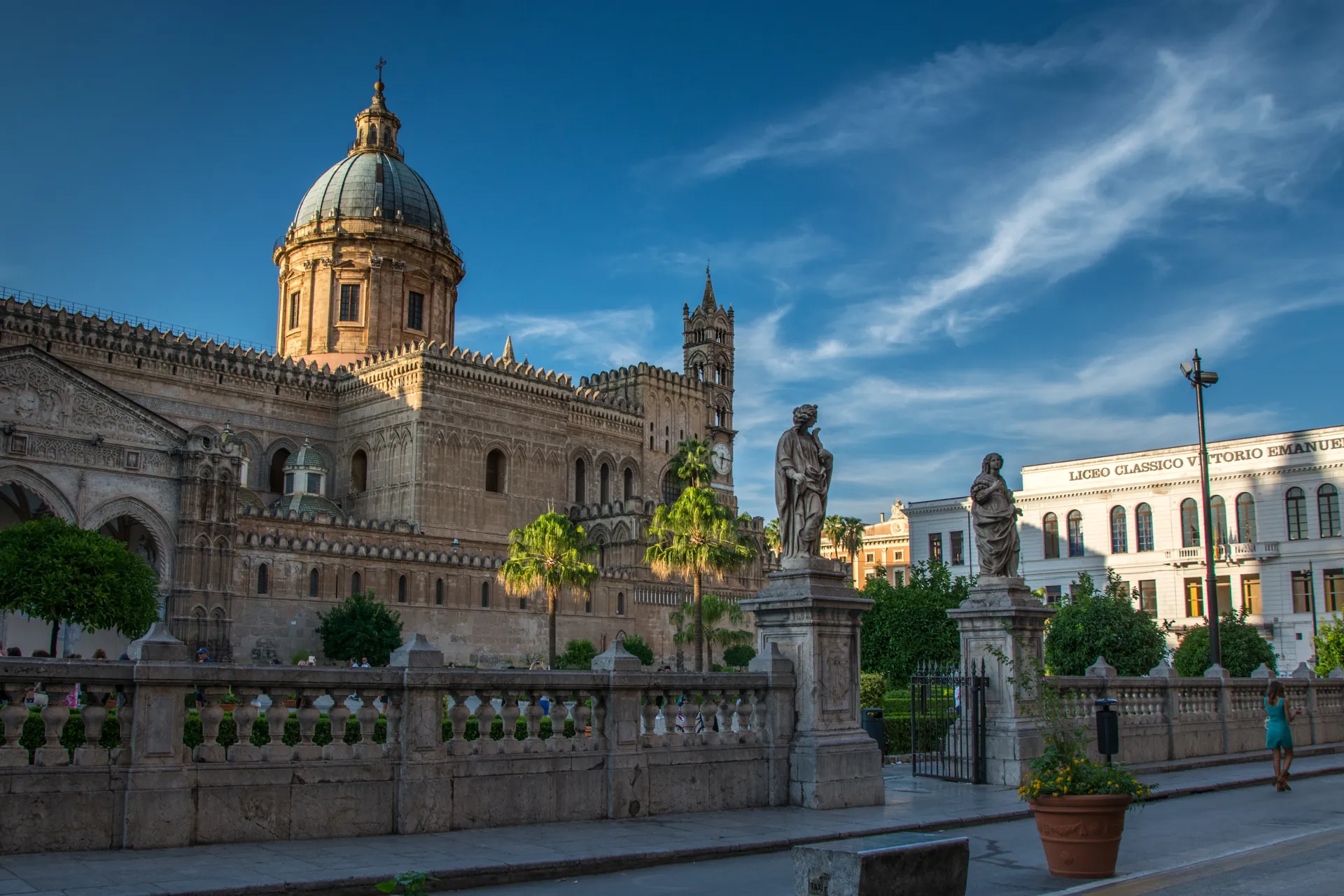
Palermo's old centre is split into four historic quarters whose corners meet at the Quattro Canti, the baroque crossroads of Via Maqueda and Corso Vittorio Emanuele, with the newer city spreading north beyond them. Each quarter feels different, and the market you live nearest says a lot about your days.
Albergheria: Ballarò on the doorstep
Living around Ballarò means the market as your pantry and the Palazzo dei Normanni, home of the Cappella Palatina, close by. It is one of the cheapest and most intense parts of the centre, crowded by day and the place where you will want to keep a close eye on your phone.
Kalsa: the old Arab quarter by the sea
The Kalsa, on the seaward side of the old town, takes its name from the Arabic al-Khalisa, and since its renewal in the 1990s it has filled with galleries, restored palaces and trattorias. It also has the city's best-known coworking space, neu [nòi], which has worked out of the ground floor of an eighteenth-century palazzo on Via Alloro since 2012. It balances atmosphere with something close to calm, a short walk from the sea.
Vucciria and Capo: markets by day and night
The Vucciria, once the city's most famous market, now keeps only a handful of stalls by day and turns into Palermo's street-food and nightlife hub after dark, with grills and music. Capo is the opposite: a compact food market best on a weekday morning. Live near the Vucciria for evenings, near the Capo for mornings.
Politeama and Libertà: the modern city
North of the old centre, around the Teatro Massimo, the largest opera house in Italy, and up the broad Via Libertà, Palermo becomes calmer, more polished and more expensive. If you want quiet streets and an easy life more than atmosphere, this is the part of town to look at.
Where do you work?
Not, mostly, in cafés. Palermo's traditional bars are built for a coffee taken standing at the counter, and our city page finds that many have no wifi at all. At home the picture is better: fibre through the main providers typically delivers 50 to 150 Mbps, enough for calls and uploads.
For a desk, neu [nòi] in the Kalsa charges about $161 a month for a fixed desk with round-the-clock access from the second month, and a flexible desk from about $17 a day, with an hour of meeting room included for calls. BeetCommunity runs coworking and coliving from two addresses, on Via Lincoln and Via Agrigento, which can solve your desk and your flat in one booking.
A working day here has a natural shape. Shop at Ballarò before nine, work through the morning at a coworking desk, eat a long lunch in a trattoria, and keep the afternoon for calls with Europe, which runs on the same clock. In the evening, walk to the Vucciria for grilled food in the street, or take the bus to Mondello for a swim when the days are long.
Paperwork in Italian?
Our Palermo directory lists lawyers who work in English and other languages, each with the source for that claim.
See lawyers in Palermo →Is Palermo safe?
For your person, generally yes; for your phone, less so. The UK government's advice for Italy notes higher levels of bag-snatching and pickpocketing in city centres and at tourist sites, and asks visitors to take care at main stations and in crowds. In Palermo that means the markets at their busiest, the area around the central station, and any crowded bus.
In practice, that is ordinary city sense: phone in a front pocket in Ballarò, laptop bag never hung on a chair, taxi or a lit main street late at night. The streets of the centre can look run-down to someone arriving from northern Europe, and some are. Neither makes Palermo a bad base; both are worth knowing before you choose a street.
When should you go?
The calendar is kind for most of the year. Average highs climb from about 15°C in January to 24°C in May and are back there in October, while the sea is warmest in August, at about 26°C. Rain arrives with autumn, and November is the wettest month.
Summer is the hard part. July and August average highs above 30°C, and when the scirocco blows in from Africa it can push far higher: the city's astronomical observatory recorded 47°C in 2023. Mid-July also brings the Festino, the feast of Santa Rosalia, the city's patron saint.
For a working stay, aim for April to June or mid-September to early November. Winter is quiet, mild and cheaper, a fair choice if you can live with some rain and cooler flats. Avoid July and August unless your flat has air conditioning and your work does not.
Getting in and getting around
Falcone Borsellino airport lies about 35 kilometres west of the city. Trains run roughly every 30 minutes from the airport station to Palermo Centrale, and the Prestia e Comandè coach runs to Via Roma in the centre. Once you are in, the historic centre is compact enough to walk, which is the best way to see it.
For longer trips, AMAT runs the buses and trams, and a monthly pass costs about $37 on our figures. Parts of the old centre, the Kalsa included, sit in a limited traffic zone, so a car is more trouble than help; a scooter is the usual answer for longer stays.
Can you stay longer than 90 days?
With an EU or EEA passport, yes. On an American, British, Canadian or Australian passport you get 90 days in any 180 across the Schengen area, which is enough for a spring or an autumn.
Italy has had a digital nomad visa since April 2024. Its income floor is a rule rather than a figure: at least three times the minimum income that exempts Italians from health charges, which the US consulates state as about $28,540 a year. You also need at least six months of experience in remote work, a degree or equivalent professional experience, health insurance and somewhere to live.
Our comparison of digital nomad visas sets Italy's floor against the other countries that offer one, and our guide to how digital nomads are taxed explains what a long stay can mean for your tax residence.
Palermo or Catania?
Sicily's other big city, Catania, costs about the same on our budgets, at around $1,420 a month, with Etna on the skyline instead of Monte Pellegrino. Palermo has the bigger historic centre, the Arab-Norman monuments that UNESCO listed in 2015, the opera house and the markets. Our ranking of the best Italian cities for remote workers sets both against the mainland.
If you do choose Palermo: come in spring or autumn, rent in the Kalsa or near Politeama, book a coworking desk in the first week, and learn enough Italian to order at a market stall. Then go to Ballarò on a Saturday morning, when it is at its liveliest.
See the whole picture for Palermo
The full cost table, neighbourhood notes, coworking spaces and all 13 of our category ratings, on one page.
Open the Palermo city guide →Frequently Asked Questions
How much does it cost to live in Palermo as a digital nomad?
About $1,490 a month for one person with a central one-bedroom. A central one-bedroom rents for about $760 and one outside the centre for about $510.
What is Ballarò?
Palermo's oldest street market, in the Albergheria quarter, with Arab origins more than a thousand years old. It sells fish, produce and street food every day but Sunday and is liveliest in the morning.
Is Palermo safe for digital nomads?
Generally, with care for your belongings. The main risks are pickpocketing and bag-snatching in crowded markets, around the central station and on busy buses.
Which neighbourhood in Palermo is best for remote workers?
The Kalsa, for atmosphere and the neu [nòi] coworking space, or Politeama and Via Libertà for calmer, more polished streets. The Albergheria around Ballarò is cheaper and more intense.
Does Italy have a digital nomad visa?
Yes, since April 2024. It needs an income of at least three times Italy's health-charge exemption floor, about $28,540 a year, six months of remote work experience, a qualification and health insurance.
When is the best time to work from Palermo?
April to June and mid-September to early November. July and August average highs above 30°C, and the scirocco can push temperatures far higher.


