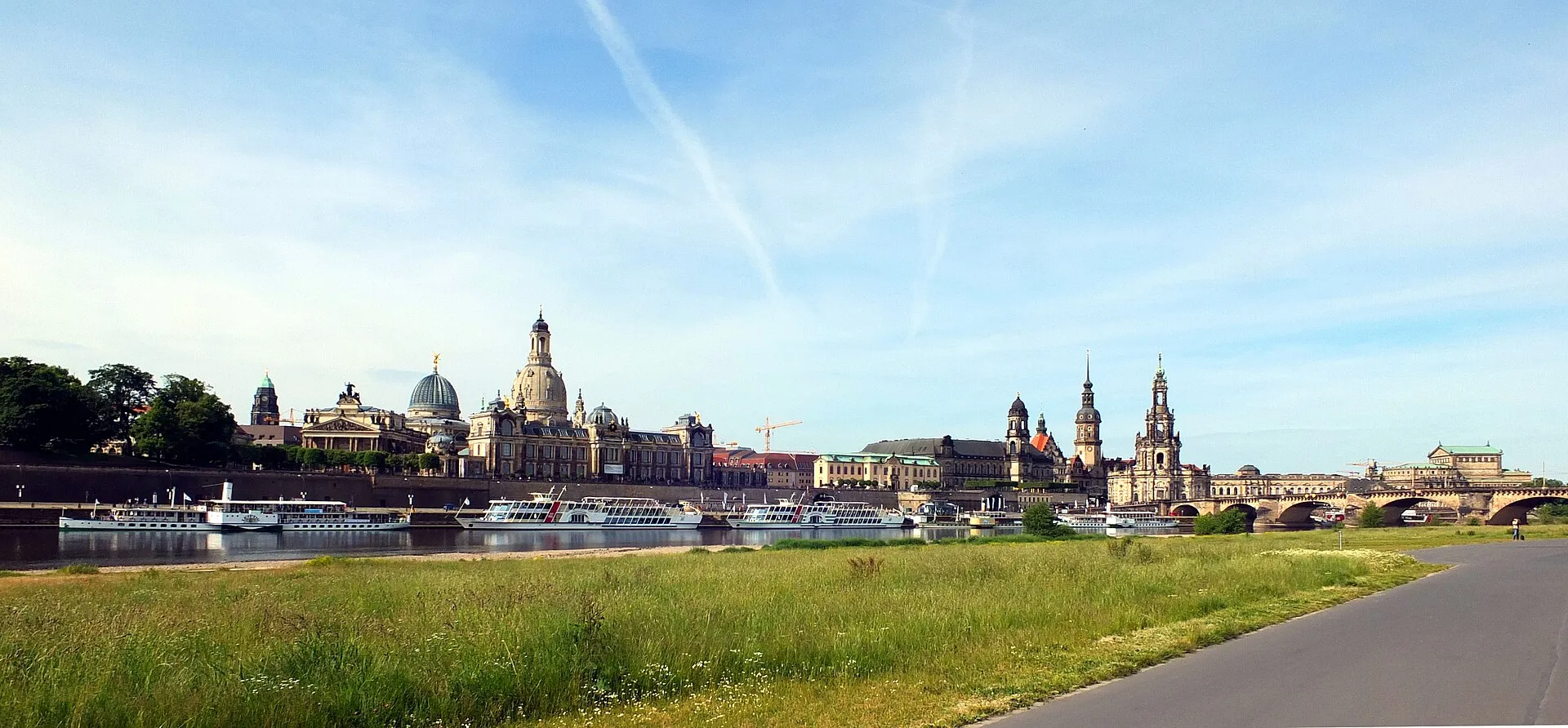

Look closely at the Frauenkirche and you can see its history in the stone. Most of the walls are pale, fresh sandstone, but scattered through them, and in places massed together, are darker blocks: the originals, blackened by fire and weather, set back in the positions they held before 15 February 1945. The church had survived the bombing two nights earlier, then burned out and collapsed. For almost five decades its ruins stood in the middle of the city as a memorial.
In 1993 the rubble was cleared, and every find was mapped, recovered and catalogued. When the church was consecrated again on 30 October 2005, 8,425 of the old stones had been reused, 7,110 of them in the façade. The gilded orb and cross on the dome were made in London by a goldsmith, Alan Smith, whose father had flown in the raids. Around the church, the baroque square of the Neumarkt was rebuilt in the years that followed.
Dresden is still a city under reconstruction. The Carola Bridge over the Elbe partly collapsed in September 2024 and is being planned anew, and the Blue Wonder bridge upstream is under renovation until 2031. For a remote worker that history has a practical side: a German city of opera, palaces and river meadows where a central one-bedroom rents for about half what it costs in Berlin.
The verdict: Dresden is one of the best-value places to live in Germany, and finding a place to live is the part that needs planning. Short furnished lets are priced above normal leases, and on a non-EU passport there is no visa for remote workers, only 90 days in Schengen or a freelance permit. Choose it for a summer, or for a year with a lease and the paperwork done properly. Skip it if you need a big nomad scene around you.
| Monthly budget, one person, central one-bedroom | about $1,760 |
|---|---|
| One-bedroom, city centre (user-reported) | $750 a month |
| One-bedroom, outside the centre (user-reported) | $510 a month |
| City rent index, average net cold rent | $8.44 per m² |
| Maximum deposit | three months' net cold rent |
| Register your address | within two weeks of moving in |
| Deutschlandticket / Dresden monthly pass | $73 / $107 |
| Freelance residence permit fee in Dresden | $115 to $127 |
Budget and user-reported rents: our city page, from Numbeo's August 2026 prices. Rent index: the city's Mietspiegel 2025. Euro amounts are converted at the exchange rate of $1.1511 per euro used across our site (1 August 2026).
Finding accommodation in Dresden
Start with how German rents are quoted. A listing's Kaltmiete, or net cold rent, is the flat alone; heating, water and building costs come on top as Nebenkosten, and together they make the Warmmiete you actually pay each month. Dresden's official rent index puts the average net cold rent at about $8.44 per square metre, which is about $420 for a 50-square-metre flat before bills.
That figure averages every lease agreed or changed in the last six years, which is why the user-reported asking rent for a central one-bedroom, about $750, is so much higher. Dresden counts as a tight market: the state has extended its rent brake for the city to 30 June 2027, so a re-let flat may cost no more than 10 percent above the local reference rent, with exceptions such as new buildings.
The rent brake does not reach the kind of flat most newcomers want first. Housing let only for temporary use, the furnished month-to-month market, sits outside it and outside most tenant protections, and it is priced accordingly. So the realistic plan for a stay of a few months is a furnished temporary let in a district you like, budgeted above the figures in the table. For six months or more, a normal lease is worth the effort.
If you sign one, the deposit may be at most three months' net cold rent, and you may pay it in three monthly instalments. Then you have two weeks after moving in to register your address with the city, with a written confirmation from your landlord. If you normally live abroad and are not registered anywhere in Germany, the duty to register starts after three months.
Which Dresden to live in
The Elbe divides the city into two moods. South of the river is the rebuilt Altstadt; north of it is the Neustadt, which, despite its name, is the part where the old streets survived. The choice shapes your evenings more than your rent.
Äußere Neustadt: the quarter that survived
The street plan here has barely changed since it was laid out in 1745, and the area came through the bombing comparatively lightly, so its late 19th-century blocks still stand. Today it is narrow lanes and winding back courtyards full of bars, restaurants and shops.
In the Kunsthofpassage, five linked courtyards between Görlitzer Straße and Alaunstraße, one blue façade is hung with drainpipes that play music when it rains. A short walk east, Pfunds Molkerei, a dairy founded in 1880, is tiled from floor to counter with hand-painted Villeroy & Boch tiles. For a first stay, this is the district.
Altstadt and the Neumarkt: the rebuilt centre
Across the river, the Frauenkirche, the Zwinger and the Semperoper stand among reconstructed baroque streets, and Brühl's Terrace, nicknamed the Balcony of Europe, runs high above the riverbank. Living here puts the city's showpieces at your door, along with most of its visitors. It suits a short stay better than a long one.
Striesen and Blasewitz: villas on a grid
East of the centre, Striesen was planned in 1860 on a checkerboard of streets, first named only with numbers and letters on the American model, and building rules kept it open and green. Its villa quarters came through 1945 comparatively lightly. Blasewitz, beyond it, is an old villa suburb whose landmark is the Blue Wonder bridge to Loschwitz. Both suit a longer, quieter stay, and Impact Hub runs a coworking space at Fetscherplatz, in a renovated old building in Striesen.
Loschwitz and Pieschen: the hill and the harbour
Across the Blue Wonder, Loschwitz climbs the slope on a funicular and on the Schwebebahn, the oldest suspension railway in the world, both still in use. Downriver, Pieschen grew from a fishing village into a workers' quarter after its harbour opened in 1859; its former armaments factory, the Zentralwerk, has been a cooperative culture factory since 2015, with live jazz every Monday. Our city page counts Pieschen among the cheaper districts.
Visa routes for remote workers
Germany has no digital nomad visa. On an American, British, Canadian or Australian passport you get 90 days in any 180 across the Schengen area, shared with every other Schengen country, which covers a summer in Dresden and no more. EU and EEA citizens need no permit, only the address registration.
For longer, the route is the freelance residence permit, and Dresden's immigration office spells out what it wants. The work must be genuinely self-employed, its financing must be secured, and any licence the profession needs must be granted.
You bring a description of the activity, a financial plan, a forecast of revenue and earnings, ideally several letters from prospective clients stating fees, proof of health insurance and your rental contract. Applicants over 45 also show adequate provision for old age. There is no fixed sum in the bank; the plan has to show the work will pay for your life.
The timeline is where people get caught out. The office says it sends an invitation about two weeks after your email, that the appointment itself will probably be about three months later, and that final processing currently takes six to eight weeks.
Citizens of the US, UK, Canada, Australia, New Zealand, Japan, South Korea and Israel may enter without a visa and apply inside Germany within 90 days, which on that timeline means applying in the first days of your stay. The permit costs $115 to $127, runs for up to three years, and covers only the activity you applied for. Our directory has no Dresden lawyers yet; the nearest are our English-speaking lawyers in Berlin, under two hours away by train.
Two more consequences of a long stay. With a home here, or more than six months in Germany, you become tax resident, and our digital nomad tax guide explains what that means for income from abroad. And the permit needs health cover; our guide to English-speaking doctors in Germany explains how insurance and appointments work.
Need a year, not 90 days?
Germany has no nomad visa, but many countries do. Our visa finder compares 41 remote-work visas by the income each one requires.
Compare digital nomad visas →A working day by the Elbe
Check the internet before you sign anything. Germany's median home broadband download is about 102 Mbps, with uploads near 38, well under half of Portugal's, and most German lines still run on DSL. A flat's speed depends on the line and the tariff, so ask for both, and keep a German SIM as a backup.
A coworking desk solves the problem for the price of a few dinners. Quartier22, on Bautzner Straße in the Neustadt, sells round-the-clock access for about $204 a month including VAT; Konnektiv62, a blue house in a back courtyard on Alaunstraße, charges about $23 a day with snacks and drinks; Impact Hub has sites by the main station and in Striesen, with a free trial day.
For lunch, the Neustädter Markthalle, restored in 1999, fills four floors with bakeries, regional produce and a wine and cheese cellar. After work, walk down to the Elbe meadows, the wide green banks that floods have kept free of building, or climb the Frauenkirche dome, 174 steps for about $14, for a view that reaches the sandstone mountains to the east. In summer, the Filmnächte am Elbufer, Germany's largest open-air cinema festival, sets up on the Neustadt bank facing the Altstadt.
Seasons and weekends
Summer is the season to come. From June to August average highs sit around 25°C, and on 21 June the sun sets at about half past nine. December is the opposite: highs near 6°C and sunset around four. The city answers with the Striezelmarkt on the Altmarkt, a Christmas market first held in 1434, open through Advent until Christmas Eve and named after the local word for Stollen.
Weekends are where Dresden's position pays off. The S1 suburban train runs every 30 minutes up the Elbe to Bad Schandau, on the edge of the Saxon Switzerland National Park, and paddle steamers from the oldest and largest such fleet in the world ply the same river. Leipzig is under an hour away by train, Berlin under two, and Prague about two and a quarter, close enough for a Saturday in another country.
What a month costs
Our budget for one person in a central one-bedroom is about $1,760 a month: about $750 for the flat and $1,000 for everything else, from Numbeo's user-reported prices. A cheaper area brings it nearer $1,510.
For transport, the nationwide Deutschlandticket, about $73 a month, covers local and regional trains, trams and buses across Germany and costs less than Dresden's own monthly pass at about $107.
Against the rest of Germany, that is good value: our budgets are about $2,520 for Berlin and $3,000 for Munich, while Leipzig, an hour away, comes in at a similar $1,730. Against Central Europe it is not cheap. Budapest, at about $1,550, costs less, Kraków about the same, and Prague a little more. Our cost of living index ranks them all by the same one-person budget.
Who Dresden suits
Choose Dresden if you want Germany without Berlin's or Munich's rents, if your evenings run to opera, galleries and river walks, and if you either hold an EU passport or are ready for a freelance permit with a three-month wait. It rewards a longer stay, because its value lies in normal leases, and a normal lease is only worth signing for six months or more.
Look elsewhere if you want to land in a ready-made nomad community, if you need fast upload speeds in any flat you rent, or if you hope to bounce between countries for a year on a non-EU passport. For the wider European picture, our guide to Europe's best cities for nomads puts Dresden in context.
See the whole picture for Dresden
The full cost table, neighbourhood notes, coworking spaces and our 13 category ratings, on one page, before you look for a flat.
Open the Dresden city guide →Frequently Asked Questions
How much does digital nomad accommodation in Dresden cost?
A central one-bedroom averages about $750 a month in user-reported prices, about $510 outside the centre. Furnished short lets cost more, because temporary lets fall outside the rent brake. The city's rent index averages about $8.44 per square metre, before bills.
Can I rent a flat in Dresden for one to three months?
Yes, as a furnished let for temporary use, priced above normal leases. For six months or more a normal lease is better value, with a deposit of at most three months' net cold rent and address registration within two weeks.
Does Germany have a digital nomad visa?
No. Most Western passports get 90 days in any 180 in Schengen. For longer stays, the freelance residence permit needs secured financing, a financial plan and client letters, but no fixed sum in the bank.
How long does the freelance permit take in Dresden?
The immigration office says the appointment comes about three months after your email, and final processing takes six to eight weeks. US, UK, Canadian and Australian citizens may apply inside Germany within 90 days of entry.
Which Dresden neighbourhood is best for digital nomads?
The Äußere Neustadt for a first stay, for its courtyards, cafés and coworking. Striesen and Blasewitz suit a quieter, longer stay, and Pieschen is among the cheaper districts.
Is the internet in Dresden good enough for remote work?
Usually, but check the line. Germany's median home download is about 102 Mbps and most lines are still DSL, so ask about the connection before you sign, or use a coworking space.
When is the best time to work from Dresden?
June to August, with highs around 25°C and light until about half past nine. December brings highs near 6°C, sunset around four and the Striezelmarkt, first held in 1434.


