The doctors' national association prints a poster for German waiting rooms. It asks "Was tun, wenn die Praxis geschlossen hat?", what to do when the practice is closed, and answers with six digits: 116117. The same number is on the business-card-sized service cards practices order from it, printed under the line "Praxis hat zu? Wir sind da!": practice shut? We are here.
The number is worth a closer look, because it explains how German healthcare is built. It does not belong to a ministry or a hospital. It belongs to the doctors' own associations: the Kassenärztliche Vereinigungen of the doctors who treat statutory patients in each region, and their national body, the KBV. The law makes the regional associations answerable for outpatient care in their region, nights and weekends included.
Outside hospitals, German medicine is delivered by doctors in their own practices, and 116117 is the switchboard those doctors run together to cover the hours when each practice is shut. The EU reserved the number across Europe for non-emergency medical on-call care in 2009, and Germany turned it into the front door of the whole outpatient system.
Behind those six digits sit three services an English speaker needs: a doctor search that filters practices by language, an appointment service with a legal cap on waiting, and an on-call doctor for the nights when your practice is dark. Each comes with a catch. The phone line runs in German only. The booking service is for statutory patients. And whether a visit costs you nothing or arrives as an invoice depends on one decision you make long before you are ill: which insurance system you join.
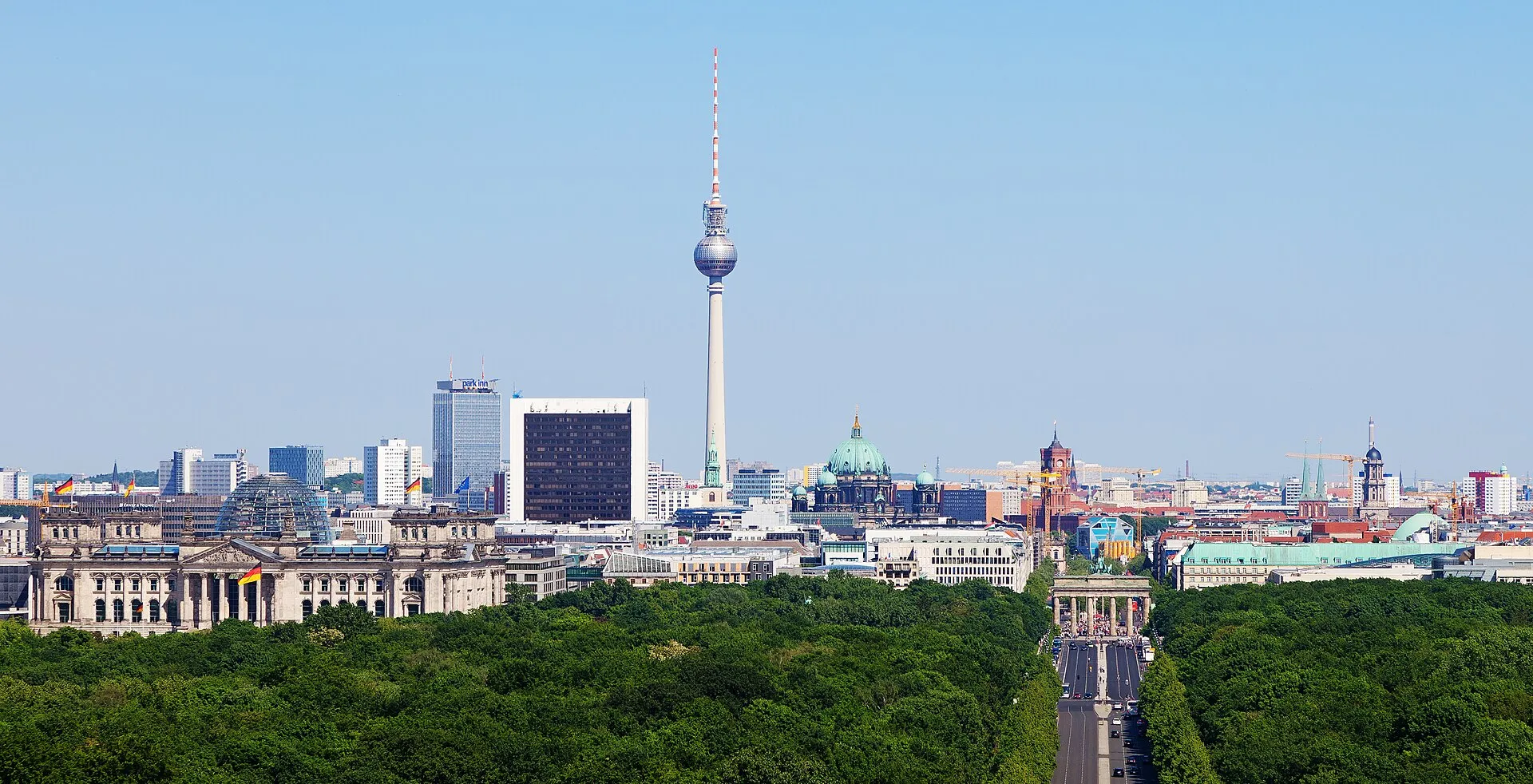
Picture where this plays out. In Berlin your GP may well be up the stairs of a nineteenth-century Altbau, a front house on the street with side wings and rear houses around courtyards, each yard once required to be at least 5.34 metres square so a horse-drawn fire engine could turn in it.
By the street door hangs a plate, and professional rules decide what it says: the doctor's name, their specialty and their consulting hours. On the corner, a red Gothic A marks the pharmacy. That is the Germany you will navigate.
The honest verdict: English-speaking care in Germany is easy to find and fairly priced, but the system will not come to you in English. Find one English-speaking family doctor through the official search, sort your insurance before you need it, and you will rarely be lost. Leave both until you have a fever on a Sunday, and every step is in German.
| 116117: on-call doctor, appointments, doctor search | free, 24/7, phone in German |
|---|---|
| 112: ambulance and fire service | life-threatening emergencies |
| GP visit, private patient (consultation + examination, 2.3 multiplier) | $24.45 |
| The same visit at the 3.5 maximum | $37.22 |
| Statutory patient at the practice | $0, show the card |
| Longest wait for a specialist booked through 116117 | 4 weeks |
| Prescription co-payment, statutory, per item | $5.70 to $11.40 |
| Night or Sunday pharmacy fee | $2.85 |
| Minimum statutory health and care cover, childless freelancer | about $317 a month |
| Largest deductible a private policy may carry | $5,702 a year |
| English-speaking doctors in our directory | Hamburg 3,580, Berlin 8, Munich 5 |
Fees: the federal GOÄ schedule and Social Code Book V. Contributions: the Federal Ministry of Health, at the 2.9% average add-on rate. Prices are in US dollars at the European Central Bank exchange rate of $1.1403 per euro on 25 September 2026.
Where the number finds you an English-speaking doctor
The most useful thing 116117 does for a newcomer is not on the phone at all. The official doctor search lists practices admitted to statutory care, and it has a field for foreign languages. Each practice card carries a "Fremdsprachen" line with the languages that practice reports. The regional associations collect those details from the practices themselves, so a listed language is the practice's own word, not a tested certificate.
You do not have to fight the German interface. The 116117 page in English links ready-made searches already filtered for English, across 14 specialisations from general practice and gynaecology to psychotherapy and radiology. Type a town or postcode into the field marked "Ort oder PLZ eingeben", press "Suchen", and you have a list. The page's own advice is to phone for an appointment, because walking in without one means a longer wait.
Filter by specialty first and language second, then ring and open the call with "Sprechen Sie Englisch?". Thirty seconds settles what the listing only claims.
Hamburg, where the language list is public
One region publishes the language data in a form anyone can read and check. The Kassenärztliche Vereinigung Hamburg lists the foreign languages each registered practice reports, and that is why our directory of doctors in Hamburg holds 3,580 who work in English. Every card links back to the association's own entry, so you can see the claim at its source before you ring.
Hamburg is also where the on-call service has a local name, Arztruf Hamburg: the same 116117 gets you telephone advice from a doctor, a home visit, or a place at one of the association's emergency practices, including one on Stresemannstraße in Altona and one at the UKE university hospital in Eppendorf.
Outside Hamburg our coverage is thin, and we say so. We list 8 English-speaking doctors in Berlin and 5 doctors in Munich, taken from the lists that embassies such as the British, French and Japanese keep for their own citizens: a useful shortlist, not a census. In Berlin and Munich, start there and then run the 116117 search, which covers every statutory practice in both cities.
Card or invoice: which system are you in?
Everything at the practice follows from your insurance, and in Germany insurance is not optional. Everyone who lives here must hold cover for outpatient and hospital care: members of the statutory system, the GKV, meet the duty automatically, everyone else needs a private policy, the PKV, with a deductible of at most $5,702 a year.
The difference shows the moment you walk in. A statutory patient hands over a plastic insurance card and pays nothing; the practice bills the association. A private patient gets an invoice, pays it, and claims the money back from the insurer. Only the first can use the appointment service.
Which rail you are on depends mostly on how you earn. Employees earning below the 2026 threshold of $88,259 a year are insured in the statutory system through their employer. Most freelancers are not compulsorily insured: they choose between joining the GKV voluntarily and buying private cover.
That choice has a gate. To join voluntarily you need 24 months of statutory insurance in the last five years, or 12 months without a break just before it ended. A freelancer arriving from the US or Australia with no German insurance history does not meet it, which in practice leaves private cover. Those who qualify pay a share of income with a floor: for a childless freelancer without sick pay, health and long-term care come to at least about $317 a month, however small the income.
What the invoice says
If you are private, or uninsured and paying cash, the invoice follows the federal fee schedule for doctors, the GOÄ. It gives every service a number of points, turns points into money at about 6.65 US cents each, and lets the doctor multiply the result by anything from 1 to 3.5 depending on difficulty and time. Above 2.3, the invoice must explain the higher factor in writing.
So 2.3 is the factor you will see on most bills: it is the highest a doctor can charge without giving a reason. A routine visit, billed as a consultation plus a symptom-focused examination, comes to $24.45 at that factor. A sick note for an employer or client adds about $6. Blood tests, ultrasound and other procedures are billed as separate items, so a first visit with lab work runs well past the consultation figure.
The fees are modest, so paying cash for a GP while your insurance is being sorted out is no disaster. Keep every invoice: its item numbers and factors are what your insurer checks before paying you back. A reformed schedule has been drafted, but the one on the federal law portal still applies.
Want a name before you start searching?
Our directory groups every English-speaking doctor we list in Germany by city, and links each one to the official list it came from.
Browse English-speaking doctors in Germany →Your Hausarzt, and the slip that opens the specialists
Germany expects you to have a family doctor, the Hausarzt: the statutory rules say the insured person chooses one. You may pick any doctor admitted to statutory care, but should not switch within a calendar quarter without good reason, and passing over the nearest suitable practice without a compelling one can leave you paying the extra cost.
For an English speaker, that family doctor is worth more than the rules suggest. A GP who speaks English becomes your interpreter into the rest of the system: they write the referrals, read the specialists' letters back to you, and issue the sick notes. Effort spent finding one pays back every time you need anyone else.
The referral is a paper slip, the Überweisung, and it matters most when you need a specialist quickly. Here 116117 reappears with its second job. The appointment service must find a statutory patient a specialist slot within four weeks, two for acute psychotherapy, at a reasonable distance. To use it you need a referral carrying a Vermittlungscode, a booking code your doctor adds when the matter is urgent. Eye doctors, gynaecologists, paediatricians, family doctors and a first psychotherapy consultation need no referral for this route.
Book online at 116117-termine.de or in the 116117 app rather than by phone: a web form can be translated in the browser, a call cannot. Know what you trade for the speed, though. The law guarantees the wait and the distance, not a particular doctor, and certainly not one who speaks English. When language matters more than days, use the search and ring the practice yourself.
Nights, weekends and the other number
This is the job the waiting-room poster was printed for. Evenings, nights, weekends and public holidays, 116117 is the on-call medical service, the ärztlicher Bereitschaftsdienst, for problems you would take to a GP that cannot wait until morning. It points you to the nearest on-call practice, or sends a doctor to your home when needed. The call is free, and private patients are treated too, billed under the fee schedule.
The other number is 112, for the ambulance and fire service. The line between them is simple: if a life is at risk or there is a danger of lasting injury, call 112. The on-call line is busy enough without misdirected calls: more than six million telephone assessments between 2022 and 2024.
Say you wake up on a Saturday in Friedrichshain with a fever and an aching ear. You could call 116117, but the voice that answers will speak German. The better first move is the on-call practice finder on 116117.de: enter your postcode, see which practice is open, and go.
On a freelance visa, insurance comes first
Germany has no dedicated digital nomad visa. Most remote workers who stay long come on the residence permit for freelancers, issued for up to three years, which our comparison of digital nomad visas lists as the Freiberufler route. Health insurance is where applications most often come undone.
The Berlin immigration office's page for the freelance permit sets the standard: you must be insured in Germany, statutory or in a comparable private policy, and foreign insurance is generally not enough. Private applicants bring their insurer's certificate on the scope and cost of cover, which you can ask for by name as the Bescheinigung nach § 257 Abs. 2a SGB V. Only insurers meeting the conditions of that section can issue it, which rules out most travel policies.
Applicants over 45 face a second check: since July 2025 Berlin expects a projected pension of $1,839 a month for at least 12 years, or assets of $264,782 by age 67. The permit itself costs $64. Get the policy in place before the appointment. Our Dresden guide walks through the same freelance route in a cheaper German city.
On an EU passport: the EHIC, until you move
Insured in another EU or EEA country or in Switzerland? Your European Health Insurance Card covers care that cannot wait until you get home, at the statutory practices the 116117 search lists and on the same terms as people insured in Germany: you show the card instead of paying.
It stops at three edges. Private practices will bill you under the fee schedule, treatment you travel for is excluded, and the card is built for temporary stays: once you move to Berlin or Hamburg, the German duty to insure applies to you like everyone else.
The red A on the corner
The sign you will see more often than any practice plate is the pharmacy's: a large red Gothic A on white with a chalice and a serpent, a protected trademark that only pharmacies and pharmacists' bodies may use. Like the practices, pharmacies are small and independent by law: a pharmacist may run one pharmacy and at most three branches, so every A has a pharmacist-owner behind it, never a chain. Germany had 16,601 of them at the end of 2025, the fewest in almost fifty years.
Prescription medicines come only from the Apotheke, and the prescription is now electronic. The e-Rezept has been mandatory in the statutory system since January 2024, and you redeem it with your insurance card at the counter, in the official E-Rezept app, or with the printout the practice hands you. Statutory patients over 18 pay 10% of each item's price, at least $5.70 and at most $11.40; a private patient pays under the terms of their policy.
At night and on Sundays, pharmacies take turns on duty, and every pharmacy that is closed must post a readable notice of the nearest ones that are open, where anyone standing outside can see it. The pharmacists' portal aponet.de finds them by postcode too. A duty pharmacy may add a fee of $2.85 between 8 pm and 6 am on weekdays and all day on Sundays and holidays.
Checking a doctor, and why nobody will rank them
Only the state medical chambers and the regional associations hold valid records of a doctor's qualifications, and a 116117 listing already tells you the doctor is admitted to statutory care and in which specialty. What nobody official will give you is a recommendation: the Berlin medical chamber says it represents every doctor in the city and cannot single any out, and it warns that rating portals rarely measure clinical skill and are not safe from manipulation. Our directory follows the same line, recording where each language claim comes from, never a verdict on quality.
A plan for your first month in Berlin
Put the pieces together and the order almost writes itself. Before you arrive, choose your insurance, because it decides your visa, your bills and whether the appointment service will book for you. In your first week, pick the neighbourhood, then run the 116117 English search with its postcode: the nearest suitable practice is also the one the rules favour.
Ring two or three practices from the results and make the one that answers in English your own, while you are still well, so the first visit is a hello rather than an emergency. Save three things in your phone: the on-call practice finder on 116117.de, aponet.de for the night pharmacy, and 112. Then, the next time you sit in a waiting room and see the poster with the six digits, you will know exactly what sits behind it.
Settling in Berlin?
Rents by neighbourhood, coworking prices and the freelance permit on one page, alongside the English-speaking doctors that embassies list for the city.
Open the Berlin city guide →Frequently Asked Questions
How do I find an English-speaking doctor in Germany?
Use the official 116117 doctor search. Its English page links searches already filtered for practices that report English, across 14 specialisations. Enter a town or postcode, pick a practice near you and phone to confirm. In Hamburg, our directory lists 3,580 English-speaking doctors from the regional association's own data.
Is the 116117 service in Germany available in English?
The phone line is not: it runs in German only. The website is usable in English, with an English information page, an English-filtered doctor search and an online finder for on-call practices that works by postcode.
How much does a doctor visit cost in Germany for a private patient?
Under the GOÄ fee schedule, a consultation plus a symptom-focused examination costs $24.45 at the usual 2.3 factor and $37.22 at the 3.5 maximum. Tests and procedures are billed separately. Statutory patients pay nothing at the practice; they show their insurance card.
Do I need a referral to see a specialist in Germany?
To have 116117 book a specialist for you, yes: you need a referral with a booking code, the Vermittlungscode. Eye doctors, gynaecologists, paediatricians, family doctors and a first psychotherapy consultation need no referral for that route, and you can always ring a practice yourself.
Which number do I call for a doctor at night in Germany?
Call 116117 for the on-call medical service when practices are closed and the problem cannot wait but is not life-threatening. It sends you to an on-call practice or arranges a home visit. Call 112 if a life is at risk or there is a danger of lasting injury.
What health insurance do I need for the German freelance visa?
Insurance in Germany: statutory cover, or a comparable private policy proved by the insurer's certificate under Section 257(2a) of Social Code Book V. Berlin's immigration office states that foreign insurance is generally not enough, so a travel policy usually will not pass.
Can EU citizens use the EHIC at a doctor in Germany?
Yes, for care that cannot wait until you return home, at statutory practices and on the same terms as locally insured patients. It does not cover private practices or planned treatment, and once you live in Germany you need German cover.


