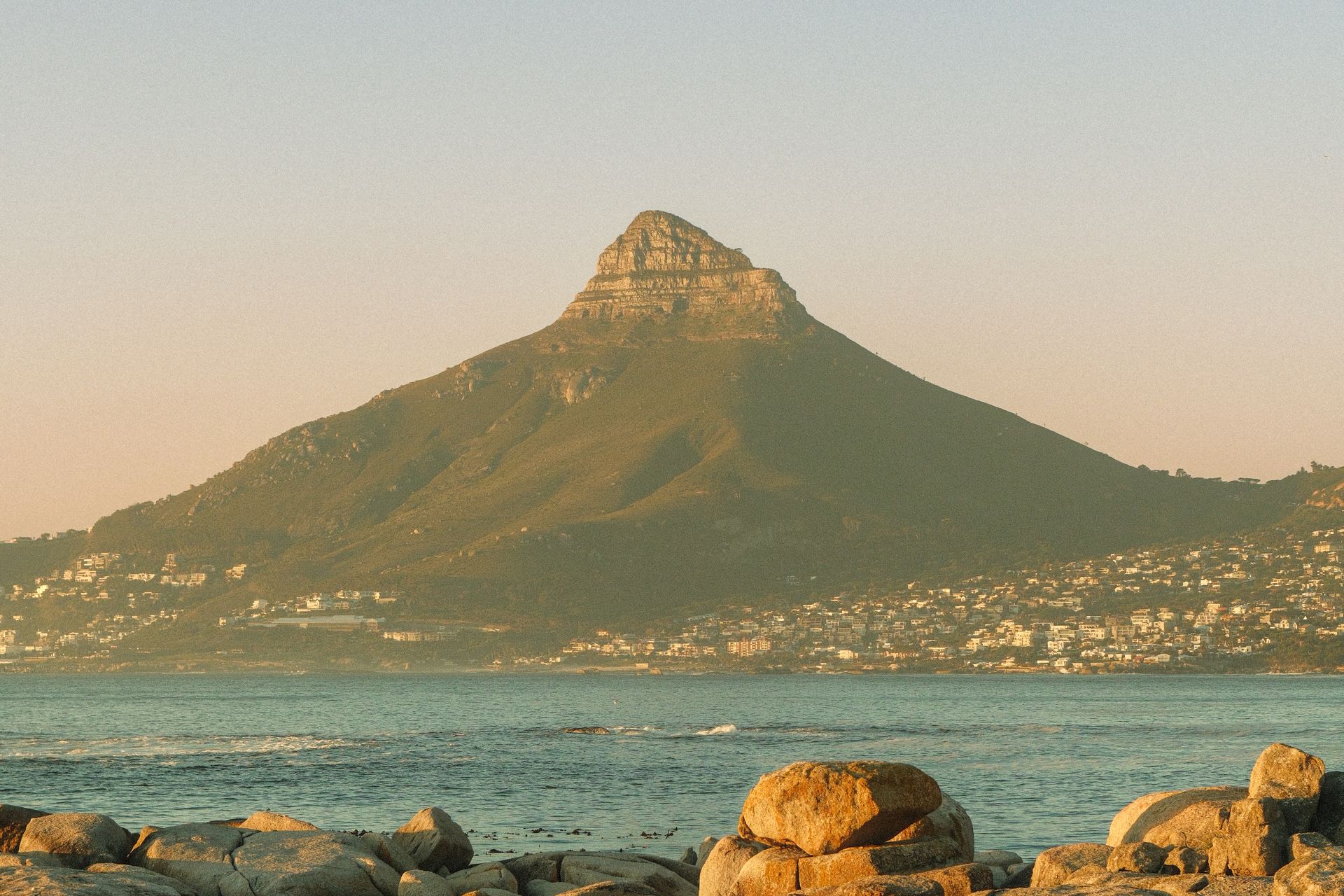

On a summer afternoon in Cape Town, a white cloud can settle on the flat top of Table Mountain and hang over its edge like a cloth over a table. Capetonians call it the tablecloth, and it means the south-easter is blowing. The wind picks up moisture over False Bay and pushes it up the back of the mountain into colder air, where it condenses along the summit, then spills over the city side and evaporates as it falls into warmer air. Legend blames a smoking contest between the Devil and a pirate called Van Hunks.
The wind has a nickname that says a lot about how the city lives with it: the Cape Doctor, from the old belief that it blows Cape Town clean of pollution and disease. It runs from spring into late summer, most persistent in November and December. An ordinary south-easter blows at 30 to 50 km/h, gusts go far higher, and a strong one stops the cable car to the summit.
In Cape Town the wind and the mountain decide more than the weather. They decide which beach is sheltered and which one is too blustery to sit on, when the cableway runs, and which months are dry and which bring the winter rain. For someone working here, three other forces matter as much: a power grid that has now gone well over a year without load-shedding, a remote work visa with a flat income floor, and crime that shapes where and how you move.
So here is the verdict. Cape Town suits you if you earn from abroad, want mountain and ocean in the same afternoon and can plan around wind in summer and rain in winter, at about $1,630 a month on our one-person budget. It is the wrong choice if you want to walk everywhere after dark, or if you need a long-stay visa for a freelance business with many clients.
| Visa-free stay (UK, US, Canada, most of the EU) | up to 90 days |
|---|---|
| Remote work visa, income floor | about $3,280 a month |
| Remote work visa, length | up to 3 years |
| Last load-shedding | 15 May 2025 |
| Home broadband median, South Africa | 50.4 Mbps down, 40.5 up |
| One-bedroom, city centre | $1,040 a month |
| One-bedroom, outside the centre | $690 a month |
| Monthly budget, one person, central flat | about $1,630 |
| Meal in an inexpensive restaurant | about $12 |
| South-easter season | September to March |
| Time zone | UTC+2, all year |
Visa: Department of Home Affairs and UK travel advice. Power: Eskom. The broadband figures are Ookla Speedtest Global Index medians for August 2026. Rents, the meal price and the monthly budget come from the Numbeo figures on our Cape Town page. Prices are in US dollars at an exchange rate of 16.54 rand to the dollar on 1 August 2026.
Two winds, two seasons: when to come
Cape Town's year turns on which way the wind blows. From about September to March the south-easter brings dry, bright weather, and December to February average highs of 23 to 26°C. It is the season for beaches, hikes and evenings outdoors, and the season when you learn to check the wind before you plan the afternoon.
The sea follows the wind too. On the Atlantic side, the south-easter drives cold water up from the deep, so the Atlantic Seaboard averages 10 to 15°C through the year, while False Bay, on the other side of the peninsula, averages 16 to 22°C and can be up to ten degrees warmer on the same summer day. If you want to swim rather than just look, that difference decides where you spend Saturdays.
In winter the other wind takes over. From June to September, cold fronts roll in from the Atlantic on north-westerly winds, which can blow harder than the Doctor but bring rain, sometimes for days. June is the wettest month, with about 148 mm, and highs sit around 17 to 18°C. The mountain turns green and the crowds thin out.
For a working stay, the months between are the sweet spot: March and April, or October and November. The weather has settled, the wind is gentler than in midsummer, and accommodation costs less than in the December peak. Come in deep winter only if cheaper rent and quiet streets matter more to you than beach days.
Where the wind lets you live
Table Mountain splits the city into sides that feel like different towns, and each takes the wind its own way. Rent follows the centre: on our figures a one-bedroom costs about $1,040 a month in the centre and about $690 further out.
City Bowl and Gardens: under the mountain
The City Bowl is the natural bowl that opens onto Table Bay, ringed by Signal Hill, Lion's Head, Table Mountain and Devil's Peak. When the south-easter blows, it gets trapped inside and swirls around the centre. Gardens is its leafy residential side, near the Company's Garden, with Kloof Street's restaurants running uphill. Just across the centre, the Bo-Kaap climbs the slopes of Signal Hill in brightly coloured houses and cobbled streets, the historic heart of Cape Malay culture.
Living here gives you walkable streets, in daylight at least, and a sound that sets the clock: the Noon Gun, fired from Signal Hill at twelve sharp every day except Sundays and public holidays, a tradition since 1806.
Sea Point and Green Point: the Atlantic promenade
Sea Point lies between Signal Hill and the ocean, a few kilometres west of the centre, with a seafront promenade along the rocks and the Mouille Point lighthouse further towards town. It is walkable, and one of the easier places in the city to live without a car. It is also exposed: in a strong south-easter the wind accelerates as it funnels down off the mountain onto the Atlantic Seaboard, which can make Sea Point and Camps Bay hard work on a windy afternoon.
The shelter is nearby. Clifton's four beaches sit in the wind shadow of Lion's Head, one of the few stretches of Cape Town coast protected from the south-easter, with white sand and chilly water of 12 to 16°C.
Woodstock and Observatory: the cheaper east
East of the centre, Woodstock's former industrial buildings hold galleries, craft breweries, design studios and the Old Biscuit Mill market, and Observatory is the bohemian student quarter around Lower Main Road. Both sit at the cheaper end of our range. Both also need more care after dark than the Atlantic side, so pick your street in daylight, and pick it with someone who knows it.
Muizenberg: the warm side
Muizenberg, at the bottom of the Southern Suburbs where the peninsula curves east, is the city's main surf spot, centred on Surfer's Corner, and False Bay's warmer water makes it the side of the city where getting in the sea is a pleasure rather than a dare. The beachfront is being rebuilt, with a new walkway set back from the sand and the historic beach huts replaced in their old design and colours, due for completion before the end of 2026. It is a long way from the centre, so it suits a stay built around the sea rather than the city.
Ninety days, or three years
Most Western visitors start with a stamp. British passport holders can visit for up to 90 days without a visa, and the same 90-day exemption covers American, Canadian and most EU passports. The new Electronic Travel Authorisation is, for now, optional for these visa-exempt travellers. What is not optional, since 1 July 2026, is the SARS online traveller declaration, which everyone must submit within 24 hours before the flight in and again before leaving.
For longer, South Africa has a remote work visa. It is a visitor's visa for stays of more than three months and up to three years, for someone working for a foreign employer. You need a gross salary of about $3,280 a month, or $39,350 a year, shown in three months of bank statements, plus a return ticket, and you may not take a job in South Africa.
Two details decide whether it fits you. The floor is a flat rand figure set in the October 2024 regulations, cut from the figure first proposed, so its dollar value moves with the currency rather than with any wage. And the checklist asks for an employment contract signed by you and your foreign-based employer. A salaried remote employee has one; a freelancer with a dozen clients does not, and should read the checklist before paying for an application. Our comparison of digital nomad visas sets South Africa's floor against the other countries that offer one.
The visa also carries its own tax rule. If you are tax resident in a country that has a tax treaty with South Africa, you must register with SARS once you spend more than 183 days in any 12 months; from a country without one, you register regardless. Our guide to how digital nomads are taxed explains what that means for the return you file at home.
Visa or tax question in Cape Town?
Our Cape Town directory lists lawyers by the language they work in, each with the source for that claim.
Browse lawyers in Cape Town →Is load-shedding still a thing?
Not in 2026. The last rotational load-shedding ran on 15 May 2025, from four to ten in the evening, and at midnight on 15 May 2026 Eskom completed its first full year without it since September 2018. Its winter outlook for April to August 2026 projected none, and winter passed without a single stage.
So the schedule apps that ruled Cape Town life a few years ago are no longer how you plan a working week. What remains is ordinary risk: a storm, a local fault, a building's own wiring. Many cafés and every coworking space bought inverters and generators during the load-shedding years, and they are still there. For the call you cannot drop, keep a data bundle on your phone and ask whether the flat has backup power before you sign.
Moving around, and staying safe
Cape Town sprawls, and it is a car city. Most people get around by Uber and Bolt, especially in the evening, and rent a car for the winelands and the coast. The MyCiTi bus is the reliable public option for the airport and daytime trips along the Atlantic Seaboard. Metrorail trains are best avoided.
Crime is the other thing that shapes a day here, and the specifics are more useful than a general warning. The UK government reports violent attacks and muggings on hikers in Table Mountain National Park, including on Lion's Head and Signal Hill, and advises busy marked trails, popular days such as weekends, and groups of four or more. It also records attacks on the roads to and from the airport and advises sticking to the N2 and M3 and the signposted airport approach road.
In practice, that means hiking in company rather than alone at dawn, taking a ride-hail rather than walking at night, keeping the phone out of sight on the street, and changing money only in banks or shopping malls. None of it stops you living well here. It does mean Cape Town is not a city for wandering unfamiliar streets after dark.
A summer weekday in Cape Town
Start with the line. South Africa's median home connection runs at about 50 Mbps down and 40 up, with 7 ms of latency, which carries calls and uploads comfortably. The clock is kind to anyone working with Europe: Cape Town sits on UTC+2 all year, so your day overlaps almost all of a London or Berlin working day, and New York's morning is your afternoon.
If you want a desk, Workshop17 has spaces at the V&A Waterfront's Watershed, on Kloof Street in Gardens, at the Newlands cricket ground and in Century City, with a Muizenberg branch due to open at the end of 2026. Our city page lists other coworking spaces and their price range.
At noon the gun booms from Signal Hill. By five, you have a choice the wind makes for you. On a calm day you could climb Lion's Head with a group, or ride the cable car up for the view over Table Bay and Robben Island. On a south-easter day, head for Clifton, out of the wind, or over to the False Bay side. On summer Sunday evenings, Kirstenbosch, the botanical garden at the eastern foot of Table Mountain, holds its sunset concerts.
If you need a doctor, our list of doctors in Cape Town by the language they speak is the place to start. And when the weekend comes, the winelands are close, and our Stellenbosch city guide covers one of their towns.
What to do next
Pick your season first, because it decides everything else: summer for beaches and wind, the shoulder months for work, winter for rain and low prices. Then pick your side of the mountain. For a first stay, Gardens or Sea Point puts you closest to the life of the city, with Clifton's shelter a short ride away.
If you are staying longer than 90 days on a foreign payroll, gather three months of bank statements and an employment contract and apply for the remote work visa before you fly. File the SARS declaration the day before each flight. And if you want a cheaper, simpler base for a longer stay, our guide to a year in Tbilisi makes the opposite trade: no mountain above the ocean, but a year without a visa application and a smaller monthly bill.
See the whole picture for Cape Town
The full cost table, the neighbourhood notes, coworking spaces and all 13 of our category ratings, on one page.
Open the Cape Town city guide →Frequently Asked Questions
Is there still load-shedding in Cape Town in 2026?
No. The last load-shedding was on 15 May 2025, and Eskom reached a full year without it in May 2026, then went through the 2026 winter without a single stage. Local outages from storms or faults still happen.
Does South Africa have a digital nomad visa?
Yes, the remote work visa: a visitor's visa for more than three months and up to three years, for people working for a foreign employer and earning at least about $3,280 a month. It needs an employment contract signed by that employer.
How long can I stay in Cape Town without a visa?
Up to 90 days on a British, American or Canadian passport, and on most EU ones. Since 1 July 2026 every traveller must also submit an online SARS traveller declaration within 24 hours before each flight in and out.
What is the Cape Doctor?
The strong south-easterly wind that blows from about September to March, named for the belief that it clears the city of pollution. It forms the tablecloth cloud on Table Mountain and can stop the cable car.
How much does it cost to live in Cape Town as a digital nomad?
About $1,630 a month for one person in a central one-bedroom. A central one-bedroom rents for about $1,040, and one outside the centre for about $690.
Which Cape Town neighbourhood is best for digital nomads?
Gardens and the City Bowl for walkable streets under the mountain, Sea Point for the promenade, Woodstock and Observatory for lower rents, and Muizenberg for surf and warmer water.
Is Cape Town safe for remote workers?
It needs care. The UK government reports attacks on hikers on Lion's Head and Signal Hill and on roads to the airport. Hike in groups on busy trails, use ride-hailing at night and keep valuables out of sight.


