
The B2 is the road from the heat of the Namibian interior to a town wrapped in Atlantic fog, and the whole change takes one afternoon's drive. Leave Windhoek after breakfast on a November morning: the capital sits more than 1,600 metres up, and its afternoon will reach about 31°C. You drive north to Okahandja, turn west onto the B2, and pass through Karibib and its hills speckled with trees to Usakos, a town first built as a railway station on the line to the coast. From there the trees shrink until only tough shrubs dot the ground, and twenty kilometres on, the granite Spitzkoppe, the "Matterhorn of Namibia", rises to the north.
Then the land flattens into gravel plains. You pass Arandis, the town built for the Rössing uranium mine, the eroded ridges of the Moon Landscape show on your left, and ahead a long bank of cloud lies over the sea. Around Usakos the average November afternoon is close to 35°C; in Swakopmund, about four hours and 360 kilometres from Windhoek, it is 21°C, and you may find yourself winding the window up against the chill. Four kilometres short of the centre, a steam traction engine stands in its own shelter by the road: the "Martin Luther", brought in 1896 to replace the ox wagons dying on the route inland. It broke down within a few stages, and a local wit named it after Luther's "Here I stand, I can do no other".
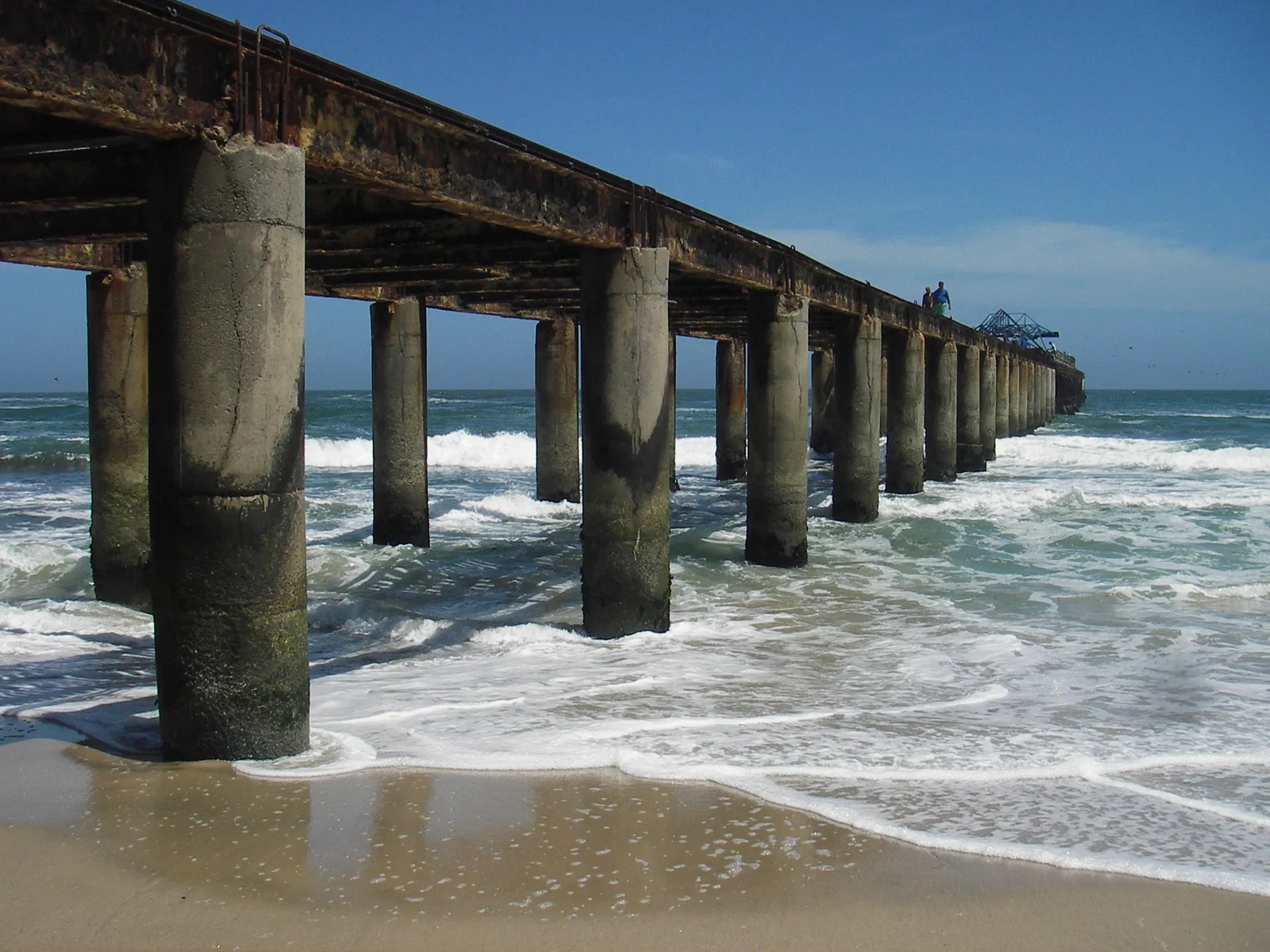
Behind the fog, the half-timbered Woermannhaus lifts its tower above the roofs, a statue of Atlas kneels on the Hohenzollernhaus holding up the globe, the old railway station is a hotel, and on the seafront a lighthouse stands above the Mole while a pier points into a cold, grey Atlantic. The town was founded in 1892 as the harbour of German South West Africa and is now a quiet, English-speaking seaside resort where the desert begins at the last street.
Can you work from it? Yes, if you want calm more than company. The connection is good on mobile data and patchier on home lines, Namibia has a six-month visa built for remote workers, and on our estimate a month costs about $900. What you give up is a scene: the nearest real nomad communities are in Cape Town and Johannesburg. Whether it works comes down to the line, the visa and the money.
| Nomad visa, income needed | $2,000 a month (+$1,000 spouse, +$500 per child) |
|---|---|
| Nomad visa, fee and length | about $202, six months, not renewable |
| Tourist visa, non-African passports | about $98 |
| Home broadband, national median | 17.66 Mbps down |
| Mobile data, last national median | 46.52 Mbps down |
| Prepaid fibre, 30 days at 30 Mbps | about $52 |
| Furnished one-bedroom | $400 to $600 a month |
| Groceries for one | $200 to $280 a month |
| Monthly budget, one person | about $900 |
| Average daily high | 18.5°C (Sep) to 24.4°C (May) |
| Time zone | UTC+2 all year |
Visa: NIPDB and the Ministry of Home Affairs. Speeds: Ookla (fixed, August 2026; mobile, November 2025). Fibre: Paratus. Rent, groceries and budget: our own estimate, as no published cost survey covers the town. Highs: Open-Meteo, 2021 to 2025. Prices in US dollars at the exchange rate of NAD 16.30 to the dollar on 25 September 2026.
Will the connection hold?
The internet reaches Namibia on the beach at the end of that drive. The West Africa Cable System has come ashore at Swakopmund since 2012, and the Equiano cable landed here in July 2022. The bottleneck is the last few hundred metres to your flat.
Across Namibia, the median home broadband line manages 17.66 Mbps down and 13.44 up, while the last national mobile median was 46.52 Mbps down. Our own city data puts a typical Swakopmund connection near 50 Mbps, which matches the mobile figure, not the fixed one. So build the day around a SIM, and treat fibre as a bonus you check before you sign.
MTC switched on commercial 5G in August 2025 in four places, Swakopmund and Walvis Bay among them, and Telecom Namibia runs the TN Mobile network. Every SIM must be registered against a valid identity document and unregistered cards are switched off, so take your passport and your address to the shop.
For a home line, Paratus sells contract fibre from about $34 a month for 25 Mbps to about $92 for 120 Mbps, but on 12 to 36-month terms. The product that fits a stay of months is prepaid fibre, about $52 for 30 days at 30 Mbps, bought in store with an installation fee, or SKY-Fi, a fixed wireless service at 10 or 20 Mbps where no fibre reaches the building. Ask the landlord which one the flat has.
The flat will also lose power now and then. Namibia imports about half of its electricity, in June 2026 mostly from Zambia and South Africa, and makes much of the rest at the Ruacana hydro station. Ordinary outages happen, so a small UPS for the router and a phone hotspot carry you through a short cut. Sockets are types D and M at 220V.
Can you stay long enough to settle in?
Yes, for six months. Namibia's Digital Nomad Visa lets you live there while working for companies or clients based outside the country. You need $2,000 a month of income, plus $1,000 for a spouse and $500 for each child, so a couple with one child shows $3,500. The fee, about $202, is paid after approval and before you fly.
The paperwork weighs more: medical and radiological reports on the ministry's forms, insurance, payslips or a contract, a six-month bank statement, a letter from your employer and a police clearance from your home country, translated into English. Once you have paid, the ministry issues what NIPDB calls a loose entry visa, the document you show at the border. No processing time is published, so leave a margin before any flight you cannot move.
The visa cannot be renewed: after six months you leave, and you may reapply twelve months after it expired. It covers foreign clients only; work for a Namibian employer needs a separate employment permit.
The shorter route changed in 2025. Since 1 April that year, citizens of countries that had not returned Namibia's visa exemption need a visa, among them the United States, the United Kingdom, Canada, Australia and most of the EU. A tourist visa costs about $98 for non-African passports and about $74 for African ones. Apply online, where processing is stated at 48 hours, and print the approval, because an electronic copy is refused at the counter. Visas on arrival are also issued at Walvis Bay airport and harbour and at Hosea Kutako near Windhoek.
A tourist visa stretches to at most 90 days in a calendar year and is meant for tourism and short visits, not a working winter on the coast. Our digital nomad visa finder sets Namibia's scheme beside the others.
Where to live, and what a month costs
Money is simple. The Namibia dollar is held at one-to-one parity with the South African rand, and rand notes are accepted in town. No published cost survey covers Swakopmund, so the $900 a month in the table, within a range of $800 to $1,100, is our own estimate rather than a measurement.
What breaks the budget is distance, not rent. The town is small and flat enough to walk, but the dunes, Sandwich Harbour and Sossusvlei need a vehicle or a paid tour, and a fortnight of car hire and fuel can cost more than a month of rent. Hire one for the weeks you explore, not the whole stay.
The centre, between the Mole and the jetty
The compact colonial core holds the Woermannhaus, now a public library, the bakeries and coffee houses and most of the guesthouses. Everything is walkable. It is the priciest part of town, towards the top of the $400 to $600 range for a furnished one-bedroom, and the busiest from December to March.
Vineta, the quiet coast to the north
Along the shore north of the centre, Vineta is a settled district of family homes, mixed and mostly well-off, with the beach close by and a short ride into town. It suits a long stay built around a home office.
Kramersdorf, more space inland
Set back from the sea, Kramersdorf is an orderly grid of family houses with more room for the money than the seafront. It is a bicycle or car ride to the cafés and the beach.
Mondesa and Tamariskia, where most of the town lives
East of the centre, across the railway, Mondesa grew in the 1960s as the district for Black residents, and Tamariskia was built in the early 1970s for coloured families moved out from between the centre and Vineta. Much of Swakopmund's Namibian population lives here, with local eateries, markets and the lowest rents, though few cafés of the kind you would work from.
Coast or capital?
Windhoek is warmer and larger; Swakopmund has the sea and the cool air. Set the two side by side on budget, internet and all 13 of our categories.
Compare Swakopmund and Windhoek →A working day in the fog belt
The cold Benguela current offshore runs the day. It chills the air above it into fog that rolls in on many mornings, so a workday can start grey and cool and turn bright once the fog burns off, usually by midday, sometimes not at all. A room with good light matters more here than a sea view.
We could not confirm a single coworking space, so the desks are your flat, a guesthouse corner or the centre's bakeries and coffee houses, a German habit the town has kept. Swakopmund keeps UTC+2 all year, the clock of Johannesburg and Cape Town, one hour ahead of Central Europe in the northern winter and level with it in summer. New York is six to seven hours behind.
At five o'clock the town turns to the water. You could walk out along the jetty, first built of wood in 1905 because the Mole's harbour had filled with sand. Its iron successor, begun just before the First World War, was meant to reach 640 metres into the sea, but the war stopped it well short. Since 2010 an oyster bar and restaurant has stood at the far end, and the pier is where the town watches the sun go down.
The Mole, the breakwater that failed as a harbour, now shelters a small beach where people swim, briefly, because the current keeps the sea cold all year. And the beer has a local past: Hansa Pilsener was first brewed here in 1928, in a brewery that closed in 2005.
The town behind the facades
The Germans built here because the coast's only natural deep-water harbour, Walvis Bay, belonged to the British. Swakopmund had fresh water and a way inland, but no shelter for ships. When South Africa took the colony in 1915, trade moved to Walvis Bay and the town shrank into a holiday resort for the territory's white population.
The facades have a darker side. During the war against the Herero and Nama, now recognised as genocide, the colonial authorities ran a concentration camp here, where Herero prisoners were forced into labour and many died. Germany formally acknowledged the genocide in 2021, and the Swakopmund Genocide Museum, founded in 2015 by the activist Laidlaw Peringanda, documents it on the edge of town. After independence, the main street, Kaiser-Wilhelm-Straße, became Sam Nujoma Avenue. Knowing it is how you read the architecture, and who lives in the centre and who in Mondesa.
When to come
The seasons run backwards. Over 2021 to 2025, average daily highs ranged from 18.5°C in September to 24.4°C in May, with night lows from 9.5°C in August to 16.8°C in February. The warmest weeks come from April to June, not at Christmas, and rain barely exists: January, the wettest month, averages around 12 mm.
The drive from Windhoek explains the calendar. When the interior bakes, from December to March, Namibians escape to the coast, the town is at its fullest and seafront flats book up early. April to October is quieter, with more grey mornings. For a working stay, aim for April to June: the warmest weather, the holiday crowds gone.
Walvis Bay and its flamingos
The road south is the one you will drive most. For 34 kilometres, about half an hour, it runs between the dunes and the Atlantic to Walvis Bay, the port with Namibia's only natural deep-water harbour. South Africa kept it as an enclave until 1 March 1994, four years after Namibian independence.
Its lagoon is reason enough to go. In this Ramsar wetland tens of thousands of flamingos, greater and lesser, feed in the shallows with their bills upside down, and in September and October hundreds of thousands of terns and shorebirds arrive on migration. Dune 7 stands at the town's edge.
Dunes, a moonscape and a harbour in the sand
The desert starts where the streets stop. South of the Swakop river, around Langstrand, the dune belt of Dorob National Park, proclaimed in 2010 over the central Namib, is where the quad bikes, sandboards and camel rides go out. Inland, beyond the green line of the Swakop valley, rise the ridges of the Moon Landscape you saw from the B2.
Sandwich Harbour is the day trip people come for: a lagoon about 80 kilometres south of Walvis Bay, inside the Namib-Naukluft Park, where the dunes run straight down to the sea. The way in is a 4x4 route along the beach that depends on the tide, so without real sand-driving experience, book a guided trip.
North of town, the Cape Cross Seal Reserve, about an hour and a half by road, protects the world's largest breeding colony of Cape fur seals, up to 210,000 animals in November and December. Sossusvlei, in the Namib Sand Sea World Heritage Site, is roughly 400 kilometres away: two nights, not a Saturday.
Roads, safety and a doctor
The larger risk is the road, not the street. Namibia carries a Canadian advisory to exercise a high degree of caution because of crime, and both Canada and the UK warn of theft from cars at service stations, so leave nothing visible on a seat. Most roads beyond the towns are gravel, the UK suggests staying under 80 km/h on it, and both governments advise against driving outside towns at night, when wildlife and livestock stand on unlit roads.
Swakopmund has the public Swakopmund State Hospital and a private hospital, Mediclinic Swakopmund on Franziska van Neel Street, with a 24-hour emergency unit. Malaria is a risk in nine northern and eastern regions and rare elsewhere; Erongo, where Swakopmund lies, is not among the nine.
Flying in instead of driving
Walvis Bay International, about 47 kilometres and 35 minutes from central Swakopmund, has scheduled flights to Johannesburg and Cape Town, which makes the Cape an easy pairing; our Cape Town remote work guide covers that side of the trip. Long-haul flights land at Hosea Kutako, east of Windhoek, about 404 kilometres and four and a half hours from the coast by road. From there, leave early enough to meet the fog bank in daylight.
Is Swakopmund worth the drive?
Come if you want a few calm, English-speaking months in cool air, can show the $2,000 a month the nomad visa asks for, and would rather spend Saturday at Sandwich Harbour than in a bar.
Skip it if you need a coworking community, gigabit uploads or a direct flight home. The visa stops at six months and the nearest nomad scenes are a flight away. As a quiet chapter on the way to or from Cape Town, though, few places make the arrival so memorable: the heat of the interior behind you, the temperature falling, and a German tower rising out of the fog.
See the whole picture for Swakopmund
Every category score, the monthly weather chart and the cost estimate behind this guide, on one page, before you book.
Open the Swakopmund city guide →Frequently Asked Questions
Does Namibia have a digital nomad visa?
Yes. It lets you live in Namibia for six months while working for employers or clients abroad. You need $2,000 a month in income, plus $1,000 for a spouse and $500 per child, and the fee is about $202. It cannot be renewed; you may reapply twelve months after it expires.
How fast is the internet in Swakopmund?
Good on mobile, slower at home. Namibia's median home broadband line is 17.66 Mbps, the last national mobile median was 46.52 Mbps. Prepaid fibre costs about $52 for 30 days at 30 Mbps.
How much does it cost to live in Swakopmund as a digital nomad?
About $900 a month for one person on our estimate, within $800 to $1,100, with a furnished one-bedroom at $400 to $600. Car hire is what pushes it up.
Do US and UK citizens need a visa for Namibia?
Yes, since 1 April 2025. A tourist visa costs about $98 for non-African passports. Apply online and bring the approval printed, or get it on arrival at Walvis Bay airport or Hosea Kutako near Windhoek.
How long is the drive from Windhoek to Swakopmund?
About four hours for roughly 360 kilometres, north to Okahandja and then west on the B2 through Karibib and Usakos. Drive it in daylight.
What is the weather like in Swakopmund?
Cool and dry, with highs from 18.5°C in September to 24.4°C in May and morning fog that often lifts by midday. April to June is warmest and calmer than the December to March holidays.
Can I work for Namibian clients on the nomad visa?
No. The visa covers remote work for companies or clients outside Namibia. Work for a Namibian employer needs a separate employment permit.


