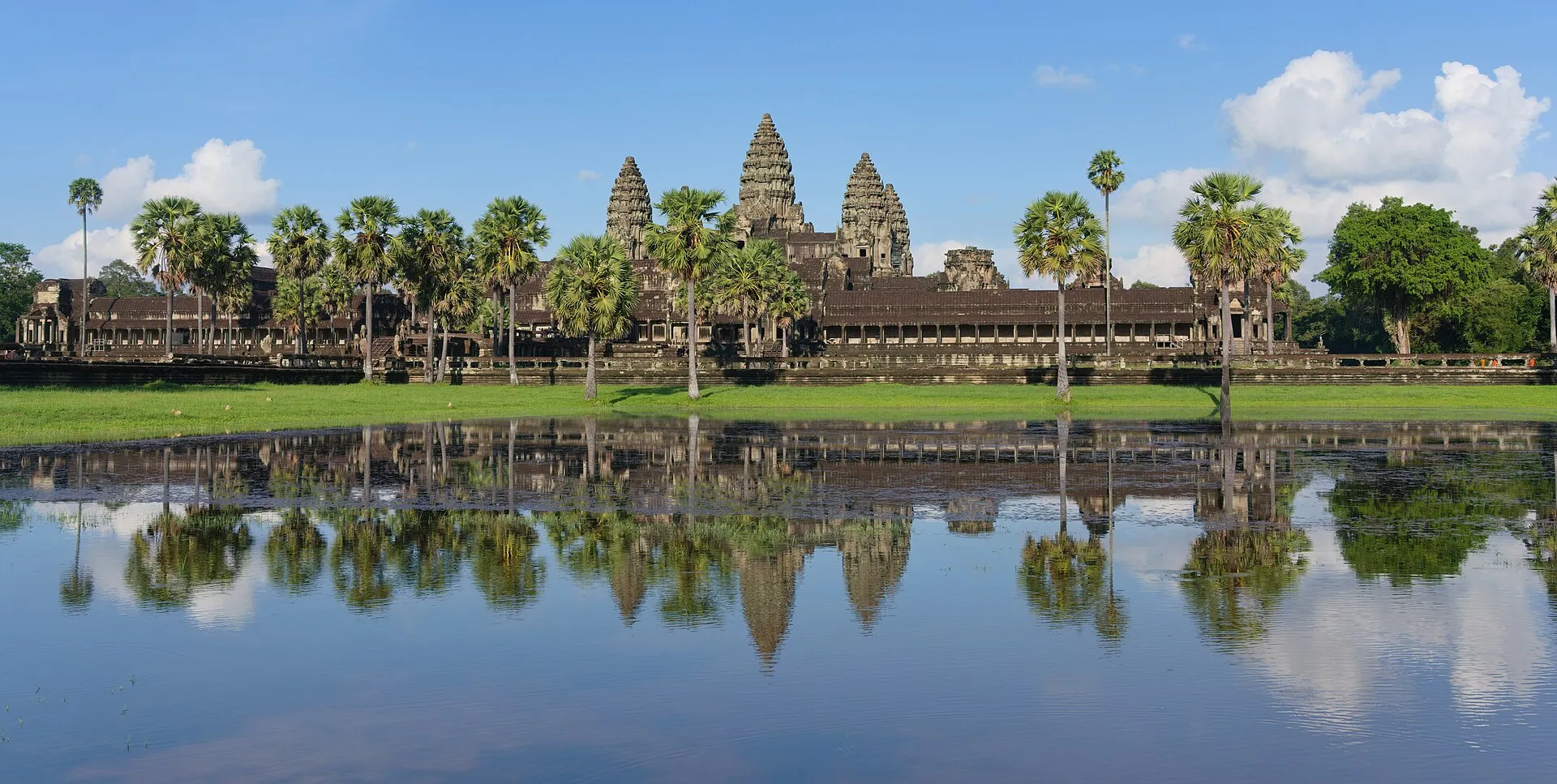

The gates of the Angkor park open at five in the morning, while it is still dark. Angkor Wat, unlike most Khmer temples, faces west, so the place to be at dawn is on its western side: on the sandstone causeway that crosses a moat 190 metres wide, or beside one of the ponds in front of the temple. As the sky lightens behind it, the five towers come up as a black outline against the east, and the pond holds a second, upside-down temple. In March and September, around the equinoxes, the sun rises directly over the central tower.
The temple is about six kilometres from town. By eight you could be back in Siem Reap over a bowl of kuyteav, rice noodles in a clear pork broth that is breakfast across Cambodia, with a laptop open beside it and a full working day ahead. That is the trade this town offers: one of the world's great archaeological sites before work, on a budget that hardly exists anywhere else.
Everything here leans on those temples. Angkor's capitals spread across some 400 square kilometres, a UNESCO World Heritage Site since 1992, and the town lives off them: hotels, tuk-tuks, guides, the bars of Pub Street. By 2010 more than half of its jobs were tied to tourism. In 2019 the park received 2.2 million foreign visitors. In 2025 it received 955,131, a fall driven mainly by the border tensions with Thailand, which closed every land crossing.
So Siem Reap suits a remote worker who wants a very low cost of living, a small and walkable town and one of the world's great archaeological sites on the doorstep, for a month or three. It does not suit anyone whose job cannot survive a shaky connection, anyone sensitive to haze in the first months of the year, or anyone who needs a big city. Our one-person budget, with a central one-bedroom, comes to about $660 a month; a comfortable month with coworking and meals out runs $700 to $1,200.
| Monthly budget, one person, central one-bedroom | about $660 |
|---|---|
| One-bedroom, city centre | $320 a month |
| One-bedroom, outside the centre | $230 a month |
| Meal in an inexpensive restaurant | about $3 |
| Angkor pass: 1 day / 3 days / 7 days | $37 / $62 / $72 |
| Tourist visa, 30 days | $30 |
| Home broadband, national median | 55 Mbps down |
| Mobile data, national median | 112 Mbps down |
| Airport to town | about 45 km |
Rents, meal and budget: Numbeo data via our city page, August 2026. Angkor pass: Angkor Enterprise. Broadband and mobile: Ookla Speedtest Global Index, August 2026, for Cambodia as a whole. Prices are in US dollars, which circulate alongside the riel at an exchange rate of about 4,000 riel to the dollar.
Can the connection carry a working day?
Usually, if you plan for a backup. Cambodia's median home line runs at about 55 Mbps in both directions, and the median mobile connection at about 112 Mbps. That second number is the useful one: here the phone network is twice as fast as a typical fixed line, so a local SIM is a real second connection, not a last resort.
A tourist SIM with about 30 GB costs around $5. Buy one in your first hour, and before you sign for a flat, ask whether the building has backup power for the router. A space with backup power is worth paying for on the days a call really matters.
The choice of desks is small, and old lists will mislead you. AngkorHUB, long the name every guide gave, closed its physical space in 2020. Footprint Cafes, a social enterprise that gives its profits to local projects, has a walk-in coworking floor above its café on Street 26, on the east side of the river, open from 7:30 to 6:30. BioLAB, on Wat Bo Road, is a café that opens at seven and stays open until ten at night. Our city page puts a coworking month at $70 to $120.
How long can you stay?
Getting in is easy. Most passports can buy a 30-day tourist visa for $30, online in advance or on arrival, paid in US dollars with a passport photo. Within the seven days before you land by air, fill in the free e-Arrival card online. The tourist visa can be extended once while you are here, for 30 more days.
For longer, the route people use is the ordinary or E visa, $35 on arrival. Through an agent it can be extended for one, three, six or twelve months as a business extension, without leaving the country. The catch is the work permit: six- and twelve-month business extensions require one if you work in Cambodia, and no official guidance says how remote work for foreign clients is treated. Over-55s have a separate retirement extension.
In practice, a month or two on the tourist visa is simple, and a longer stay works for many people on business extensions, but with a grey area you should go into with open eyes. Cambodia has no digital nomad visa; our digital nomad visa finder lists the countries that do.
Where to live
Siem Reap is low-rise and spread out along its river, a channel first dug in Angkorian times that has grown meanders since. Rents are low everywhere: about $320 a month for a central one-bedroom and $230 further out, so choose by noise and by how far you want to ride each day.
Old Market and Pub Street: the tourist heart
The Old Market, Psar Chas, is so central that businesses give their address in relation to it. Its stalls sell dried fish, sausages, prahok, the fermented fish paste, baguettes and grilled frogs next to silk and carvings. A block away, Pub Street, officially Street 8, closes to traffic at night and turns into one long bar. Both are convenient for a week and wearing for a month.
The French Quarter: shophouses on the river
Along the river and around the market, French colonial and Chinese-style shophouses survive, with the town's upscale hotels and riverside restaurants. It is the prettiest part of town and the most expensive.
Wat Bo and Sala Kamreuk: where long stays settle
East of the river, Wat Bo is the residential quarter: quiet streets, local temples, and cafés like BioLAB. Sala Kamreuk is where many expats and long-staying visitors live, with quiet lanes and good restaurants. For anything longer than a fortnight, start your search here.
Living next to Angkor
The temples are the reason to choose Siem Reap over a cheaper or better-connected base, and a resident can use them differently from a tourist. The seven-day Angkor pass costs $72 and can be used on any seven days within a month, so a month in town buys a week of temple mornings, spread out between deadlines. Buy it at the ticket office on Road 60, about four kilometres from the centre, or in the official app.
Spread those mornings across the park. North of Angkor Wat, the south gate of Angkor Thom is lined by gods and demons hauling a giant serpent, and at its centre the Bayon has about 200 stone faces. Ta Prohm was built without mortar, and after it was abandoned the trees took root in its loosened stones. For a quieter sunrise, the landing stage at Srah Srang, a royal bath 700 metres long, looks east across the water. Cover your shoulders and knees: the rule is checked at the temple galleries.
The rest of the region fills the weekends. On Tonle Sap, the largest freshwater lake in Southeast Asia, the village of Kampong Phluk stands on stilts six to nine metres high, built for a lake that rises with the monsoon. In the evenings, Phare, the Cambodian Circus, performs at eight, with tickets from $18 to $38.
Need a doctor in Cambodia?
Our directory lists doctors in Siem Reap, Phnom Penh and three other cities by the languages they speak, each with its source.
Browse doctors in Cambodia →When to go, and the months of haze
The dry season runs from November to April. December and January are the most comfortable, with highs around 31°C and nights that drop to about 20°C, and they are also the busiest months for the temples. The heat then builds to April, the hottest month, with average highs near 36°C.
The rains run from May to October, peaking in September with close to 290 millimetres, mostly as heavy afternoon storms. That is when the town is emptiest and cheapest. October and November, as the rain tapers off and before the crowds return, are the sweet spot for a long stay.
One caveat sits on the best weather. From January to April a haze builds over the region: model estimates put fine particulate levels in March at three to four times their rainy-season level. If your lungs are sensitive, check live readings before you commit to those months.
Getting in, staying well
The old airport on the edge of town has been replaced. The new Siem Reap Angkor International Airport opened in October 2023 about 45 kilometres to the east, roughly an hour by road. The shuttle bus into town costs about $8, a Grab car about $25 to $35, and an official taxi $25 to $40.
The other route has closed. The overland journey from Bangkok through Poipet used to be the cheap way in, but all land crossings between Cambodia and Thailand remain suspended after the 2025 fighting and the ceasefire signed on 27 December, and the UK advises against all but essential travel within 20 kilometres of the border. Fly in, for example from Bangkok, where our Bangkok budget guide covers a stopover.
For care, the Royal Angkor International Hospital on National Road 6 offers emergency treatment and arranges air evacuation; the well-known Angkor Hospital for Children treats Cambodian children only. On the street, the common crime is bag snatching by thieves on motorbikes. The UK government also reports lone women being assaulted by men posing as motorbike-taxi drivers around Pub Street, so take a tuk-tuk or a Grab at night. Around the outer temples, stay on the main paths: landmines remain in rural Cambodia.
Siem Reap, Phnom Penh or Battambang?
Phnom Penh is the capital: bigger, with more coworking, better hospitals and more flights. Battambang, a few hours west, is quieter and more local still. Siem Reap is the one with Angkor, and that is the whole case for it. If the temples matter to you, nothing else in the region comes close; if they do not, the capital is the more practical base, and our ranking of the cheapest cities for remote work has other options.
If you come: fly into the new airport, fill in the e-Arrival card a few days before, and buy a local SIM on day one. Rent in Wat Bo or Sala Kamreuk, choose your month by the haze and the rain, and buy the seven-day pass. Then set an alarm for half past four, and be on the causeway when the gates open.
The full Siem Reap profile
Costs, neighbourhoods, coworking notes and all 13 of our category ratings, on one page.
Open the Siem Reap city guide →Frequently Asked Questions
How much does it cost to live in Siem Reap as a digital nomad?
About $660 a month on our one-person budget with a central one-bedroom, and $700 to $1,200 for a comfortable month with coworking and meals out. A central one-bedroom averages $320.
How far is the new Siem Reap airport from town?
About 45 km east, roughly an hour by road. It opened in October 2023. The shuttle costs about $8, a Grab car about $25 to $35.
Does Cambodia have a digital nomad visa?
No. Most visitors get a 30-day tourist visa for $30, extendable once. Longer stays usually run on an E visa with business extensions of up to 12 months, though longer extensions require a work permit if you work in Cambodia.
What is the Cambodia e-Arrival card?
A free online form that air arrivals complete within the seven days before landing, at the government's arrival.gov.kh site.
Can I travel overland from Thailand to Siem Reap?
Not at present. All land crossings between Cambodia and Thailand, including Poipet, are suspended after the 2025 border fighting, so fly in.
How much is the Angkor pass?
$37 for one day, $62 for three days within a week, and $72 for seven days within a month. The park opens at 5:00 for sunrise.
When is the best time to work from Siem Reap?
October and November, as the rains end and before the crowds. December and January are the most comfortable but busiest, and January to April brings haze.


