At the eastern end of Sarajevo's main pedestrian street, where Ferhadija meets Sarači beside Gazi Husrev-beg's Bezistan, a brass line crosses the paving stones. The plate set into it reads "Sarajevo Meeting of Cultures", and the city calls it the spot where the two cultures that shaped Sarajevo join. Stand on it and turn your head, and you can see what it means.
Face east and you are looking into Baščaršija, the bazaar founded in the fifteenth century: low wooden shopfronts, copper workshops, the covered Bezistan of 1555, a 109-metre street of small shops under one roof, and beyond it the courtyard of the Gazi Husrev-beg Mosque, built in 1530 and in 1898 the first mosque in the world lit by electricity. Further in stands the Sebilj, the fountain that legend says brings back anyone who drinks from it.
Turn west and the street becomes Vienna. Ferhadija carries on for half a kilometre between the facades the Habsburgs built after 1878, past the sixteenth-century Ferhadija Mosque, the twin towers of the Sacred Heart Cathedral that appear on the city's flag, and the Eternal Flame at the far end. Within a few hundred metres of the line are a mosque, a Catholic cathedral, an Orthodox cathedral and the old synagogue, which is why the city was called the Jerusalem of Europe.
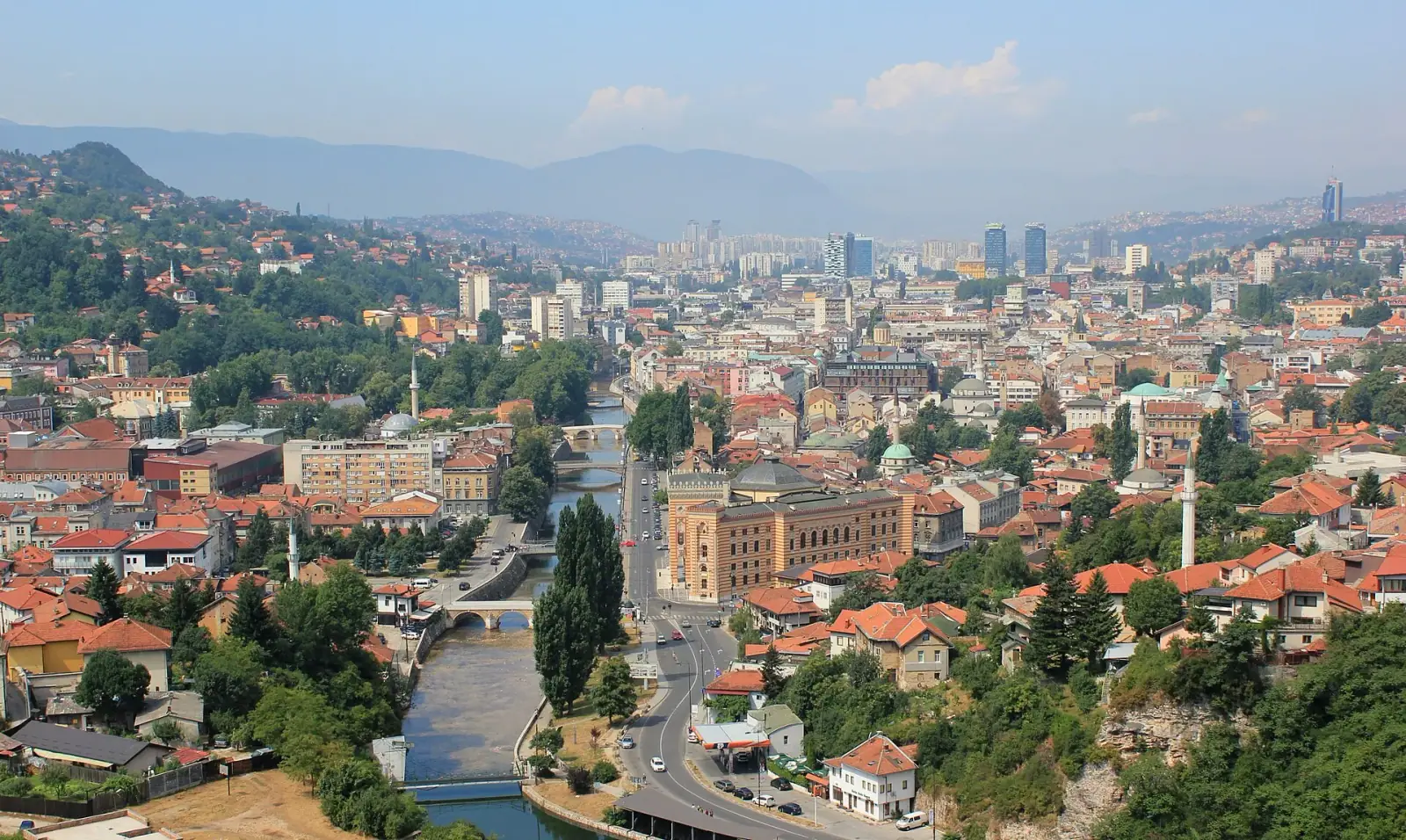
That is Sarajevo's pitch for a remote worker: a capital of about 275,000 people where Ottoman, Habsburg and Yugoslav Sarajevo sit within a half-hour walk along the Miljacka, mountains rise straight from the suburbs and a month costs about $1,080. It suits someone who wants a cheap, walkable base for one to three months between spring and autumn, outside the Schengen clock. It does not suit anyone who has to be here in January, anyone with asthma, or anyone who wants a nomad scene waiting at the door.
The money is simple to plan. The convertible mark is pegged to the euro, so a euro earner prices a stay today and pays the same in six months; a dollar earner still carries the swing between the dollar and the euro. Rent is the big line: an average one-bedroom in the centre costs about $480 a month, and one outside the centre about $320.
| Monthly budget, one person, central one-bedroom | about $1,080 |
|---|---|
| One-bedroom, city centre | $480 a month |
| One-bedroom, outside the centre | $320 a month |
| Meal in an inexpensive restaurant | about $9 |
| Single tram or bus ticket | $1.29 |
| Coworking, one month at HUB387 | $247 |
| Home broadband, national median | 37 Mbps down |
| Visa-free stay (US, UK, EU, Canada, Australia) | 90 days in 180 |
| Worst air | October to February |
Rents, meal and budget: Numbeo data via our city page, August 2026. Ticket: GRAS. Coworking: HUB387's published price. Broadband: Ookla Speedtest Global Index, August 2026. Prices are in US dollars at an exchange rate of 1.699 convertible marks to the dollar on 1 August 2026; the mark is pegged at 1.95583 to the euro.
How long can you stay?
Ninety days in any 180, on a US, British, EU, Canadian or Australian passport, without a visa. The useful part is that Bosnia and Herzegovina is not in Schengen. Those 90 days run on their own clock, so a summer here does not eat into the time you have left for neighbouring Croatia, or for anywhere else in the Schengen area.
There is one rule visitors miss. A hotel registers you with the police within 12 hours, but in a private flat where the landlord does not, the law gives you or your host 48 hours from entry to register a stay of more than three days. Ask about it when you book, and keep the receipt with your passport. Overstaying is costly: about $88 for each day over.
Beyond 90 days the road narrows. Bosnia has no digital nomad visa, and the law on foreigners has no category for someone working for clients abroad. Temporary residence exists, a year at a time and renewable, but on set grounds: family, study, work with or without a work permit, owning property here, or "other justified reasons". Remote work for a foreign employer fits none of them neatly. Treat Sarajevo as a three-month base, and for a long legal stay elsewhere, compare the options in our digital nomad visa finder.
The months to leave out of the calendar
The same valley that makes Sarajevo so compact traps its air. In winter, cold air settles on the floor of the valley under a warmer layer, and the smoke from thousands of stoves stays where it is. On 23 January 2026, fine particulate matter reached nearly 300 micrograms per cubic metre, about twenty times the World Health Organization's daily guideline.
That was an extreme day, but not an odd one. When Swiss and Bosnian researchers measured through a January, about two-thirds of their readings broke the WHO's daily limit, with wood and coal heating the main cause in the evenings. The season runs roughly from October to February, and Human Rights Watch puts the toll at about 3,300 premature deaths a year across the country.
So the calendar decides the stay. From March or April to September the valley is clear, the mountains are open and the cafés move outside. Book those months. If winter is the only time you can come, choose a flat with an air purifier and check the daily readings before you plan a day outdoors.
Which side of the line to live on
The city runs along the Miljacka from east to west, and it reads like a timeline: Ottoman bazaar, Habsburg centre, Yugoslav towers, then the suburbs out towards the airport. The tram ties it together, so you can live almost anywhere along the valley floor and still reach the old town in minutes.
Baščaršija: east of the line
Living in the bazaar means waking up to the call to prayer from the Gazi Husrev-beg Mosque and walking out past grill kitchens and coffee houses. It is also the busiest, most visited corner of Sarajevo, and the smoke from those grills is one of the sources the air study found. Lovely for a week; tiring for three months.
Ferhadija and Centar: west of the line
The Austro-Hungarian blocks around Ferhadija and the cathedral are the practical centre for most stays, with cafés on every corner and the bazaar five minutes away on foot. Flats here sit around the $480 average for the centre, in the city's grandest nineteenth-century streets.
Marijin Dvor: the Yugoslav centre
A tram ride west, Marijin Dvor is the modern administrative district: concrete towers, the National Museum, parliament and the newer apartment stock. It has less charm and more practicality, and the tram runs past the door.
Grbavica and Ilidža: where rents drop
Across the river, Grbavica is residential, with markets and parks, war damage still visible on some facades and rents nearer the $320 outer average. At the far end of the tram line, Ilidža is a spa suburb with the springs of the Bosna and a three-kilometre avenue of trees to walk or ride by horse carriage. Since 27 September 2026 a new tram line, the first extension of the network since 1962, runs on from Ilidža to Hrasnica.
A working day in the valley
Start with the connection, because it decides where you work. Bosnia's typical home line is modest: the median fixed connection runs at about 37 Mbps down and 9 up, even though the average is pulled above 80 by fast fibre. That is enough for calls, but ask the landlord for a speed test on the flat's own line before you pay.
For a desk you can count on, the city has two serious spaces. Tershouse fills a restored 1890 railway workshop at Kolodvorska 12, with 80 desks, round-the-clock access and gigabit wifi, from about $15 a day or $177 a month for a fixed desk. HUB387, on Maglajska, is the older tech hub, at about $18 a day or $247 a month.
Lunch is the easy part. Sarajevo's ćevapi, small grilled fingers of minced meat served in soft somun bread with chopped raw onion, are made in grill shops all over Baščaršija, and an inexpensive restaurant meal costs about $9. Coffee is the other ritual: here it is something you sit over, not something you carry.
At five o'clock you could cross the river to Bistrik and take the cable car up Trebević. Destroyed in the war, it reopened in April 2018, and in seven to nine minutes it lifts you from 583 metres to 1,160, onto a forested ridge where the graffiti-covered bobsleigh track of the 1984 Olympics winds down through the trees. The city lies below you, the line on Ferhadija somewhere in the middle of it.
Getting around costs little. Sarajevo ran a horse tram from 1885 and electric trams from 1895, a test line for Vienna itself, and the trams still run the length of the valley. A single ticket from GRAS, the city operator, costs $1.29.
Need a doctor or a lawyer in Sarajevo?
Our Sarajevo directory lists English-speaking doctors and lawyers, each with the source for the languages they work in.
Browse Sarajevo services →The history under your feet
Walk a few minutes from the line in either direction and the twentieth century catches up. At the northern end of the Latin Bridge, a stone bridge of 1565, Gavrilo Princip shot Archduke Franz Ferdinand on 28 June 1914. Across the water stands the pseudo-Moorish City Hall, Vijećnica, built in the 1890s and later the national library, burned with its books on 25 August 1992 and reopened in 2014.
The siege that followed lasted 1,425 days, from April 1992 to February 1996, the longest of any capital in modern warfare. You will walk over it without meaning to: about 200 Sarajevo Roses, mortar scars in the pavement filled with red resin, mark places where people were killed. Out by the airport, the Tunnel of Hope museum keeps a short stretch of the 800-metre passage that kept the city supplied.
The city answered the siege with culture, and still does. The Sarajevo Film Festival was founded in 1995, while the shelling went on, and now fills the city every August. For a remote worker, that is the month to come if you want Sarajevo at its fullest, and the one to book furthest ahead.
Weekends: mountains and the Neretva
The 1984 Winter Olympics left Sarajevo with two ski mountains, Bjelašnica and Jahorina, both within an hour's drive and still running as resorts. In summer the same slopes are hiking country. Stay on paved roads and marked, used trails: the war left about 820 square kilometres of the country still suspected of mines, and the UK's travel advice is not to leave paved surfaces without an experienced guide. That rule matters most in the hills, so take it seriously there.
The best day trip runs south by rail. The Talgo to Mostar takes about two hours along the Neretva valley, through Konjic and Jablanica, and leaves Sarajevo early enough to see the old bridge by mid-morning and be back for dinner. Sit on the left for the river.
Getting in, staying well
Sarajevo's airport, at Butmir on the edge of Ilidža, handled about 2.2 million passengers in 2025, up by a fifth, and the choice of low-cost flights is growing: Wizz Air adds Berlin, Bratislava and Prague in December 2026. Ryanair, though, is suspending its Sarajevo flights for the winter of 2026 to 2027, so check your route before you plan a winter arrival. The alternative is to fly into Zagreb, Split or Belgrade and come overland.
Day to day, the city is safe to walk at night; the UK government warns mainly about pickpockets on trams and in tourist areas, and about car thefts on Trebević. For serious care, the Clinical Centre of the University of Sarajevo, at Koševo, is the largest public hospital in the country. For routine visits, our list of English-speaking doctors in Sarajevo gives the source for each language.
Sarajevo, Belgrade or Tirana?
All three sit outside Schengen and cost a fraction of Western Europe. Belgrade is bigger, louder and has more of a scene to plug into. Tirana is about as cheap and has a sea within reach. Sarajevo is the one with the richest old town of the three and mountains at the end of a tram ride, and the one with the worst winter air.
So come between March and October, sign up at one of the two coworking spaces in the first week, register your address within 48 hours, and keep your 90 days for the summer. If you are weighing it against a cheap capital further east, our Tbilisi guide covers a city where a year without a visa is possible. Then go back to the brass line on Ferhadija one evening, and look both ways.
All the numbers for Sarajevo
The full cost table, the neighbourhood notes and our 13 category ratings, before you sign for a flat.
Open the Sarajevo city guide →Frequently Asked Questions
How much does it cost to live in Sarajevo as a digital nomad?
About $1,080 a month for one person with a central one-bedroom, or about $920 living leaner. A central one-bedroom averages $480 a month, one outside the centre $320, and an inexpensive restaurant meal about $9.
Does Bosnia and Herzegovina have a digital nomad visa?
No. US, UK, EU, Canadian and Australian citizens can stay 90 days in any 180 without a visa, on a clock separate from Schengen. Temporary residence exists, a year at a time, but on grounds such as family, study, work or property, none of which fits remote work neatly.
Do I need to register my address in Sarajevo?
Yes. A hotel does it within 12 hours. In a private flat, you or your host must register a stay of more than three days within 48 hours of entering the country.
How bad is the air in Sarajevo in winter?
Bad enough to plan around. From about October to February, wood and coal smoke is trapped in the valley, and on 23 January 2026 fine particulates reached nearly 300 micrograms per cubic metre, about twenty times the WHO daily guideline.
Is the internet in Sarajevo good enough for remote work?
Usually. The national median home line is about 37 Mbps down and 9 up, so test the flat's own connection. Tershouse advertises gigabit wifi, and HUB387 is the other established coworking space.
Which area of Sarajevo is best for a month-long stay?
The Austro-Hungarian centre around Ferhadija, for cafés and walking distance to everything. Marijin Dvor has newer flats, Grbavica lower rents, and Baščaršija is atmospheric but crowded.
When is the best time to work from Sarajevo?
March or April to September, when the air is clear and the mountains are open. August brings the film festival; October to February brings the smog.


