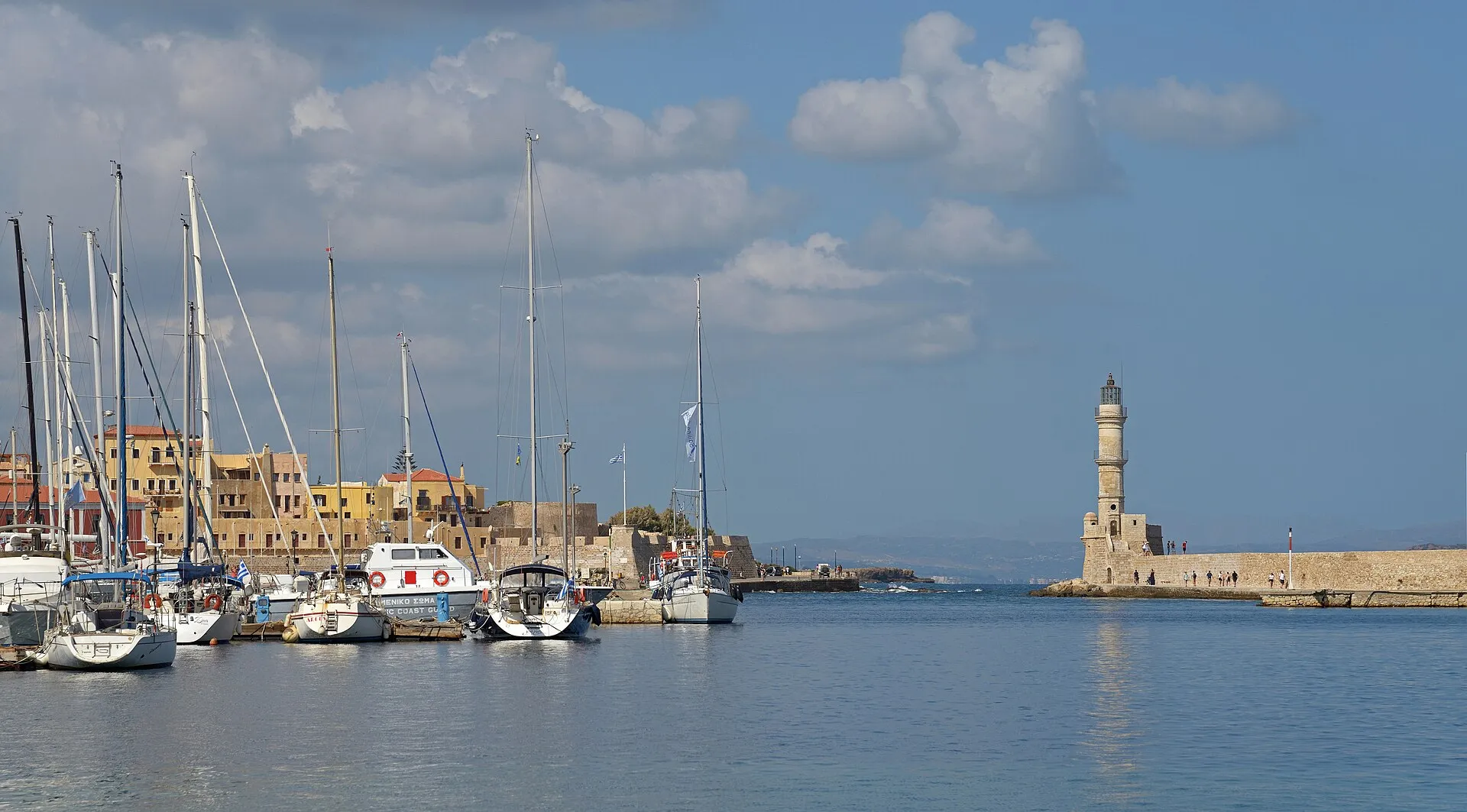

At the mouth of Chania's old harbour, at the end of a long stone breakwater, stands a pale tower that still flashes red every two and a half seconds. The Venetians laid its foundations on bare rock between 1595 and 1601. It was rebuilt in 1839, in the decade when Egypt governed Crete for the Ottoman sultan, and that is why the town's most photographed landmark is often called the Egyptian lighthouse.
Walk out along the breakwater, about ten minutes from the quay, and turn around. The waterfront curves past the white dome of the Mosque of the Janissaries, built in 1645, the year the Ottomans took the town. To the left, vaulted Venetian shipyards open onto the water; to the right sits Firkas, the fortress that now holds the Maritime Museum of Crete. Above the rooftops rise the White Mountains, snow on their peaks until late spring.
Most of what a remote worker needs to know about Chania can be read from that spot. The harbour front is the beautiful, crowded, expensive part; the flats and the desks are in the quarters behind it; the mountains are where the weekends go. And this is a real town of about 55,000 people, not a resort, so it does not shut when the season ends.
So here is the verdict. Chania is one of the best places in the Mediterranean to spend a spring or an autumn working, if you book a coworking desk before you book the flat and you do not need a large nomad scene around you. It is the wrong choice if your work depends on fast home uploads you have not checked, or if you are looking for a cheap July.
| One-bedroom, city centre | $650 a month |
|---|---|
| One-bedroom, outside the centre | $520 a month |
| Monthly budget, one person, central flat | about $1,380 |
| Monthly budget, couple sharing | about $1,960 |
| Workhub hot desk | $20 a day, $332 a month |
| Greek home broadband, median download / upload | 91 / 20 Mbps |
| Greece digital nomad visa, net income | $4,030 a month |
| Average high, January / July | 15°C / 30°C |
Rents and budgets: our figures, priced from Numbeo's August 2026 data. Broadband: Ookla's Speedtest Global Index, August 2026, for Greece as a whole. Workhub: its published hot-desk rates. Climate: Open-Meteo averages for 2019 to 2023. Prices are in US dollars, converted at the site's exchange rate of 0.8687 euros per dollar on 1 August 2026.
Why the desk comes before the flat
Start with the connection, because it is the one thing in Chania that can go wrong quietly. Across Greece, the median home broadband line downloads about 91 Mbps and uploads about 20 Mbps, which places the country 86th in the world for fixed speeds. Download is fine. The upload is what you feel, on a video call or when you push a large file at the end of the day.
Chania adds its own twist. Fibre is common in newer buildings, but the thick-walled stone houses of the old town, the ones that look best in the listing photos, can be patchy. Ask for a speed test screenshot before you sign, and treat "wifi included" as a promise, not a measurement.
The fix has existed for years. Workhub, which calls itself the first coworking space in the city, runs a 1,000 Mbps down, 500 Mbps up fibre line from the Trianon Center on Iroon Polytechniou. Coffee, snacks, printing and video call booths come with the desk, and members can work there around the clock on weekdays.
A hot desk costs $20 for a day, $90 for a week or $332 for a month. The best buy for most people is the ten-day pass at $173, which never expires: work from the flat on quiet days and take the big calls on Workhub's line.
Your phone is the other safety net: Greek mobile networks are faster than its home lines, with a median download of about 133 Mbps, so a local SIM is a credible backup.
The quarters behind the harbour
From the end of the breakwater you can see where to live, and where not to. The harbour front itself is for walking, not sleeping. Its cafés and restaurants fill every evening from spring to autumn, and summer nights there are loud. Live a few streets back and come down for the sunset instead.
Topanas and the old town: the postcard, at a price
West of the harbour, the old Venetian quarter is a tangle of narrow lanes and old houses, many restored as small hotels, bars and shops, with the former Jewish quarter, Evraiki, tucked inside it. It is the most atmospheric address in town and the one most often let to holidaymakers. On a year-round lease, our figures put an old-town one-bedroom at $690 to $1,040 a month, above the city-centre average.
Splantzia: the square with two towers
East of the harbour, Splantzia was the Ottoman quarter. Its square is shaded by old plane trees, and its church of Agios Nikolaos is the only church in Greece with both a minaret and a bell tower. The streets around it hold neighbourhood tavernas and fewer tour groups. For a first stay, this is the quarter we would start with: inside the old town, walking distance from everything, and quieter at night.
Nea Chora: the town beach
Less than a kilometre west of the harbour, Nea Chora has the closest sandy beach to the centre, a small fishing harbour and a promenade of fish tavernas. It feels like a neighbourhood rather than a monument, and it is cheaper: our figures put one-bedrooms here, in Halepa and in the blocks to the south at $405 to $635 a month.
Halepa: the consuls' quarter
East along the coast, Halepa is where the European consulates stood in the nineteenth century, and its streets still have the mansions to prove it. Eleftherios Venizelos, the Cretan who became Greece's prime minister, lived here, and his house is now a museum. It is quiet, residential and a longer walk from the old town: good for a long stay, less so for a first month.
What a month in Chania costs
On our figures, a central one-bedroom rents for about $650 a month, and one person's other costs come to about $730, so a solo month lands near $1,380. A couple sharing a flat needs about $1,960. That is a little cheaper than Athens, where the same basket costs about $1,520, rather than a different league.
The number that moves is rent, and it moves with the season. Many owners can earn more from summer visitors than from a year-round tenant, so long-term listings thin out from May to September and prices climb. The way round it is timing: arrive in October or November, sign a lease that runs through the spring, and you will be paying winter rates when the summer crowd arrives.
Eating out costs about $17 for a meal at an inexpensive restaurant on our figures. The harbour front charges extra for its view; the tavernas a few streets back do not.
Need paperwork help in Chania?
Our Chania directory lists lawyers by the language they work in, with the official list each language claim comes from.
See lawyers in Chania →A working day in Chania
Say it is an ordinary Tuesday in May, with an average high around 22°C. The morning is at the desk: Workhub, or your own table if the flat's line has proved itself.
Lunch could be in Splantzia under the plane trees, or down at Nea Chora with a plate of grilled fish and your feet near the sand. Order dakos, the barley rusk heaped with tomato and soft cheese, and you are eating the diet that made Crete famous: the island was one of the cohorts in Ancel Keys's Seven Countries Study, the research behind the idea of the Mediterranean diet.
Five o'clock is for the harbour. Walk the breakwater to the lighthouse, look back at the domes and the shipyards turning gold, and find a table a street or two behind the waterfront when it gets dark. From December you will have another reason to go into town: the covered Municipal Market, under restoration since 2022, reopens on 4 December 2026, 113 years to the day after it first opened, as a market for food and local produce.
English will carry you through all of it except the paperwork, where Greek, or a translator, helps.
When the harbour changes with the season
The lighthouse was built for ships, and Chania still lives by the sailing season. In July and August the town is hot, with average highs of 30°C, crowded and at its most expensive.
The best months for working are the ones on either side. May, June, September and October bring warm sea, open tavernas and space at the desks. Winter is mild, with January highs around 15°C, but it is the rainy season and the airport loses many of its direct European routes. The town stays open, which a small island does not, though some seasonal businesses close.
That rhythm shapes the people you meet. Remote workers arrive in spring and leave in autumn, on top of a settled layer of long-term foreign residents. If you come in January expecting a scene, you will find the long-termers and not much else.
Can you stay longer than a season?
With an EU passport, yes, as long as you like. From the US, the UK, Canada or Australia, you get 90 days in any 180 across the whole Schengen area, logged by the EU's Entry/Exit System. That covers a spring or an autumn in Chania. Use it all and you then spend 90 days outside the area before you can come back, so a spring here and a summer in Portugal do not fit together.
For longer, Greece's digital nomad visa asks for at least $4,030 a month after tax from employers or clients outside Greece, plus 20 percent for a spouse and 15 percent for each child. It gives you up to a year, after which you can apply for a digital nomad residence permit of up to two years, renewable. You may not work for Greek companies on it.
That income floor is among the higher ones in southern Europe. Our comparison of digital nomad visas sets it beside the others we track, and if you need a Greek lawyer for the residence permit, our Chania services page lists them by language, along with the General Hospital of Chania.
Weekends: from the harbour to the gorge
The mountains you saw from the breakwater are what set Chania apart from the smaller islands. The White Mountains, the Lefka Ori, have more than 30 summits above 2,000 metres, topped by Pachnes at 2,453 metres, and their name comes from pale limestone in summer and snow in spring.
Through them runs the Samaria Gorge, 16 kilometres from 1,250 metres down to the Libyan Sea at Agia Roumeli, where walkers leave by boat. At the Gates the walls close to four metres apart and rise almost 300 metres. The national park opens from May to October, and a ticket costs about $12.
West of town are the beaches people fly in for, Balos lagoon and Elafonisi, far calmer outside July and August. Most of western Crete is easier by car, so many long-stayers live without one in town and rent one for weekends.
Getting around, and getting off the island
The old town is car-free by its nature, so daily life is on foot. KTEL coaches run along the north coast: Rethymno is about 70 minutes away and Heraklion about two and a half hours, so most of the north coast is a day trip.
The airport sits on the Akrotiri peninsula, about 14 kilometres from town; in winter you may have to connect through Athens. The slower way out is the overnight ferry from Souda, east of town, to Piraeus: about nine hours, a cabin, and Athens at breakfast.
Chania or Athens?
Athens is a capital, with far more coworking choice and a remote-work crowd that does not leave in autumn, for about $140 a month more on our budgets. Chania has the harbour, the mountains, a walkable town you can know in a week, and a gorge for Saturday.
If you want to settle into a place rather than a network, take Chania. If you need people around you every month of the year, take Athens. Our ranking of Europe's best cities for nomads sets both against the rest, and the comparison tool puts any two side by side.
If you do choose Chania: come in spring or autumn, buy the Workhub ten-day pass before you land, rent in Splantzia or Nea Chora rather than on the harbour, and sign through the winter if you are staying long. Then walk out to the lighthouse on your first evening, and look back at the town you picked.
All of Chania on one page
The full cost table, the five neighbourhoods and all 13 of our category ratings, before you book.
Open the Chania city guide →Frequently Asked Questions
How much does Workhub Chania cost?
A hot desk costs about $20 a day, $90 a week or $332 a month, and a ten-day pass that never expires costs about $173. Dedicated desks and private offices cost more. Coffee, snacks, printing, call booths and a 1,000 Mbps fibre line are included.
How much does it cost to live in Chania as a digital nomad?
About $1,380 a month for one person in a central one-bedroom, on our figures, and about $1,960 for a couple. A central one-bedroom rents for about $650, and rents climb in summer, so a lease signed in autumn is the cheapest way in.
Is the internet in Chania good enough for remote work?
Good enough with a plan. Greece's median home line downloads about 91 Mbps but uploads only about 20 Mbps, and old-town stone houses can be patchy. Workhub's fibre and a Greek SIM, with a median mobile download of about 133 Mbps, cover the gaps.
Does Greece have a digital nomad visa?
Yes. It needs at least $4,030 a month after tax from outside Greece, plus 20 percent for a spouse and 15 percent per child, and runs up to a year before a renewable residence permit of up to two years. Without it, non-EU visitors get 90 days in any 180.
Which part of Chania is best for remote workers?
Splantzia for a first stay, inside the old town but quieter than the harbour, or Nea Chora for the town beach and lower rents. Halepa suits a long, quiet stay. Avoid sleeping on the harbour front in summer.
When is the best time to work from Chania?
May, June, September and October: warm sea, open tavernas and room at the desks. July and August are hot and expensive. Winter is mild but rainy, with fewer flights, though the town itself stays open.
Can you visit the Samaria Gorge from Chania?
Yes, from May to October. The 16-kilometre walk runs downhill from the White Mountains to Agia Roumeli on the south coast, where you leave by boat. The ticket costs about $12.


