In January 2026, about 3,500 passengers a day passed through Milas-Bodrum airport. In August it was nearly 29,000. Domestic traffic rose almost fivefold over those months, and international traffic 85-fold. Bodrum is one peninsula with two populations, and which one you meet depends entirely on the month you land.
On paper the town is modest: Turkey's statistics office counted about 207,000 registered residents at the end of 2025. The municipality's own count is different. About 450,000 people live on the peninsula through the winter, and more than a million in summer, once the hotels and the second homes fill, which is why the mayor has asked residents to register their address here.
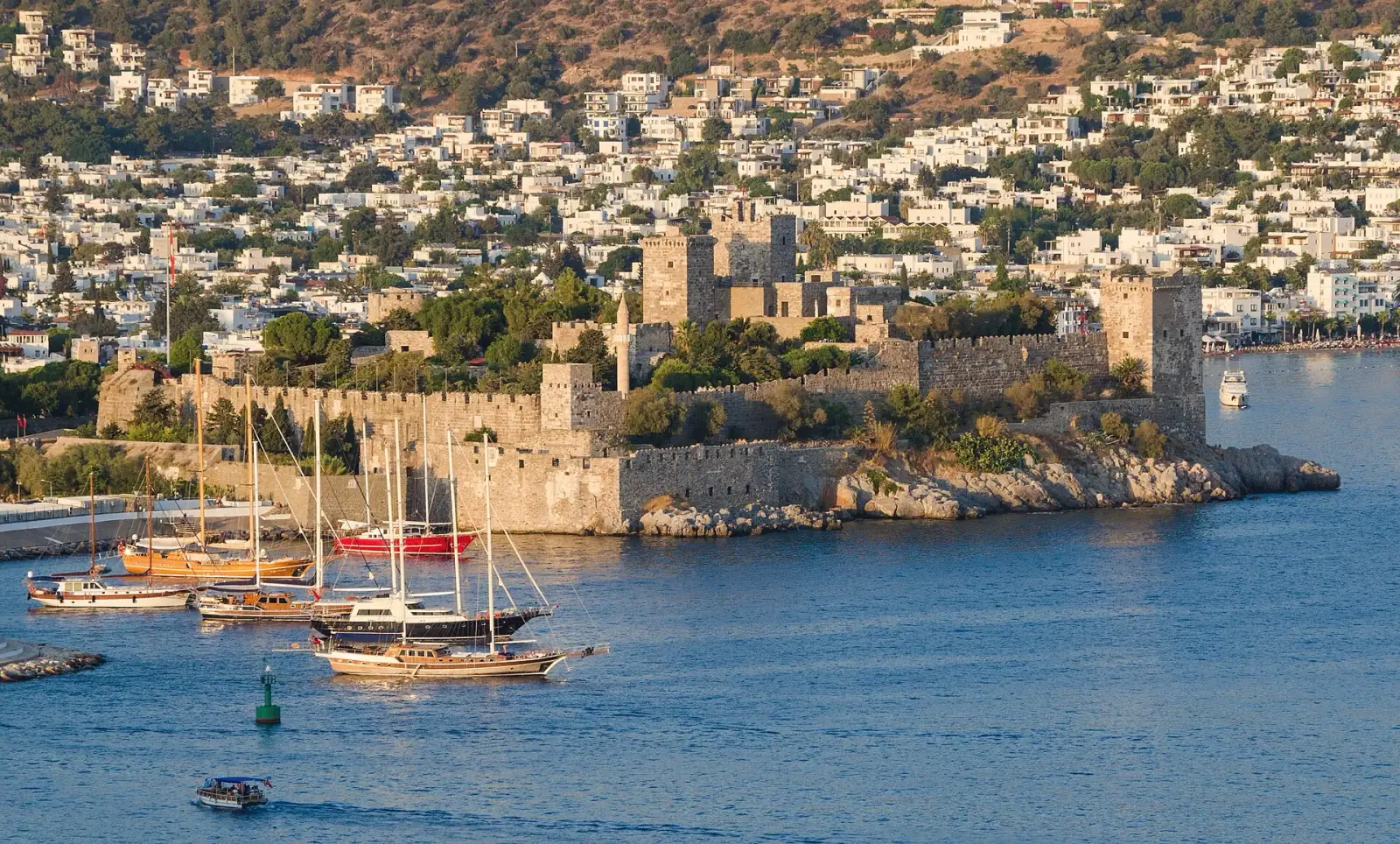
You can see both towns from the harbour. The Castle of St Peter sits on its rocky point between two bays, its towers named French, Italian, English, German and Spanish after the knights who built it. Below it the wooden gulets line the quay, and the white houses climb the hill towards the old windmills. In August that scene is shoulder to shoulder. In February it belongs to the people who live here.
For a remote worker, the paradox is the whole story. Rent, water, network load and the people around you all swing with the season. Come in May, June, September or October with a coworking desk lined up, and Bodrum is an Aegean base outside the Schengen clock, about $400 a month cheaper on our figures than Rhodes across the water. Come in August expecting a quiet month of calls, and you will be working inside the busiest weeks of the Turkish coast.
| Registered population, end 2025 | 207,196 |
|---|---|
| Living on the peninsula in winter / summer | about 450,000 / over 1 million |
| One-bedroom, centre / outside the centre | $630 / $420 a month |
| Monthly budget, one person, central flat | about $1,050 |
| CoBodrum coworking, monthly | about $210 plus VAT |
| Turkish home broadband, median download / upload | 84 / 21 Mbps |
| Turkish mobile data, median download | 133 Mbps |
| Average high, January / August | 15.5°C / 35°C |
| Visa-free stay, US, UK, Canada, Australia | 90 days in any 180 |
Population: TÜİK and Bodrum Municipality. Rents and budget: our figures, priced from Numbeo's August 2026 data. Coworking: CoBodrum's published rate. Speeds: Ookla's Speedtest Global Index for Türkiye, August 2026. Climate: WMO normals for 1991 to 2020. Prices are in US dollars at the site's exchange rate of 47.54 lira per dollar on 1 August 2026.
Internet: a summer town's network
There is no measured average speed for Bodrum itself, whatever the nomad forums say. What is measured is the country. Across Türkiye the median home broadband line downloads about 84 Mbps and uploads about 21 Mbps, 95th in the world, while the median mobile connection downloads about 133 Mbps. The phone in your pocket is faster than the typical home line.
The season adds its own strain. A café router shared by a dozen holidaymakers in August is not the connection it was in April, and a villa listing that says "wifi included" tells you nothing about the line. Ask the landlord for a speed test screenshot before you sign, and buy a Turkish SIM with a large data allowance on arrival, so the backup is in place before you need it.
For a fixed desk, CoBodrum, in the centre, lists a monthly coworking membership at about $210 plus VAT, a flexible pack of four days a month at about $126 and a single day at about $42, all before tax. That makes the day pass poor value: if you need a desk more than four or five days in a month, take the membership. Our advice is to sort the desk first, then choose the flat within walking distance of it.
Water, power and a town built for fewer people
The swing in population is not only a question of crowds. Bodrum has no river; its drinking water comes from the Mumcular and Geyik dams and from wells, and the municipality's own climate plan states that the summer population brings water cuts. In October 2023 both dams were shut because their levels had fallen below the intake channels, and in September 2025 the water utility announced rotating cuts across the district, the centre included.
This year has been kinder. In May 2026 Geyik was full and Mumcular reached 91 percent for the first time in five years, and the 48-hour cut in 28 neighbourhoods in June was for new pipes, not shortage. Still, ask whether a flat has its own water tank on the roof. Power is under the same pressure: the peninsula's electricity use grew by about 11 percent in the single year to 2024, which the municipality puts down to growth and tourism.
Where to live: the towns that stay open
The peninsula is a ring of bays and villages, and they do not empty evenly. The municipality names Yalıkavak, Akyarlar, Türkbükü and Gündoğan as the second-home districts where the summer population concentrates. Those are the places that are fullest in August and quietest in February. For a working stay, pick a town where people live all year.
Bodrum centre: the castle and the markets
The centre wraps around the two bays below the castle. The weekly markets set its rhythm: textiles on Tuesday, a producers' market on Wednesday, fruit and vegetables on Thursday and Friday, and antiques on Sunday. It has the marina, the ferry quay, cafés that stay open in winter and the most services of anywhere on the peninsula. On our figures a central one-bedroom rents for about $630 a month. It is the best base for a first stay and the only one that runs at full strength out of season.
Gümbet and Bitez: the next bays west
Gümbet, just over the hill, is the package-holiday and nightlife bay: loud in July, cheap and quiet in winter. Bitez, one bay further, is calmer and more residential, a short minibus ride from the centre. Both are reasonable for a long stay outside the peak, and our figures put a one-bedroom outside the centre at about $420 a month.
Yalıkavak, Türkbükü and Gümüşlük: summer addresses
Yalıkavak, 18 km from the centre, is built around a superyacht marina. Türkbükü is where the Istanbul weekend crowd goes for beach clubs. Gümüşlük sits on the ruins of ancient Myndos, some of them under the water of its bay. All three are beautiful and seasonal, and all three are expensive in summer and thin in winter. Visit them; base yourself elsewhere unless you have a car and a reason.
What a month costs, and why the season matters
On our figures, a solo month with a central one-bedroom comes to about $1,050, a couple sharing to about $1,390, and a leaner month in a cheaper area to about $840. In our cost of living index that is below the $1,220 we price for Antalya and the $1,350 for İzmir, which surprises people who know Bodrum by its marinas.
Treat that as a year-round figure. Muğla, Bodrum's province, now has the second-highest average rent in Turkey after Istanbul, about $860 a month across all sizes, and summer lets are priced for holidaymakers, not tenants. No index publishes a winter and summer split, but the logic of a town whose population more than doubles is plain: sign a lease in October or November and you will pay far less than for the same flat found in June.
Food is where you decide the rest. A lokanta, the canteen-style restaurant serving the day's stews from a counter, keeps lunch cheap; the marina restaurants charge marina prices. Where you eat moves the month more than which bay you live in.
Paperwork in Bodrum?
Our Bodrum directory lists sworn translators and lawyers by the language they work in, each with the official register it comes from.
See services in Bodrum →How long can you stay?
Turkey sits outside Schengen and keeps its own clock. The foreign ministry gives US, British, Canadian and Australian passport holders 90 days in any 180 without a visa, and German and French citizens 90 days too. For anyone who has used up a Schengen summer, that is a separate allowance.
Two warnings about the ferry to Kos, which is 20 to 30 minutes away. Kos is Greece, so every day there counts against your Schengen 90. And a hop across does not reset Turkey's count either: the 180 days roll, so the days you spent in Bodrum stay on the books.
For a longer stay, Turkey's digital nomad visa asks for $3,000 a month or $36,000 a year, a university degree, an age between 21 and 55, and a passport from one of 36 listed countries, which include the US, the UK, Canada and every EU country except Cyprus, but not Australia.
Tourism is still a legal ground for a short-term residence permit, though first-time tourism permits have been hard to get since 2022, so plan around the 90 days or the nomad route. Our comparison of digital nomad visas sets Turkey's beside the rest, and our list of lawyers in Bodrum shows the language each one works in.
When to come: the two Bodrums
The summer town is hot. July and August average highs of 35°C, and there is practically no rain from June to August. The airport is at full stretch and the beaches are full. It is the worst time to try to concentrate.
The shoulder months are the answer. In May, June, September and October the sea is warm, the crowds are thinner, rents are lower and a café line can carry a call. Most of the airport's international routes are seasonal, so arriving in early May or leaving in late October can mean a connection through Istanbul, which has flights all year.
Winter is the other town. January averages a high of 15.5°C and nights around 8.5°C, December and January are the wet months, and much of the resort trade winds down. What remains is the residents: a working town of several hundred thousand, the produce markets, empty coves on a sunny day. If you can work happily from a coworking desk, winter is the best value on the coast.
Who you will meet
Bodrum is not a nomad hub, and there is no meetup calendar to join. What it has is a settled international community: Muğla province counts about 28,000 foreigners with residence permits, against about 150,000 in Antalya's province. In winter, those residents are most of the foreigners you will meet.
In summer the mix changes completely, to holidaymakers and second-home owners. The shoulder months are when you are likeliest to meet other people working rather than on holiday, and the coworking space is the easiest place to start.
Off the laptop: castle, coves and the blue voyage
The castle is the place to begin. The Knights of St John built it in the fifteenth century from the stones of the Mausoleum of Halicarnassus, the tomb of Mausolus that gave every later mausoleum its name and was one of the Seven Wonders of the ancient world. Since 1964 it has housed the Museum of Underwater Archaeology, with one of the world's richest collections of eastern Mediterranean amphorae and the hull of a ship that sank in 1025, from which three tonnes of glass were raised.
The sea is the other half. The gulets in the harbour are the boats of the mavi yolculuk, the blue voyage, a tradition of slow trips along the coast that began with Cevat Şakir Kabaağaçlı, the writer exiled here in 1925 who signed himself the Fisherman of Halicarnassus. A shorter weekend is a walk up to the windmills above town, or a day trip to Kos.
Getting around the peninsula
The dolmuş, a shared minibus, links the bays with the centre and is how most people without a car get around; the intercity coach station moved out to Torba in 2021, but the minibuses to the peninsula's towns still leave from the centre. For the empty bays of the north coast, rent a scooter or a car for a few days.
Milas-Bodrum airport is 36 km from town. Turkish Airlines, AJet and Pegasus fly to Istanbul and Ankara year-round; most international routes are summer-only. The ferries to Kos run all year, with more sailings in summer.
Who Bodrum suits
Bodrum suits someone who wants the Aegean, real history and a visa clock separate from Schengen, and who can time a stay to the shoulder months or the winter. It suits less well anyone who needs a nomad scene, a guaranteed fast line at home, or a quiet August. For a Turkish base that runs at the same pace all year, look at İzmir or Antalya, and put any two side by side in the comparison tool.
If you do come: arrive in May or late September, sign up at a coworking space before you sign a lease, rent in the centre or Bitez, buy a Turkish SIM at the airport, and keep count of your days. Then walk up to the windmills and look back at the castle, and decide which of the two Bodrums you came for.
Every number for Bodrum, in one place
The full cost table, the neighbourhoods, the weather by month and all 13 of our category ratings.
Open the Bodrum city guide →Frequently Asked Questions
How fast is the internet in Bodrum?
No measured figure exists for the town. Across Türkiye the median home line downloads about 84 Mbps and uploads about 21 Mbps, and the median mobile connection about 133 Mbps, so a Turkish SIM is a strong backup. Café wifi slows in the summer crowds.
How much does it cost to live in Bodrum as a digital nomad?
About $1,050 a month for one person with a central one-bedroom, on our figures, or about $840 for a leaner month. A central one-bedroom rents for about $630 and one outside the centre for about $420. Summer lets cost far more.
Does Turkey have a digital nomad visa?
Yes. It needs $3,000 a month or $36,000 a year, a university degree, an age of 21 to 55 and a passport from one of 36 listed countries, including the US, the UK, Canada and every EU country except Cyprus. Australians are not eligible.
Does a ferry trip to Kos reset the 90 days in Turkey?
No. Turkey counts 90 days in any rolling 180, so a trip abroad does not reset it. Kos is in Greece, so days there also count against your Schengen allowance.
What is the best area of Bodrum for a remote worker?
The centre for a first stay, since it has the most services and stays open in winter, or Bitez for a quieter bay nearby. Yalıkavak, Türkbükü and Gümüşlük are lovely, seasonal and expensive in summer.
When is the best time to work from Bodrum?
May, June, September and October. July and August average 35°C and the town fills to over a million people. Winter is mild by day, rainy in December and January, and much of the resort trade closes.
How many people live in Bodrum?
About 207,000 are registered, but the municipality estimates about 450,000 live on the peninsula in winter and more than a million in summer, when second homes and hotels fill.


