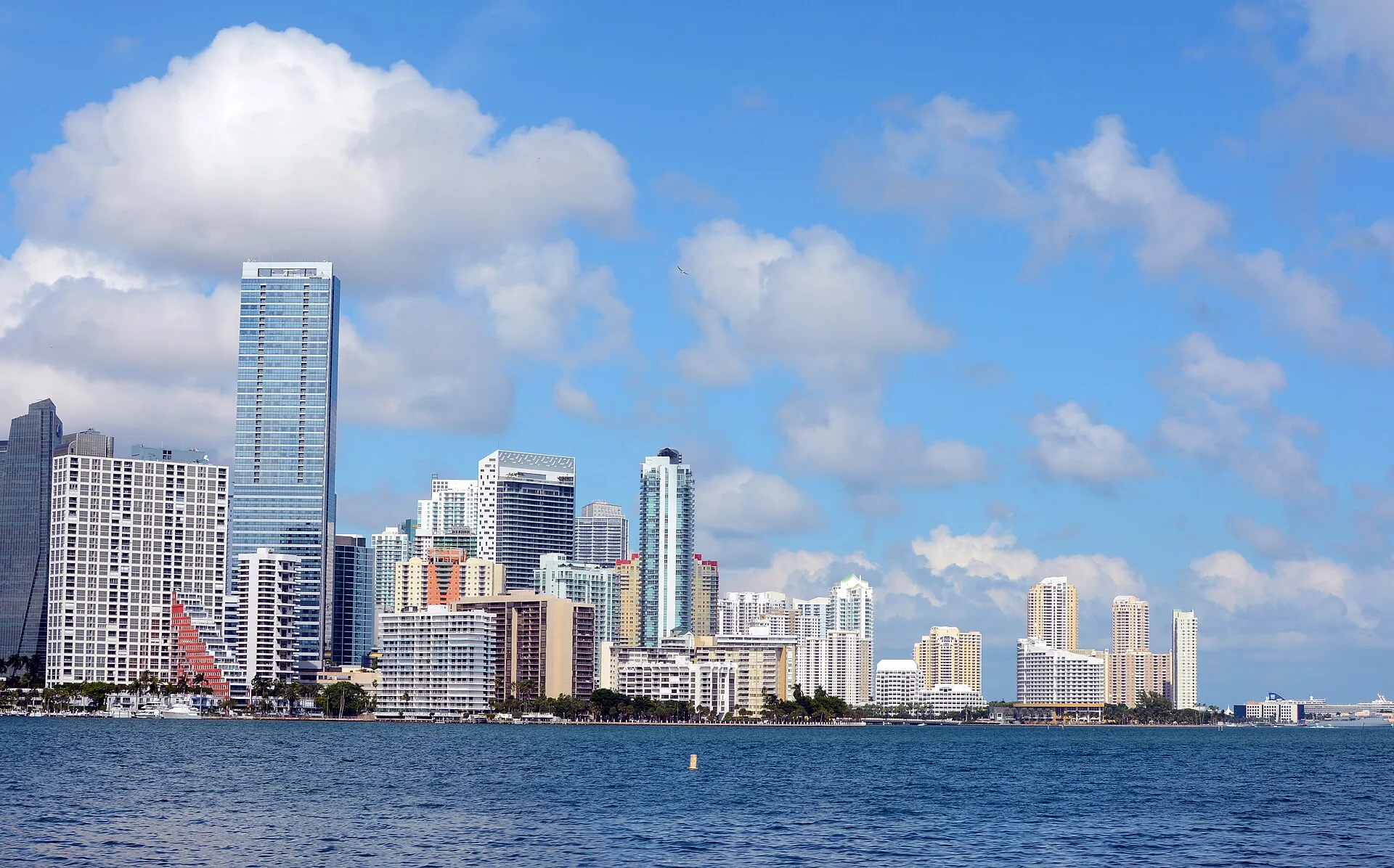

Biscayne Bay fills most of the view from a tower in Brickell: a lagoon 35 miles long and on average under six feet deep, spreading east and crossed by causeways to a line of islands. On the far side, the pastel hotels of South Beach stand on what was a mangrove sand bar until it was dredged and filled a century ago. Below, the Miami River slides between the towers into the bay.
That water decides more about where you should live than any rent table. It sets how a street looks, from the Art Deco front on Ocean Drive to the sailboats moored off Coconut Grove. It sets the price, because a bay view is what the towers sell. And it sets the risk. On 10 September 2017, Hurricane Irma did not even hit Miami directly, yet its surge put three to five feet of water along the bay shore and turned Brickell Avenue, the financial district's main street, into a river.
So choose your relationship with the water first. Live in Brickell or Downtown if you want to work without a car and look at the bay while you do: they sit on the free Metromover, and they are the dearest. Choose Coral Gables for the lowest flood risk, Little Havana for the lowest rent near the center if you are happy in Spanish, and Miami Beach only if you can stay longer than six months or find a licensed building. On a 90-day visa waiver, that rules most of the island out.
None of it is cheap: our one-person Miami budget is $3,960 a month. What changes from one district to the next is what landlords ask and how close the water comes.
| Neighborhood (ZIP) | Asking rent | HUD 1-bed | Surge zone | FEMA zone | Nearest rail |
|---|---|---|---|---|---|
| Brickell (33131) | $3,831 | $2,990 | B | AE / X | 0.1 km |
| Downtown (33132) | $3,511 | $2,900 | B | AE | 0.2 km |
| Edgewater (33137) | $3,572 | $2,860 | C | X / AE | 1.0 to 1.3 km |
| Wynwood (33127) | $2,956 | $1,750 | none | X | 1.4 km |
| Little Havana (33135) | $2,080 | $1,830 | E | X | 1.9 km |
| Coconut Grove (33133) | $3,621 | $2,490 | B / A | X / AE | 1.3 km |
| Coral Gables (33134) | $2,987 | $2,370 | E | X | 1.9 km |
| South Beach (33139) | $2,835 | $2,960 | B | AE | over 5 km |
| North Beach (33141) | $2,418 | $2,380 | B | AE | over 9 km |
Monthly rents. Asking rent: Zillow Observed Rent Index, all unit types, August 2026. HUD 1-bed: FY2026 Small Area Fair Market Rent. Zones: Miami-Dade County maps at one named point per district, September 2026. Rail: straight line to the nearest Metromover or Metrorail station.
Zillow follows what listings ask, studios, condos and houses together. The HUD fair market rent is a one-bedroom benchmark set for each ZIP code, utilities included, and it is the figure to plan on for an unfurnished flat on a 12-month lease.
Read the zone columns as the water's reach. Storm surge zones run from A, evacuated first, to E, at risk only in a Category 5 storm. FEMA Zone AE is the floodplain with a 1 percent chance of flooding every year; Zone X is minimal hazard. Each lookup is one point, and the building two blocks away can differ.
Brickell and Downtown: the bay out of the window
Brickell is Miami's densest neighborhood, about 40,000 people packed between the bay and the river. Brickell Avenue, a street of lavish mansions in the early 1900s, is now lined with office and apartment towers, and Brickell City Centre stacks three levels of shops and restaurants. The draw for a remote worker runs overhead: the Metromover, a driverless train on an elevated track, free since 2002, running 5:30 a.m. to 10 p.m. every day and stopping roughly every two blocks.
Walk Score gives the block by the Eighth Street station 100 for transit. Outside Brickell and Downtown, no address we checked scored above 53. In a city where most neighborhoods assume a car, that is the whole case for Brickell. The case against it is also the water: the bayside towers sit in FEMA Zone AE, and in Irma the surveyed surge topped six feet in spots here. West of SW 2nd Avenue the same neighborhood drops to Zone X, so rent on that side or on a high floor.
Downtown, across the river, is where the Metromover meets Metrorail at Government Center, with trains on to the airport, and Brightline's MiamiCentral station sends trains to Fort Lauderdale and Orlando. On the bay, the Pérez Art Museum stands on stilts under hanging gardens, its raised terraces designed to ride out hurricanes and floods. Rents run a little below Brickell, with the same surge exposure.
Edgewater and Wynwood: one step back from the shore
North of Downtown, Edgewater has filled with towers since 2000, with the bay as its eastern edge and Margaret Pace Park's running paths and courts on the water. It is surge Zone C, one step safer than Brickell, and Irma's surge measured about two to three feet here rather than three to five. Biscayne Boulevard at 27th Street is FEMA Zone X, though the bayfront buildings fall back into AE. The trade is a walk of a kilometer or more to the nearest Metromover stop.
Wynwood, a few blocks inland, was the only district in this guide outside every surge zone at the point we queried, NW 2nd Avenue at 25th Street. That corner is the Wynwood Walls, the outdoor street-art museum that Tony Goldman opened in 2009 on the walls of old warehouses. The district was a garment quarter in the 1920s and "Little San Juan" to Puerto Rican families from the 1950s; today the warehouses hold galleries, breweries, restaurants and dance venues.
For hurricane exposure Wynwood beats every waterfront option, but transit scores only 49 here, and its HUD one-bedroom looks cheap only because ZIP 33127 stretches far beyond the murals. Sleep a few blocks from the bars on NW 2nd Avenue. Our Miami city guide lists the coworking spaces, which cluster in Brickell, Downtown and Wynwood.
Little Havana: dominoes beyond the water's reach
Walk west along Calle Ocho, SW 8th Street, and the bay drops out of the picture. The street is lined with bakeries, fruit stands, cigar shops, rum bars and music venues, and at the ventanitas, the little service windows, you can order a strong, sweet Cuban coffee and a guava and cheese pastelito without going inside. At Máximo Gómez Park, known as Domino Park, older Cuban exiles and immigrants have gathered over dominoes since the early 1970s, beside mosaics of cigars, instruments and fruit.
The Tower Theater, from 1926, shows independent films; one Friday a month, Viernes Culturales brings music and art onto the street; and the Calle Ocho Festival draws more than a million people once a year. Domino Park sits in surge Zone E and FEMA Zone X, and Little Havana has the lowest asking rent in the table, down on a year earlier.
The trade is language and transport. In ZIP 33135, 91 percent of residents speak Spanish at home, so expect landlords to start in Spanish, and the nearest Metrorail station is almost two kilometers away. For a Spanish speaker on a budget, or anyone who wants to become one, it is the best-value base in central Miami.
Is Miami worth this rent at all?
Put it side by side with Mexico City or Medellín: budget, internet and all thirteen category scores on one screen.
Compare Miami with other cities →Coconut Grove and Coral Gables: sailboats and a flooded quarry
Coconut Grove is the oldest continuously inhabited neighborhood in Miami, and the green one: banyans, palms and live oaks shade its residential streets. Dinner Key Marina, the largest in Florida, fills the water with masts, and the Barnacle, a house built in 1891 for a yacht designer, still stands on its original site by the bay.
The Grove shows how finely the water draws its lines. At CocoWalk, the open-air shopping center, you are in surge Zone B and FEMA Zone X. About 700 meters east, on the bayfront, you are in Zone A, evacuated first, and FEMA Zone AE; in Irma, the surge left sailboats on South Bayshore Drive. Away from CocoWalk, most errands take a bike or a car.
Coral Gables, a separate city next door, is for anyone who wants the water to stay ornamental. George Merrick planned it in the 1920s with Mediterranean Revival houses, plazas, fountains and avenues named after Spanish and Italian towns. It takes its name from his family's house, built of Miami limestone, the local "coral rock".
The rock left the city its most famous swim. The Venetian Pool opened in 1924 in an abandoned limestone quarry, with two waterfalls, cave-like grottoes and a Venetian bridge, and it is refilled daily with more than 820,000 gallons of spring water from the aquifer below. It is the only pool on the National Register of Historic Places; a non-resident adult pays $23.
Miracle Mile, the shopping street, is surge Zone E and FEMA Zone X, the lowest exposure in this guide alongside Little Havana. A free trolley runs up Ponce de Leon Boulevard from Douglas Road Metrorail, Monday to Saturday. Walk Score gives Miracle Mile 99 and the city as a whole 56, so pick a street near the trolley.
Miami Beach: living on the island
On Miami Beach the water is the whole point and the whole problem. The city sits on barrier islands an average of 4.4 feet above sea level, with parts of South Beach at almost the height of a normal high tide, and its emergency managers are blunt: all of Miami Beach is an evacuation zone. Every point we checked, from South Pointe to Normandy Isles, was surge Zone B and FEMA Zone AE.
Even on a clear day the sea comes up. During the king tides, which in Miami Beach usually fall in September, October and November, streets can flood for about three hours with no rain, and the city deploys temporary pumps in the lowest neighborhoods. A $500 million program of pumps, taller sea walls and raised roads has lifted some streets by about two and a half feet. In autumn, ask whether your street has been raised, and never drive through the salt water.
South Beach: the Art Deco front
The reward is South Beach. Its Art Deco district holds about 960 historic buildings, the largest collection of the style anywhere. Along Ocean Drive, pastel hotels with neon trim face Lummus Park, ten blocks of palms and the winding Beach Walk, then the sand and William Lane's lifeguard stands. The sea runs from about 71°F in January to 86°F in August, warm enough for a swim after work.
Here the water does something unexpected to the price: the typical asking rent in 33139 is about $1,000 below Brickell. There is no rail within five kilometers, but a free city trolley runs from 8 a.m. to 11 p.m. Expect March to be loud: in 2025 the city made the whole month a high-impact spring-break period, closed garages south of 23rd Street on peak weekends and towed non-residents' cars for $516. Residents with proof of address were exempt, so keep a copy of your lease.
North Beach: the quieter end
North Beach is the value end of the island, with the lowest asking rent on it. Spanish is the home language of two in three residents, and rail is nine kilometers or more away, so the trolley and a bike carry most trips.
The six-month line: rentals, tax and the 90-day visitor
On the island, one rule matters more than the tide. The City of Miami Beach bans rentals of less than six months and one day in all single-family homes and in many apartment buildings. A legal listing shows the city's Business Tax Receipt and Resort Tax numbers in every advertisement, and the city publishes a lookup to check a unit before you pay. A furnished monthly listing without them is unlicensed, whatever the platform shows.
Florida draws the same line in its taxes. A rental of six months or less pays the 6 percent state sales tax, a 1 percent county surtax and a local transient rental tax of 6 percent, or 7 percent in Miami Beach. That is 13 percent in Miami and 14 percent on the Beach, about $455 to $490 a month on a $3,500 flat. A written lease longer than six months is exempt, and Florida has no personal income tax.
The catch is the visa. The Visa Waiver Program allows stays of up to 90 days with an approved ESTA and an e-passport, and the United States has no digital nomad visa. A waiver visitor can never clear the six-month line, so either pay the tax or pay for six months to use three. For a long, legal working stay, our digital nomad visa finder covers the countries that issue one, Mexico and Colombia among them.
September: when the water comes inland
Miami's year has two halves. From mid-May to mid-October the days are muggy, broken by afternoon thunderstorms and a breeze off the Atlantic; the dry months bring winter highs around 76°F and little rain. The Atlantic hurricane season runs from 1 June to 30 November and peaks on 10 September, the same weeks the king tides arrive. If you sign anything for those months, check:
- The surge zone and the FEMA flood zone for the exact address. AE means a one-in-four chance of flooding or worse over 30 years.
- The floor, and the windows: in an AE zone, ask for a unit above ground level, with impact-rated glass or shutters someone else puts up.
- The flood disclosure that a 2025 Florida law requires for leases of a year or longer.
- Flood cover: renters' insurance excludes flood, and a new FEMA policy typically takes 30 days to start.
For a first stay, December to April is the easy choice: the storms and the king tides are over, and the sea is still around 71°F at its coolest.
Spanish, fiber and a doctor's bill
English works everywhere, but Spanish is the majority home language: 68.8 percent of City of Miami residents over five speak it, from 43 percent in South Beach to 91 percent in Little Havana. Our Miami services directory lists lawyers and other providers by the languages they work in.
The connection is rarely the problem: we rate Miami's wifi 8 out of 10, at about 80 Mbps. For an older building, look the address up on the FCC's National Broadband Map before you sign.
Healthcare is the real cost. At Jackson Memorial, the county's public hospital, the published facility fee alone for a moderate emergency visit is $2,317, or $387 at its discounted cash rate, before doctors and scans, and its charity care is for Miami-Dade residents only. Arrive with a policy that explicitly covers the United States.
Pick the zone, then the street
Whichever side of the water you choose, Miami is dear. At $3,960 a month it costs about $1,760 less than New York at $5,720 and more than double Mexico City at $1,680 or Medellín at $1,440. If the six-month line rules Miami out, our Mexico City guide for nomads covers the nearest alternative. If not, pick your zone, then your street, then spend the weekend on the bay: cycle the Venetian Causeway to the Beach, or cross the Rickenbacker to Key Biscayne, where more than a mile of Atlantic beach ends at the Cape Florida lighthouse.
Before you sign for the first month
Every Miami score, the full cost basket, the coworking list and the neighborhood notes, on one page.
Open the Miami city guide →Frequently Asked Questions
What is the best Miami neighborhood for digital nomads without a car?
Brickell or Downtown, on the free Metromover, which runs 5:30 a.m. to 10 p.m. every day and meets Metrorail at Government Center. Walk Score rates Brickell 100 for transit; outside Brickell and Downtown, no address we checked scored above 53.
How much is rent for a one-bedroom in Miami neighborhoods?
HUD's 2026 one-bedroom benchmarks run from $1,750 in the Wynwood ZIP to $2,990 in Brickell. Zillow's typical asking rent across all unit types runs from $2,080 in Little Havana to $3,831 in Brickell.
Which Miami neighborhoods are safest from hurricane flooding?
Coral Gables around Miracle Mile and Little Havana around Calle Ocho, both storm surge Zone E and FEMA Zone X. Wynwood sat outside every surge zone at our test point. All of Miami Beach is an evacuation zone.
Can digital nomads rent a monthly apartment in Miami Beach?
Only in a licensed building. Miami Beach bans rentals under six months and one day in all single-family homes and many apartment buildings; a legal listing shows the city's Business Tax Receipt and Resort Tax numbers.
What taxes do digital nomads pay on a Miami rental?
A rental of six months or less pays 13 percent in Miami and 14 percent in Miami Beach. A written lease longer than six months is exempt, and Florida has no personal income tax.
How long can digital nomads stay in Miami?
Up to 90 days on the Visa Waiver Program, with an approved ESTA and an e-passport. The United States has no digital nomad visa.
When is hurricane season in Miami?
From 1 June to 30 November, peaking on 10 September. The dry months, roughly mid-October to mid-May, are the easier time for a first stay.
Do you need Spanish to live in Little Havana?
Not strictly, but it helps: 91 percent of residents in ZIP 33135 speak Spanish at home, so expect landlords to start in Spanish.


