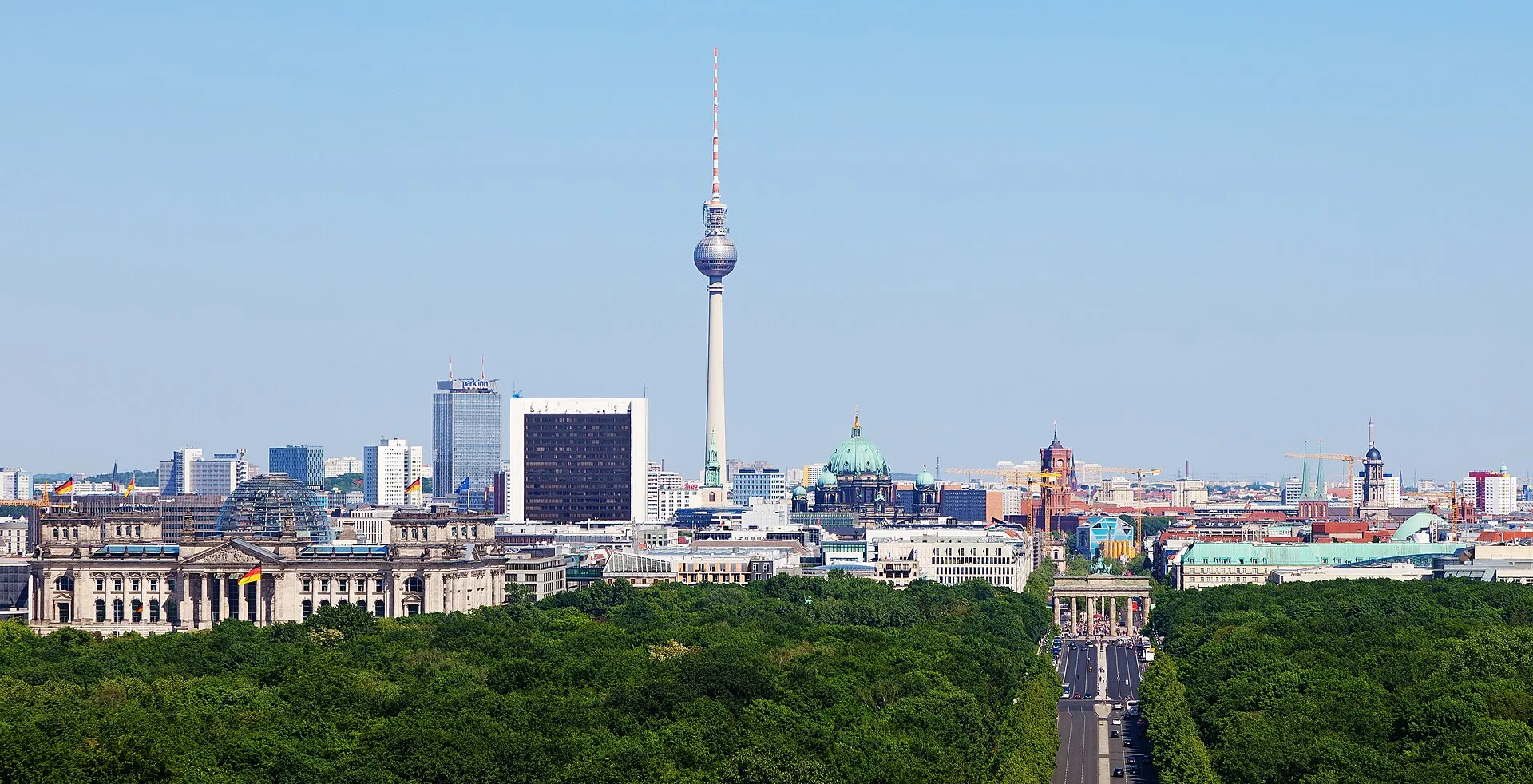
 Berlin
Munich's water is in a hurry. The Isar rises in the Karwendel range and comes through the city straight off the Alps, and between 2000 and 2011 Munich tore out stretches of its embankments and widened the bed, so that the river now braids around gravel islands in the middle of a city of 1.5 million. On a hot evening at the Flaucher, beside the zoo, the shingle fills with people grilling, swimming and, under a bathing ordinance that allows it, wearing nothing. A beer garden has stood there since the 1870s.
Berlin's water barely moves. The Spree slides across the plain to meet the Havel at Spandau, and about a third of the city is forest, park, canal, river or lake. Müggelsee, the largest lake, covers more than seven square kilometres inside the city limits, and the Friedrichshagen waterworks on its shore draws from it, so some of what comes out of Berlin's taps began as somebody's swimming spot. Strandbad Wannsee has 1,275 metres of sand brought from the Baltic, a walk from the S-Bahn at Nikolassee. The central Spree is another matter: it has long been dirty enough that the Badeschiff exists, a ship's hull fitted out as a pool and moored in the river since 2004, so you can swim beside the water you should not swim in.
Those two rivers tell you most of what you need. Berlin is flat, slow and asks nothing of you. You can have a lake on a Wednesday with no gear and no plan, and nobody will think it odd that you are not at a desk. Munich points you uphill. The Alps begin about 50 kilometres south, and the S6 runs out to Starnberg, a lake 127 metres deep where King Ludwig II was found dead in 1886, while the S8 goes to the Ammersee. Weekends there tend to involve boots.
The wave in the English Garden
If you want one story about how Munich treats its pleasures, take the Eisbach. Where this side channel of the Isar runs out from under Prinzregentenstraße, a standing wave has drawn surfers since the 1970s, in the middle of a landlocked city. In April 2025 a surfer was fatally injured there, and the city banned surfing. That autumn the wave vanished after the annual dredging. Activists fitted a beam to bring it back, and the authorities took it out. It returned in 2026 with tighter rules: experienced surfers only, and a leash that breaks away.
It is a very Munich sequence, and not an unreasonable one. This city is safe, clean and managed, and the things you love about it have paperwork attached. Berlin would have left the beam in and argued about it for a decade. Whether that sounds charming or awful to you is a useful thing to know before signing a lease.
Rent, rain and the same rulebook
By our estimate you will spend around $3,400 a month in Berlin, against about $3,800 in Munich. That gap understates what happens at the flat viewing. A central one-bedroom in Schwabing or Maxvorstadt runs roughly $1,730 to $2,070, and the same thing in Kreuzberg or Mitte about $1,350 to $1,700, and neither is easy to get. In Berlin, though, a room in a shared flat or a furnished sublet is a normal way in for a foreigner, in a city where far more of daily life will happen in English. Munich pays better, if you work for someone in Munich. If your salary arrives from abroad, BMW and Allianz are of no use to you.
Germany's freelance visa and its immigration law are the same in both cities, so paperwork will not decide this. Water might, one last time. Munich's mountains catch the weather: June, its wettest month, brings around 120 mm of rain against about 76 mm in Berlin's wettest. In exchange the same mountains send the föhn, a warm wind that can lift the temperature sharply within hours, even in winter. January is a grey 4°C by day in both places, so do not choose either one for its winter.
We would send most people to Berlin first. It is cheaper to get wrong, easier to enter alone and better company if you do not yet speak German. Move to Munich if you have looked at that gravel, those lakes and that wall of mountains and know you will be out there every Saturday, because that is the only thing the extra money buys.
 United States
 United Kingdom
 Canada
 Australia
 India