
Luna Park's great open-mouthed face, Mr Moon, has stared out over St Kilda's Lower Esplanade since 1912. At half past six on a weekday morning the cake shop windows along Acland Street below it are still dark, and a route 96 tram waits at its terminus there, ready to run 13.9 km north through the city, Carlton and Fitzroy to East Brunswick, partly on the old St Kilda railway line.
That tram is the reason St Kilda works as a base. The suburb sits on Port Phillip Bay six kilometres south-east of the city centre, and it became Melbourne's playground a century ago because tram lines brought the city down to its seaside rides, ballrooms, cinemas and cafés. Today about 19,500 people live between its 700-metre beach, a pier with a penguin colony and some of the cheapest one-bedroom rents in inner Melbourne.
This digital nomad guide follows one weekday there, hour by hour, with the practical facts arriving where they belong. The short verdict: if you want the bay and a single tram to the north side, and you mostly work from home, St Kilda is hard to beat, because it undercuts every popular inner suburb on rent and is the only one of them on the beach. Without a visa that lets you work, read the three o'clock section first.
| One-bedroom flat, median new lease | $332 a week, about $1,440 a month |
|---|---|
| Two-bedroom flat, median new lease | $448 a week |
| Tram fare, two hours / daily cap (half price in 2026) | $2.00 / $4.00 |
| Coworking hot desk, Melbourne | $210 to $350 a month |
| Month for one, before a desk | about $2,440 |
| ETA visitor authority | $14, 3 months per entry |
| Working Holiday visa | $590, 12 months |
| Sunset, latest / earliest | 8:47pm in January / 5:08pm in June |
Rents: Homes Victoria Rental Report, September quarter 2025, new bonded leases; monthly is weekly times 52 divided by 12. Living costs and coworking: our Melbourne city data, priced from Numbeo. Prices are in US dollars at the Reserve Bank of Australia exchange rate of A$1 = US$0.7019 on 25 September 2026.
7am: a walk on the foreshore, and the rent on the flat behind it
Before work, you could walk the length of the beach. It runs about 700 metres between the marina and the harbour, with a boardwalk and a bike track beside it, and on windy days kitesurfers and windsurfers work the bay. At the north end, Catani Gardens lines its paths with avenues of Canary Island palms, planted on foreshore reclaimed between 1890 and the First World War. The Sea Baths, first opened in 1860, stand just south of the pier.
The flat you walk back to is the best news of the day. In the latest official data, a one-bedroom flat in St Kilda let for a median of $332 a week on a new lease, about $1,440 a month, below every other inner suburb a remote worker usually shortlists. It is also a deep market: 338 new one-bedroom leases were signed here in a single quarter, so you are not waiting for one flat to come up.
Read that figure as a floor. It comes from bonds lodged on ordinary leases, so it leaves out rooms in share houses and furnished flats taken by the month, which cost more: our Melbourne city guide carries a central one-bedroom at about $1,740 a month. Sharing helps: a St Kilda two-bedroom, at $448 a week, is about $224 each. And East St Kilda, one suburb inland, lets one-bedrooms for about $298.
8.30am: will the connection hold?
At the kitchen table, what matters is the line into the building, not the suburb. Home broadband runs over the national NBN, which sets the technology premises by premises: one St Kilda block may have fibre to each flat, the next copper from a street cabinet (fibre to the node, FTTN). Put the exact address into nbn's address checker, or ask the agent, before you sign.
In the competition watchdog's final broadband report, in June 2026, a 100 Mbps plan averaged 92 Mbps in the busy evening hours and a 500 Mbps plan delivered its full speed. Most services that fell short were on FTTN. Uploads, which carry your side of a video call, ran at about 90 percent of plan speed. On fibre with a 100 Mbps plan or better, you are unlikely to think about it again.
10am: the 96 north, and the suburbs it passes
There is no coworking space in St Kilda itself on our Melbourne list; the hot desks, at $210 to $350 a month, are in the city, Richmond and Collingwood. So on desk days you ride in. The 96 leaves Acland Street past Luna Park and Catani Gardens, runs along the light rail through Albert Park and South Melbourne, then crosses the centre on Bourke Street. On Friday and Saturday nights it runs right through the night.
Route 16 is the other way out, up Fitzroy Street and St Kilda Road past the Shrine of Remembrance to Swanston Street and Melbourne University; routes 12 and 3 fill in towards South Melbourne and the Town Hall. The ride is unusually cheap: Victoria has halved fares until the end of 2026, so an adult two-hour fare is $2.00 and the daily cap $4.00. Expect both to roughly double if the discount ends on schedule.
You no longer need a myki card to board: since June 2026 you can tap on any tram with a bank card, phone or smartwatch. The catch is the Free Tram Zone. Rides inside the city centre and Docklands are free, but a trip that starts in St Kilda needs a fare even when it ends inside the zone.
The suburbs you pass, and what they cost
The 96's route is also a list of the alternatives, and every one costs more for a one-bedroom. The city centre is $406 a week, the only place with free trams at the door. Carlton, beside the university and the Italian restaurants of Lygon Street, is $372. Fitzroy, the café Melbourne most people picture, is $378 and a thin market, with only 60 new leases a quarter.
Collingwood, next door, is about $10 a week cheaper and home to The Commons coworking space; at the top of the line, East Brunswick and Brunswick are both about $350. Off the route, Richmond ($368) has Inspire9, Melbourne's first coworking space, and South Yarra ($365) is the nearest match to St Kilda, without the beach. Pick the north if your week is desks and late cafés; pick St Kilda if it is a laptop at home and the bay after work.
1pm: lunch on Acland Street, and the monthly bill
Back in St Kilda, Acland Street is the obvious lunch walk. Its cake shops go back to 1934, when Monarch Cakes moved here from Carlton to serve the Jewish refugees from Europe settling by the bay. The Acland Cake Shop followed in 1962, Le Bon Continental in 1978 and Europa in 1982, all within a few doors of each other and all still known for Central European cakes such as kugelhopf and Black Forest.
Since 2016 the stretch between Belford and Barkly streets has been closed to through traffic, with the tram terminus rebuilt in the middle of it, so lunch outside happens in a pedestrian street.
Lunch is also the moment to add up the month. Take the one-bedroom at the median, about $1,440, and add our one-person basket of groceries, meals out, utilities, phone, internet and transport, about $1,000 from Numbeo's August 2026 prices. That is roughly $2,440 before a workspace, and $2,650 to $2,790 with a hot desk.
That is far below Sydney, where our Sydney city guide puts a month at about $3,490. Across the region, our ranking of Oceania's nomad cities shows Adelaide as the only Australian city that comes in cheaper, and Wellington, across the Tasman, about $600 a month below.
3pm: the call with the office abroad
The mid-afternoon video call with an employer back home is where the plan meets Australian law. Australia has no digital nomad visa, so it is missing from our comparison of digital nomad visas, and most remote workers arrive as visitors. On a US or Canadian passport that means an ETA: a $14 service charge, valid for 12 months, with stays of up to three months after each entry. Most European passports get the free eVisitor on the same terms.
Neither is a work visa. The ETA rules out paid work for an Australian employer and services to an Australian business, and the Visitor visa, from $175, says simply that you can't work. What the Department's procedural guidance adds is that online work incidental to a holiday is no breach of the no-work condition.
Keeping up with the job while on holiday is fine; working full time from a St Kilda flat for three months is not, and back-to-back three-month stays can prompt questions at the airport and, for anyone found not to be a genuine visitor, a cancelled visa.
The visa that makes the whole day legal
If you are young enough, the Working Holiday visa ends the grey area. The subclass 417 is open from 18 to 30, or to 35 on passports including the UK, Canada, France, Germany, Ireland, Italy and South Korea. Other countries use the subclass 462, open to 30, with a ballot for China, India and Vietnam. Either costs $590 and gives 12 months in which you can do any kind of work.
You can usually work for one employer for six months at most, you must apply from outside Australia without dependent children, and processing takes around three months, so book the flight after the grant. Earning here also raises the question of where you owe tax, which our guide to how digital nomads are taxed works through. For a St Kilda base, this is the visa that fits: a year of the day above, with the three o'clock call no longer a question.
Visa application in your own language?
Our directory lists 4,396 lawyers in Melbourne by the language they work in, 965 of them in Chinese and 480 in Greek, each with the source of the language claim.
Browse lawyers in Melbourne →5pm: the Esplanade, the Palais and Mr Moon
At five, the laptop closes and the Esplanade takes over. On the upper side, the Espy, a pub built in 1878 that looks out over the bay, is reputed to be the longest continuously running live music venue in Australia, with three stages since its 2018 reopening. At weekends the nightlife here can get rowdy.
On the Lower Esplanade stands the Palais Theatre, opened in 1927 and, with nearly 3,000 seats, the largest seated theatre in Australia. Next door, Luna Park's Scenic Railway, which opened with the park in 1912, is the oldest continually operating roller coaster in the world, and one of the few where a brakeman still rides standing in the middle of the train.
The strip changes on Sundays. The Esplanade Market, which began in 1970 as an open-air exhibition for local artists priced out of traditional shows, fills the Upper Esplanade from 10am to 4pm with makers selling jewellery, woodwork, art and food. For something quieter, the St Kilda Botanical Gardens, a short walk inland, are free and have a rose garden and a rainforest conservatory.
Dusk: penguins at the end of the pier
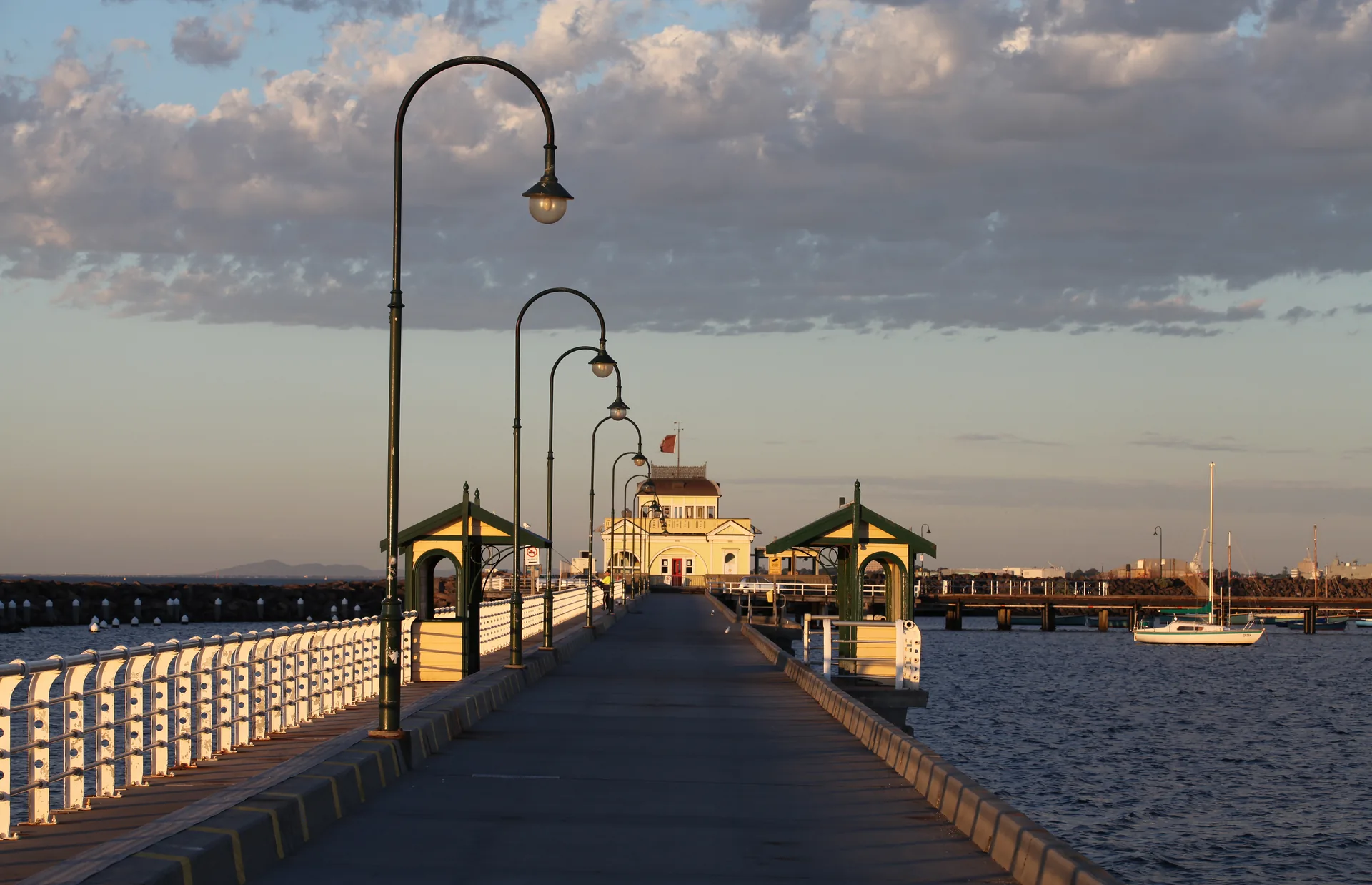
The day ends on the pier. The new pier opened in November 2024, and its Edwardian kiosk, built in 1904, burnt down in 2003 and rebuilt to the original design, serves food and drinks seven days a week. At the far end, a rock breakwater shelters the harbour, and in its rocks lives a colony of around 1,400 little penguins.
They spend the day feeding out in the bay and come ashore just after sunset. Since October 2025 a 150-metre boardwalk keeps watchers apart from the nests, and two free one-hour viewing sessions run each evening, capped at 150 people and booked in advance through Phillip Island Nature Parks. Switch off the flash, leave the torch in your pocket and stay three metres back: bright light frightens the birds.
When dusk comes at five: choosing your season
The month decides how much of this day you get. In early January the sun sets at 8:47pm, leaving hours of light on the beach after work. In mid-June it sets at 5:08pm: dusk on the pier is the end of the working day, and the walk home is in the dark.
Summer averages a January high of 26.8°C, but Melbourne's "four seasons in a day" is real: at the long-running city weather station, one January day in ten stays below 19.4°C and one in ten tops 35.6°C. About ten days a year pass 35°C, most of them from December to February.
For a St Kilda stay, March to May is the sweet spot: highs of 18 to 24°C, the heatwaves mostly over and, in March at least, the sunset still after the working day. June to August is grey and cool, with July highs of 14.5°C. Come in winter only if you can do without the beach.
If the day goes wrong: doctors and Medicare
Visitors to Australia pay their own healthcare costs. The exception is the eleven countries with a reciprocal health care agreement: Belgium, Finland, Ireland, Italy, Malta, the Netherlands, New Zealand, Norway, Slovenia, Sweden and the United Kingdom.
A UK visitor who lived in the UK before arriving can enrol in Medicare through myGov and gets medically necessary care outside hospital, treatment as a public patient in a public hospital and some prescription medicines at the general rate, until the visa expires. Hospital care under every agreement is as a public patient only, so travel insurance still earns its place, and visitors from anywhere else, the US and Canada included, need it from day one. In an emergency, dial 000.
Is St Kilda the right end of the 96?
Go back to that first tram at the Acland Street terminus. At one end of the line are the beach, the pier and the lowest one-bedroom rent among Melbourne's popular inner suburbs. At the other are Fitzroy's cafés, the coworking desks and the free trams of the centre. St Kilda is the right end if you work mostly from home, want the bay at five o'clock and can live with a fare into town.
It suits a working holiday maker best of all, with a year to fill and one of the inner city's deepest rental markets to fill it in. Choose Fitzroy or Collingwood if your week revolves around a desk, and pay $36 to $46 a week more. Still weighing Melbourne against elsewhere? Our city comparison tool lines up budget, internet and all 13 of our categories side by side.
If St Kilda wins, book a furnished month first, check the NBN at the address before you sign anything longer, and aim to arrive in March, when dusk on the pier still comes after work.
See the whole picture for Melbourne
The full cost table, neighbourhood notes, coworking list and all 13 of our category ratings, on one page, before you choose your suburb.
Open the Melbourne city guide →Frequently Asked Questions
Is St Kilda a good base for digital nomads in Melbourne?
Yes, if you want the beach and mostly work from home. A one-bedroom let for a median $332 a week, below Fitzroy, Brunswick, Carlton and South Yarra. The trade-offs are a paid fare into the centre, no coworking in the suburb and a rowdy weekend nightlife.
How much is rent in St Kilda compared with Fitzroy and Brunswick?
On new leases, a one-bedroom flat had a median of $332 a week in St Kilda, $350 in Brunswick and $378 in Fitzroy. Furnished monthly lets cost more.
Can I work remotely from St Kilda on an Australian visitor visa?
Only incidentally. Visitor visas are not work visas, and Home Affairs guidance accepts online work only when it is incidental to a holiday. Full-time work needs a visa that allows it, such as the Working Holiday visa.
Which trams go from St Kilda to Melbourne's city centre?
Route 96 runs from Acland Street through the city to Carlton, Fitzroy and East Brunswick. Route 16 goes up St Kilda Road to Melbourne University. A two-hour fare is $2.00 while fares are half price, until the end of 2026.
How fast is the internet in St Kilda for remote work?
It depends on the building's NBN connection, which is set per address. In the final national measurements, a 100 Mbps plan averaged 92 Mbps at peak times and most slow services were fibre to the node, so check the address before you sign.
When can you see the penguins at St Kilda Pier?
Just after sunset, when around 1,400 little penguins come ashore on the breakwater. Two free one-hour sessions run each evening, booked in advance, and flash and torches are not allowed.
When is the best time of year to live in St Kilda?
March to May, with highs of 18 to 24°C and the heatwaves mostly over. Summer has about ten days above 35°C, and in June the sun sets around 5pm.


